
2 layers77.9 × 54.5 mm
 CarlosGS/GNBot27
A 3D-printable robotic platform for testing swarm algorithms
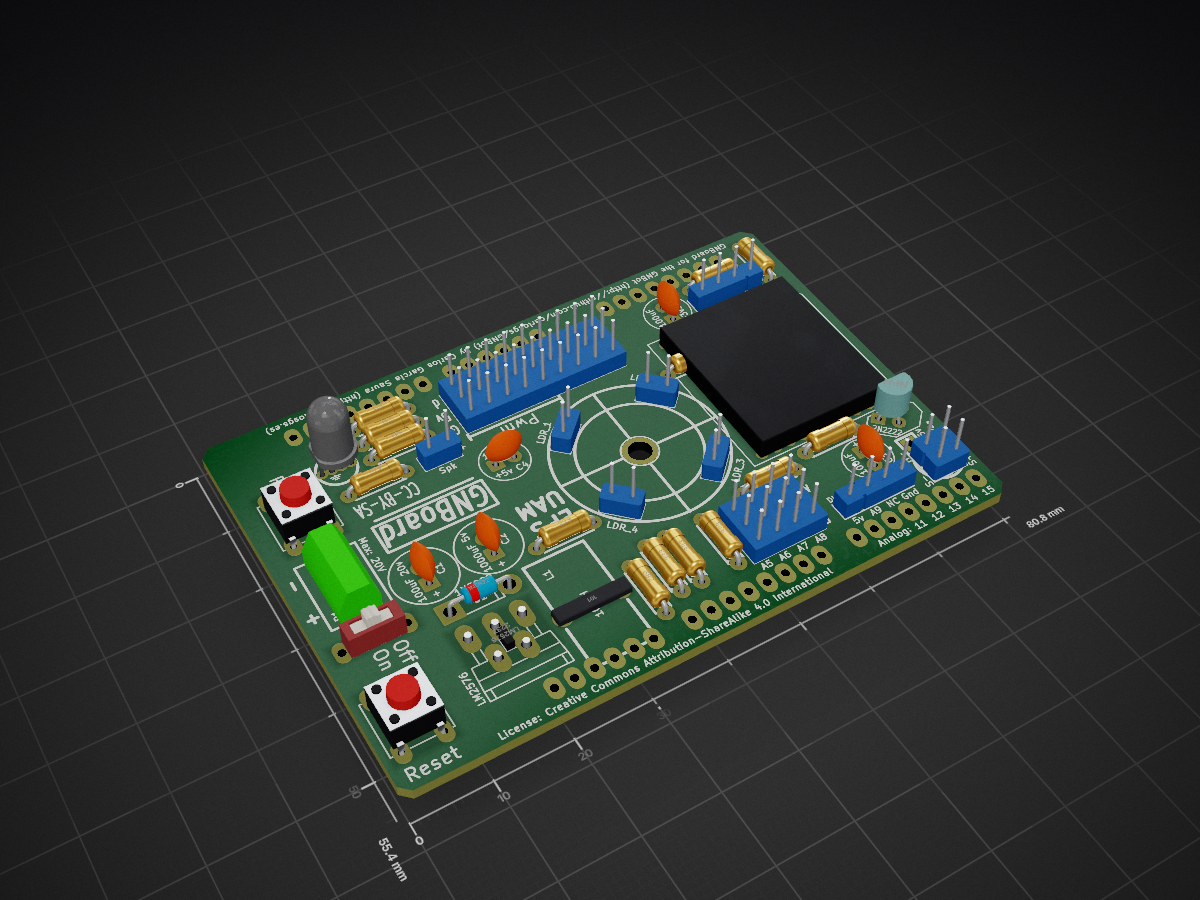
GNBoard is an open-source printed circuit board by CarlosGS, from the CarlosGS/GNBot repository on GitHub. It is a 2-layer board of 80.8 × 55.4 mm with 58 parts on 45 nets, routed with 232 tracks and 8 vias.
It is built around the LM2576WT. Its parts include 18 resistors, 16 switches, 11 connectors, 5 capacitors and 2 diodes. It belongs with the AVR (ATmega, ATtiny) boards of this library.
Low-cost 3D-printable robot design for testing cooperative search algorithms.
Check the GNBot wiki page for more information
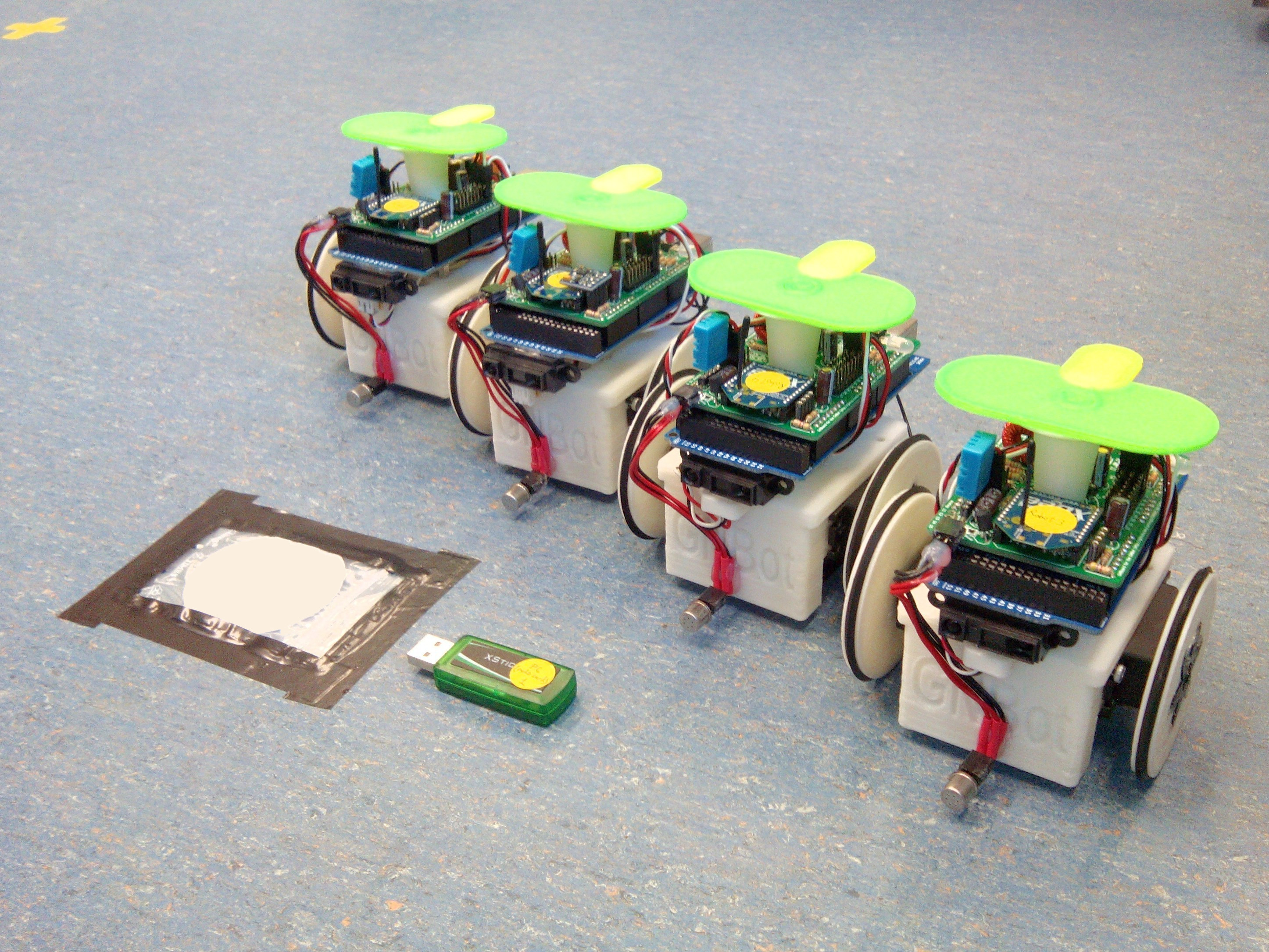
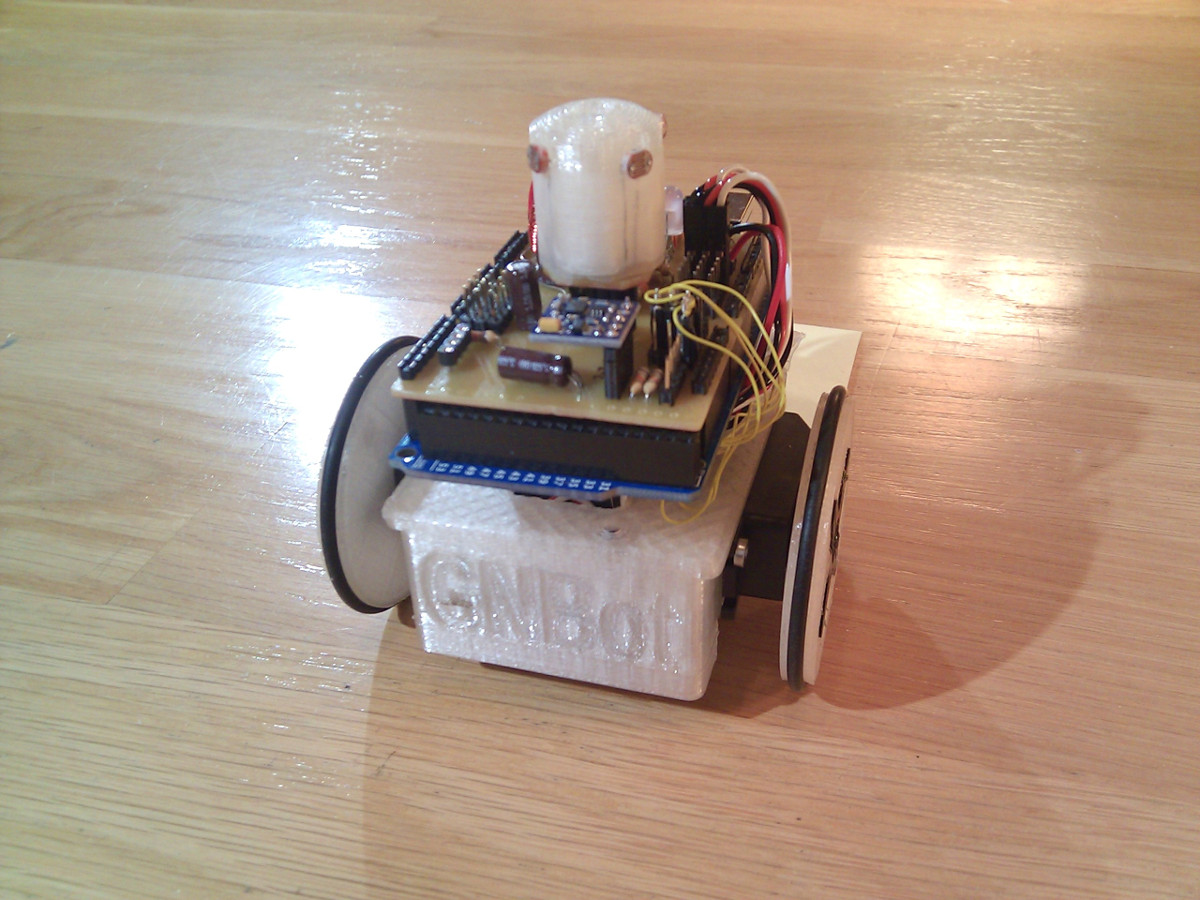
The GNBot design allows the construction of a swarm of remotely-controlled robots that have multimodal sensory input (perceiving light, distance, temperature, humidity and orientation with an electronic compass) and are capable of detecting odor sources such as the low-profile target shown on the left.
Demonstration video of the swarm of GNBots used for Lévy-walk-based search:

These robots are also energy efficient, open-source and easy to expand to allow the implementation of a great variety of cooperative search strategies (including those that use range information from each sensor modality with a characterization of the uncertainty of odor sources, and also the ones that use classical heuristic or brute-force approaches for search). Most importantly, the standardization of the platform could finally provide a fair base of comparison for evaluating differences in efficiency among these odor search strategies.
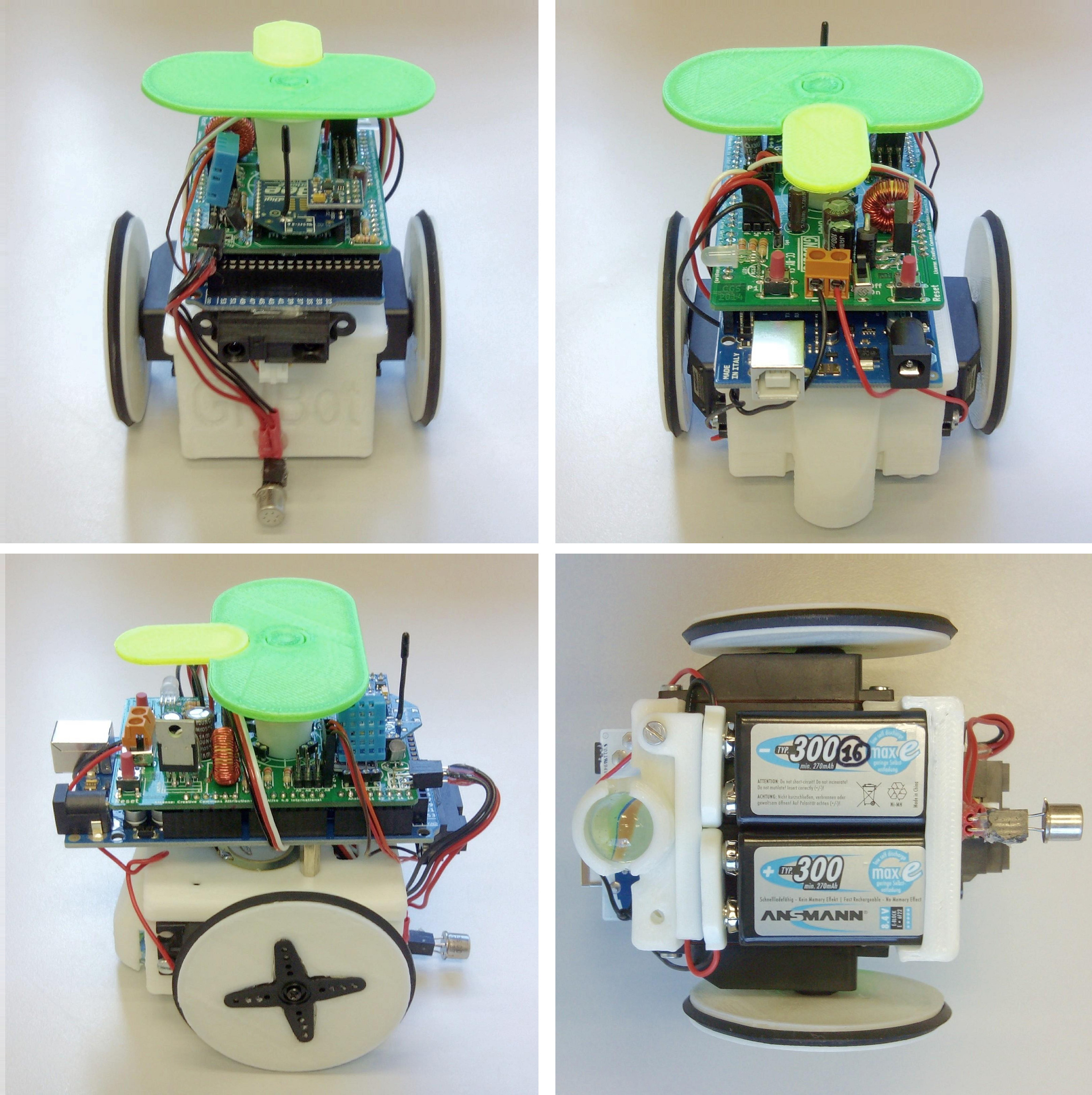
List of sensors present in the robot: TGS-2600 odor sensor, IR rangefinder, LDR light sensor array, electronic compass module, temperature and humidity sensors. Battery voltage is also monitored. The base actuators are two servomotors and the wireless interface is based on a ZigBee-compatible module.
Version 1.0:
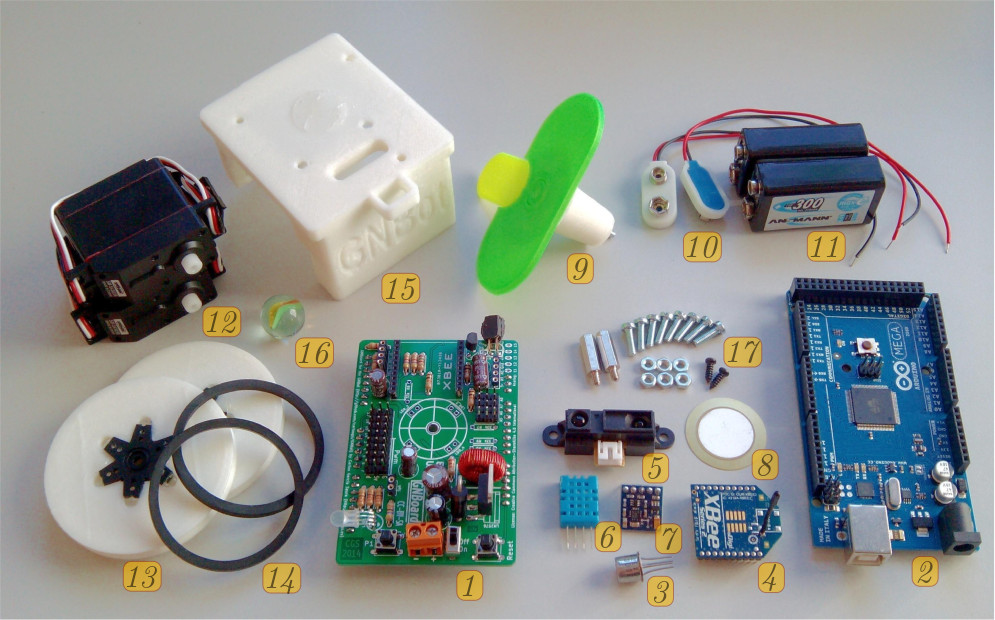
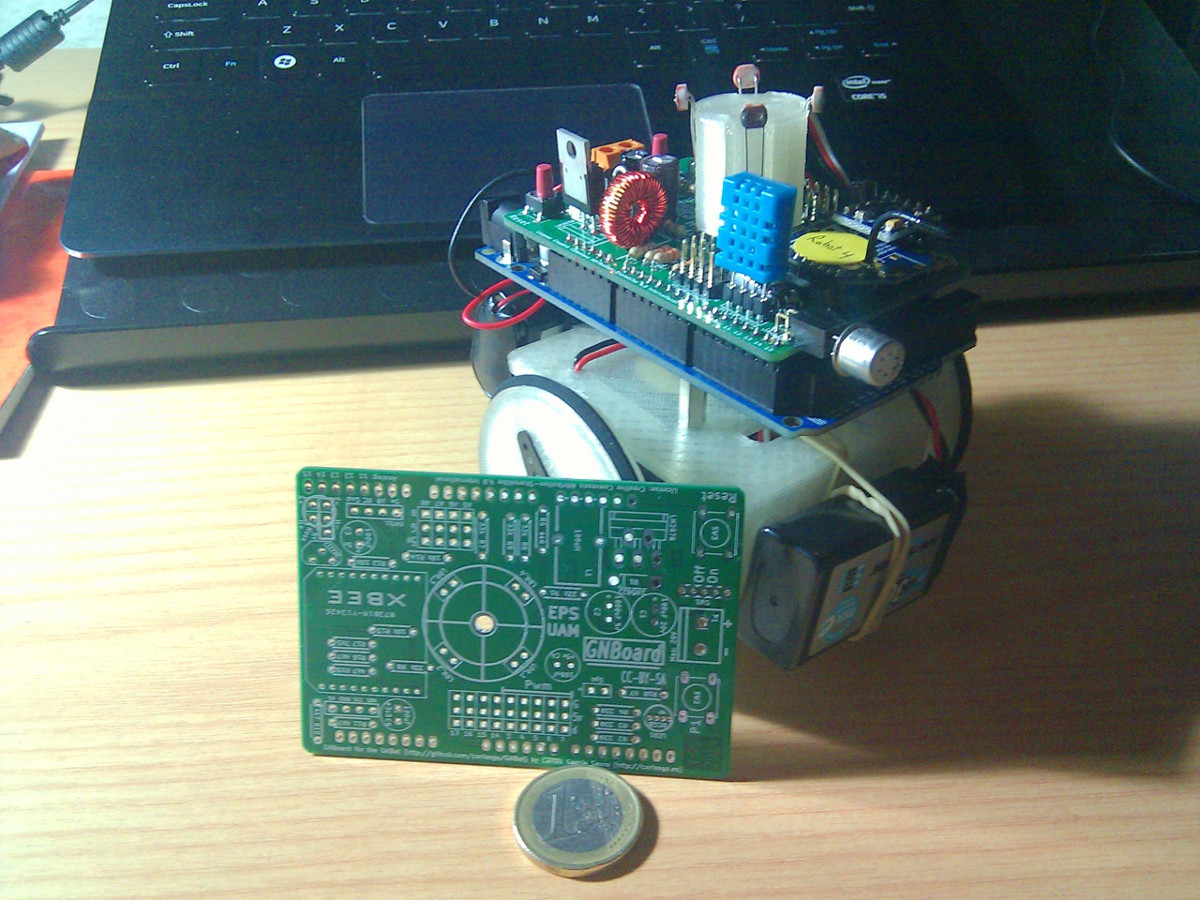
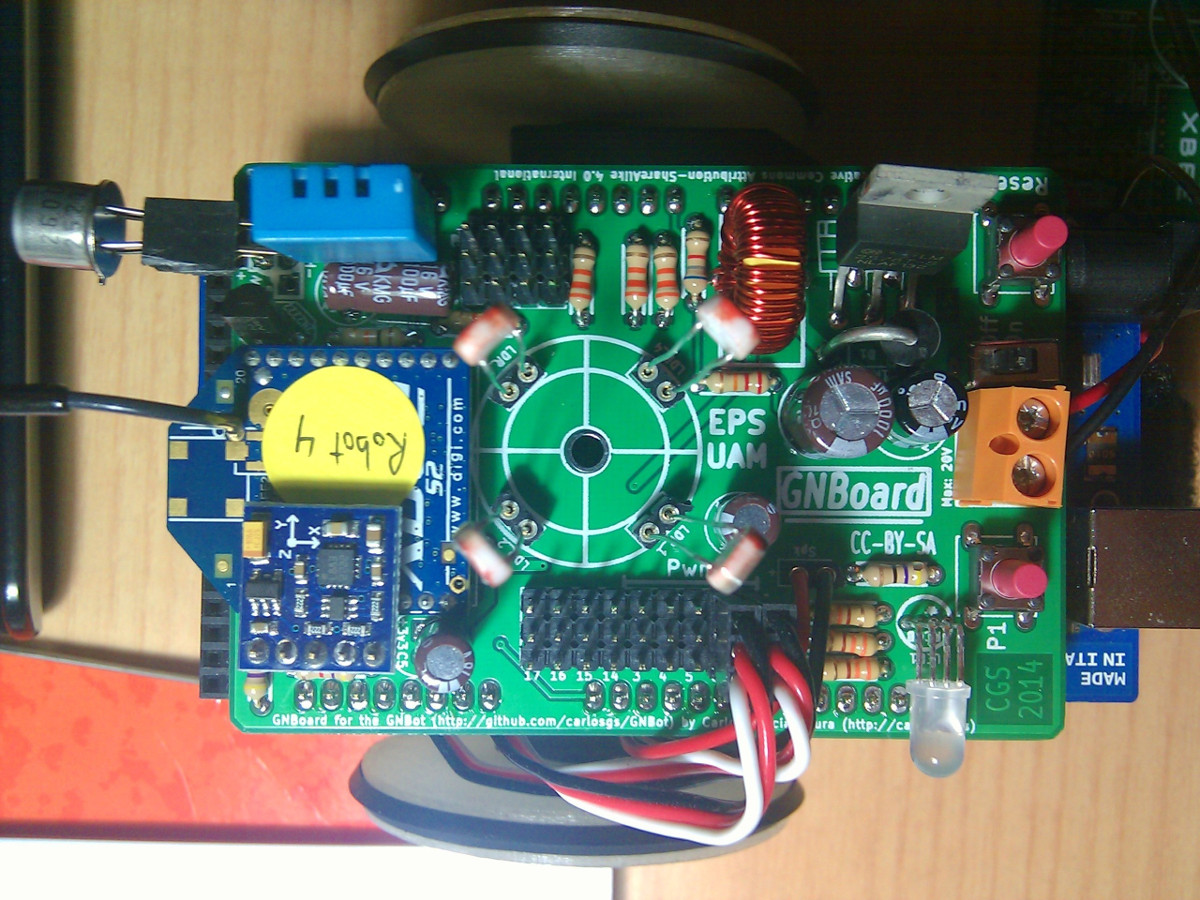
Items shown in the picture: 1) GNBoard electronics. 2) Arduino MEGA board. 3) TGS-2600 odor sensor. 4) ZigBee-compatible RF module. 5) Infra-red distance sensor. 6) DHT11 temperature and humidity sensor. 7) HMC5883L magnetometer sensor. 8) Piezoelectric buzzer. 9) Visual marker attachment. 10) Two 9V battery connectors. 11) Two 9V rechargeable batteries (300mAh). 12) Two continuous-rotation servomotors. 13) 3D-printed robot wheels. 14) Rubber outer-wheel rings. 15) 3D-printed GNBot chassis. 16) Marble for the idler wheel.
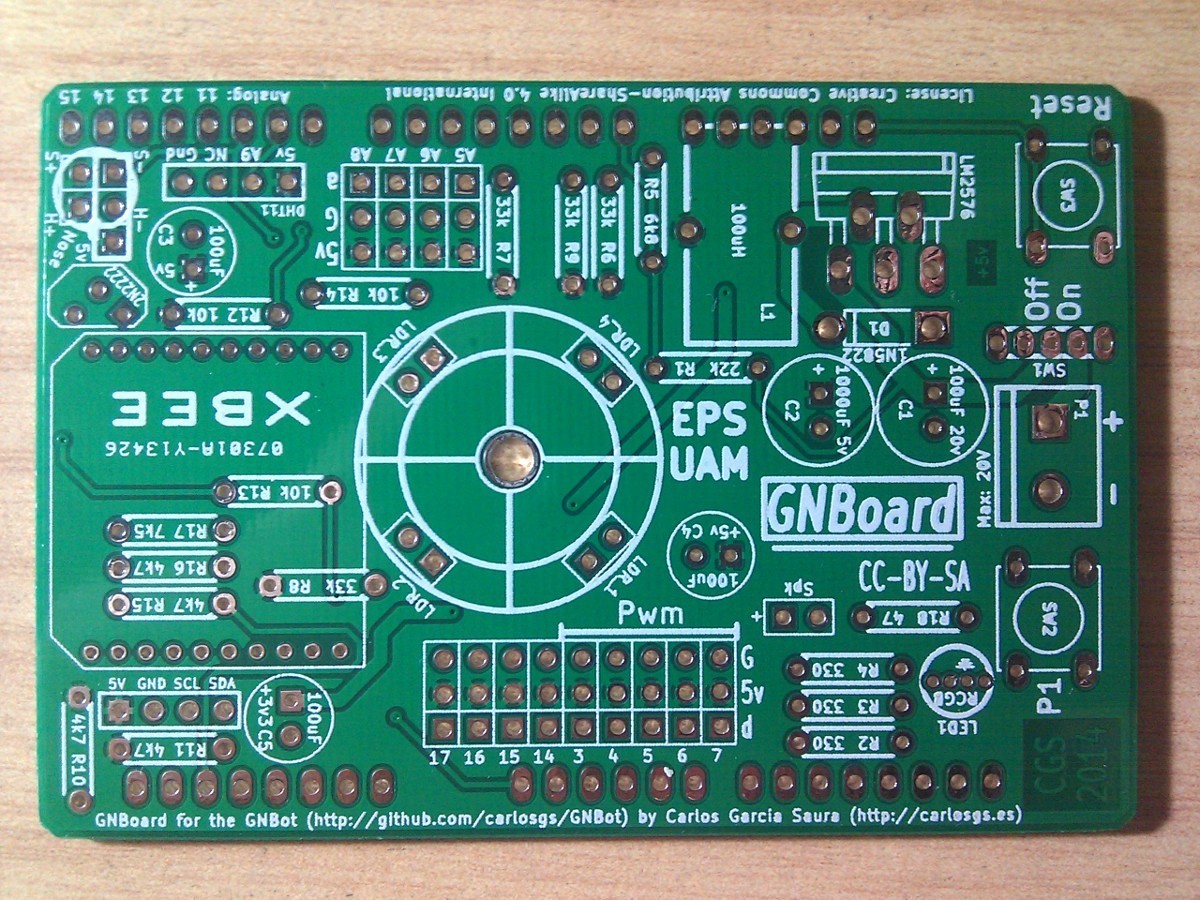
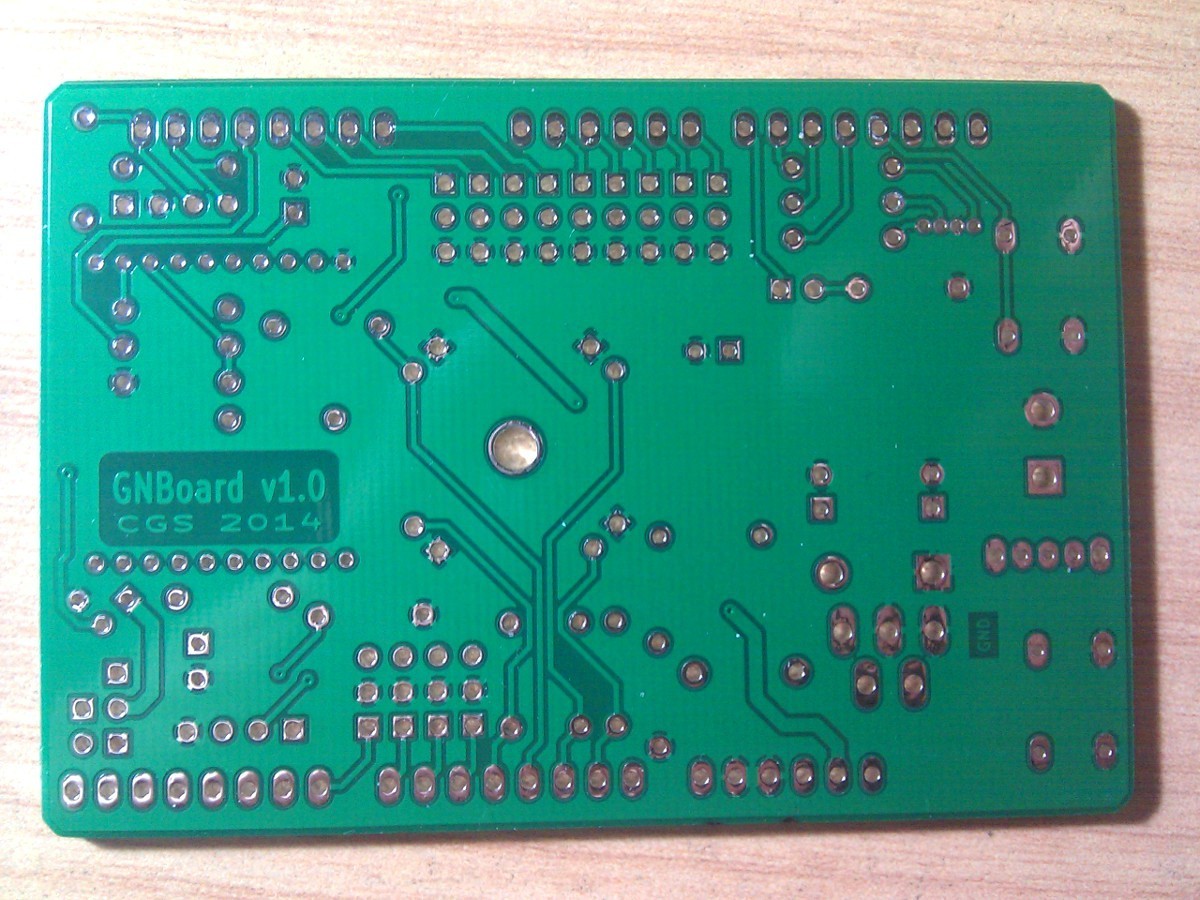
Version 1.0a:
Version 0.5:
License: Attribution - Share Alike - Creative Commons (http://creativecommons.org/licenses/by-sa/3.0/)
@CarlosGS https://github.com/CarlosGS
This hardware/software is provided "as is", and you use the hardware/software at your own risk. Under nocircumstances shall any author be liable for direct, indirect, special, incidental, or consequential damages resulting from the use, misuse, or inability to use this hardware/software, even if the authors have been advised of the possibility of such damages.
| Qty | Value | Footprint | References |
|---|---|---|---|
| 4 | 33k | R3-LARGE_PADS_CUSTOM | R6, R7, R8, R9 |
| 4 | 4k7 | R3-LARGE_PADS_CUSTOM | R10, R11, R15, R16 |
| 3 | 100uF | C1V7 | C3, C4, C5 |
| 3 | 10k | R3-LARGE_PADS_CUSTOM | R12, R13, R14 |
| 3 | 330 | R3-LARGE_PADS_CUSTOM | R2, R3, R4 |
| 2 | SW_PUSH | SW_PUSH_SMALL | SW2, SW3 |
| 1 | 1000uF | C1V8 | C2 |
| 1 | 100uF | C1V8 | C1 |
| 1 | 100uH | Choke_Toroid_8x16mm_Vertical | L1 |
| 1 | 1N5822 | DO41_3 | D1 |
| 1 | 22k | R3-LARGE_PADS_CUSTOM | R1 |
| 1 | 47 | R3-LARGE_PADS_CUSTOM | R18 |
| 1 | 6k8 | R3-LARGE_PADS_CUSTOM | R5 |
| 1 | 7k5 | R3-LARGE_PADS_CUSTOM | R17 |
| 1 | ARDUINO_MEGA_SHIELD | ARDUINO_MEGA_SHIELD_040pins_MOD | SHIELD1 |
| 1 | Battery | bornier2 | P1 |
| 1 | CNY_1 | PIN_ARRAY_3X1 | K11 |
| 1 | CNY_2 | PIN_ARRAY_3X1 | K12 |
| 1 | CNY_3 | PIN_ARRAY_3X1 | K13 |
| 1 | CNY_4 | PIN_ARRAY_3X1 | K14 |
| 1 | CONN_1 | PIN_ARRAY_1 | P11 |
| 1 | DHT_Conn | PIN_ARRAY_4x1 | P6 |
| 1 | I2C_1 | PIN_ARRAY_4x1 | P4 |
| 1 | IR1 | PIN_ARRAY_3X1 | K1 |
| 1 | IR2 | PIN_ARRAY_3X1 | K2 |
| 1 | IR3 | PIN_ARRAY_3X1 | K9 |
| 1 | IR4 | PIN_ARRAY_3X1 | K10 |
| 1 | LDR_1 | PIN_ARRAY_2X1 | P2 |
| 1 | LDR_2 | PIN_ARRAY_2X1 | P5 |
| 1 | LDR_3 | PIN_ARRAY_2X1 | P7 |
| 1 | LDR_4 | PIN_ARRAY_2X1 | P8 |
| 1 | LED_RCGB | LED5_RGB_long | LED1 |
| 1 | LM2576 | v-reg-L200S | U1 |
| 1 | NPN | TO92-123 | Q1 |
| 1 | Nose_Heater | PIN_ARRAY_2X1 | P10 |
| 1 | Nose_Sense | PIN_ARRAY_2X1 | P9 |
| 1 | P*** | ldr_drill | 1PIN |
| 1 | PowerSwitch | switch_power_custom | SW1 |
| 1 | SERVO_1 | PIN_ARRAY_3X1 | K3 |
| 1 | SERVO_2 | PIN_ARRAY_3X1 | K4 |
| 1 | SERVO_3 | PIN_ARRAY_3X1 | K5 |
| 1 | SERVO_4 | PIN_ARRAY_3X1 | K6 |
| 1 | SERVO_5 | PIN_ARRAY_3X1 | K7 |
| 1 | Spk | PIN_ARRAY_2X1 | P3 |
| 1 | XBEE | xbee_r1-XBEE | M1 |


Le-Dome-RDS/hope-bike
An open source Pedalling Assistant Sytem for 26" wheeled bikes


Testato/ADB-3020-CDV
CDV (Community Digital Version) of the switching power supply ADB-3020

johnbeardmore/oBeMS
Open source environmental monitoring, automatic meter reading and building management system.


EthicalEarth/LM2576_PCB_BOARD_actual
Good step-down converter. Project have stable status and released. After build, this board work perfectly from 2016-2018

LacieUnlam/UNLaM-duino
Clon Arduino desarrollado en la UNLaM con KiCad, simple faz y pensado para fabricación casera.

aarondennis/mup-astro-cat-hardware
Kicad schematic and pcb files for the MUP Astro CAT project.
It measures 80.8 × 55.4 mm and has 2 copper layers, 1.6 mm thick.
58 parts, built around the LM2576WT. The full list of its parts is on this page, with links to each part's symbol and footprint where PCBKit's library has them.
From the CarlosGS/GNBot repository on GitHub, at the commit this page was made from: the board is Electronics/GNBoard_1.0/GNBoard.kicad_pcb. PCBKit opens the board in the browser, with nothing to install.
Its repository states no licence, so its author keeps all rights: ask CarlosGS before reusing the design.