2 layers99.5 × 90.5 mm

 CameronNix/Autonomous-Terrain-Profiler1
Custom 2-layer ESP32 PCB (KiCad) with a servo-swept HC-SR04 ultrasonic sensor for 180 degree obstacle detection, buzzer/LED proximity alerts. Includes USB-C programming circuitry (CH340C, AMS1117) and C++ firmware for sweep control and threshold-based alerts.
Terrain Profiler is an open-source printed circuit board by CameronNix, from the CameronNix/Autonomous-Terrain-Profiler repository on GitHub. It is a 2-layer board of 63.5 × 101.5 mm with 28 parts on 58 nets, routed with 289 tracks and 58 vias.
It is built around the CH340C, ESP32-WROOM-32D and AMS1117-3.3, with the PN2222A among its other parts. Its parts include 9 resistors, 7 capacitors, 3 ICs, 2 connectors and 2 switches. It belongs with the robots and motor control boards and the ESP32 boards of this library.


Servo-mounted ultrasonic obstacle-detection system on a custom 2-layer PCB. Sweeps a 180 degree arc with an HC-SR04, flags close objects with a buzzer + LEDs.
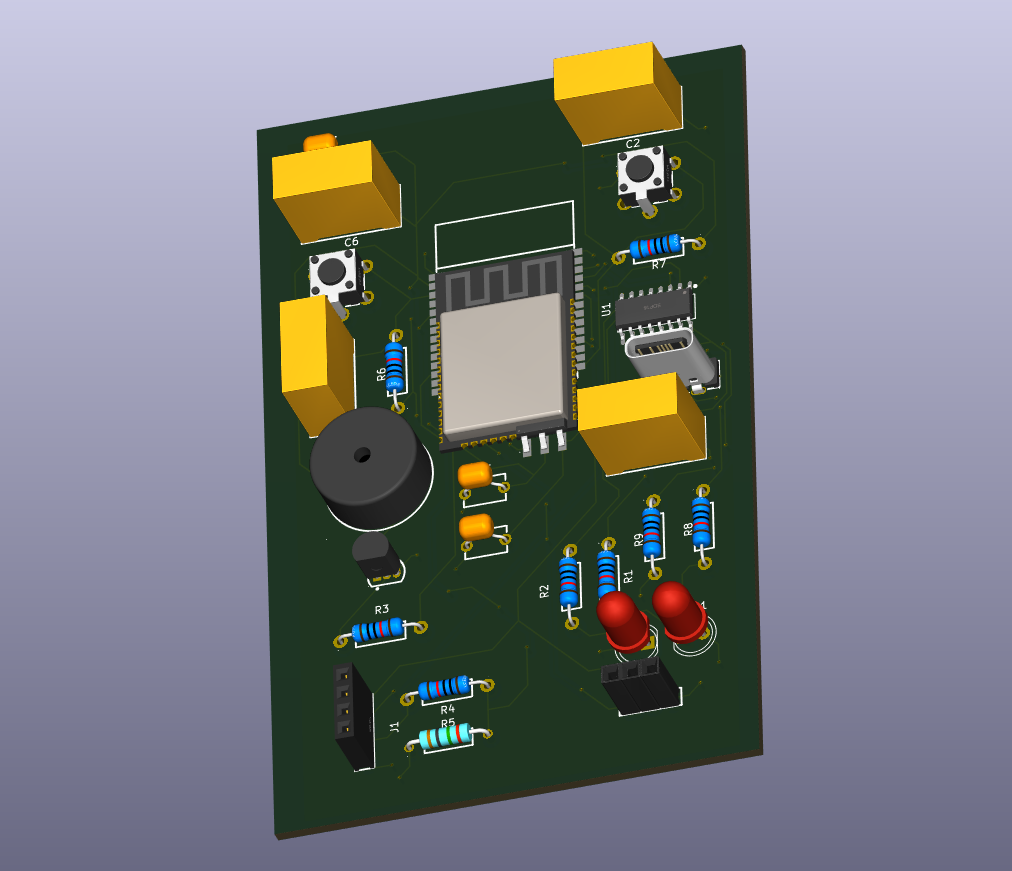
MCU: ESP32-WROOM-32D (bare module, custom board — not a dev board) Sensor: HC-SR04 ultrasonic, mounted on a servo for continuous bidirectional 180 degree sweep Alerts: Transistor-switched (PN2222A) LEDs and passive buzzer, threshold-based proximity warnings PCB: Custom 2-layer board designed from schematic to layout in KiCad
All footprints sourced from LCSC part numbers and pulled into KiCad via the easyeda2kicad CLI tool for exact manufacturer-match footprints.
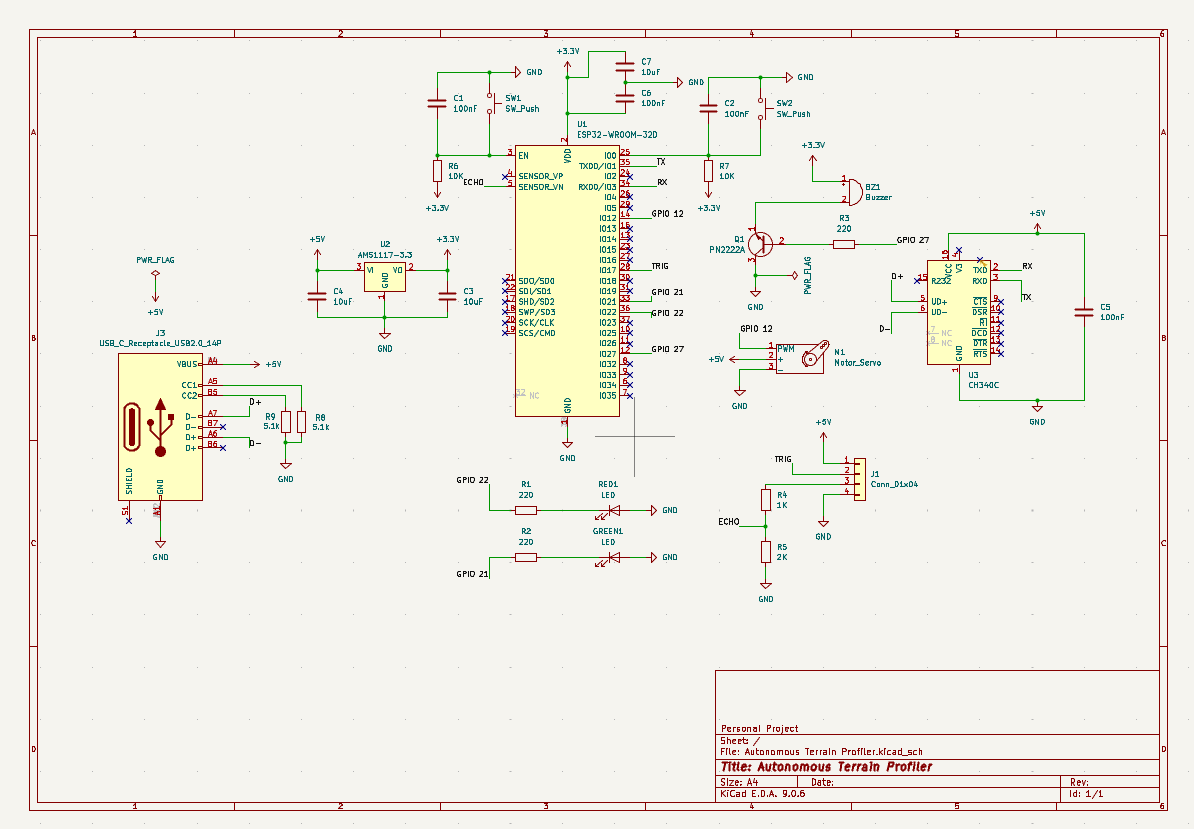
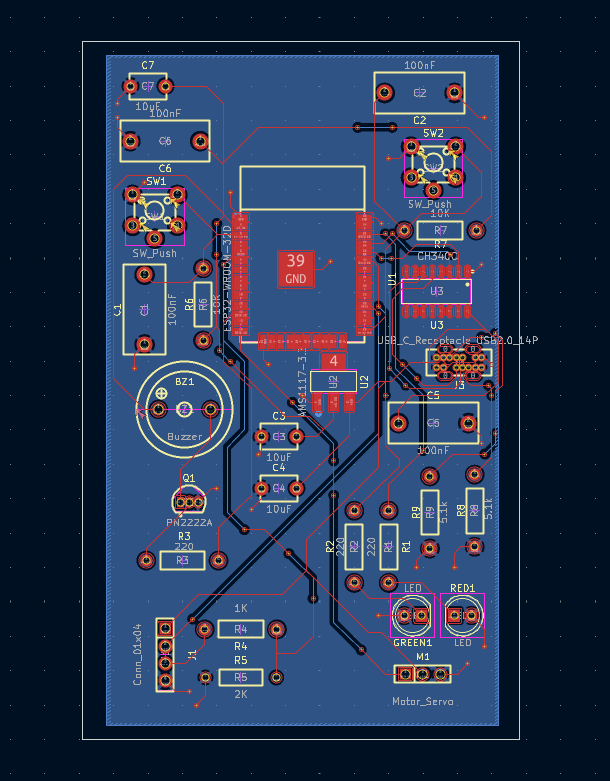
Written in C++ (Arduino framework). Core logic:
ESP32Servo for sweep positioning HCSR04_ESP for ultrasonic timing/distance Threshold-based alert logic (buzzer/LED) tied to sweep angle and distance
See firmware/terrain_profiler.ino.

Complete KiCad schematic and PCB layout in hardware/. The board was fully designed and verified for manufacturability (footprints checked, DRC clean) but not fabricated, the project's firmware and sweep logic were validated on a breadboard prototype instead.
Cameron Nix — Electrical and Computer Engineering, Oregon State University
| Qty | Value | Footprint | References |
|---|---|---|---|
| 4 | 100nF | easyeda2kicad:CAP-TH_L13.0-W6.0-P10.00-D1.0 | C1, C2, C5, C6 |
| 3 | 10uF | easyeda2kicad:CAP-TH_L5.5-W3.8-P5.08-D0.5 | C3, C4, C7 |
| 3 | 220 | easyeda2kicad:RES-TH_BD2.5-L6.5-P10.50-D0.6 | R1, R2, R3 |
| 2 | 10K | easyeda2kicad:RES-TH_BD2.5-L6.5-P10.50-D0.6 | R6, R7 |
| 2 | 5.1k | easyeda2kicad:RES-TH_BD2.5-L6.5-P10.50-D0.6 | R8, R9 |
| 2 | LED | LED_THT:LED_D5.0mm | GREEN1, RED1 |
| 2 | SW_Push | easyeda2kicad:SW-TH_5P-L6.0-W6.0-P4.50-LS6.5 | SW1, SW2 |
| 1 | 1K | easyeda2kicad:RES-TH_BD2.5-L6.5-P10.50-D0.6 | R4 |
| 1 | 2K | easyeda2kicad:RES-TH_BD2.4-L6.3-P10.30-D0.6 | R5 |
| 1 | AMS1117-3.3 | easyeda2kicad:SOT-223-3_L6.5-W3.4-P2.30-LS7.0-BR | U2 |
| 1 | Buzzer | easyeda2kicad:BUZ-TH_BD14.1-P7.62-D1.0-FD | BZ1 |
| 1 | CH340C | easyeda2kicad:SOP-16_L10.0-W3.9-P1.27-LS6.0-BL | U3 |
| 1 | Conn_01x04 | easyeda2kicad:HDR-TH_4P-P2.54-V-F | J1 |
| 1 | ESP32-WROOM-32D | easyeda2kicad:WIFIM-SMD_39P-L25.5-W18.0-P1.27-BL | U1 |
| 1 | Motor_Servo | easyeda2kicad:HDR-TH_3P-P2.54-V-F | M1 |
| 1 | PN2222A | easyeda2kicad:TO-92-3_L4.8-W3.7-P1.27-L | Q1 |
| 1 | USB_C_Receptacle_USB2.0_14P | easyeda2kicad:USB-C-TH_SHOUHAN_TYPE-C-14PLC-H10.0 | J3 |


MarkJB/ESP32_Plotter_Controller
An ESP32/TMC2130 based 2 axis controller designed for pen plotters

Citrullin/Sovereign_Bunny_Stack
From web 3 unicorn fantasy to federated web 2.5 reality.


akashh218/ESP32-8-Channel-Smart-Switch-PCB
ESP32-based 8-channel smart switch PCB for wireless control of multiple electrical loads, featuring relay interfaces and a compact PCB design.

It measures 63.5 × 101.5 mm and has 2 copper layers, 1.6 mm thick.
28 parts, built around the CH340C, ESP32-WROOM-32D, AMS1117-3.3 and PN2222A. The full list of its parts is on this page, with links to each part's symbol and footprint where PCBKit's library has them.
From the CameronNix/Autonomous-Terrain-Profiler repository on GitHub, at the commit this page was made from: the board is hardware/Terrain_Profiler.kicad_pcb and its schematic hardware/Terrain_Profiler.kicad_sch. PCBKit opens the board in the browser, with nothing to install.
Its repository states no licence, so its author keeps all rights: ask CameronNix before reusing the design.