2 layers
Major phaseA 00
Bot-Ro-Bot/Major-Year-Project
The full version of the thesis is also publicly available at ResearchGate. ### Citation
38 parts2
 Bot-Ro-Bot/Major-Year-Project2
The full version of the thesis is also publicly available at ResearchGate. ### Citation
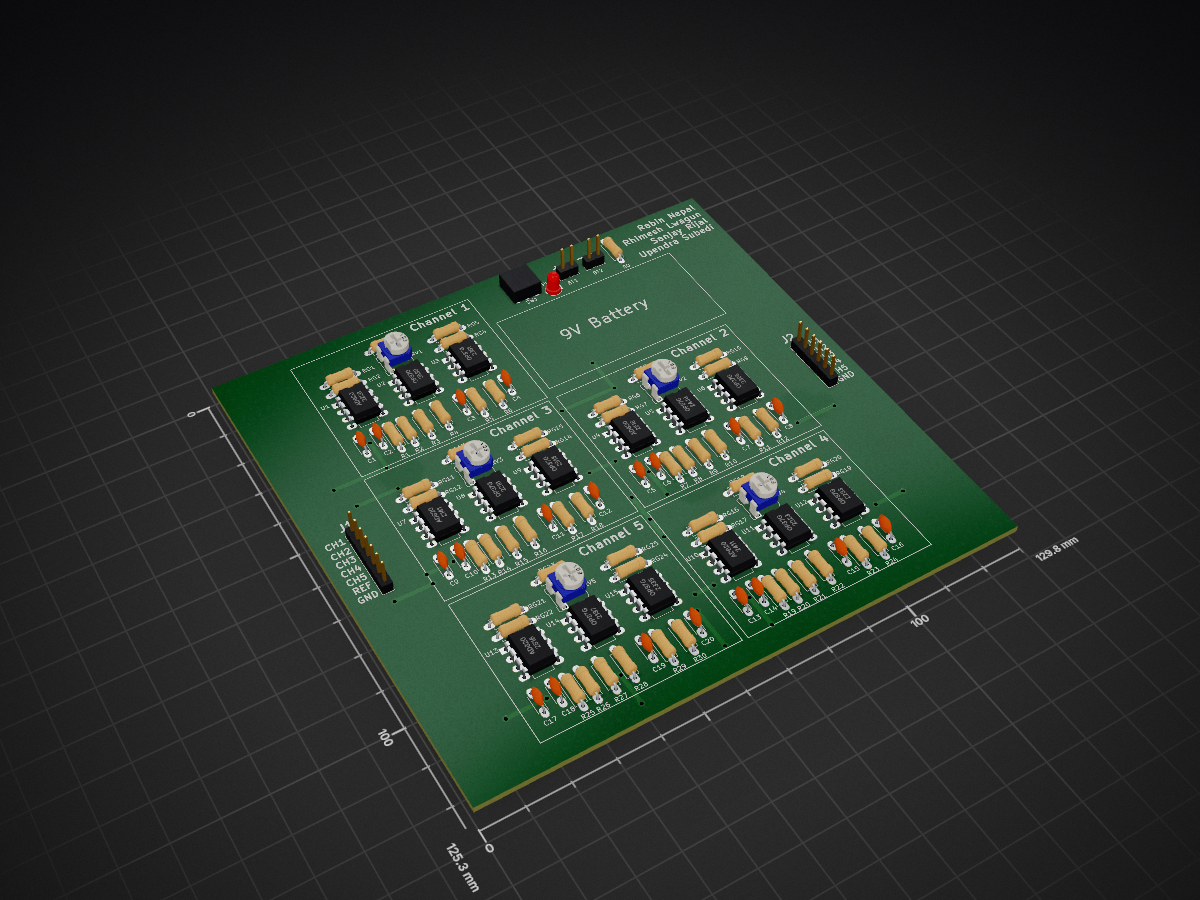
EMG Instrumentation is an open-source printed circuit board by Bot-Ro-Bot, from the Bot-Ro-Bot/Major-Year-Project repository on GitHub. It is a 2-layer board of 129.8 × 125.2 mm with 102 parts on 104 nets, routed with 753 tracks and 33 vias.
Its parts include 36 resistors, 20 capacitors, 15 ICs, 2 connectors and 1 switch.
Subvocal speech or internal articulation is a form of non-voiced speech that is voluntarily spoken. It is generated alongside the micromovement of the articulatory muscles, imperceptible to others. However, the faint sEMG (surface Electromyography) signals can still be detected and analyzed to predict the internally articulated speech. This research project attempts to study this very phenomenon and its possible use case in human-computer interaction. By extracting sEMG signals from several of these articulators and processing the extracted signals, prominent features of a particular utterance can be isolated. They can be used to train a machine-learning model. After training the model on several such utterances, accurate predictions of the utterances can be made which can be further utilized to perform a predefined action on a remote computer. This research also explores improving traditional speech recognition models by possible augmentation of both approaches.
The full version of the thesis is also publicly available at ResearchGate.
@InProceedings{IOEGC-12-082-12118,
    author       = {Rhimesh Lwagun and  Sanjay Rijal and  Rabin Nepal and  Upendra Subedi and  Dinesh Baniya Kshatri},
    title        = {{Silent Speech Recognition in Nepali}},
    pages        = {628 -- 635},
    booktitle    = {Proceedings of 12th IOE Graduate Conference},
    year         = {2022},
    volume       = {12},
    month        = {October},
    organization = {Institute of Engineering, Tribhuvan University, Nepal}
}| Qty | Value | Footprint | References |
|---|---|---|---|
| 20 | 0.1uF | Battery:Disc_Capacitor_Longpads | C1, C2, C3, C4, C5, C10, C11, C12, C13, C14, C15, C16, C17, C18, C19, C20 +4 |
| 10 | 1.5M | Battery:Axial_Resistor_Longpads | R1, R2, R7, R8, R13, R14, R19, R20, R25, R26 |
| 10 | 100 | Battery:Axial_Resistor_Longpads | RG1, RG2, RG6, RG7, RG11, RG12, RG16, RG17, RG21, RG22 |
| 10 | 10K | Battery:Axial_Resistor_Longpads | R6, R12, R18, R24, R30, RG3, RG8, RG13, RG18, RG23 |
| 10 | 16K | Battery:Axial_Resistor_Longpads | R4, R5, R10, R11, R16, R17, R22, R23, R28, R29 |
| 10 | OP37G | Package_DIP:DIP-8_W7.62mm_LongPads | U2, U3, U5, U6, U8, U9, U11, U12, U14, U15 |
| 5 | 100k | Battery:Trim_Potentiometer | RV1, RV2, RV3, RV4, RV5 |
| 5 | 10k | Battery:Axial_Resistor_Longpads | RG5, RG10, RG15, RG20, RG25 |
| 5 | 1K | Battery:Axial_Resistor_Longpads | R3, R9, R15, R21, R27 |
| 5 | 5K | Battery:Axial_Resistor_Longpads | RG4, RG9, RG14, RG19, RG24 |
| 5 | AD620 | Package_DIP:DIP-8_W7.62mm_LongPads | U1, U4, U7, U10, U13 |
| 2 | 9V | Battery:9V_Battery_Connector | BT1, BT2 |
| 1 | 2.5K | Battery:Axial_Resistor_Longpads | R0 |
| 1 | Input Terminal | Connector_PinHeader_2.54mm:PinHeader_1x07_P2.54mm_Vertical | J1 |
| 1 | Output Terminal | Connector_PinHeader_2.54mm:PinHeader_1x06_P2.54mm_Vertical | J2 |
| 1 | Red | LED_THT:LED_D3.0mm | PWR |
| 1 | Switch | Battery:Microswitch | SW1 |
Bot-Ro-Bot/Major-Year-Project
The full version of the thesis is also publicly available at ResearchGate. ### Citation

Bot-Ro-Bot/Major-Year-Project
The full version of the thesis is also publicly available at ResearchGate. ### Citation

Bot-Ro-Bot/Major-Year-Project
The full version of the thesis is also publicly available at ResearchGate. ### Citation

Bot-Ro-Bot/Major-Year-Project
The full version of the thesis is also publicly available at ResearchGate. ### Citation

pierrechevalier83/ferris
A low profile split keyboard designed to satisfy one single use case elegantly


hackclub/OnBoard
💡 Join 1,000 teenagers and make your first PCB with a $100 grant!


newdigate/teensy-eurorack
Hardware Design: Eurorack shield for teensy 4.1 with 14 in / 16 out analog channels


It measures 129.8 × 125.2 mm and has 2 copper layers, 1.6 mm thick.
102 parts. The full list of its parts is on this page, with links to each part's symbol and footprint where PCBKit's library has them.
From the Bot-Ro-Bot/Major-Year-Project repository on GitHub, at the commit this page was made from: the board is PCB Design/EMG Instrumentation/EMG Instrumentation.kicad_pcb. PCBKit opens the board in the browser, with nothing to install.
Its repository states no licence, so its author keeps all rights: ask Bot-Ro-Bot before reusing the design.