Skip to the content
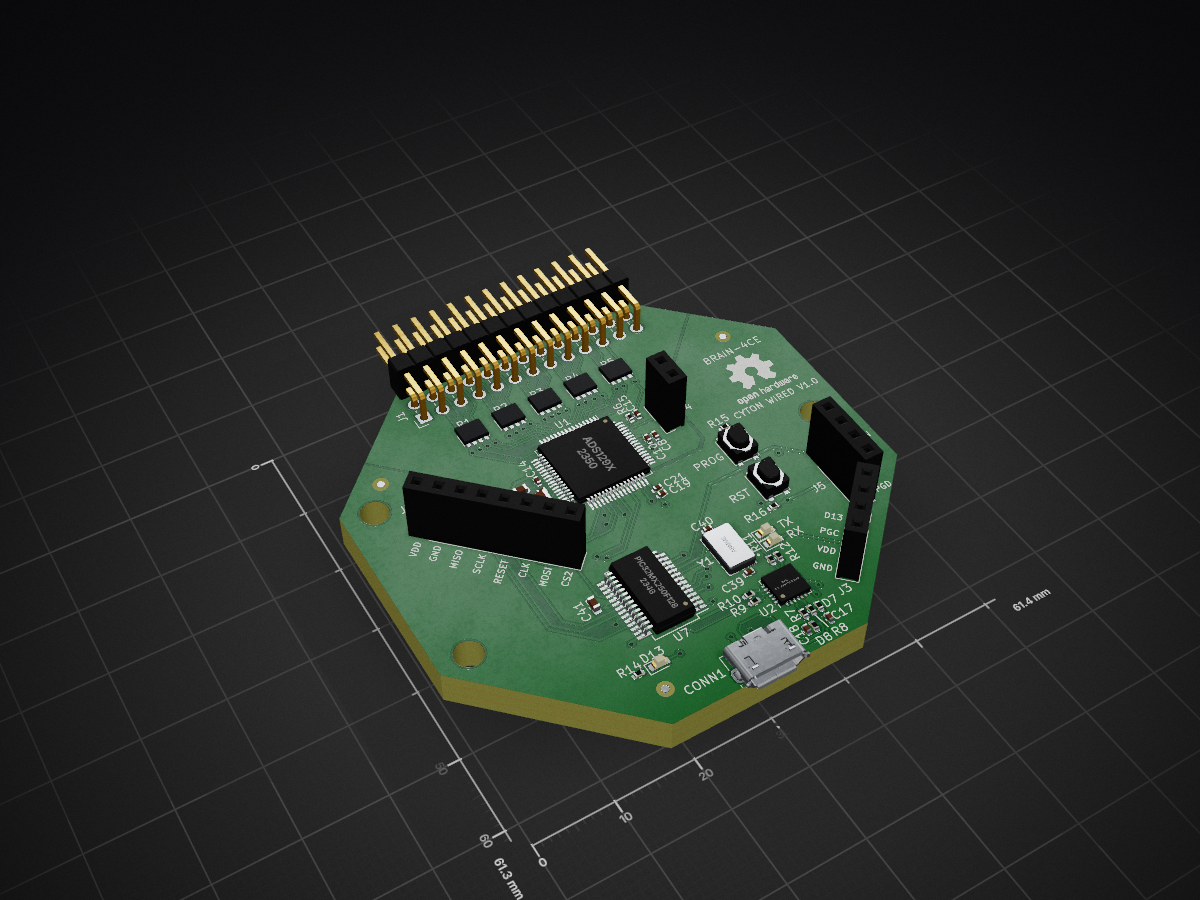
4 layers61.4 × 61.3 mmCyton wired, the printed circuit board in 3D

Where thoughts become motion. Designed by BU ECE 2023 Senior Design Capstone Team 4 From left to right: Brendan Shortall, Mitchell Gilmore, Dayanna De La Torres, Jonathan Mikalov, Alexander Johnson

Size
61.4 × 61.3 mm
Copper layers
4
Thickness
4.69 mm
Parts
100
Nets
123
Pads
450
Tracks, vias
769, 55
Pours
7
Routed
Yes
KiCad
KiCad 7 (file 20221018)
Created
23 Mar 2023
Updated
8 May 2023

Overview

Cyton wired is an open-source printed circuit board by BostonUniversitySeniorDesign, from the BostonUniversitySeniorDesign/brain-4ce repository on GitHub. It is a 4-layer board of 61.4 × 61.3 mm with 100 parts on 123 nets, routed with 769 tracks and 55 vias.

It is built around the PIC32MX250F128B-I/SS, LM2664M6 and TPD4E1B06DCKR-TP, with the CA0508KRX7R9BB102, CAY16-222J4LF and ABMM2-8.000MHZ-E2-T among its other parts. Its parts include 41 capacitors, 16 resistors, 13 diodes, 7 ICs and 5 connectors. It belongs with the PIC boards of this library.

Main components

6

README

README.md

Brain-4ce - An EEG-based Brain-Computer Interface

Brain 4ce Logo
Where thoughts become motion.

Designed by BU ECE 2023 Senior Design Capstone Team 4

Brain 4ce Logo
From left to right: Brendan Shortall, Mitchell Gilmore, Dayanna De La Torres, Jonathan Mikalov, Alexander Johnson


Table of Contents


Abstract

The ability to manipulate objects using only your mind is no longer a far-fetched idea. While It may sound like something out of science fiction, our team has turned this into a reality. We have created a headset that utilizes electroencephalogram (EEG) technology to quickly and accurately record a user's neural activity. Our state-of-the-art deep learning algorithm then decodes these signals into predefined motor-imagery tasks.

This breakthrough technology is integrated with a computer game that provides the user with an environment to navigate using their mind. With the Brain-4ce (pronounced "Brain Force") headset, users can perform four different actions: rotating clockwise, rotating counterclockwise, moving forward, and moving backward. Each action corresponds to a physical motion that the user imagines themselves doing.

Our team was inspired to develop this project by our aspiration to bridge the digital divide for those who are physically disabled. With the Brain-4ce headset, users will be able to operate a computer, a wheelchair, and virtually anything else using nothing but their thoughts! The possibilities are endless, and we are excited to see what the future holds.

Getting Started

Current State of the Project

As it currently stands, our project has three major components:

  1. A working EEG data capture headset that interfaces with a Python application to monitor and record brain activity in real time.
  2. A convolutional neural network machine learning algorithm, trained on the recorded brain activity, for classifying motor-imagery tasks observed from a user wearing the headset.
  3. 2D and 3D video games developed in Python to demonstrate the efficacy of the neural network's brain activity classification.

The software communicates in real time using socket programming techniques to achieve parallelism and multithreading.

Lessons Learned

  • Developing on Apple Silicon, and ARM-based processors in general, is tricky for this project. Certain libraries, such as the ChipKIT Core library for compiling firmware onto the microcontroller, lack proper support for ARM architecture. We recommend performing all software development on an x64-based Windows machine. Some development is possible on Intel-based macOS and Linux, but it will probably save you a lot of headache to stick to Windows if possible.
  • The microcontroller appears to have USB functionality built-in, which might make the USB to UART conversion unnecessary. This may be something to examine in the documentation during a future continuation of this project.
  • The ADS1299 chip from Texas Instruments remains difficult to obtain as of Q2 2023 due to the ongoing chip shortage. We tried using the ADS1296 chip in its place, but this was unsuccessful because of differing startup and common-mode rejection configurations between the chips.
  • If future boards are manufactured, it may be worth considering paying for them to be machine-assembled. Assembling the boards by hand takes a long time and requires a substantial amount of electrical rules checking to ensure no shorts or incontinuity between components.
  • Obtaining good skin contact for all electrodes is crucial to ensure proper reading of brain activity.
  • The OpenBCI Forum is a great place to turn to for help troubleshooting. As is their documentation.

Bug Fixes

Parts

100
QtyValueFootprintReferences
91uFCapacitor_SMD:C_0402_1005MetricC6, C7, C8, C9, C11, C19, C20, C23, C24
60.1uFCapacitor_SMD:C_0402_1005MetricC10, C14, C21, C22, C25, C26
610uFCapacitor_SMD:C_0603_1608MetricC13, C29, C30, C36, C38, C41
62.2uFCapacitor_SMD:C_0402_1005MetricC28, C31, C32, C33, C35, C37
6TPD4E1B06DCKRTSV - Diodes:TPD4E1B06DCKRD1, D2, D3, D4, D5, D6
5CA0508KRX7R9BB102Capacitor Arrays:CAPCAXE50P210X130X94-8NC1, C2, C3, C4, C5
5CAY16-222J4LFResistor Arrays:RESCAF80P320X160X60-8NR1, R2, R3, R4, R5
20.01uFCapacitor_SMD:C_0402_1005MetricC16, C34
218pFCapacitor_SMD:C_0402_1005MetricC39, C40
21k ohmResistor_SMD:R_0402_1005MetricR9, R10
21nFCapacitor_SMD:C_0402_1005MetricC15, C27
222 ohmResistor_SMD:R_0402_1005MetricR7, R8
2330 ohmResistor_SMD:R_0402_1005MetricR11, R12
2470kResistor_SMD:R_0402_1005MetricR15, R16
247pFCapacitor_SMD:C_0402_1005MetricC17, C18
2CHOKEInductor_SMD:L_0402_1005MetricL1, L2
2Conn_01x04Connector_PinSocket_2.54mm:PinSocket_1x04_P2.54mm_VerticalJ3, J5
2ESD_VARISTORDiode_SMD:D_0402_1005MetricD7, D8
2SW_PushButton_Switch_SMD:SW_SPST_PTS810SW1, SW2
10Resistor_SMD:R_0402_1005MetricR13
1100uFCapacitor_SMD:C_1206_3216MetricC12
11MResistor_SMD:R_0402_1005MetricR6
11kResistor_SMD:R_0402_1005MetricR14
1ABMM2-8.000MHZ-E2-TABMM:XTAL_ABMM2-8.000MHZ-E2-TY1
1ADS129xPackage_QFP:TQFP-64_10x10mm_P0.5mmU1
1CP2102N-Axx-xQFN24Package_DFN_QFN:QFN-24-1EP_4x4mm_P0.5mm_EP2.6x2.6mmU2
1Conn_01x02Connector_PinSocket_2.54mm:PinSocket_1x02_P2.54mm_VerticalJ4
1Conn_01x08Connector_PinSocket_2.54mm:PinSocket_1x08_P2.54mm_VerticalJ2
1Conn_02x13_Odd_EvenConnector_PinHeader_2.54mm:PinHeader_2x13_P2.54mm_HorizontalJ1
1D_ZenerDiode_SMD:D_SOD-323D12
1LEDLED_SMD:LED_0603_1608MetricD13
1LED_GREENLED_SMD:LED_0603_1608MetricD11
1LED_REDLED_SMD:LED_0603_1608MetricD10
1LM2664Package_TO_SOT_SMD:SOT-23-6U4
1MCP1754T-3302E/OTPackage_TO_SOT_SMD:SOT-23-5U3
1PIC32MX250F128B-I/SSPackage_SO:SSOP-28_5.3x10.2mm_P0.65mmU7
1SM_FUSEFuse:Fuse_1812_4532MetricF1
1TPS723xx-Q1Package_TO_SOT_SMD:SOT-23-5U6
1TPS7A24Package_TO_SOT_SMD:SOT-23-5U5
1TVS_DTSV - Diodes:ESDALC6V1-1M2D9
1USB_B_MicroConnector_USB:USB_Micro-B_Molex-105017-0001CONN1

The 89 most common of 100 parts.

More from BostonUniversitySeniorDesign/brain-4ce

2
  • 4 layers61.4 × 61.3 mmCyton hat, the printed circuit board in 3D

    Cyton hat

    BostonUniversitySeniorDesign/brain-4ce

    Where thoughts become motion. Designed by BU ECE 2023 Senior Design Capstone Team 4 From left to right: Brendan Shortall, Mitchell Gilmore, Dayanna De La Torres, Jonathan Mikalov, Alexander Johnson

    66 parts3
  • 4 layers61.4 × 39.7 mmCyton daisy, the printed circuit board in 3D

    Cyton daisy

    BostonUniversitySeniorDesign/brain-4ce

    Where thoughts become motion. Designed by BU ECE 2023 Senior Design Capstone Team 4 From left to right: Brendan Shortall, Mitchell Gilmore, Dayanna De La Torres, Jonathan Mikalov, Alexander Johnson

    41 parts3

Similar boards

  • 4 layers70 × 55 mmMind Speak (Main Board), the printed circuit board in 3D

    Mind Speak (Main Board)

    Mo3tasemO/Graduation_Project

    This repository will be for the Graduation Project.

    89 parts
  • 4 layers45.5 × 52 mmEeg, the printed circuit board in 3D

    Eeg

    jwmke/eeg

    Open Source 8-channel EEG Pi Pico Shield for <$80

    73 parts7
  • 2 layers89.9 × 42.7 mmMonolith, the printed circuit board in 3D

    Monolith

    Monolith-BCI/Trillium-PCB

    We're a group of teens working on creating a BCI PCB to start running our own experiments on noise filtering, signal processing speed, and data collection.

    89 parts5
  • 4 layers155.4 × 101.8 mmSpark tboi, the printed circuit board in 3D

    Spark tboi

    emb3rcia/spark-tboi

    The Binding of Isaac: Repentance dedicated small footprint macropad/keyboard with display and auto clicking capability to reduce strain on arms.

    45 parts
  • 2 layers60.5 × 95 mmPhylax Version 3, the printed circuit board in 3D

    Phylax Version 3

    ta007403/PHYLAX

    PHYLAX (Greek φύλαξ, "guardian") is an open-source, Bitcoin-only hardware wallet built around a simple idea: no black-box chips, no wireless radios, no telemetry, and firmware you can read and verify yourself.

    65 parts
  • 2 layers55.5 × 84.5 mmCW308T 87C51, the printed circuit board in 3D

    CW308T 87C51

    nikitalita/cw-kicad-conversions

    43 parts

Questions

How big is the Cyton wired PCB?

It measures 61.4 × 61.3 mm and has 4 copper layers, 4.69 mm thick.

What parts does the Cyton wired use?

100 parts, built around the PIC32MX250F128B-I/SS, LM2664M6, TPD4E1B06DCKR-TP and CA0508KRX7R9BB102. The full list of its parts is on this page, with links to each part's symbol and footprint where PCBKit's library has them.

Where can I download the Cyton wired KiCad files?

From the BostonUniversitySeniorDesign/brain-4ce repository on GitHub, at the commit this page was made from: the board is hardware/electrical/cyton wired/cyton wired.kicad_pcb and its schematic hardware/electrical/cyton daisy/cyton daisy.kicad_sch. PCBKit opens the board in the browser, with nothing to install.

Can I use the Cyton wired design in my own project?

Its repository states no licence, so its author keeps all rights: ask BostonUniversitySeniorDesign before reusing the design.