2 layers65.5 × 75.9 mm

 AwesomeSno/HLF-MIDI
LET'S MAKE MUSICCC
HLF MIDI is an open-source printed circuit board by AwesomeSno, from the AwesomeSno/HLF-MIDI repository on GitHub. It is a 2-layer board of 180 × 75 mm with 30 parts on 22 nets, routed with 37 tracks and 0 vias.
It is built around the ESP32-S3-WROOM-1-N8 and SK6812MINI-E. Its parts include 8 diodes, 4 switches, 3 ICs and 1 connector. It belongs with the audio and music boards and the ESP32 boards of this library.


A super slim, solid-state MIDI keyboard built with an ESP32-S3 that uses capacitive touch pads instead of mechanical switches. It plugs straight into any laptop, phone, or DAW as a plug-and-play USB-MIDI device.
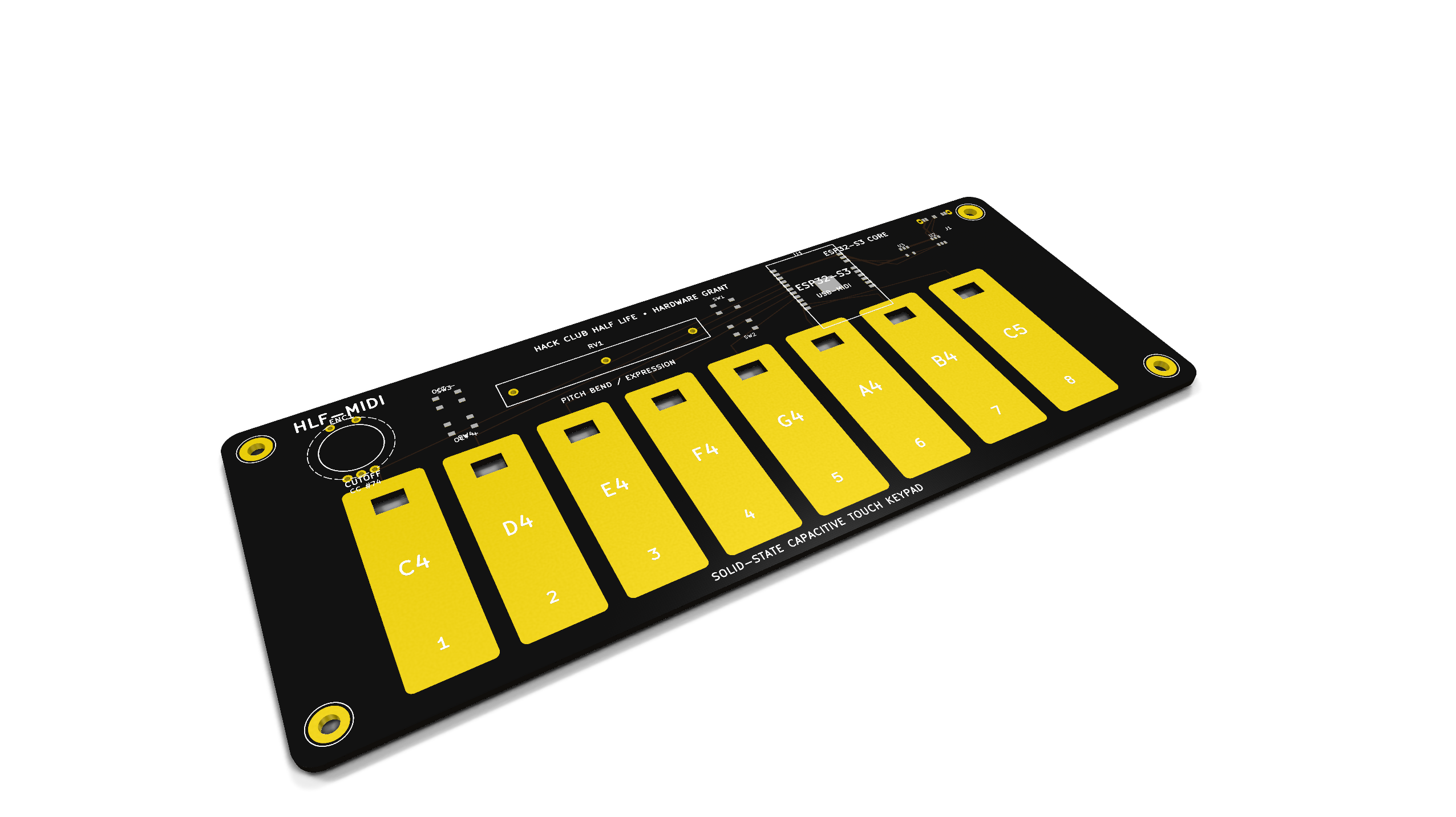
Traditional MIDI keyboards are usually pretty bulky, full of plastic mechanisms, and annoying to carry around. For Hack Club's Half Life, I wanted to build something super flat and minimal: a solid-state MIDI keyboard with zero moving key parts, where the keys are literally etched onto the PCB in gold (ENIG).
Your fingers touch the pads directly, the ESP32-S3 detects the electric field change with its built-in hardware capacitive touch channels, and it immediately sends standard MIDI notes to your computer or synthesizer over native USB-C.
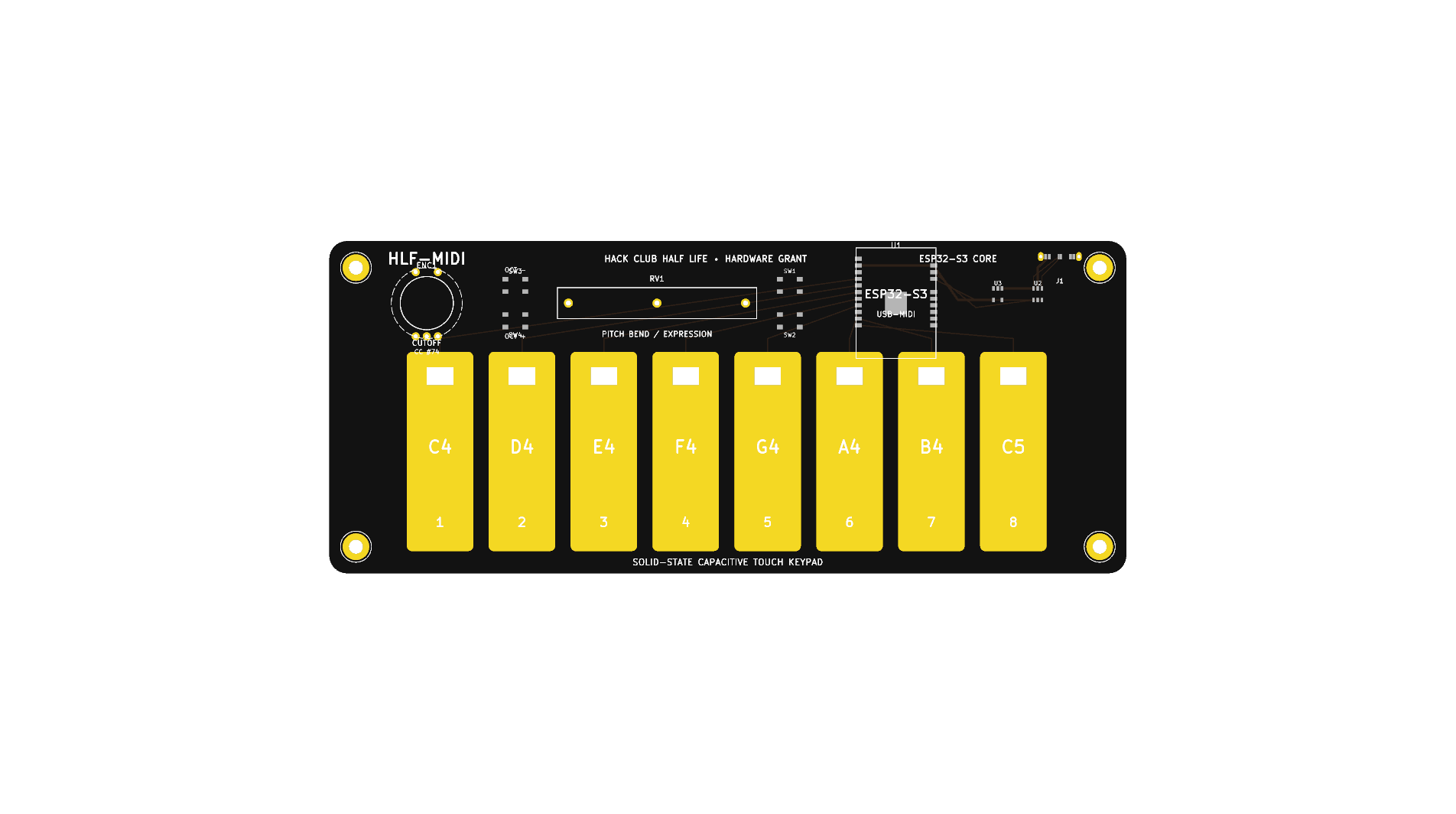
The whole board was designed in KiCad with a clean 2-layer stackup:
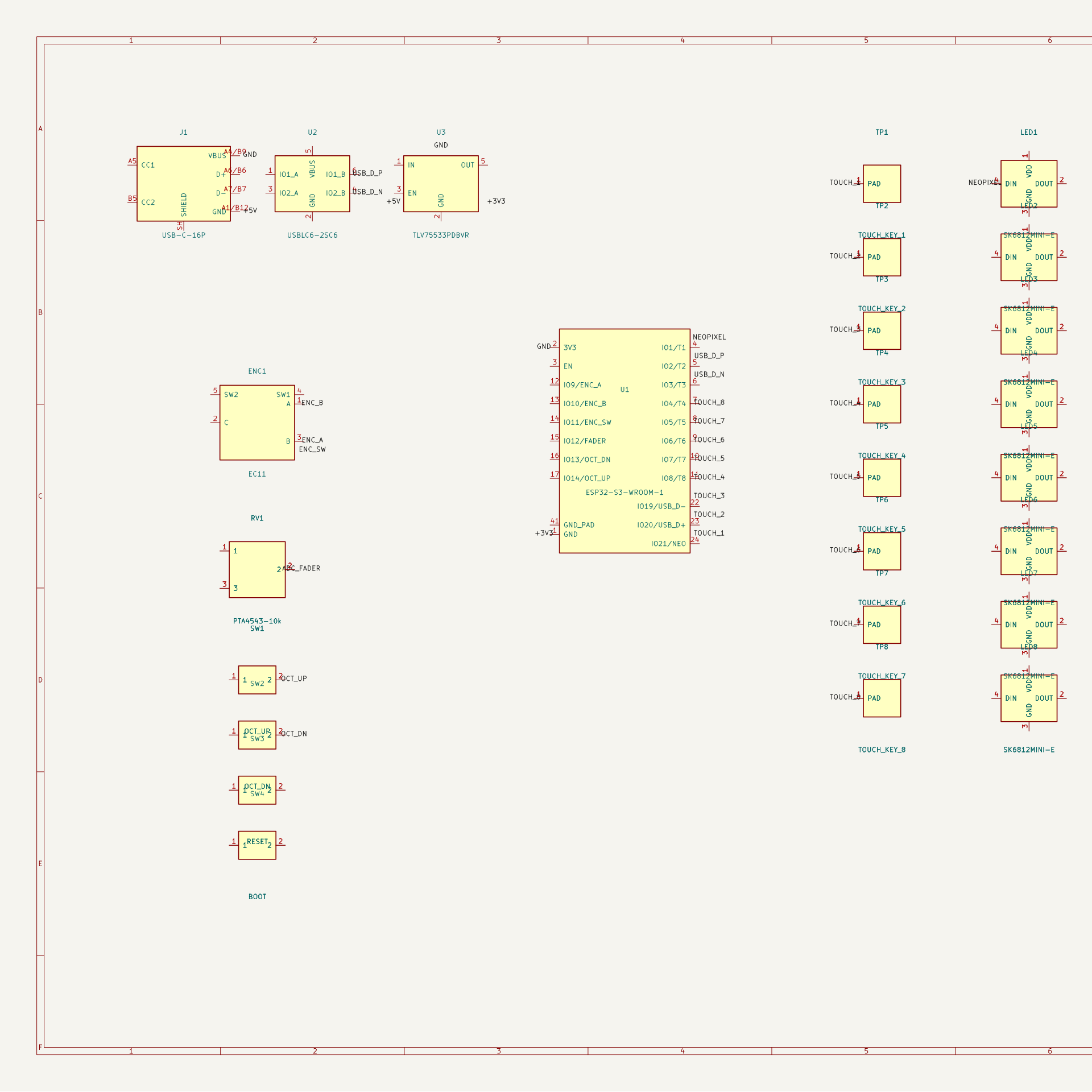
All hardware design files are in the kicad/ directory:
kicad/hlf_midi.kicad_sch (and printable kicad/hlf_midi_schematic.pdf)kicad/hlf_midi.kicad_pcbkicad/hlf_midi.kicad_prokicad/bom.csvkicad/cpl.csvkicad/hlf_midi_gerbers.zipThe firmware is written in Arduino C++ for the ESP32-S3 using the native TinyUSB stack. It handles touch baseline calibration, exponential moving average (EMA) filtering for the analog slider to prevent jitter, and sends class-compliant MIDI packets at ~500Hz.
The code is available in firmware/hlf_midi_firmware/hlf_midi_firmware.ino.
kicad/hlf_midi.kicad_pro in KiCad to view the full schematic and 3D PCB layout.firmware/hlf_midi_firmware/hlf_midi_firmware.ino in Arduino IDE.Designed and built by Harinandan J V for Hack Club's Half Life hardware program.
This project is completely open source under the MIT License. Feel free to use, modify, or build upon it for your own synths and music gear!
| Qty | Value | Footprint | References |
|---|---|---|---|
| 8 | SK6812MINI-E | LED_SMD:LED_SK6812MINI-E | LED1, LED2, LED3, LED4, LED5, LED6, LED7, LED8 |
| 4 | — | Button_Switch_SMD:SW_SPST_TL3342 | SW1, SW2, SW3, SW4 |
| 1 | EC11_Knob | Rotary_Encoder:RotaryEncoder_Alps_EC11E-Switch_Vertical_H20mm | ENC1 |
| 1 | ESP32-S3-WROOM-1 | RF_Module:ESP32-S3-WROOM-1 | U1 |
| 1 | — | Package_TO_SOT_SMD:SOT-23-6 | U2 |
| 1 | — | Potentiometer_THT:Potentiometer_Bourns_PTA4543_Single_Slide | RV1 |
| 1 | — | Connector_USB:USB_C_Receptacle_HRO_TYPE-C-31-M-12 | J1 |
| 1 | — | Package_TO_SOT_SMD:SOT-23-5 | U3 |
The 18 most common of 30 parts.

Uspizig/WifiWallSwitch
A WallSwitch with a clever EINK Display that measures your Air Quality, measures Temperature, detects movement, measures Light Conditions... and many more.

YeetTheAnson/AnsonKeyboard
When in custom color configuration mode, the display shows prompts for entering RGB values.

OmkarKnkr/Atlas-S3-DevBoard
Atlas S3 DevBoard is a custom ESP32-S3 development board designed from the ground up with an emphasis on compactness, usability, and clean PCB design practices.

OklahomaOpenSourceHardware/Oklahoma-Open-Hardware-Mechanical-Keyboard
Oklahoma themed open source hardware licensed keyboard from the Oklahoma community


It measures 180 × 75 mm and has 2 copper layers, 1.6 mm thick.
30 parts, built around the ESP32-S3-WROOM-1-N8 and SK6812MINI-E. The full list of its parts is on this page, with links to each part's symbol and footprint where PCBKit's library has them.
From the AwesomeSno/HLF-MIDI repository on GitHub, at the commit this page was made from: the board is kicad/hlf_midi.kicad_pcb and its schematic kicad/hlf_midi.kicad_sch. PCBKit opens the board in the browser, with nothing to install.
Its repository states no licence, so its author keeps all rights: ask AwesomeSno before reusing the design.