2 layers229.9 × 93.3 mm
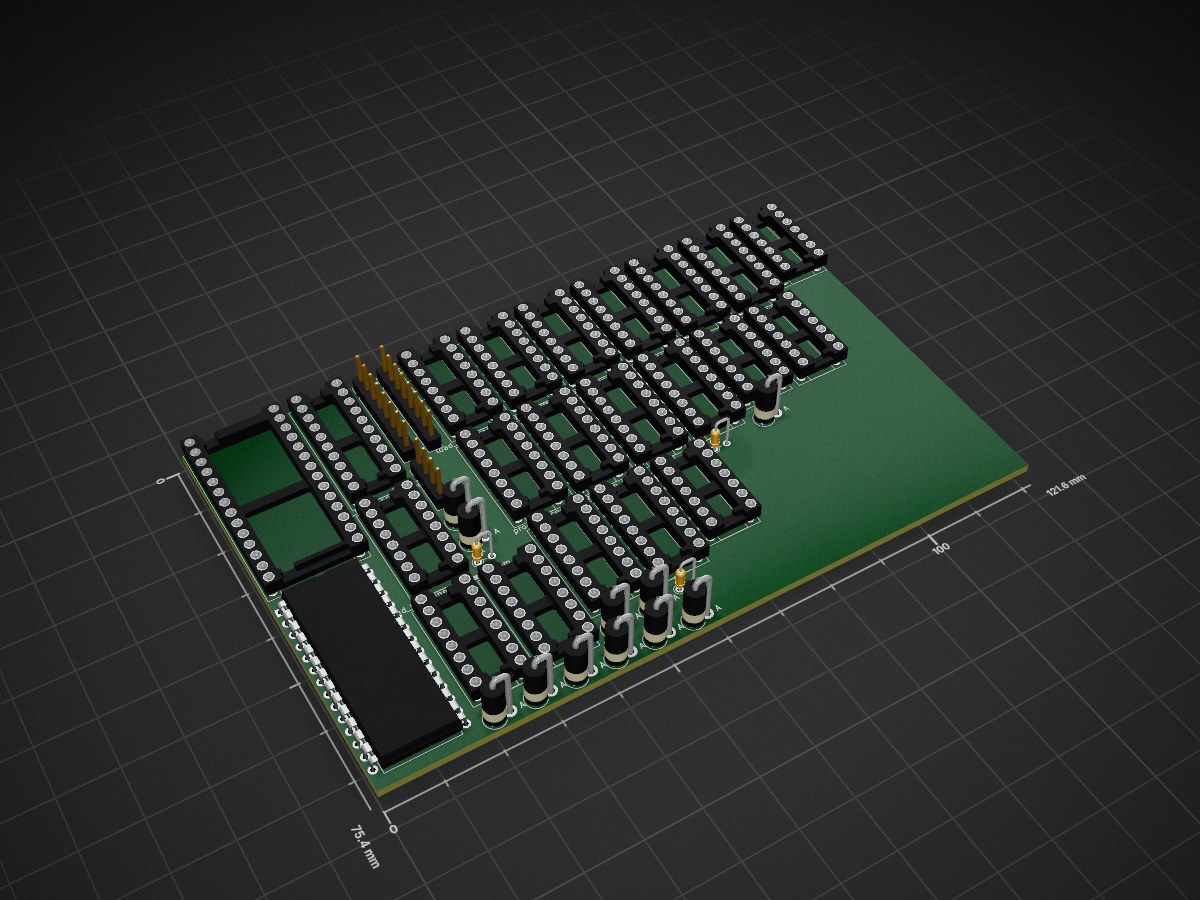
 Amp-Lab-at-VT/Simple-PLC
Simple turing-complete computer using the least components possible
Computer is an open-source printed circuit board by Amp-Lab-at-VT, from the Amp-Lab-at-VT/Simple-PLC repository on GitHub. It is a 2-layer board with 39 parts on 133 nets.
It is built around the 74LS245SC, 74LS195APC and 74LS161DC, with the 74LS00SC, 74LS04PC and HM62256BLP-7 among its other parts. Its parts include 11 diodes, 3 resistors, 3 connectors and 2 ICs.


Eddie Pritchard - Computer Engineering Students (2024) epritchard@vt.edu, Youssef Chebil - Computer Engineering Student (2025) youssefchebil@vt.edu
Rusty Stewart, Vasili Konstantinakos, Felipe Quintero, Pacheck Nicholas
Eddie Pritchard, Ethan James
IN PROGRESS
The Eight Bit simple PLC is a reductionist eight bit computer and compiler/assembler pair which uses as few 74 series chips as possible. The reductionist design can be replicated in a variety of mediums not only 74 series chips (for example relays, vacuum tubes, or on an fpga) in order to use as little power as possible. This project serves as a research project into computer architecture allowing students to learn what design decisions allow for less hardware to be used at the expense of a more complicated virtual architecture / rom layout.
This project will allow students to explore design choices in computer engineering. Instruction set design maps directly to the hardware required to execute each step within a processor, and certain instruction sets require expensive hardware designs which are wasteful in terms of resources and power. By learning more about how instruction sets design maps to hardware, students will be able to design more efficient computer architectures which multiplex hardware in the time domain (pipelining).
We have already completed the virtual simulation in Logisim. We have already begun writing the assembler / compiler.
Final steps are PCB design of the final design once we have determined the optimal computer architecture.
PCB design is big. First we need to finish simulations to make sure the computer design is turing complete / most effective design avoiding complex / time expensive instructions.
0$ - 50$. The final product will be a hand soldered PCB ordered from JLC PCB. All components (74 series chips) I have on hand.
PCB ordered by 2/3/24
| Qty | Value | Footprint | References |
|---|---|---|---|
| 11 | D | Diode_THT:D_DO-15_P2.54mm_Vertical_AnodeUp | D1, D2, D3, D4, D5, D6, D7, D8, D9, D10, D11 |
| 8 | 74LS195 | Package_DIP:DIP-16_W7.62mm_Socket | load_from_constant1, load_from_input_lower1, load_from_input_upper1, load_from_nand1, load_from_plus1, load_from_ram_upper1, load_lower_pc1, load_upper_pc1 |
| 4 | 74LS161 | Package_DIP:DIP-16_W7.62mm_Socket | program_counter_0, program_counter_1, program_counter_2, program_counter_3 |
| 3 | 10k | Resistor_THT:R_Axial_DIN0204_L3.6mm_D1.6mm_P2.54mm_Vertical | R1, R2, R3 |
| 2 | 74LS08 | Package_DIP:DIP-14_W7.62mm_Socket | U1, U2 |
| 2 | 74LS138 | Package_DIP:DIP-16_W7.62mm_Socket | clock_and_shift_decoder1, parallel_load_decoder1 |
| 2 | Conn_01x08_Male | Connector_PinHeader_2.54mm:PinHeader_1x08_P2.54mm_Vertical | J2, J3 |
| 1 | 28C256 | Package_DIP:DIP-28_W15.24mm_Socket | instruction_memory1 |
| 1 | 74LS00 | Package_DIP:DIP-14_W7.62mm_Socket | alu_nand1 |
| 1 | 74LS04 | Package_DIP:DIP-14_W7.62mm_Socket | misc_inverter1 |
| 1 | 74LS245 | Package_DIP:DIP-20_W7.62mm_Socket | ram_write_buffer1 |
| 1 | 74LS283 | Package_DIP:DIP-16_W7.62mm_Socket | alu_adder1 |
| 1 | Conn_01x04_Male | Connector_PinHeader_2.54mm:PinHeader_1x04_P2.54mm_Vertical | J1 |
| 1 | HM62256BLP | Package_DIP:DIP-28_W15.24mm | ram1 |

cyrillvalentini/SAP-Extended
Extended Simple-As-Possible Computer based on Ben Eaters video series

ArqueologiaDigital/SintetizadorGuidoStolfi
Repositório contendo documentação técnica sobre o sintetisador musical criado na década de 70 na Escola Politécnica da USP pelo professor Guido Stolfi.


fortinsylvain/MyCpu
Home brew CPU Hardware with 1-bit ALU implementation using 74LSxx, a micro-code and assembler coded in C#.


Nakazoto/CenturionComputer
This is just a simple backup of all the files related to the Centurion that I have stored on my HD. The Wiki itself has far more in-depth information about the Centurion and it's individual cards.
39 parts, built around the 74LS245SC, 74LS195APC, 74LS161DC and 74LS00SC. The full list of its parts is on this page, with links to each part's symbol and footprint where PCBKit's library has them.
From the Amp-Lab-at-VT/Simple-PLC repository on GitHub, at the commit this page was made from: the board is KiCad/computer/computer.kicad_pcb and its schematic KiCad/computer/computer.kicad_sch. PCBKit opens the board in the browser, with nothing to install.
Its repository states no licence, so its author keeps all rights: ask Amp-Lab-at-VT before reusing the design.