2 layers63.2 × 27.7 mm
ESPCameleonV2
Alan-GIRAUDON/ESPCameleonV2
ESPCameleonV2 is an ESP32 Camera PCB. It resolve the biggest issues of its first version, ESP32Cameleon. This board allow video capture and streaming through WiFi or USB.
47 partsMIT

 Alan-GIRAUDON/ESPCameleon
ESPCameleon is an ESP32 Camera PCB. It takes most of its design from the AI Thinker ESP32-Cam and adapt it to use the ESP32-S2-MINI-2-N4R2. This board allow video capture and streaming through WiFi or USB.
ESPCameleon is an open-source printed circuit board by Alan-GIRAUDON, from the Alan-GIRAUDON/ESPCameleon repository on GitHub, published under the MIT licence. It is a 2-layer board of 64.4 × 38.9 mm with 45 parts on 56 nets, routed with 581 tracks and 172 vias.
It is built around the AMS1117-3.3, XC6206P122MR and XC6206P282MR, with the MDD2301 among its other parts. Its parts include 14 capacitors, 9 resistors, 4 ICs, 4 connectors and 3 diodes. It belongs with the ESP32 boards of this library.


ESPCameleon is an ESP32 Camera PCB. It takes most of its design from the AI Thinker ESP32-Cam and adapt it to use the ESP32-S2-MINI-2-N4R2. This board allow video capture and streaming through WiFi or USB.
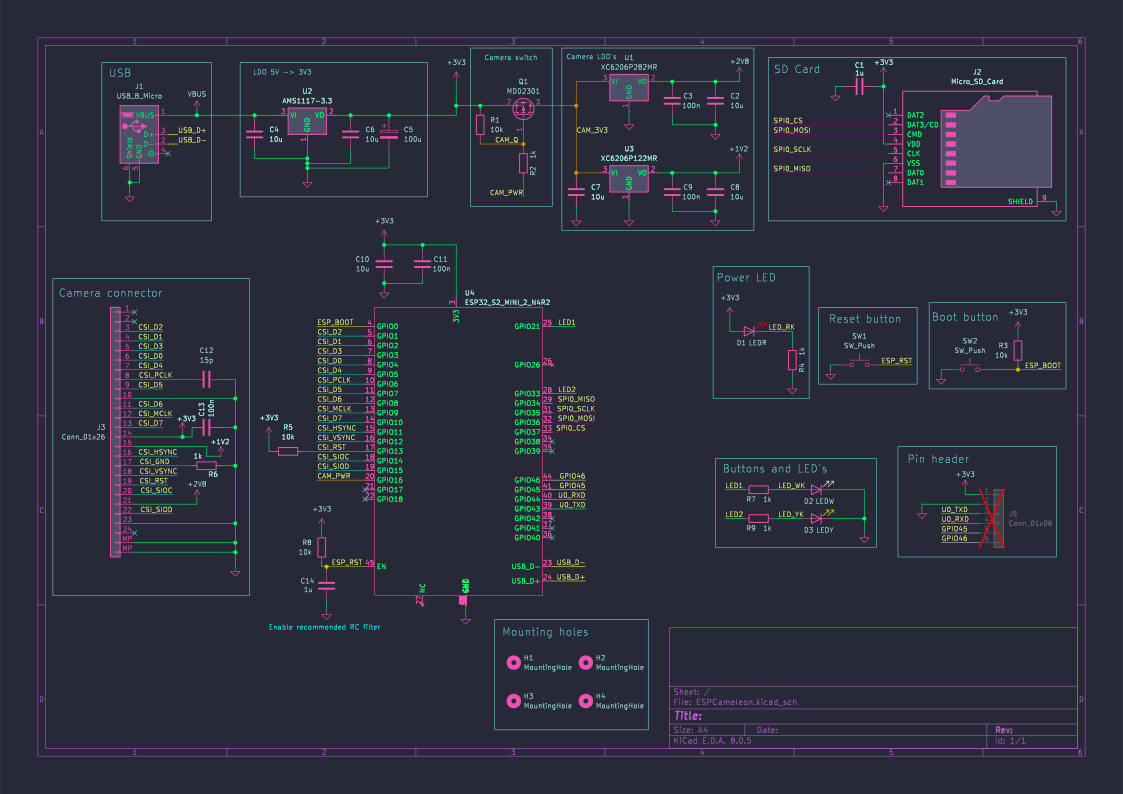
The PCB is a two layer board with single-sided assembly, the thinnest trace is 0.1562 mm and the vias have a 0.7 mm diameter ring and a 0.3 mm hole. The USB traces are as short and as thick as possible to be as close as possible to the 90 $\Omega$ impedance of the JLCPCB two-layer board stackup.
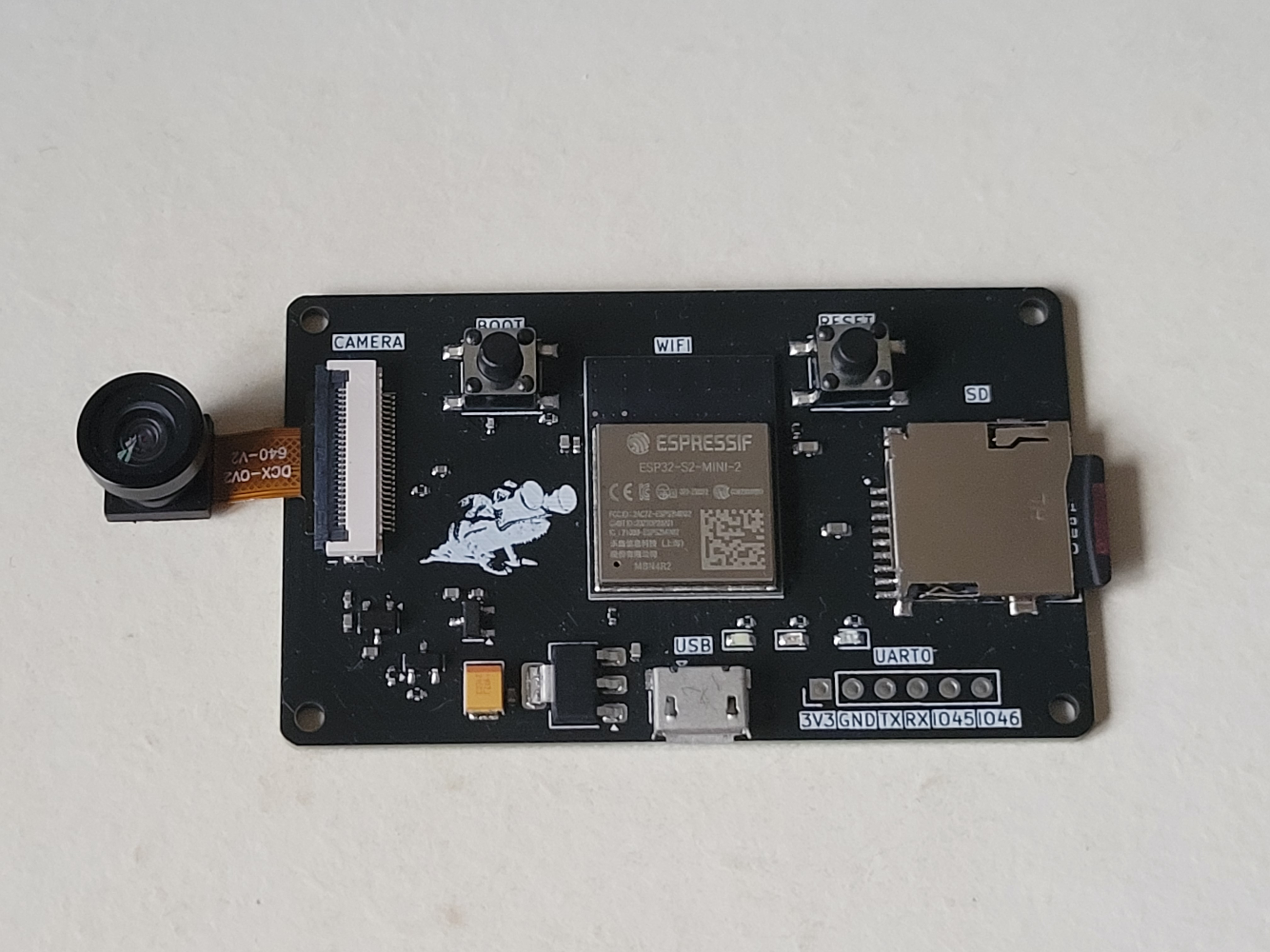
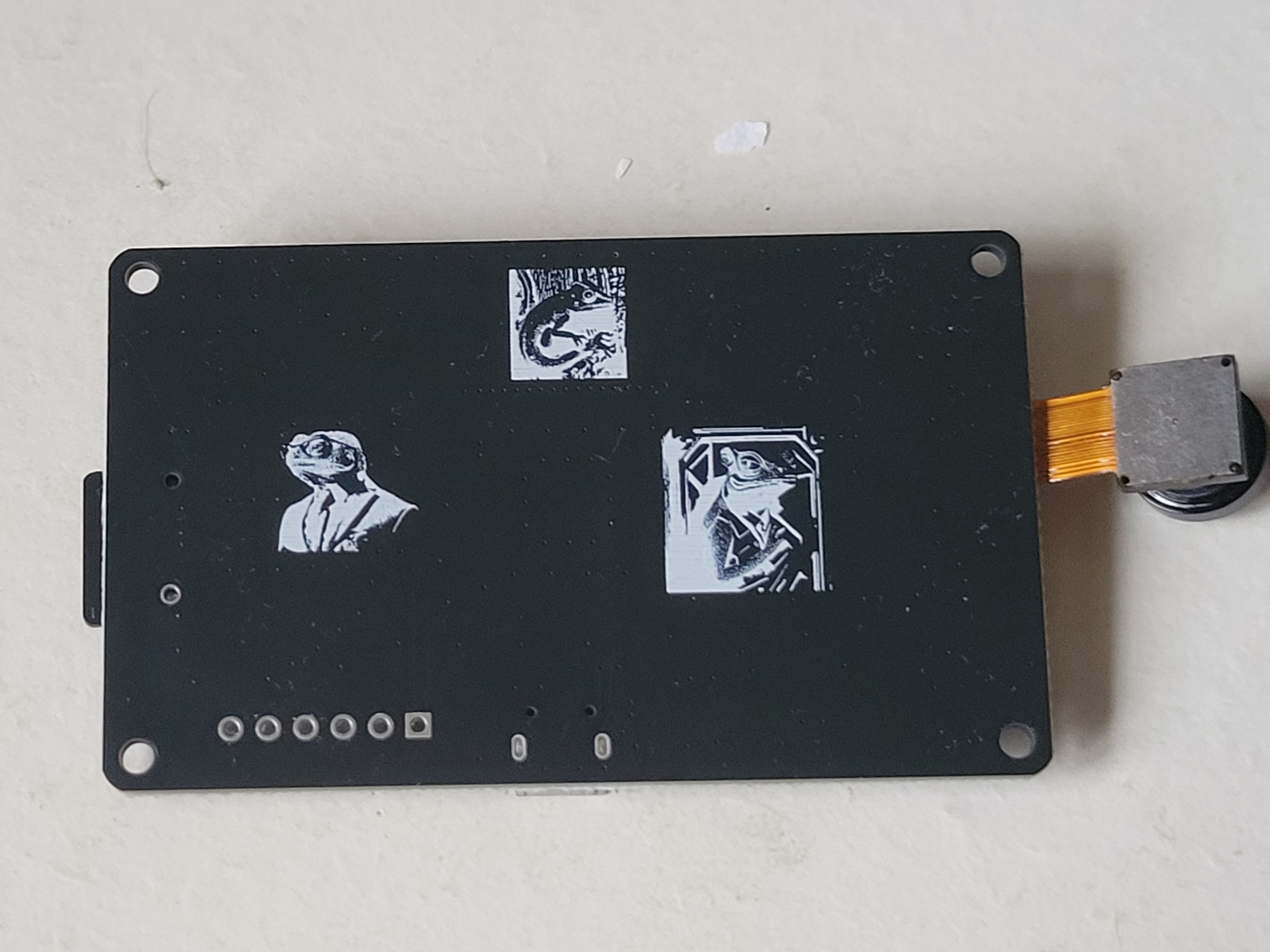
The board can be "easily" programmed with both ESP-IDF and Arduino IDE but the later is much faster to get working.
For the arduino IDE, you just need to download the ESP32 boards configurations. Select board "ESP32S2 Dev module", enable "USB CDC on boot", "upload mode" as "internal USB". For the camera webserver example (File->Example->ESP32->Camera->CameraWebServer), you should set "PSRAM" as "enabled", enter your Wifi credentials and update the camera_pins.h to match the board (an example is given in my CameraWebServer2 repository).
An example of streaming through the USB port is available in the USBCameraStreaming repository. It contains an Arduino script to send JPEG images via USB and a Basic Flutter android app to receive and display the video stream.
Most of those issues are addressed in the ESP32CamelonV2 repository.
| Qty | Value | Footprint | References |
|---|---|---|---|
| 6 | 10u | Capacitor_SMD:C_0402_1005Metric | C2, C4, C6, C7, C8, C10 |
| 5 | 1k | Resistor_SMD:R_0402_1005Metric | R2, R4, R6, R7, R9 |
| 4 | 100n | Capacitor_SMD:C_0402_1005Metric | C3, C9, C11, C13 |
| 4 | 10k | Resistor_SMD:R_0402_1005Metric | R1, R3, R5, R8 |
| 4 | LOGO | LOGO | G***, G***, G***, G*** |
| 4 | MountingHole | MountingHole:MountingHole_2.2mm_M2 | H1, H2, H3, H4 |
| 2 | 1u | Capacitor_SMD:C_0603_1608Metric | C1, C14 |
| 2 | SW_Push | Button_Switch_SMD:SW_Push_1P1T_NO_6x6mm_H9.5mm | SW1, SW2 |
| 1 | 100u | Capacitor_Tantalum_SMD:CP_EIA-3528-21_Kemet-B | C5 |
| 1 | 15p | Capacitor_SMD:C_0402_1005Metric | C12 |
| 1 | AMS1117-3.3 | Package_TO_SOT_SMD:SOT-223-3_TabPin2 | U2 |
| 1 | Conn_01x06 | Connector_PinHeader_2.54mm:PinHeader_1x06_P2.54mm_Vertical | J5 |
| 1 | Conn_01x26 | ESPCameleon:AFC01_S24FCA_00 | J3 |
| 1 | ESP32_S2_MINI_2_N4R2 | ESPCameleon:ESP32-S2-MINI-2 | U4 |
| 1 | LEDR | LED_SMD:LED_0603_1608Metric | D1 |
| 1 | LEDW | LED_SMD:LED_0603_1608Metric | D2 |
| 1 | LEDY | LED_SMD:LED_0603_1608Metric | D3 |
| 1 | MDD2301 | Package_TO_SOT_SMD:SOT-23 | Q1 |
| 1 | Micro_SD_Card | ESPCameleon:GCT_MEM2075-00-140-01-A | J2 |
| 1 | USB_B_Micro | Connector_USB:USB_Micro-B_XKB_U254-051T-4BH83-F1S | J1 |
| 1 | XC6206P122MR | Package_TO_SOT_SMD:SOT-23-3 | U3 |
| 1 | XC6206P282MR | Package_TO_SOT_SMD:SOT-23-3 | U1 |
Alan-GIRAUDON/ESPCameleonV2
ESPCameleonV2 is an ESP32 Camera PCB. It resolve the biggest issues of its first version, ESP32Cameleon. This board allow video capture and streaming through WiFi or USB.


Nieko27/Frame-Workshop
A repo for all things steam frame hardware.


LCQIANN/esp32s3-camera
ESP32-S3 camera board v1.2: OV2640 DVP camera, microSD, USB-C, LiPo, KiCad 10 project for JLCPCB PCBA


It measures 64.4 × 38.9 mm and has 2 copper layers, 1.6 mm thick.
45 parts, built around the AMS1117-3.3, XC6206P122MR, XC6206P282MR and MDD2301. The full list of its parts is on this page, with links to each part's symbol and footprint where PCBKit's library has them.
From the Alan-GIRAUDON/ESPCameleon repository on GitHub, at the commit this page was made from: the board is ESPCameleon.kicad_pcb and its schematic ESPCameleon.kicad_sch. PCBKit opens the board in the browser, with nothing to install.
Its repository publishes it under the MIT licence: you may reuse it on that licence's terms (keep the author's notice, and for a copyleft licence share your changes alike).