2 layers170 × 90 mm
 Adamh-Tech/PCB
The hand
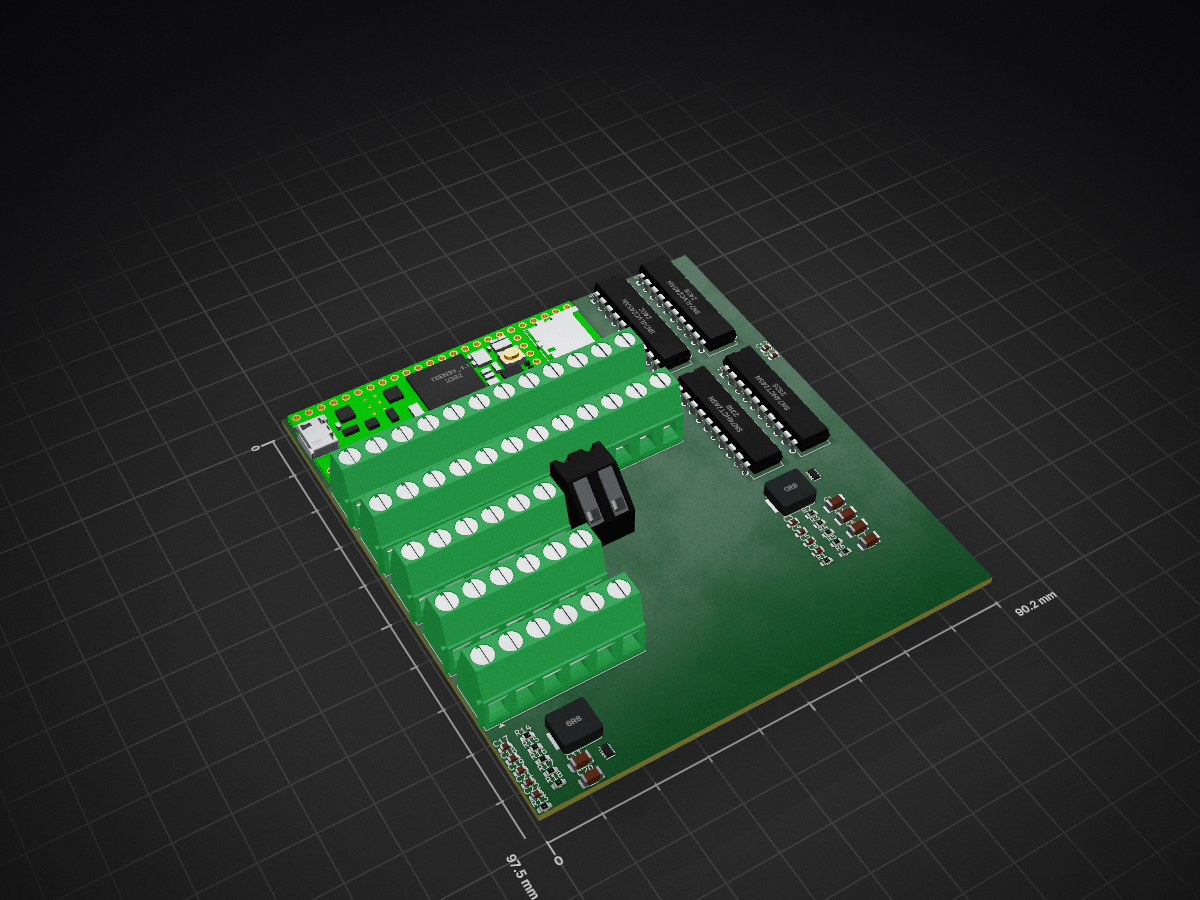
Powerboard is an open-source printed circuit board by Adamh-Tech, from the Adamh-Tech/PCB repository on GitHub. It is a 2-layer board with 44 parts on 114 nets.
It is built around the SN74HCT245N, TEENSY 4.1 and MP2338GTL-Z, with the SN74LVC245AN among its other parts. Its parts include 17 capacitors, 12 resistors, 7 ICs, 6 connectors and 2 inductors. It belongs with the NXP (LPC, Kinetis, i.MX RT) boards of this library.


| Qty | Value | Footprint | References |
|---|---|---|---|
| 4 | 0.1uF | Capacitor_SMD:C_0603_1608Metric | C3, C5, C17, C19 |
| 4 | 10k | Resistor_SMD:R_0603_1608Metric | R4, R15, R16, R17 |
| 4 | 22uF | Capacitor_SMD:C_1206_3216Metric | C6, C7, C11, C20 |
| 3 | Screw_Terminal_01x06 | TerminalBlock_Phoenix:TerminalBlock_Phoenix_MKDS-1,5-6_1x06_P5.00mm_Horizontal | J4, J5, J6 |
| 2 | 100nF | Capacitor_SMD:C_0603_1608Metric | C12, C13 |
| 2 | 10uF | Capacitor_SMD:C_1206_3216Metric | C1, C2 |
| 2 | 191k | Resistor_SMD:R_0603_1608Metric | R1, R13 |
| 2 | 22nF | Capacitor_SMD:C_0603_1608Metric | C4, C18 |
| 2 | 49.9k | Resistor_SMD:R_0603_1608Metric | R2, R14 |
| 2 | 6.8uH | Inductor_SMD:L_Bourns_SRP7028A_7.3x6.6mm | L1, L3 |
| 2 | MP2338GTL-Z | MP2338GTL:SOT583_MP2338_MNP | U1, U3 |
| 2 | SN74HCT245N | SN74HCT245N:N20 | U5, U6 |
| 2 | SN74LVC245AN | SN74LVC245AN:N20 | U7, U8 |
| 2 | Screw_Terminal_01x12 | TerminalBlock_Phoenix:TerminalBlock_Phoenix_MKDS-1,5-12-5.08_1x12_P5.08mm_Horizontal | J3, J7 |
| 1 | 100k | Resistor_SMD:R_0603_1608Metric | R3 |
| 1 | 22uF | Capacitor_SMD:C_0603_1608Metric | C21 |
| 1 | 300pF | Capacitor_SMD:C_0603_1608Metric | C22 |
| 1 | 470pF | Capacitor_SMD:C_0603_1608Metric | C8 |
| 1 | 51k | Resistor_SMD:R_0603_1608Metric | R6 |
| 1 | 9.09k | Resistor_SMD:R_0603_1608Metric | R5 |
| 1 | 90.9k | Resistor_SMD:R_0603_1608Metric | R18 |
| 1 | Screw_Terminal_01x02 | TerminalBlock_Altech:Altech_AK100_1x02_P5.00mm | J1 |
| 1 | TEENSY_4.1 | TEENSY_4.1:TEENSY41 | IC1 |


Robert-Riordan-UCD/8_Bit_CPU_PCB
PCB version of Ben Eaters 8-bit breadboard computer

MicroCoreLabs/Projects
Ted Fried's MicroCore Labs Projects - FPGA CPU cores and emulators for the 8088, 8086, 8051, 6502, 68000, Z80, Risc-V, and also Typewriter and EPROM Emulator projects.

neurorishika/MultiBiOS
High-precision, hardware-clocked olfactometer control system for behavioral neuroscience

44 parts, built around the SN74HCT245N, TEENSY 4.1, MP2338GTL-Z and SN74LVC245AN. The full list of its parts is on this page, with links to each part's symbol and footprint where PCBKit's library has them.
From the Adamh-Tech/PCB repository on GitHub, at the commit this page was made from: the board is Powerboard/_restore_backup_2026-06-24T22-12-58-407/Powerboard.kicad_pcb and its schematic Powerboard/3v3_Stepdown.kicad_sch. PCBKit opens the board in the browser, with nothing to install.
Its repository states no licence, so its author keeps all rights: ask Adamh-Tech before reusing the design.