
4 layers226.3 × 178.3 mm
 1ConHeoUnIn/Pcb_design
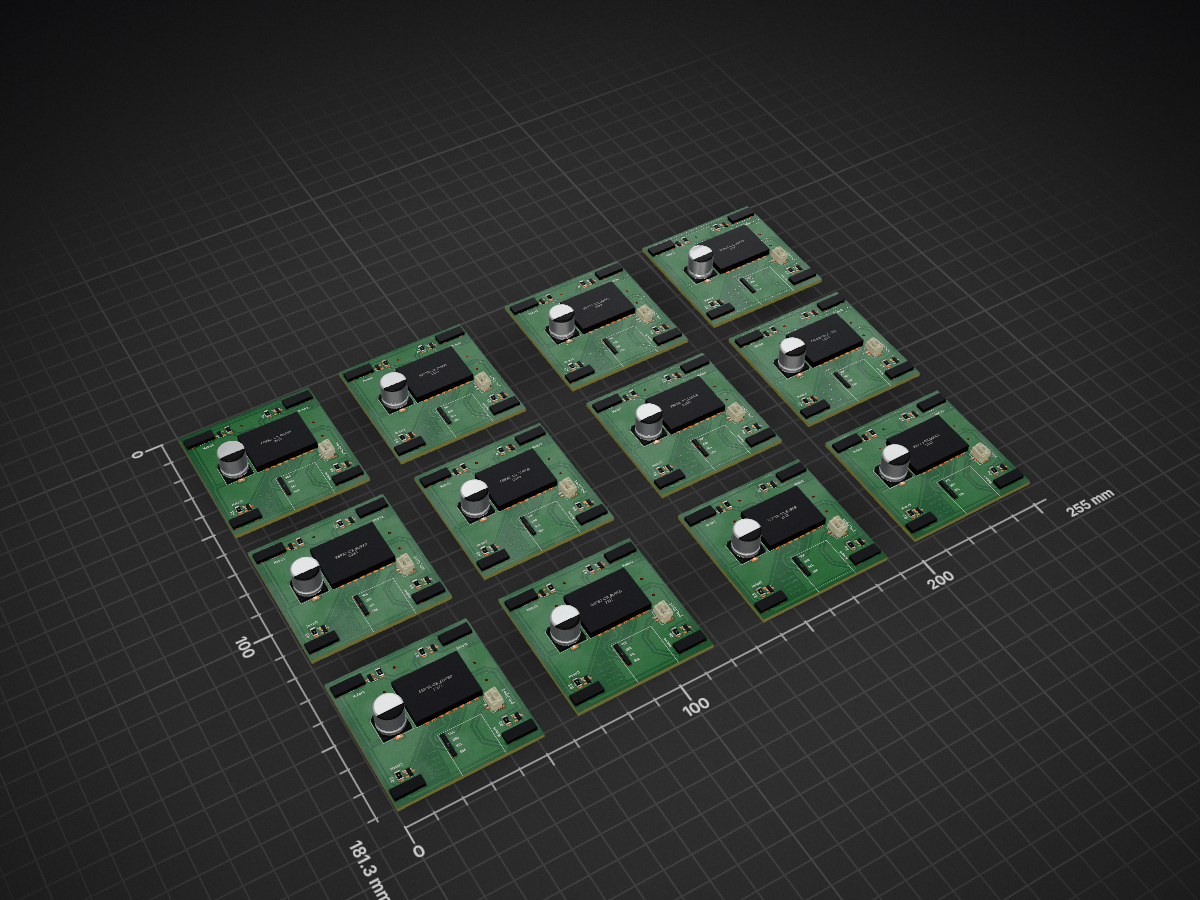
Control quacopter 1 is an open-source printed circuit board by 1ConHeoUnIn, from the 1ConHeoUnIn/Pcb_design repository on GitHub. It is a 4-layer board of 255 × 181.3 mm with 240 parts on 20 nets, routed with 1,272 tracks and 48 vias.
It is built around the SI2302CDS-T1-E3-HXY. Its parts include 48 resistors, 48 diodes, 48 transistors, 24 ICs and 12 capacitors. It belongs with the ESP32 and RISC-V boards of this library.
| Qty | Value | Footprint | References |
|---|---|---|---|
| 48 | 10K | Resistor_SMD:R_1206_3216Metric | R1, R1, R1, R1, R1, R1, R1, R1, R1, R1, R1, R1, R2, R2, R2, R2 +32 |
| 48 | 1N5819 | Diode_SMD:D_SOD-323 | D1, D1, D1, D1, D1, D1, D1, D1, D1, D1, D1, D1, D2, D2, D2, D2 +32 |
| 48 | SI2302CDS-T1-E3 | mosfet:si2302 | Q1, Q1, Q1, Q1, Q1, Q1, Q1, Q1, Q1, Q1, Q1, Q1, Q2, Q2, Q2, Q2 +32 |
| 48 | weld_here | welding_pad:2pin_pad | Motor1, Motor1, Motor1, Motor1, Motor1, Motor1, Motor1, Motor1, Motor1, Motor1, Motor1, Motor1, Motor2, Motor2, Motor2, Motor2 +32 |
| 12 | 470uf | Capacitor_SMD:CP_Elec_10x10.5 | C5, C5, C5, C5, C5, C5, C5, C5, C5, C5, C5, C5 |
| 12 | ESP32-C3_SUPERMINI_SMD | esp32_c3_super_mini:MODULE_ESP32_C3_SUPERMINI_THT | U1, U1, U1, U1, U1, U1, U1, U1, U1, U1, U1, U1 |
| 12 | JST 1x2 | Connector_JST:JST_GH_BM02B-GHS-TBT_1x02-1MP_P1.25mm_Vertical | pin_lipo1, pin_lipo1, pin_lipo1, pin_lipo1, pin_lipo1, pin_lipo1, pin_lipo1, pin_lipo1, pin_lipo1, pin_lipo1, pin_lipo1, pin_lipo1 |
| 12 | MPU6050 | mpu6050:mpu6050_module | U2, U2, U2, U2, U2, U2, U2, U2, U2, U2, U2, U2 |


atopile/atopile
Design circuit boards with code! ✨ Get software-like design reuse 🚀, validation, version control and collaboration in hardware; starting with electronics ⚡️

will127534/Miniature-CM4-Cluster
A dense cluster for four Raspberry Pi Compute Module 4

NVIDIA-AI-IOT/my-jetson-nano-baseboard
An open source Jetson Nano baseboard and tools to design your own.


osmocom/osmo-e1-hardware
Osmocom open source E1 (TDM) hardware; mirror of https://gitea.osmocom.org/retronetworking/osmo-e1-hardware

antmicro/audio-latency-tester-board
This project contains open hardware design files for an audio latency processing board. The system allows driving an external speaker and collecting audio samples from a pair of PDM or I2S microphones.

hugoNN1001/LattePanda-Mu-Custom-Carrier-Board
Personal project, work in progress - Learning digital high-speed PCB design by designing a custom carrier board for the LattePanda Mu - based on the reference design: https://github.com/LattePandaTeam/LattePanda-Mu

It measures 255 × 181.3 mm and has 4 copper layers, 1.6 mm thick.
240 parts, built around the SI2302CDS-T1-E3-HXY. The full list of its parts is on this page, with links to each part's symbol and footprint where PCBKit's library has them.
From the 1ConHeoUnIn/Pcb_design repository on GitHub, at the commit this page was made from: the board is control_quacopter_1/control_quacopter_1.kicad_pcb and its schematic Tracking_inator/Tracking_inator.kicad_sch. PCBKit opens the board in the browser, with nothing to install.
Its repository states no licence, so its author keeps all rights: ask 1ConHeoUnIn before reusing the design.