
SN74AHC74DRE4
Texas InstrumentsExtended
- Part id
- ti/SN74AHC74DRE4
- Category
- Flip Flops
- Pins
- 5
- In stock
- 0 at JLCPCB (C22305123)
- Used on
- 8 open-source boards
Overview
The SN74AHC74DRE4 is a flip Flop made by Texas Instruments with 14 pins.
PCBKit's library has its KiCad symbol (EasyEDA_Cloud:SN74AC74N, from EasyEDA) and its footprint (EasyEDA_Cloud:SOIC-14_L8.7-W3.9-P1.27-LS6.0-BL, from EasyEDA), ready for a KiCad board. JLCPCB lists it (part C22305123). 8 open-source boards in 3 repositories on GitHub use it.
Symbol
Footprint
Pinout
14| Pin | Name | Type |
|---|---|---|
| 1 | 1CLR# | Unspecified |
| 2 | 1D | Unspecified |
| 3 | 1CLK | Unspecified |
| 4 | 1PRE# | Unspecified |
| 5 | 1Q | Unspecified |
| 6 | 1Q# | Unspecified |
| 7 | GND | Unspecified |
| 8 | 2Q# | Unspecified |
| 9 | 2Q | Unspecified |
| 10 | 2PRE# | Unspecified |
| 11 | 2CLK | Unspecified |
| 12 | 2D | Unspecified |
| 13 | 2CLR# | Unspecified |
| 14 | VCC | Unspecified |
Open-source boards using it
8- 4 layers293 × 406 mm
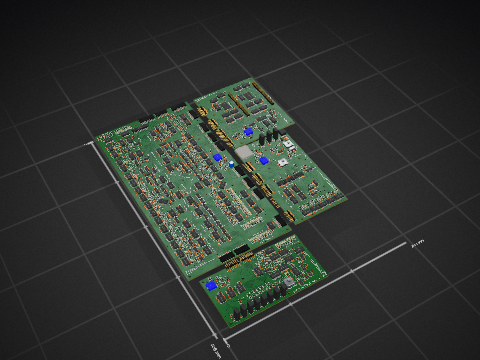
- 2 layers41.9 × 33.6 mm

Sk002-input clamp
mirdej/synkie
The Synkie is a modular open source analog video processor, developed by Michael Egger, Max Egger and Flo Kaufmann
49 parts47 - 4 layers41.9 × 98.4 mm

Sk101-inAndOut
mirdej/synkie
The Synkie is a modular open source analog video processor, developed by Michael Egger, Max Egger and Flo Kaufmann
124 parts47 - 4 layers50.2 × 69.8 mm

Zx50 Clock Mezzanine RevC
mmosko/Zx50
This is the primary CPU board for the Zx50 8-slot passive backplane system. It hosts the Z80 microprocessor (running at 5 MHz to 10 MHz) and acts as the master controller for the primary bus.
40 parts - 4 layers166 × 317 mm

- 4 layers93 × 171 mm

- 4 layers153 × 81 mm

- 4 layers116 × 135 mm

Parts like it
8HEC4013BT/C118
--40℃~+125℃ 1 2 3.4mA 3.4mA 3V~15V 4000B Series 40MHz 4uA 60ns@15V,50pF 7.5pF Complementary type D-Type Rising Edge Set and Reset - Flip Flops ROHSNexperiaFlip FlopsHEC4013BT/C4118
--40℃~+125℃ 1 2 3.4mA 3.4mA 3V~15V 4000B Series 40MHz 4uA 60ns@15V,50pF 7.5pF Complementary type D-Type Rising Edge Set and Reset - Flip Flops ROHSNexperiaFlip FlopsHEC4013BT/C5J
--40℃~+125℃ 0ns 1 2 3.4mA 3.4mA 3V~15V 4000B Series 40MHz 4uA 5ns 60ns@15V,50pF 7.5pF Asynchronous Complementary D-Type Rising Edge Set and Reset - Flip Flops ROHSNexperiaFlip FlopsHEF4013BT-Q100118
--40℃~+125℃ 1、1 2 3.4mA 3.4mA 30ns@15V,50pF 3V~15V 40MHz 4uA 7.5pF Asynchronous D-Type Rising Edge Set and Reset - Flip Flops ROHSNexperiaFlip FlopsHEF4013BT/C118
--40℃~+125℃ 0ns、0ns、5ns 1 15ns、20ns、25ns 2 30ns@15V,50pF 3V~15V 4.2mA 4.2mA 40MHz 4uA 7.5pF Asynchronous Complementary type D-Type Rising Edge Set and Reset - Flip Flops ROHSNexperiaFlip FlopsHEF4013BT/S200118
--40℃~+125℃ 0ns 1、1 2 20ns 3.4mA 3.4mA 30ns@15V,50pF 3V~15V 40MHz 4uA 7.5pF Asynchronous Complementary type D-Type HEF4013B Rising Edge Set and Reset - Flip Flops ROHSNexperiaFlip FlopsHEF4013BT/S400118
--40℃~+125℃ 0ns 15ns 1、1 2 30ns@15V,50pF 3V~15V 4.2mA 4.2mA 40MHz 4uA 7.5pF Asynchronous Complementary type D-Type Rising Edge Set and Reset - Flip Flops ROHSNexperiaFlip FlopsHEF4013BT/S705118
--40℃~+125℃ 0ns 1 2 3.4mA 3.4mA 30ns@15V,50pF 3V~15V 40MHz 4uA 5ns 7.5pF Asynchronous Complementary type D-Type HEF4013B Rising Edge Set and Reset - Flip Flops ROHSNexperiaFlip Flops
Questions
Is there a KiCad symbol and footprint for the SN74AHC74DRE4?
Yes. The symbol is EasyEDA_Cloud:SN74AC74N and the footprint EasyEDA_Cloud:SOIC-14_L8.7-W3.9-P1.27-LS6.0-BL, both drawn on this page. PCBKit places them on a board for you when you design with it.
Where can I order the SN74AHC74DRE4?
JLCPCB lists it as part C22305123, with 0 in stock; the sellers' links on this page open their listings.
What can replace the SN74AHC74DRE4?
Parts like it in the library: the HEC4013BT/C118 by Nexperia, the HEC4013BT/C4118 by Nexperia, the HEC4013BT/C5J by Nexperia and the HEF4013BT-Q100118 by Nexperia. Check their datasheets: a part that fits the footprint may still differ in its ratings.
Which open-source boards use the SN74AHC74DRE4?
8 boards in 3 repositories on GitHub; the most starred are listed on this page, with their KiCad files.