2 layers32 × 29 mm
Node
cUDGk/vrc-fbt-hardware
VRChat向けフルボディトラッキング基板 — ハブ+デイジーチェーン端末・数と位置を自由に変更可能・KiCad/OpenSCAD一式
25 parts

 zhixuan2333/buffering_cat
Open-source CH32V003 LED cat hardware, firmware, and WebHID updater
Buffering cat is an open-source printed circuit board by zhixuan2333, from the zhixuan2333/buffering_cat repository on GitHub, published under the MIT licence. It is a 2-layer board of 48 × 79.6 mm with 22 parts on 30 nets, routed with 233 tracks and 54 vias.
It is built around the CH32V003F4P6, ME6211C33M5G-N and USBLC6-2SC6. Its parts include 8 diodes, 5 resistors, 3 ICs, 2 capacitors and 2 connectors. It belongs with the RISC-V boards of this library.


Buffering Cat is a tiny USB status light built around the WCH CH32V003. Eight LEDs form a ring around a cat face and can be controlled from the browser, the Rust CLI, or lightweight Codex/ChatGPT activity hooks.
The repository contains the complete KiCad design, firmware, host tools, and a WebHID controller with browser-based firmware updates.
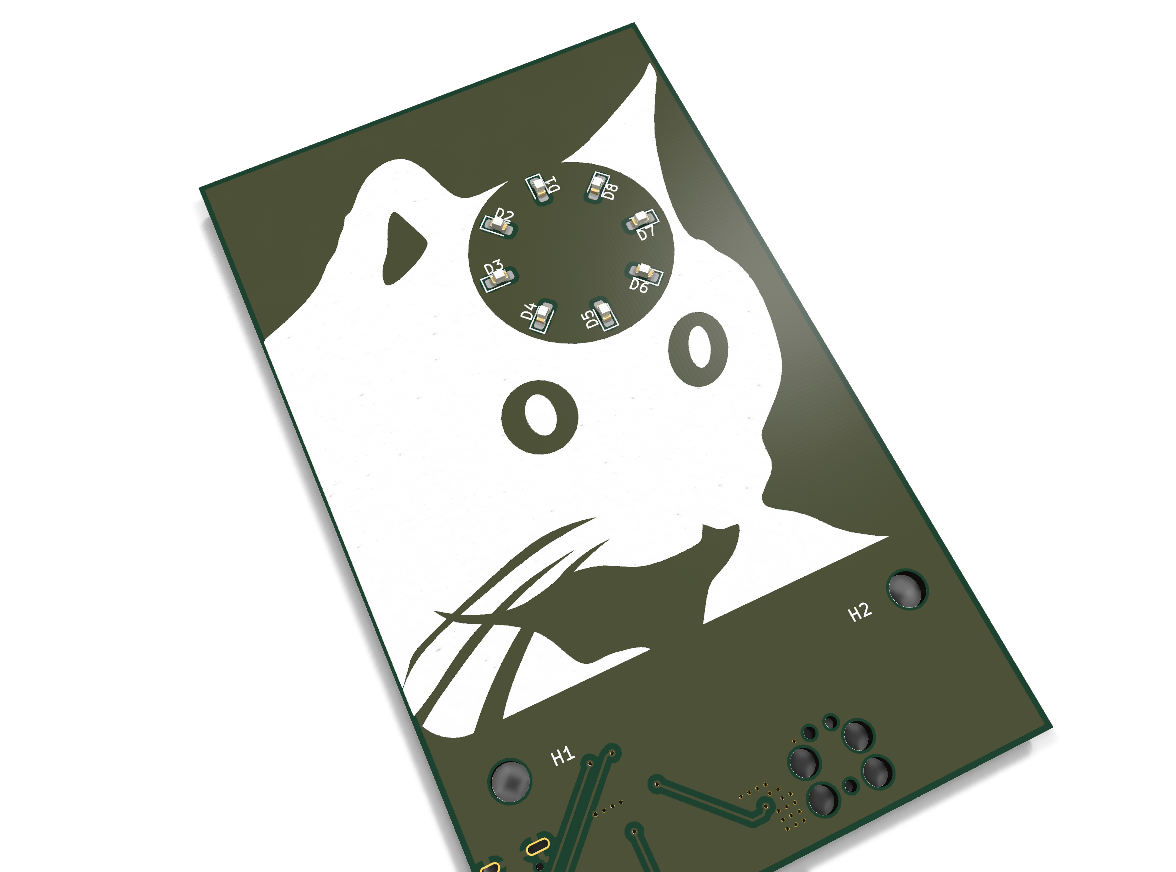
buffering_cat.kicad_sch and
buffering_cat.kicad_pcb: current hardware v1.1firmware/: CH32V003 application and one-time USB HID
bootloaderhost/: native Rust command-line controllerwebhid/: Chrome/Edge controller and firmware updaterintegrations/: token-free Codex/ChatGPT activity
hooksGenerated fabrication files, KiCad backups, editor state, build products, dependencies, and tool caches are intentionally excluded from Git.
| Revision | LED matrix GPIO | USB GPIO | Notes |
|---|---|---|---|
| v1.0 | PA1/PD4/PA2 × PD0/PC7/PC0 | PD3=D+, PD2=D- | Original 3×3 matrix; A2/C2 share a node and can ghost |
| v1.1 | PC0/PD4/PC1/PA1 × PC2/PA2 | PD3=D+, PD2=D-, PD0=DPU | Current KiCad 4×2 matrix; PD0 drives R5 (1.5 kΩ) |
On v1.0, D1 is at the left and D2–D8 continue counter-clockwise. Starting with v1.1, D1 is at the top and D2–D8 continue counter-clockwise. Select the matching hardware revision when building or updating; a build for the wrong revision will drive the wrong GPIOs.
GitHub Actions builds application images for both v1.0 and v1.1, the common USB bootloader, and native Rust controller binaries for Linux, macOS, and Windows on both x86_64 and ARM64.
main that changes firmware creates a prerelease whose tag is the
first eight characters of the Git commit hash. GitHub rejects tag names made
of exactly 40 hexadecimal characters, so a full SHA cannot be used directly.vX.Y.Z version and
publishes it as the latest stable release..bin files, the one-time bootloader, six native
CLI archives, firmware-manifest.json, and SHA256SUMS.The application embeds the release version, Git hash, hardware revision, and
HID protocol version. buffering-cat status and the web controller expose the
machine-readable hardware/hash fields.
Install buffering-cat-usb-bootloader.bin once with WCH-Link. After that, open
the WebHID site in current Chrome or Edge, select the hardware revision and
release, reboot the device to updater mode, and install directly in the
browser. A local .bin can be selected when testing an unreleased build.
On connection, the site automatically detects the hardware revision and
firmware commit. It also resolves and selects the matching vX.Y.Z GitHub
Release when one exists.
The Rust CLI remains available as a recovery/update path:
buffering-cat bootloader
buffering-cat flash-usb buffering-cat-v1.1-v1.2.3.bin
The web controller is a serverless static export intended for self-deployment
to Cloudflare Pages. Use webhid as the project root and out as the build
output directory; no OpenAI/ChatGPT hosting integration is included.
make -C firmware HARDWARE_REV=10
make -C firmware clean
make -C firmware HARDWARE_REV=11
cargo test --manifest-path host/Cargo.toml
npm --prefix webhid test
The firmware Makefile expects sibling ch32fun and rv003usb checkouts by
default; see firmware/README.md for path overrides.
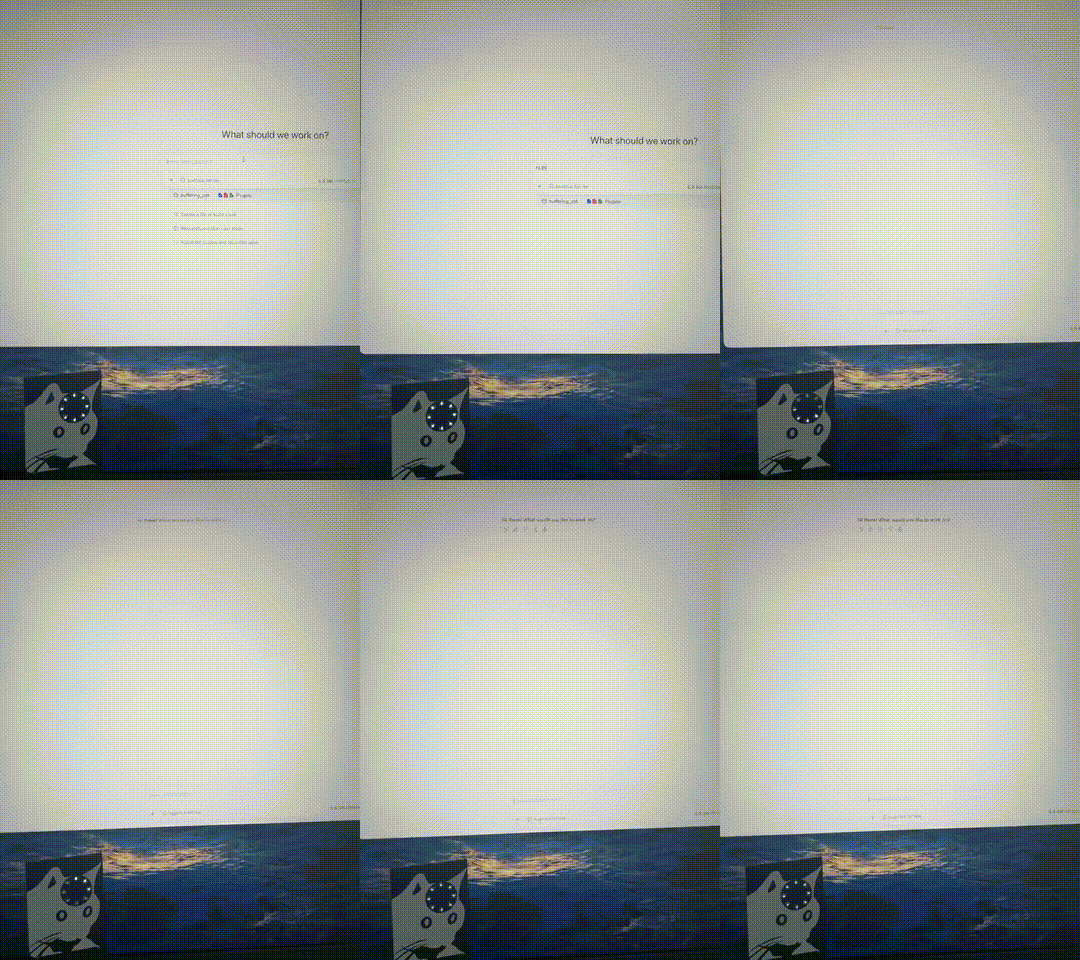
Watch or download the video (MP4) · View the original post on X
MIT. See LICENSE.
| Qty | Value | Footprint | References |
|---|---|---|---|
| 8 | LED_45deg | LED_SMD:LED_0603_1608Metric_Pad1.05x0.95mm_HandSolder | D1, D2, D3, D4, D5, D6, D7, D8 |
| 2 | 1u | Capacitor_SMD:C_0603_1608Metric | C1, C2 |
| 2 | 5.1k | Resistor_SMD:R_0603_1608Metric | R1, R2 |
| 2 | MountingHole | MountingHole:MountingHole_3.2mm_M3 | H1, H2 |
| 2 | R | Resistor_SMD:R_0603_1608Metric_Pad0.98x0.95mm_HandSolder | R3, R4 |
| 1 | 1.5k | Resistor_SMD:R_0603_1608Metric | R5 |
| 1 | CH32V003F4P6 | Package_SO:TSSOP-20_4.4x6.5mm_P0.65mm | U3 |
| 1 | Conn_ARM_SWD_TagConnect_TC2030 | Connector:Tag-Connect_TC2030-IDC-FP_2x03_P1.27mm_Vertical | J2 |
| 1 | ME6211C33M5 | Package_TO_SOT_SMD:SOT-23-5 | U2 |
| 1 | USBLC6-2SC6 | Package_TO_SOT_SMD:SOT-23-6 | U1 |
| 1 | USB_C_Receptacle_USB2.0_16P | Connector_USB:USB_C_Receptacle_Palconn_UTC16-G | J1 |
cUDGk/vrc-fbt-hardware
VRChat向けフルボディトラッキング基板 — ハブ+デイジーチェーン端末・数と位置を自由に変更可能・KiCad/OpenSCAD一式

slopus/codex-keybored
A 100% vibe-coded hardware build: Fusion 360, six-layer KiCad PCB, STM32 firmware, and live JLC factory handoff.

GuzziFlipFlops/ESP32-Walkie-Talkie
An open source ESPNOW based walkie talkie with a 600 meter tested distance, with an OLED and multiple buttons to interact with

cornim/comfospot50
The schematic and PCB in this directory are the project-authored controller board design. The board is intended to interface an ESP32-C3 with the existing ComfoSpot panel.

dcbokonon/darknet-smao
Darknet SMAO: Meshtastic LoRa+BLE mesh node SAO for DEF CON 34

makerspacelt/esp-flasher
This is ESP8266 modular flasher based on CH340 usb uart converter and USB-C port.


It measures 48 × 79.6 mm and has 2 copper layers, 1.6 mm thick.
22 parts, built around the CH32V003F4P6, ME6211C33M5G-N and USBLC6-2SC6. The full list of its parts is on this page, with links to each part's symbol and footprint where PCBKit's library has them.
From the zhixuan2333/buffering_cat repository on GitHub, at the commit this page was made from: the board is buffering_cat.kicad_pcb and its schematic buffering_cat.kicad_sch. PCBKit opens the board in the browser, with nothing to install.
Its repository publishes it under the MIT licence: you may reuse it on that licence's terms (keep the author's notice, and for a copyleft licence share your changes alike).