
2 layers229.5 × 95.1 mm
Sweep high
davidphilipbarr/Sweep
Sweep - a small promicro based keyboard inspired by the Ferris.
55 parts2.1k

 zakqwy/NeuroBytes14
Previous repo for NeuroBytes, an open-source hardware neuron simulator created by NeuroTinker, LLC. See https://github.com/neurotinker for the current platform.
NeuroBytes v091 is an open-source printed circuit board by zakqwy, from the zakqwy/NeuroBytes repository on GitHub, published under the GPL-3.0 licence. It is a 2-layer board of 56.4 × 30.9 mm with 55 parts on 31 nets, routed with 797 tracks and 41 vias.
It is built around the ATTINY88-MMH. Its parts include 8 resistors, 7 connectors, 5 capacitors, 2 ICs and 2 diodes. It belongs with the AVR (ATmega, ATtiny) boards of this library.
This repository is no longer actively maintained or current. This clean break helped us do many things, such as:
Official repo for NeuroBytes, an open-source hardware neuron simulator created by NeuroTinker, LLC. An exhuastive history of the project can be found at https://hackaday.io/project/3339-neurobytes, while more information on the company and people behind the project can be found at https://www.neurotinker.com. A good source for up-to-date and interesting pictures are the various NeuroTinker social media accounts: https://www.instagram.com/neurotinker, https://www.twitter.com/neurotinker, and https://www.facebook.com/neurotinker.
NeuroBytes were created to bridge the gap between middle- and high-school biology classes and postsecondary neuroscience education. We believe that a hands-on, modular, free-form tool in the spirit of LEGO, littleBits, or SnapCircuits that uniquely focuses on core neuroscience principles can connect engineering and biology concepts and ultimately improve STEM/STEAM retention rates for students as they pursue higher education. Our company's history goes back to 2012 and work done independently by Andrew Salveson (an architect) and Joe Burdo (a neuroscientist). After Zach Fredin created the first few generations of hardware simulators in 2014, Joe and Zach found each other via Hackaday.io and decided to collaborate on the project. In 2016, we were awarded a Phase I SBIR grant from the National Science Foundation and continue to work full-time on the project. NeuroBytes are not yet available for commercial sale, but we have sold a number of prototype kits to educators and students at a wide variety of levels and are always interested in collaborations. The project's creators can be easily reached via email: joe[at]neurotinker[dot]com and zach[at]neurotinker[dot]com.
All hardware files can be found under the /HARDWARE folder in this repository. The NeuroBytes boards, currently in version 0.91, were designed in KiCad v4.x. Various custom schematic symbols and PCB footprints were used, which are included in ZF.lib. The board outline itself along with the copper layer NeuroTinker logo were modified and redied for KiCad use using Inkscape and Gimp; various files titled v091-logo.xxx and v091_outline.xxx are included in the repo and were used in this process. Note that the NeuroTinker logo is a registered trademark of NeuroTinker, LLC and cannot be used without explicit permission from the company. Having said that, we urge interested parties to build and commercially sell electronic neuron simulators and accessories based on the NeuroBytes platform, keeping in mind the requirements outlined under our chosen license (GPLv3).
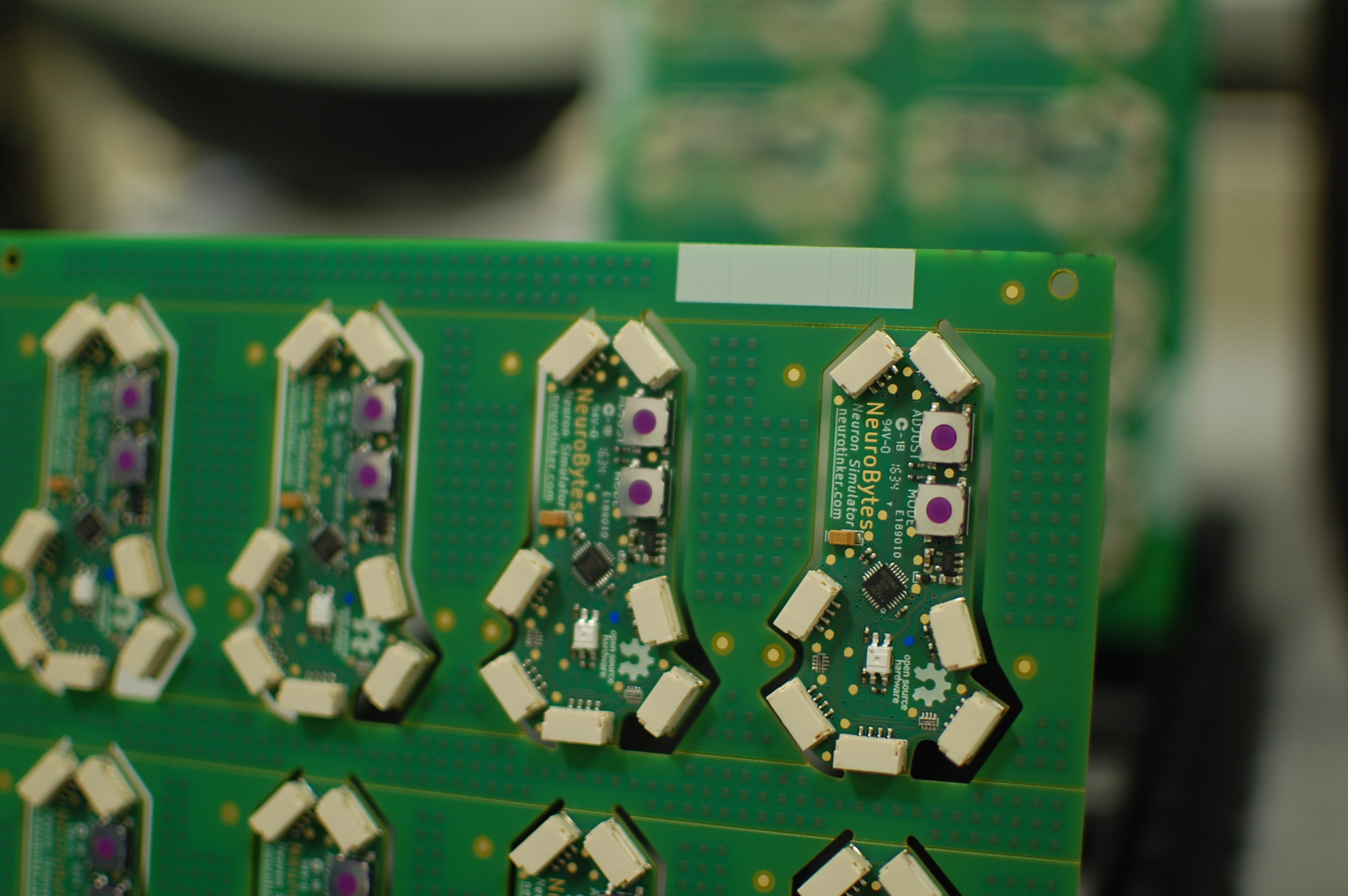
All firmware files can be found under the /FIRMWARE folder in this repository. NeuroBytes (at least v0.91) are based around the ATtiny88 platform and programmed in AVR-C using the avrdude/gcc toolchain and an Adafruit USBtinyISP programmer. Each runtime program is standalone in its folder, including a suitable Makefile that configures the proper microcontroller fuses. As expected, the test_LED program just lights the RGB LED white to test a few connections; the v091_run-iaf (stands for "integrate-and-fire") folder holds the latest firmware iteration, and includes an operating mode for direct servo control (hold the 'mode' switch down for a few seconds to change this). As with any pre-commercial work-in-progress, the firmware will be changing rapidly but any code in this repo has been thoroughly tested (so let us know if it doesn't work).
| Qty | Value | Footprint | References |
|---|---|---|---|
| 22 | Test Point | KiCad_Footprints:ZF_CONN_1-2_pad | TP10, TP11, TP12, TP13, TP14, TP15, TP16, TP17, TP18, TP19, TP20, TP21, TP22, TP23, TP24, TP25 +6 |
| 7 | JST GH 4-position | KiCad_Footprints:ZF_CONN_JST_GH | P1, P2, P3, P4, P5, P28, P29 |
| 5 | 10k | KiCad_Footprints:ZF_SMD_NonPol_0402 | R4, R5, R6, R7, R8 |
| 2 | 100 | KiCad_Footprints:ZF_SMD_NonPol_0402 | R2, R3 |
| 2 | 100 nF | KiCad_Footprints:ZF_SMD_NonPol_0402 | C2, C4 |
| 2 | 10k (x4) | KiCad_Footprints:ZF_RN_4iso_CTS-0804 | RP1, RP2 |
| 2 | SW_PUSH | KiCad_Footprints:ZF_SW_Momentary_KSEM31J | SW1, SW2 |
| 1 | 1 uF | KiCad_Footprints:ZF_SMD_NonPol_0603 | C3 |
| 1 | 10 uF | KiCad_Footprints:ZF_SMD_pol_1206 | C1 |
| 1 | 150 | KiCad_Footprints:ZF_SMD_NonPol_0402 | R1 |
| 1 | 2.2 uF | KiCad_Footprints:ZF_SMD_NonPol_0603 | C5 |
| 1 | ATTINY88-MM | KiCad_Footprints:ZF_IC_VQFN28-045 | IC2 |
| 1 | D_Schottky | KiCad_Footprints:ZF_SMD_pol_SC79 | D2 |
| 1 | LD2980ABM50TR | KiCad_Footprints:ZF_SOT23-5L | IC1 |
| 1 | LOGO | NeuroBytes-v09:v09-logo-fmask | G*** |
| 1 | LOGO | NeuroBytes-v09:v09-logo-fcu | G*** |
| 1 | LOGO | NeuroBytes-v091:oshw | G*** |
| 1 | RGB LED CA | KiCad_Footprints:ZF_LED_RGB_SunLED_XZMDKCBDDG45S-9 | D1 |
The 53 most common of 55 parts.
It measures 56.4 × 30.9 mm and has 2 copper layers, 1.6 mm thick.
55 parts, built around the ATTINY88-MMH. The full list of its parts is on this page, with links to each part's symbol and footprint where PCBKit's library has them.
From the zakqwy/NeuroBytes repository on GitHub, at the commit this page was made from: the board is HARDWARE/NeuroBytes-v091.kicad_pcb. PCBKit opens the board in the browser, with nothing to install.
Its repository publishes it under the GPL-3.0 licence: you may reuse it on that licence's terms (keep the author's notice, and for a copyleft licence share your changes alike).
davidphilipbarr/Sweep
Sweep - a small promicro based keyboard inspired by the Ferris.

VoronDesign/Voron-Hardware
Cool Hardware designed by the Voron Design group

hackclub/OnBoard
💡 Join 1,000 teenagers and make your first PCB with a $100 grant!

lever-tech/flake
An open-source, wireless, split ergonomic keyboard designed to be productive, healthy, and enjoyable. [formerly Anywhy Flake]

jes/scamp-cpu
A homebrew 16-bit CPU with a homebrew Unix-like-ish operating system.

CRImier/MyKiCad
My KiCad boards. Can't be bothered uploading individually anymore, so here you go.

rgoulter/keyboard-labs
Repo with my PCB designs and keyboard firmware

dcpedit/dissatisfaction30
To get the PCB manufactured, upload dissat-pcb.zip to JLCPCB, select your desired PCB color while keeping all the other default options, and place your order (minimum 5).