2 layers182.9 × 172.7 mm

 yuburoll/yuwol10
row staggered 60% keyboard with reversible PCB, ilwol with little ergo boost
Yuwol is an open-source printed circuit board by yuburoll, from the yuburoll/yuwol repository on GitHub, published under the MIT licence. It is a 2-layer board of 172.9 × 123.3 mm with 120 parts on 64 nets, routed with 1,318 tracks and 137 vias.
Its parts include 66 switches, 40 diodes, 3 connectors and 1 IC. It belongs with the keyboards and input boards and the AVR (ATmega, ATtiny) boards of this library.
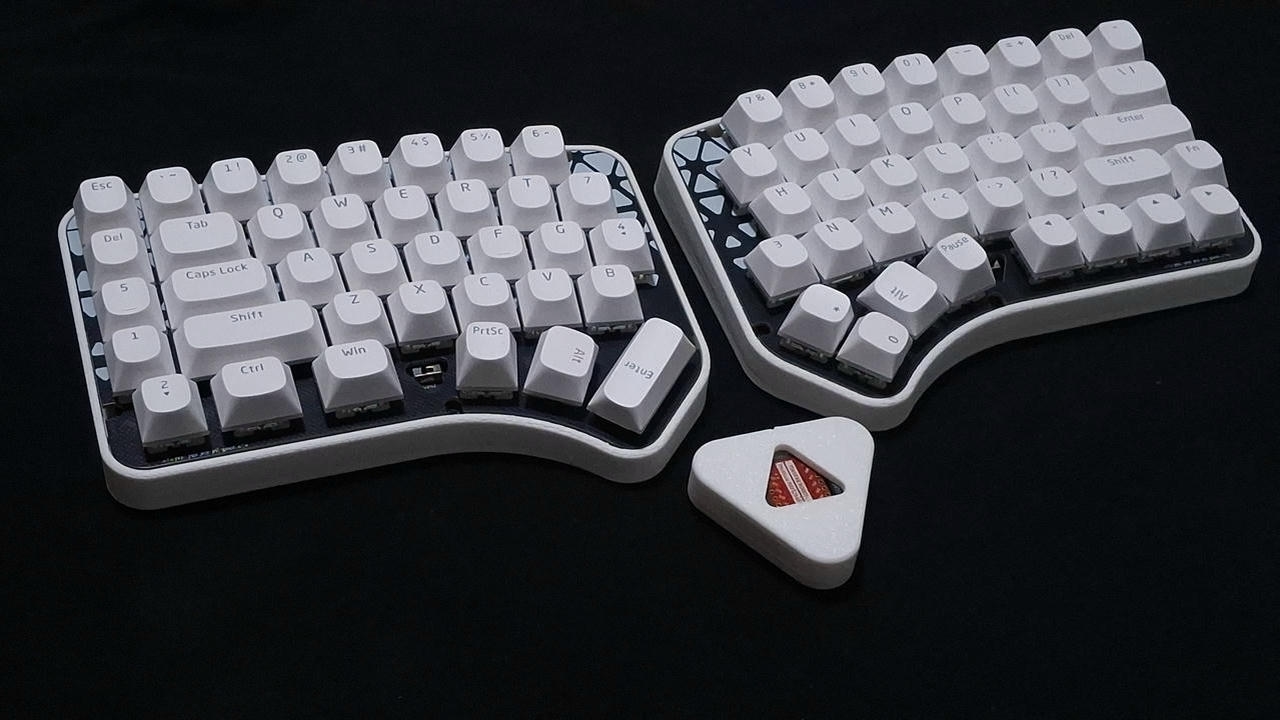
row staggered 60% hotswappable keyboard with reversible PCB, little ergo boost of ilwol
The name yuwol is June in Korean.
This keyboard has additional Y/H/B keys which positioned between keyboards, and auxilary row at left outside. You may put the keycaps from numpad.
This keyboard has hotswap-only PCB.
yuwol can change layout to followings:
Split left shift, to ISO shaped one.(2.25u to 1.25u/1u)
Split right shift, to HHKB inspired shape.(2.75u to 1.75u/1u)
Split outside thumb keys(2u to 1u/1u)
Split backspace(2u to 1u/1u)
Can use stepped caps lock
common:
2x yuwol PCB Boards, provided from the repo
1x printed case sets, 2 parts total, provided from the repo
1x 1.5-1.6T keyboard plate sets, 2 parts total, provided from the repo
80x diodes, normally 1N4148
84x Kailh hotswap sockets (or compatibles)
2x 4x4x1.5mm surface mount tact switches (optional, for dev boards without reset button)
1-6x PCB Mounted 2u Keyboard Stabilizers, normally 6
73-78x MX Keyswitches, normally 73
8x 10mm bumpon stickers
A set of Keycaps, Full-size layout, ANSI preferred.
for wired build:
2x pro micro form factor dev board
2x USB-C 6 pin jack, top mount
1x USB-C data cable
10x M2x6 screws / or M2x3x3 heat inserts and M2x6 bolts
for wireless build:
2x pro micro form factor dev board, with wireless chipset
2x 523450 battery, with molex picoblade 1.25mm pitch male, 2pin
2x molex picoblade 1.25mm pitch female, 2pin
2x SS-12D00 switches
2x battery cover, provided from the repo
14x M2x6 screws / or M2x3x3 heat inserts and M2x6 bolts
dongle:
1x pro micro form factor dev board, with wireless chipset
1x printed dongle case sets, 2 parts total, provided from the repo
2x M2x6 screws / or M2x3x3 heat inserts and M2x6 bolts
3x 10mm bumpon stickers
Screw: 1.5 pi mounting holes for screws
Insert: 3 pi mounting holes for heat inserts
there's some notices before the build:
You may solder all hotswaps before soldering the dev board.
Assemble dev board with 2.5mm height pin headers on back side, assume that components side are faced up.
Jump a jumper when it is left hand board.
all codes follow MIT license.
all designs and the hardware board follow CC BY-SA 4.0 license.
Markdown documents and photos in docs/images folder are copyrighted, all rights reserved. You can use it for fair use.
If you want to make a commercial product, it would be appreciated if you sponsor some bucks for me.
| Qty | Value | Footprint | References |
|---|---|---|---|
| 40 | D | yubuGadgetsFootpints:Diode_TH_SMD_REVERSIBLE | D1, D2, D10, D11, D12, D13, D14, D15, D16, D17, D18, D19, D20, D21, D22, D23 +24 |
| 38 | SW_Push | yubuGadgetsFootpints:MX_HotswapOneside_Via_Guided | SW10, SW10, SW17, SW17, SW18, SW19, SW19, SW20, SW20, SW21, SW21, SW22, SW22, SW23, SW23, SW24 +22 |
| 19 | SW_Push | yubuGadgetsFootpints:MX_Hotswap_FootprintPropertyFix_Guided | SW1, SW2, SW3, SW4, SW5, SW11, SW12, SW13, SW14, SW15, SW16, SW25, SW33, SW37, SW38, SW39 +3 |
| 4 | SW_Push | yubuGadgetsFootpints:MX_HotswapOnesideReverse_Via_Guided | SW1, SW18, SW26, SW26 |
| 2 | SW_Push | Button_Switch_SMD:SW_SPST_TL3342 | SW41, SW41 |
| 2 | SW_Push | yubuGadgetsFootpints:MX_HotswapReverse_FootprintPropertyFix_Guided | SW39, SW40 |
| 2 | TestPoint | TestPoint:TestPoint_THTPad_D1.5mm_Drill0.7mm | TP-1, TP-1 |
| 2 | TestPoint | TestPoint:TestPoint_THTPad_1.5x1.5mm_Drill0.7mm | TP+1, TP+1 |
| 2 | USB_C_Receptacle_PowerOnly_6P | Connector_USB:USB_C_Receptacle_GCT_USB4125-xx-x_6P_TopMnt_Horizontal | J1, J1 |
| 1 | Conn_01x02_Socket | yubuGadgetsFootpints:Molex_PicoBlade_53048-0210_1x02_P1.25mm_Horizontal_ReversibleThru | J2 |
| 1 | ProMicro | promicroReversiblePad:ProMicro_ReveribleThru_ComponentUp_OuterPad | U1 |
| 1 | SW_SPDT | yubuGadgetsFootpints:SW_SPDT_SS-12D00 | SW42 |
| 1 | SolderJumper_2_Open | Jumper:SolderJumper-2_P1.3mm_Open_TrianglePad1.0x1.5mm | JP1 |
The 115 most common of 120 parts.


BerkeleyHCI/PolymorphicBlocks
A Python-based hardware description language for PCBs for higher-level (block-diagram / system-architecture level) PCB design through libraries of directly reusable subcircuit generators.

oliviahanley/wren-keyboard
A split ergonomic keyboard with options for numpad, nav cluster, and more.


It measures 172.9 × 123.3 mm and has 2 copper layers, 1.6 mm thick.
120 parts. The full list of its parts is on this page, with links to each part's symbol and footprint where PCBKit's library has them.
From the yuburoll/yuwol repository on GitHub, at the commit this page was made from: the board is kicad/yuwol.kicad_pcb and its schematic kicad/yuwol.kicad_sch. PCBKit opens the board in the browser, with nothing to install.
Its repository publishes it under the MIT licence: you may reuse it on that licence's terms (keep the author's notice, and for a copyleft licence share your changes alike).