REFFER to ./input/readme.md first! REFFER to ./input/readme.md first! REFFER to ./input/readme.md first! REFFER to ./input/readme.md first! REFFER to ./input/readme.md first! REFFER to ./input/readme.md first!
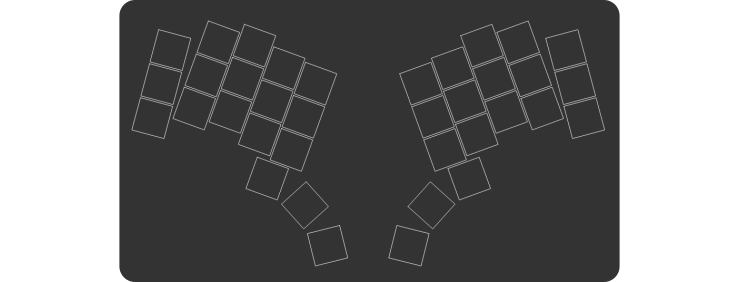
Thumb3 is an open-source printed circuit board by yangit, from the yangit/ergogen repository on GitHub, published under the MIT licence. It is a 2-layer board of 20 × 51 mm with 12 parts on 8 nets, routed with 31 tracks and 0 vias.
Its parts include 3 diodes and 3 switches.
README
README.md
Ergogen
text
Ergonomic Keyboard Generator
The project aims to provide a common configuration format to describe ergonomic 2D layouts and generate automatic plates, cases, as well as un-routed PCBs for them. The project grew out of (and is an integral part of) the Absolem keyboard, and shares its Discord server as well.
Getting Started
Until there's a proper "Getting started" guide, try getting acquainted with Ergogen by following these steps in order:
D'uuh.
They're not complete by any measure, but should give you a fairly good idea what you're dealing with here.
Try one of the web-based deployments.
The unofficial deployment is probably better, tbh, and will soon be replacing the official one.
Choose either one, then click things, look at outputs and see if things start to make sense.
There is no need for you to download the CLI unless you want to do one of the following:
There, you can look at (and reverse engineer) a variety of real life configs using Ergogen.
Pop them into the web UI to see what they do, tinker with them and things should start to make more sense.
If a question persists after all of the above, feel free to ask it over on Discord and we'll do our best to help you out.
Contributions
Feature ideas, documentation improvements, examples, tests, or pull requests welcome!
Get in touch on our Discord, and we can definitely find something you can help with, if you'd like to.
Parts
12
Qty
Value
Footprint
References
3
Kailh_socket_PG1350_no_silk
S1, S2, S3
3
D_SOD-523
D_SOD-523
D1, D2, D3
2
MountingHole_2.2mm_M2
H1, H2
1
JST_SH_SM05B-SRSS-TB_1x05-1MP_P1.00mm_Horizontal
JC1
1
Flactyl 5.0 (thumb3)
somelogo
T1
1
x
somelogo
T2
1
y
somelogo
T3
Questions
How big is the Thumb3 PCB?
It measures 20 × 51 mm and has 2 copper layers, 1.6 mm thick.
What parts does the Thumb3 use?
12 parts. The full list of its parts is on this page, with links to each part's symbol and footprint where PCBKit's library has them.
Where can I download the Thumb3 KiCad files?
From the yangit/ergogen repository on GitHub, at the commit this page was made from: the board is input/routed/thumb3.kicad_pcb and its schematic input/schema/left.kicad_sch. PCBKit opens the board in the browser, with nothing to install.
Can I use the Thumb3 design in my own project?
Its repository publishes it under the MIT licence: you may reuse it on that licence's terms (keep the author's notice, and for a copyleft licence share your changes alike).
REFFER to ./input/readme.md first! REFFER to ./input/readme.md first! REFFER to ./input/readme.md first! REFFER to ./input/readme.md first! REFFER to ./input/readme.md first! REFFER to ./input/readme.md first!
Tap is a nozzle-based z-probe for the V2 and Trident printer designs. The entire toolhead moves to trigger an optical switch. Tap offers many advantages: