


2 layers175 × 86 mm

 wenzellabs/bare_metal
bare_metal FPGA open source development board
Bare metal is an open-source printed circuit board by wenzellabs, from the wenzellabs/bare_metal repository on GitHub. It is a 4-layer board of 74.3 × 115.1 mm with 261 parts on 336 nets, routed with 2,635 tracks and 687 vias.
It is built around the ICE40UP5K-SG48ITR50, BD83070GWL-E2 and W25Q128JVSIQ, with the BQ24074RGTR, IP4234CZ6 and MIC5268-1.2BM5 among its other parts. Its parts include 136 diodes, 58 capacitors, 34 resistors, 10 ICs and 7 switches. It belongs with the FPGA and CPLD boards of this library.


bare metal is an FPGA development board - the ideal platform to get started with FPGAs and HDL of one or another sort. all open source.
you can buy bare_metal over at my little lectronz shop.
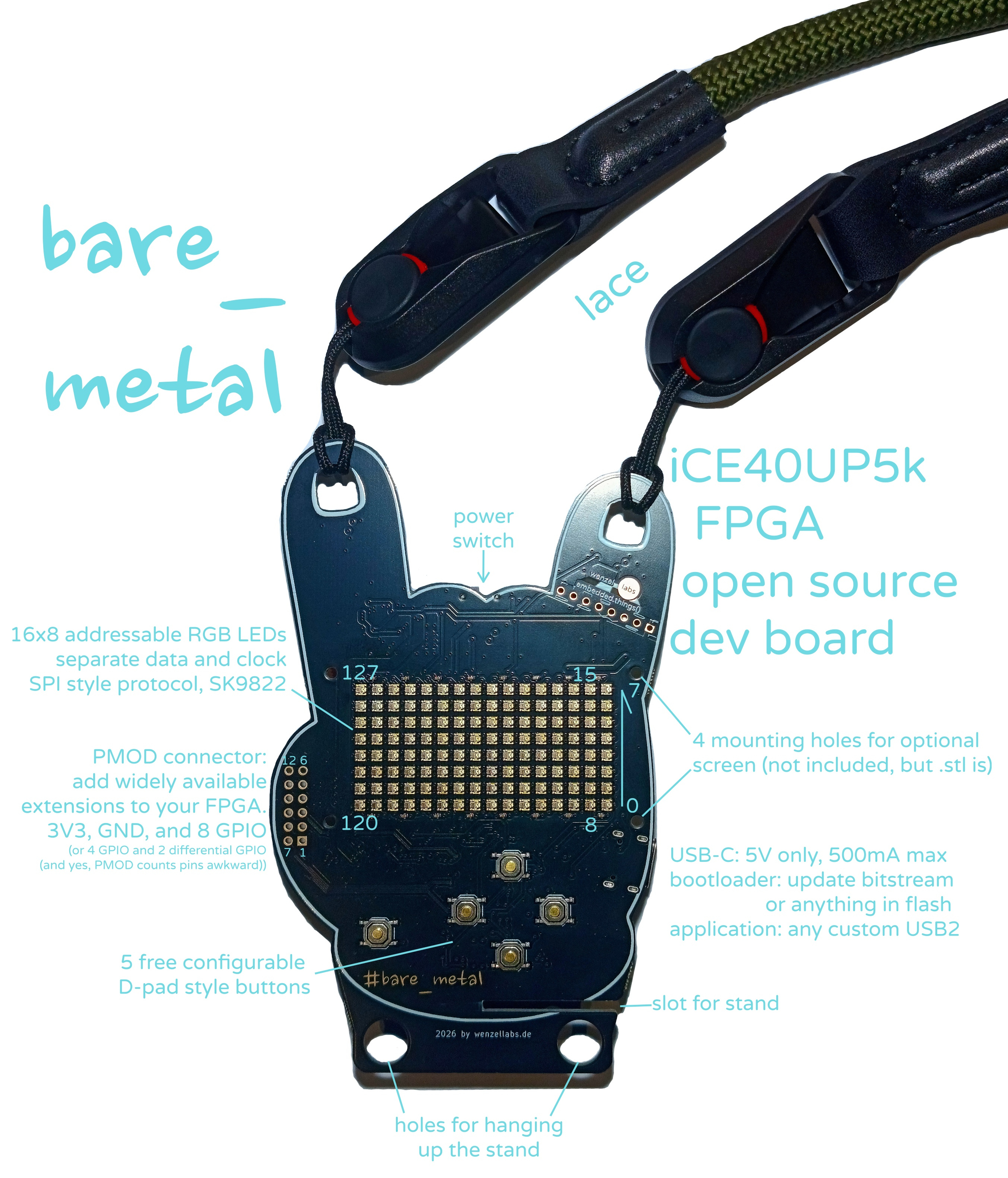
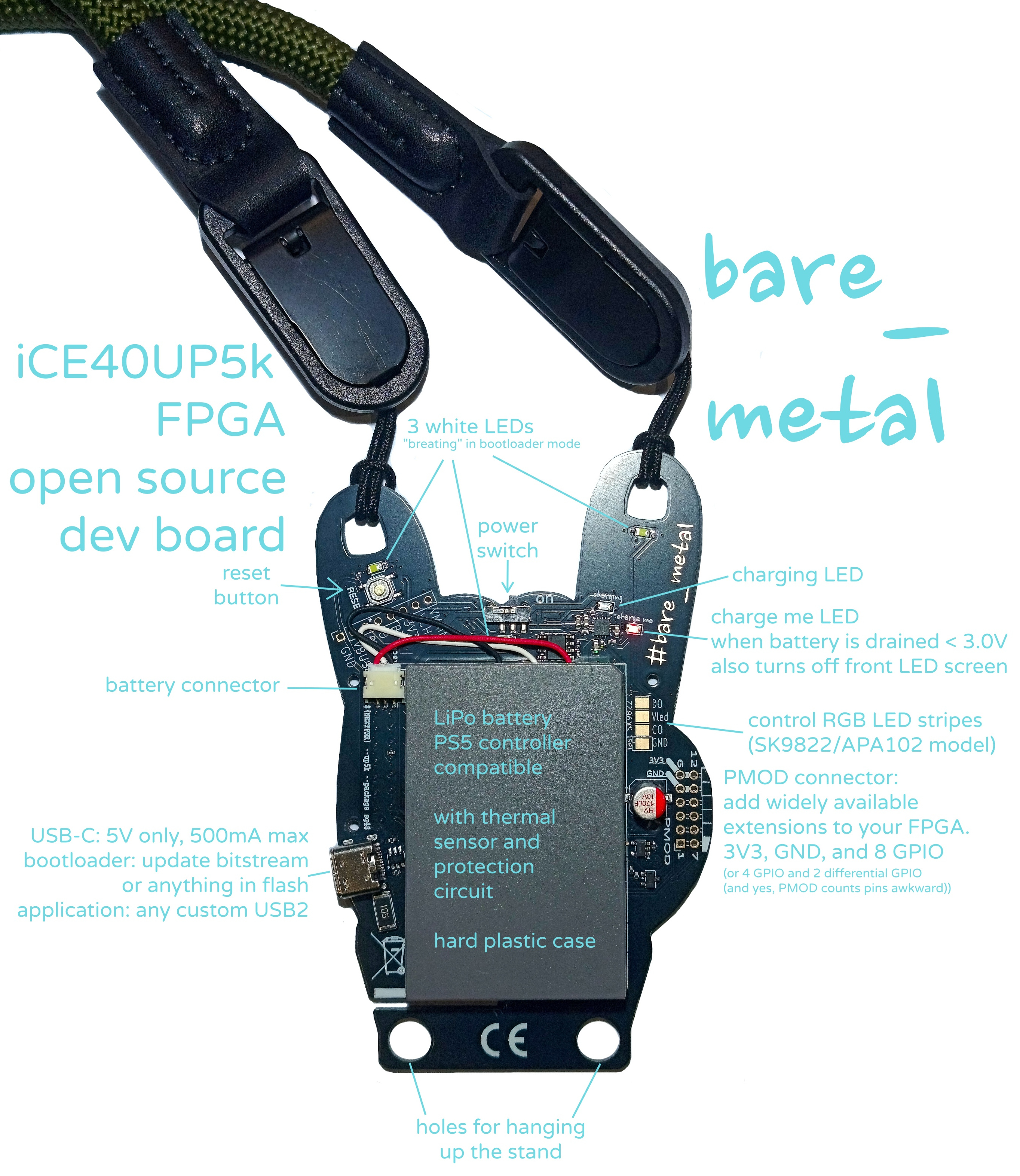
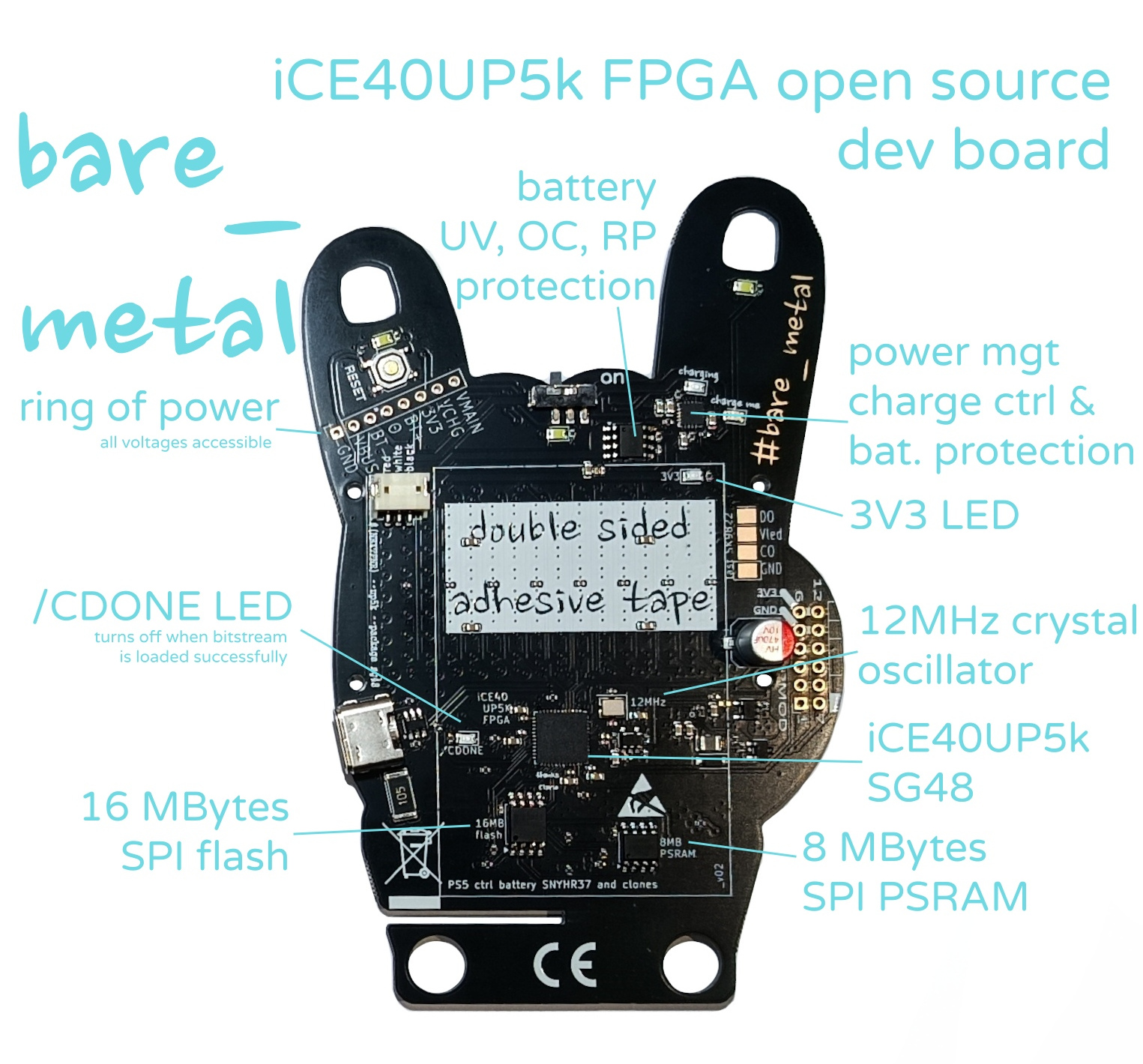
bare_metal, the opensource FPGA development board:
bootloader belowsee the hardware directory. find the schematics, the KiCad sources and some nice renderings.
here's a memory map of the SPI flash:
# 0x000_0000 - 0x000_009f =160b, multiboot header, slot table
# 0x000_00a0 - 0x001_efff ~124kB, slot 0, bare_metal_bootloader
# 0x001_f000 - 0x001_ffff =4kB, bootmetadata
# 0x002_0000 - 0x003_ffff =128kB, slot 1, user bitstream, hackerstacker_demo by default
# 0x004_0000 - 0x005_ffff =128kB, slot 2, another bitstream, transputers anyone?
# 0x006_0000 - 0x007_ffff ~128kB, slot 3, yab, hooray for transputers!
# 0x008_0000 - 0x100_0000 ~15.5MB, user data, images, fonts, text, sounds, videos etc# in hackerstacker_demo, we reserve the first 512 KB for bootloader and bitstreams,
# and use the rest for user data:
# 0x008_0000 - 0x008_ffff = 64 kB, font data
# 0x009_0000 - 0x009_ffff = 64 kB, game data
# 0x00a_0000 - 0x00a_ffff = 64 kB, nick names
# 0x00b_0000 - 0x0ff_ffff = ~15.3MB images, videothe bootloader is always started after power up or reset. it lives in slot0 of the four default bitstream slots.
the bootloader is forked from https://github.com/tinyfpga/TinyFPGA-Bootloader which looks unmaintained nowadays. we forked, and implement our bootloader and the tinyprog flashing tool at https://codeberg.org/wenzellabs/bare_metal_bootloader
                   [-----------][----------][----------]
                   [ user bit- ][ user bit-][ user bit-]
                   [ stream 1  ][ stream 2 ][ stream 3 ]
                   [           ][          ][          ]
                   [===========][==========][==========]
                   [-----------------------------------]
                   [    USB-bootloader bitstream 0     ]
                   [===================================]
               [-------------------------------------------]
               [ iCE40-up5k-sg48 FPGA, 5k LCs, DSP fn()s   ]
               [===========================================]
[-----]    [----------------------------------------------------]    [---------------]
[ USB ]----[ bare_metal, buttons, batt., LEDs, RGB-display, PMOD]----[PMOD extensions]
[=====]    [====================================================]    [===============]
the bootloader animates the three white LEDs index, middle and pinky. if the bootloader detects a host PC (if it gets USB enumerated) it stays in the bootloader and creates a cdc_acm /dev/ttyACM0 that can be used in conjunction with tinyprog to flash user bitstreams into slot1, slot2 or slot3, or any other flash content.
if no host PC is detected the bootloader "jumps" to the user bitstream in slot1.
stay in bootloader although there's no host PC:
jump to slot1 user bitstrem although we're connected to a host PC:
jump to slot2 user bitstrem although we're connected to a host PC:
jump to slot3 user bitstrem although we're connected to a host PC:
by default the first user bitstream in slot1 is hackerstacker_demo, that has various modes, which can be advanced by a long btn_ok press.
modes:
the texts, fonts and images live in the SPI flash aside from the bitstream, so they can be replaced or extended without re-synthesizing the bitstream. see the hackerstacker_demo directory and there the make targets
make flash-nick # see nick.txt first!
make flash-font
make flash-image # see image.txt first!reach it by pressing btn_left while powerup/reset.
by default the second user bitstream in slot2 is julia. it renders a julia set, and loops:
the up/down/left/right control the complex coordinate C of the julia set being rendered.
the OK button changes the palette.
reach it by pressing btn_right while powerup/reset.
for now the default third user bitstream in slot3 is psram_probe, just a production PSRAM test. lights up one LED in green per pass.
I hope to get some small spade demo, looking at you @TheZoq2.
a PS5 controller compatible battery similar to SNYHR37. 2500 mAh, 1S. the little plasic box is a nice feature to protect the pouch cell from stabbing you and vice versa.
there's a current limit of 500mA in place. no USB-PD, just 5V.
the data pins are usable and available for creating any USB2 devices. the board has no dedicated USB-HW (aside from ESD protection) but anything can be implemented in the FPGA, just as the bootloader does. related pins:
# USB
set_io -nowarn usbp         42    # IOT_51a  - USB D+
set_io -nowarn usbn         38    # IOT_50b  - USB D-
set_io -nowarn usb_det 37 # IOT_36b - USB_DET, active-high enables 1k5 pull-up on D+we turn the screen off at around 3V battery voltage to notify the user that she needs a power up. there's also a red charge me LED that indicates this state.
at 2.5V a hard battery protection kicks in, and everything is switched off, until charging via USB-C again.
there's also a overvoltage and overcurrent protection and thermal monitoring in place.
bare_metal wears a little ring at it's pinky, the ring of power.
here all various important voltages are accessible:
it's a Lattice iCE40 UP5K in a SG48 package
it's all in the examples and printed on the stand, but for completenes here's a PCF:
# bare_metal
# iCE40UP5K SG48 (QFN 48)

# this is a complete bare_metal pin definition
# you may use for your designs

# 12 MHz crystal oscillator (dedicated clock pad)
set_io -nowarn clk_12M      35    # IOT_46b_G0

# USB
set_io -nowarn usbp         42    # IOT_51a  - USB D+
set_io -nowarn usbn         38    # IOT_50b  - USB D-
set_io -nowarn usb_det      37    # IOT_36b  - USB_DET, active-high enables 1k5 pull-up on D+

# buttons
set_io -nowarn btn_ok       23    # IOT_37a
set_io -nowarn btn_up       45    # IOB_5b
set_io -nowarn btn_down     11    # IOB_20a
set_io -nowarn btn_left     44    # IOB_3b_G6
set_io -nowarn btn_right    10    # IOB_18a

# LED indicators - three white LEDs, low active
set_io -nowarn led_index    39    # white_index
set_io -nowarn led_middle 40 # white_middlethe stand can serve multiple purposes
it conveniently lists all PMOD and all other pins.
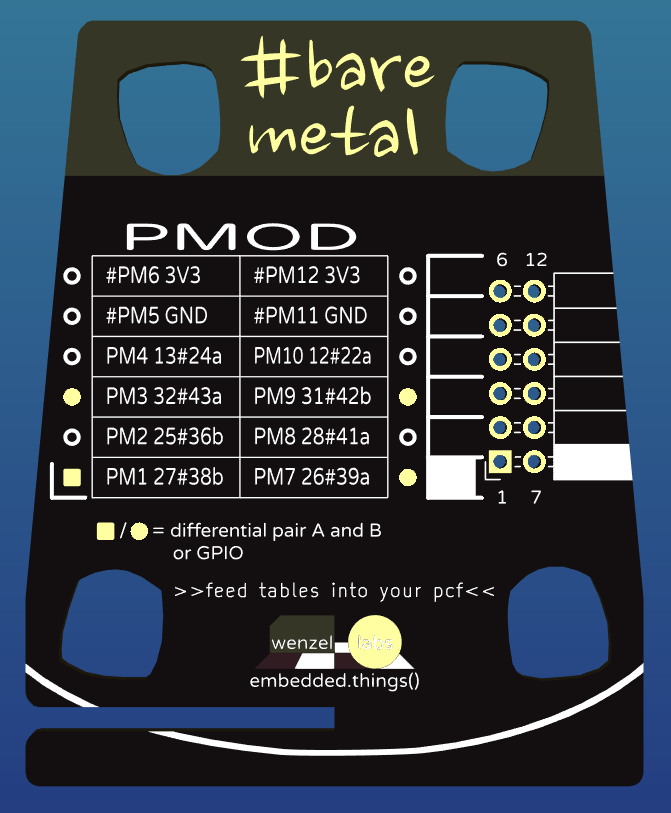
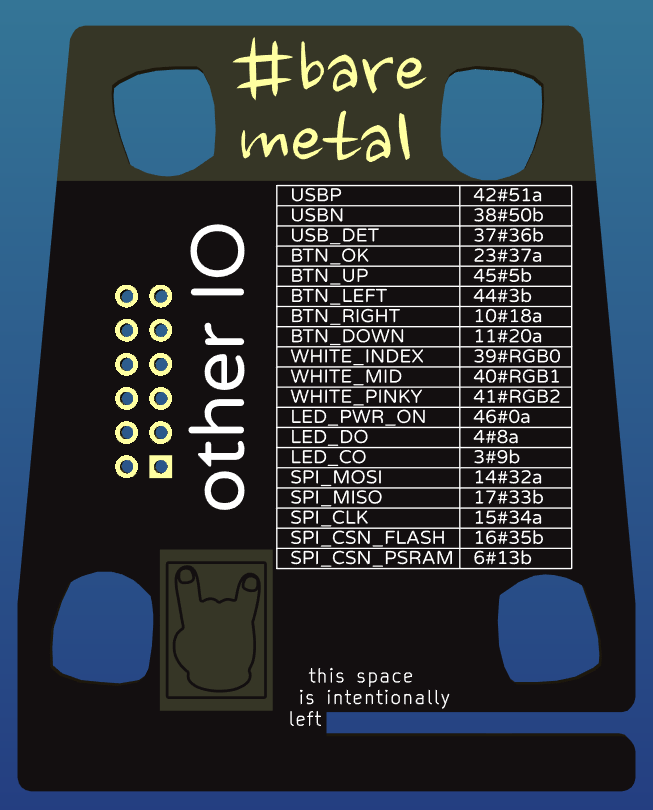
use it to display the bare_metal board, by sliding the two slots into each other.
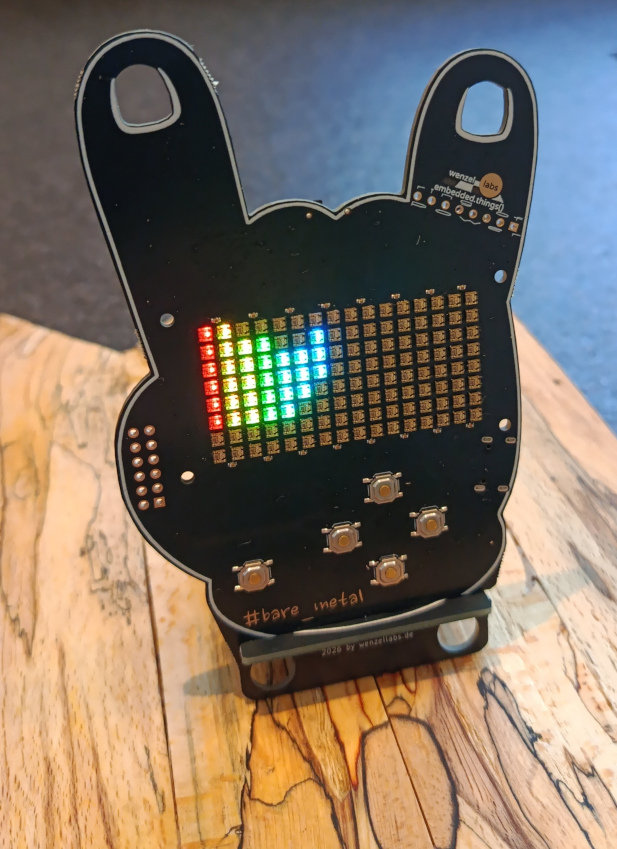
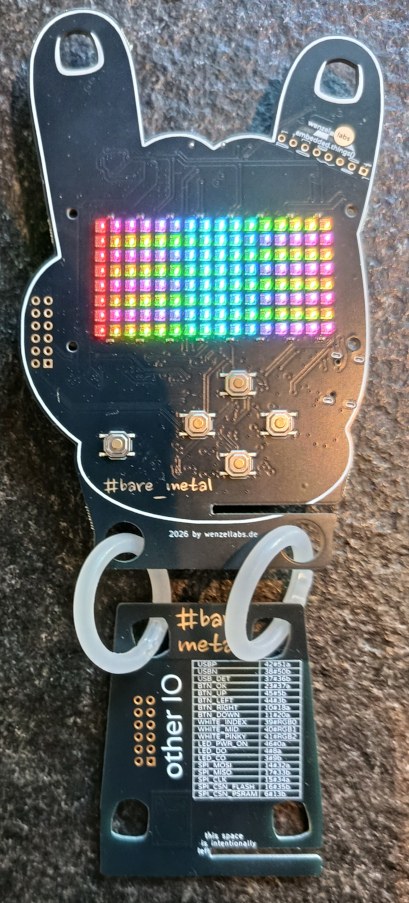
or when hanging the bare_metal around your neck (or elsewhere) you can hang the stand into the bottom holes, the stand then mimicks a sleeve.
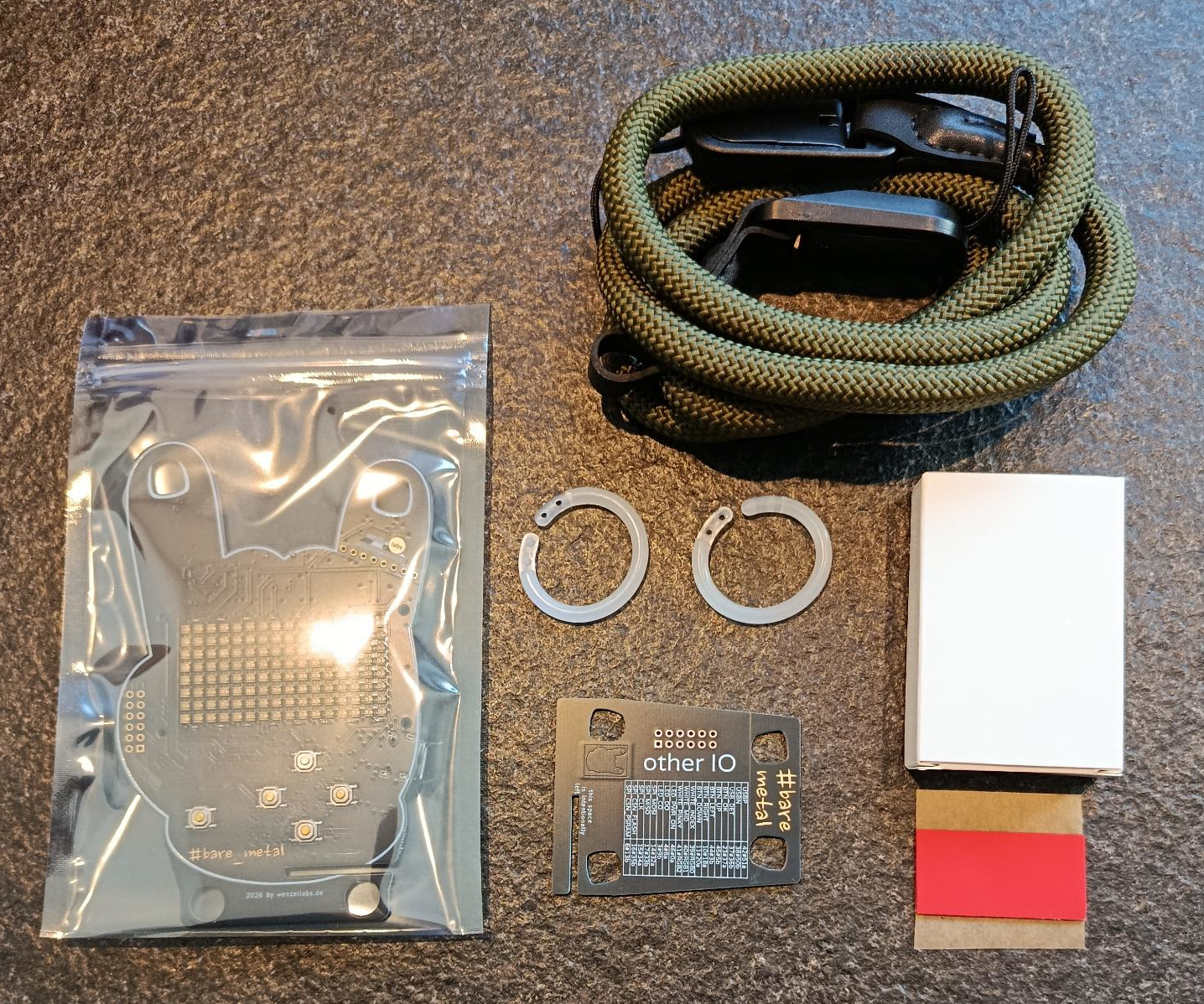
bare_metal is available through my little lectronz shop.
Copyright (c) 2026 m. wenzel, wenzellabs
Unless otherwise stated, the hardware designs, firmware source code, and documentation in this repository are licensed under:
Creative Commons Attribution-NonCommercial-ShareAlike 4.0 International (CC BY-NC-SA 4.0)
https://creativecommons.org/licenses/by-nc-sa/4.0/
Commercial use, including commercial manufacture, sale, or distribution of products based on these materials, is not permitted without separate permission from the copyright holder.
see LICENSE.txt
| Qty | Value | Footprint | References |
|---|---|---|---|
| 128 | APA102-2020 | wenzellabs:SK9822-EC20 | D3001, D3002, D3003, D3004, D3005, D3006, D3007, D3008, D3009, D3010, D3011, D3012, D3013, D3014, D3015, D3016 +112 |
| 35 | 100n | Capacitor_SMD:C_0402_1005Metric | C1002, C1004, C1006, C1008, C1009, C1011, C1013, C1101, C1102, C2004, C3001, C3002, C3003, C3004, C3005, C3006 +19 |
| 18 | 10u | Capacitor_SMD:C_0603_1608Metric | C1001, C1003, C1005, C1007, C1010, C1012, C2001, C2002, C2003, C2005, C2008, C2010, C2011, C3025, C3026, C3027 +2 |
| 12 | 10k | Resistor_SMD:R_0402_1005Metric | R4, R6, R7, R1001, R1005, R1007, R1008, R1009, R1010, R1101, R1102, R1103 |
| 6 | BTN | Button_Switch_SMD:SW_Push_1P1T_XKB_TS-1187A | SW1001, SW1002, SW1003, SW1004, SW1005, SW1006 |
| 4 | 100k | Resistor_SMD:R_0402_1005Metric | R2, R2006, R2007, R2008 |
| 4 | 470 | Resistor_SMD:R_0402_1005Metric | R1, R8, R1012, R2002 |
| 4 | MountingHole | MountingHole:MountingHole_2mm | H1, H2, H3, H4 |
| 3 | 33 | Resistor_SMD:R_0402_1005Metric | R1002, R1003, R1004 |
| 3 | 5k1 | Resistor_SMD:R_0402_1005Metric | R3, R4001, R4002 |
| 3 | green | LED_SMD:LED_0805_2012Metric | D1, D1004, D2001 |
| 2 | 1u | Capacitor_SMD:C_0402_1005Metric | C2006, C2007 |
| 2 | 3k3 | Resistor_SMD:R_0402_1005Metric | R5, R2009 |
| 1 | 100 | Resistor_SMD:R_0402_1005Metric | R1006 |
| 1 | 10n | Capacitor_SMD:C_0402_1005Metric | C4002 |
| 1 | 12MHz | Crystal:Crystal_SMD_3225-4Pin_3.2x2.5mm | X1001 |
| 1 | 1M | Resistor_SMD:R_2512_6332Metric | R4004 |
| 1 | 1k | Resistor_SMD:R_0402_1005Metric | R2001 |
| 1 | 1k2 | Resistor_SMD:R_0402_1005Metric | R2003 |
| 1 | 1k5 | Resistor_SMD:R_0402_1005Metric | R4003 |
| 1 | 1k8 | Resistor_SMD:R_0402_1005Metric | R2004 |
| 1 | 1u5 | Inductor_SMD:L_1008_2520Metric | L2001 |
| 1 | 3.0V, OD | Package_TO_SOT_SMD:SOT-23-3 | U1 |
| 1 | 470n | Capacitor_SMD:C_0402_1005Metric | C2009 |
| 1 | 470u | Capacitor_SMD:CP_Elec_6.3x7.7 | C3029 |
| 1 | BD83070GWL | wenzellabs:UCSP50L1C | U2004 |
| 1 | BQ24074RGT | Package_DFN_QFN:VQFN-16-1EP_3x3mm_P0.5mm_EP1.6x1.6mm | U2002 |
| 1 | Conn_01x04_Pin | wenzellabs:SMD_pads_01x04 | J1 |
| 1 | Conn_01x08_Socket | Connector_PinSocket_2.54mm:PinSocket_1x08_P2.54mm_Vertical | J1101 |
| 1 | Conn_02x06_Top_Bottom | wenzellabs:PMOD_PinSocket_2x06_P2.54mm_Horizontal | J5001 |
| 1 | D_Small | Diode_SMD:D_SOD-123 | D2 |
| 1 | ICE40UP5K-SG48ITR | Package_DFN_QFN:QFN-48-1EP_7x7mm_P0.5mm_EP5.6x5.6mm | U1001 |
| 1 | IP4234CZ6 | Package_TO_SOT_SMD:SC-74-6_1.55x2.9mm_P0.95mm | U4001 |
| 1 | LOGO | LOGO | G*** |
| 1 | LY68L6400 | Package_SO:SOIC-8_3.9x4.9mm_P1.27mm | U1101 |
| 1 | Logo wenzellabs | wenzellabs:wenzellabs_logo_v1_13x6 | L101 |
| 1 | MIC5268-1.2 | Package_TO_SOT_SMD:SOT-23-5 | U2003 |
| 1 | SY6280AAAC | Package_TO_SOT_SMD:SOT-23-5 | U2005 |
| 1 | USB_C_Receptacle_USB2.0_16P | wenzellabs:USB_C_Receptacle_GCT_USB4800-03-A_16P_TopMnt_Horizontal | J4001 |
| 1 | W25Q128JVSIQ | Package_SO:SOIC-8_5.3x5.3mm_P1.27mm | U1102 |
| 1 | XB8089D | Package_SO:SOIC-8-1EP_3.9x4.9mm_P1.27mm_EP2.62x3.51mm_ThermalVias | U2001 |
| 1 | battery | wenzellabs:JST_ZH_S3B-ZR-SM4A-TF_1x03-1MP_P1.50mm_Horizontal | J2001 |
| 1 | power | wenzellabs:diptronics_switch_SS3-CM | SW2001 |
| 1 | red | LED_SMD:LED_0805_2012Metric | D3 |
| 1 | white middle | LED_SMD:LED_0805_2012Metric | D1002 |
| 1 | white_index | LED_SMD:LED_0805_2012Metric | D1003 |
| 1 | white_pinky | LED_SMD:LED_0805_2012Metric | D1001 |
The 258 most common of 261 parts.

askiiart/guilty-devboard-xrd
A Xiao clone with a ton of GPIO, a focus on extremely low power draw, and which is relatively easy to assemble

ericyuanyong/asset-tracker
a asset tracker demo project based on msom

stefano-papadopolo/Selfwatering-Flower-Pots
18650 battery powered self watering flower pots with low battery alarm, low water level alarm, solar charging, moisture sensors and water pumps. Controlled by ATTiny828

ElektorLabs/210047-LoRa-with-the-Raspberry-Pi-Pico
Raspberry Pi Pico with a RFM95 and DS18B20

wafaffles/Miniamp
A pocketable DAC/amp based on the PCM2706CPJTR IC. It will be a low power DAC/amp with multiple buttons to be able to easily control media without opening the device.


yousef-yasser-T/Smart-cycling-farming-system
A complete modular LiPo battery management solution, designed in KiCad by Eng. Mohamed Yousry. This project combines a charger, protection circuit, and active balancer for safe and efficient LiPo battery management…
It measures 74.3 × 115.1 mm and has 4 copper layers, 1.7 mm thick.
261 parts, built around the ICE40UP5K-SG48ITR50, BD83070GWL-E2, W25Q128JVSIQ and BQ24074RGTR. The full list of its parts is on this page, with links to each part's symbol and footprint where PCBKit's library has them.
From the wenzellabs/bare_metal repository on GitHub, at the commit this page was made from: the board is hardware/bare_metal.kicad_pcb and its schematic hardware/bare_metal.kicad_sch. PCBKit opens the board in the browser, with nothing to install.
Its repository states no licence, so its author keeps all rights: ask wenzellabs before reusing the design.