

2 layers112.4 × 74.2 mm

 webmariner/Radiolarian3
A flexible digital radio Hexpansion for the Tildagon
Radiolarian is an open-source printed circuit board by webmariner, from the webmariner/Radiolarian repository on GitHub, published under the CERN-OHL-P-2.0 licence. It is a 2-layer board of 109.3 × 59.7 mm with 10 parts on 36 nets, routed with 245 tracks and 21 vias.
It is built around the DMG2305UX-7 and M24128-UFMN6TP. Its parts include 2 capacitors, 2 resistors, 1 IC and 1 connector. It belongs with the RP2040 boards of this library.
A flexible open-source hardware expansion board for the EMF Tildagon badge supporting digital radio applications.
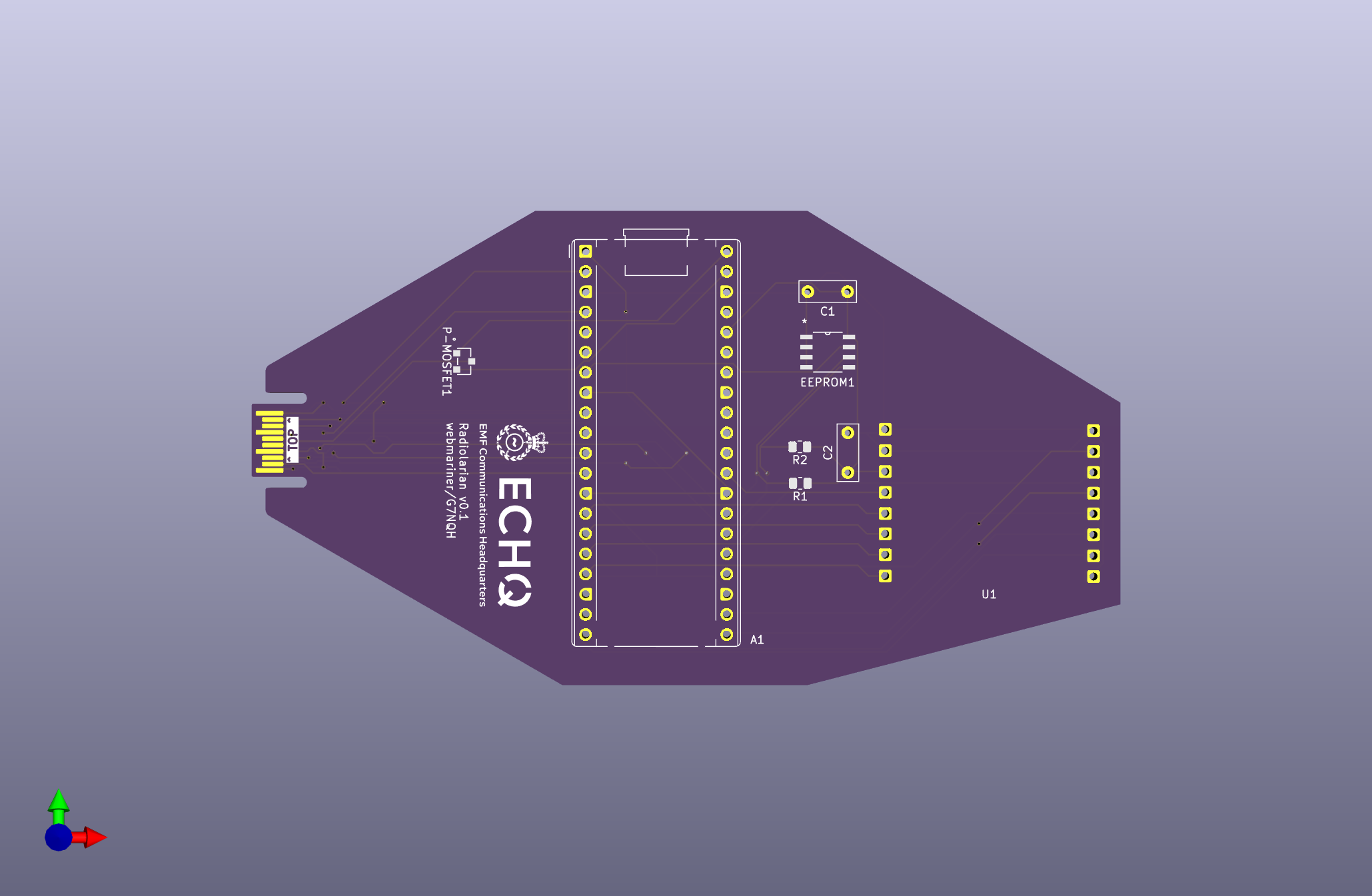
The hexpansion is based on the Semtech SX1278 radio module, controlled via SPI by a Raspberry Pi Pico, which in turn can get commands from or send data to the badge via the I2C and other I/O lines on the edge connector. There's also an EEPROM on board sharing the I2C bus, so the badge can check the hexpansion identifier and (if desired) boot your custom software.
| Qty | Value | Footprint | References |
|---|---|---|---|
| 2 | 10nF | Capacitor_THT:C_Disc_D7.0mm_W2.5mm_P5.00mm | C1, C2 |
| 2 | 1k8 | Resistor_SMD:R_0805_2012Metric | R1, R2 |
| 1 | Ai-Thinker-Ra-02 | components:ALR00002A | U1 |
| 1 | DMG2305UX-7 | Radiolarian:DMG2305UX-7-SOT-23_DIO | P-MOSFET1 |
| 1 | Hexpansion-Connector | Radiolarian:hexpansion-edge-connector | J1 |
| 1 | LOGO | components:echq | G*** |
| 1 | M24128-UFMN6TP | Radiolarian:M24128-UFMN6TP-SO-8_STM | EEPROM1 |
| 1 | RaspberryPi_Pico | Module:RaspberryPi_Pico_Common_THT | A1 |


Allegra42/ZEReader-KiCad
ZEReader is an open source hardware and software E-Book Reader platform. Originally developed as a bachelor's thesis in electrical engineering, the project now evolves as a hobby initiative dedicated to further develop…


aws/iot-expresslink
This device was designed and created for the AWS IoT ExpressLink Demo Badge Workshop, which was run at re:Invent 2022.


aws-samples/aws-iot-connected-product-demo-badge
This device was designed and created for a hands-on workshop at re:Invent 2023.

befinitiv/minidisc_cad
This repository contains the CAD files (PCB & mechanics) for the 8cm "minidisc" player project.
It measures 109.3 × 59.7 mm and has 2 copper layers, 1.09 mm thick.
10 parts, built around the DMG2305UX-7 and M24128-UFMN6TP. The full list of its parts is on this page, with links to each part's symbol and footprint where PCBKit's library has them.
From the webmariner/Radiolarian repository on GitHub, at the commit this page was made from: the board is Radiolarian.kicad_pcb and its schematic Radiolarian.kicad_sch. PCBKit opens the board in the browser, with nothing to install.
Its repository publishes it under the CERN-OHL-P-2.0 licence: you may reuse it on that licence's terms (keep the author's notice, and for a copyleft licence share your changes alike).