2 layers140.5 × 30 mm
Type e
google/mozc-devices
Circuit diagrams and firmware source code for Gboard DIY keyboards
16 parts3kApache-2.0

 wallaceowen/FilaScale-S
Simple through-hole board implementing a no-gui FilaScale
FilaScale S is an open-source printed circuit board by wallaceowen, from the wallaceowen/FilaScale-S repository on GitHub, published under the MIT licence. It is a 2-layer board of 65 × 50 mm with 16 parts on 29 nets, routed with 100 tracks and 28 vias.
Its parts include 7 connectors, 3 capacitors and 2 resistors. It belongs with the AVR (ATmega, ATtiny) boards of this library.
Simple through-hole board implementing a no-gui FilaScale
This is a small Arduino Nano-based board designed to implement the sensor suite of a FilaScale but without a GUI, and using through-hole parts.
It was built to the requirements of a filament monitoring device. The board provides:
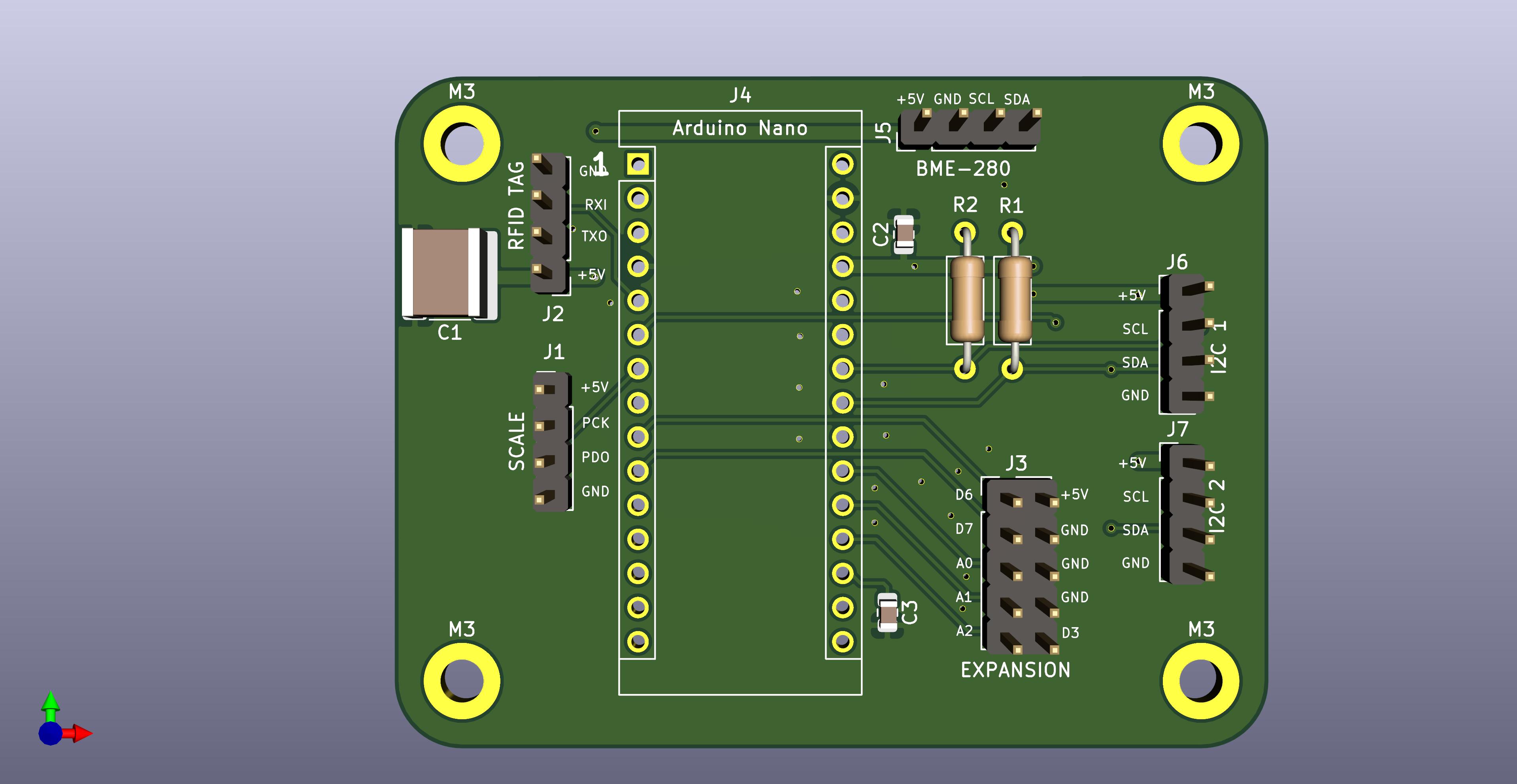
The Code is at https://github.com/wallaceowen/FilaScale/tree/nogui_nano
| Qty | Value | Footprint | References |
|---|---|---|---|
| 4 | MountingHole_3.2mm_M3_ISO7380_Pad | MountingHole:MountingHole_3.2mm_M3_ISO7380_Pad | M3, M3, M3, M3 |
| 2 | .1uF | Capacitor_SMD:C_0805_2012Metric | C2, C3 |
| 2 | 3.9K | Resistor_THT:R_Axial_DIN0207_L6.3mm_D2.5mm_P10.16mm_Horizontal | R1, R2 |
| 1 | 10uF | Capacitor_SMD:C_2225_5664Metric_Pad1.80x6.60mm_HandSolder | C1 |
| 1 | Arduino_Nano_v3.x | Module:Arduino_Nano | J4 |
| 1 | BME-280 | Connector_PinHeader_2.54mm:PinHeader_1x04_P2.54mm_Vertical | J5 |
| 1 | EXP1 | Connector_PinHeader_2.54mm:PinHeader_2x05_P2.54mm_Vertical | J3 |
| 1 | HX711MOD | Connector_PinHeader_2.54mm:PinHeader_1x04_P2.54mm_Vertical | J1 |
| 1 | I2C 1 | Connector_PinHeader_2.54mm:PinHeader_1x04_P2.54mm_Vertical | J6 |
| 1 | I2C 2 | Connector_PinHeader_2.54mm:PinHeader_1x04_P2.54mm_Vertical | J7 |
| 1 | RFID | Connector_PinHeader_2.54mm:PinHeader_1x04_P2.54mm_Vertical | J2 |
google/mozc-devices
Circuit diagrams and firmware source code for Gboard DIY keyboards

conorpp/u2f-zero
U2F USB token optimized for physical security, affordability, and style

rusefi/rusefi
rusefi - GPL internal combustion engine control unit

VoronDesign/Voron-Hardware
Cool Hardware designed by the Voron Design group

hoglet67/RGBtoHDMI
Bare-metal Raspberry Pi project that provides pixel-perfect sampling of Retro Computer RGB/YUV video and conversion to HDMI

hackclub/OnBoard
💡 Join 1,000 teenagers and make your first PCB with a $100 grant!


It measures 65 × 50 mm and has 2 copper layers, 1.6 mm thick.
16 parts. The full list of its parts is on this page, with links to each part's symbol and footprint where PCBKit's library has them.
From the wallaceowen/FilaScale-S repository on GitHub, at the commit this page was made from: the board is FilaScale-s.kicad_pcb. PCBKit opens the board in the browser, with nothing to install.
Its repository publishes it under the MIT licence: you may reuse it on that licence's terms (keep the author's notice, and for a copyleft licence share your changes alike).