2 layers27.9 × 16.5 mm
 UKASITECH/HackPad
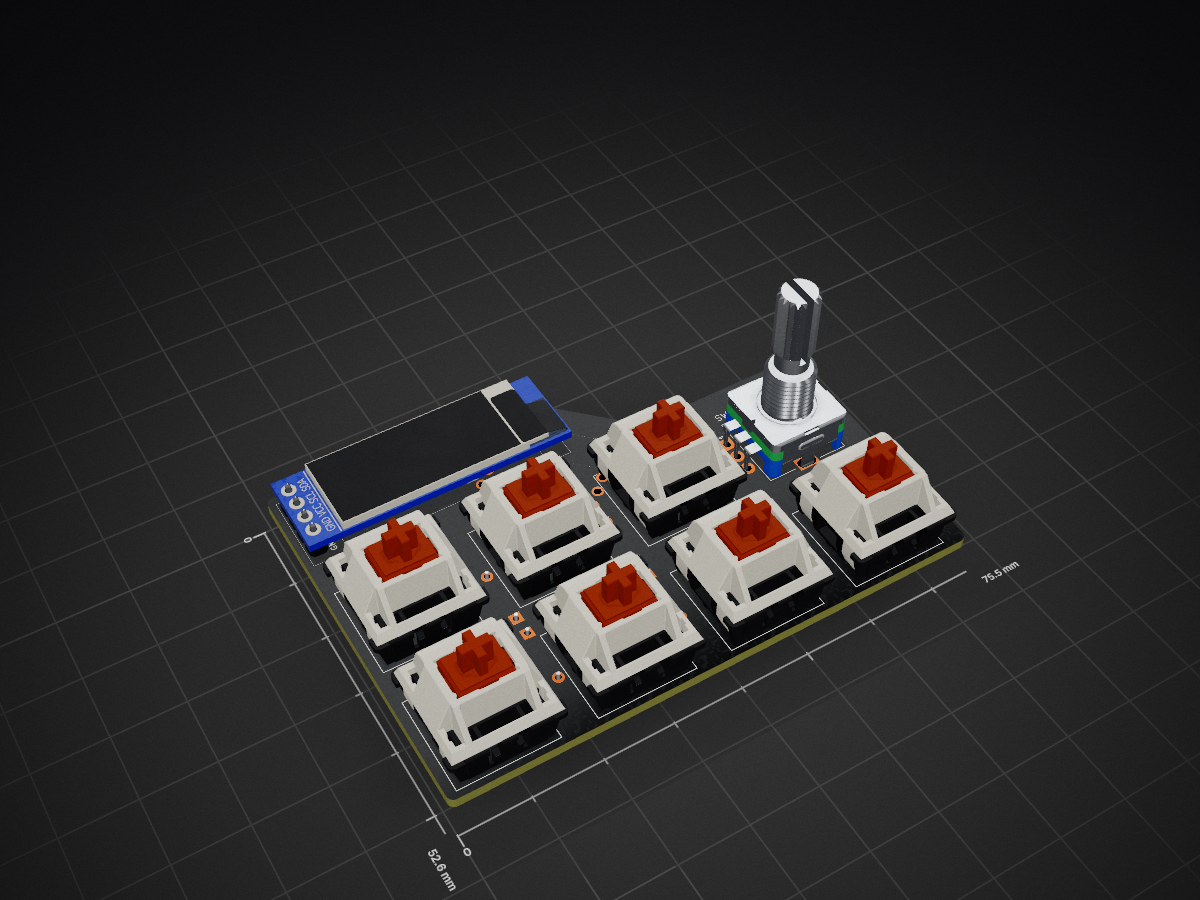
A custom USB macropad with programmable keys for coding, productivity, and media controls. I will design the enclosure, PCB, and firmware from scratch.
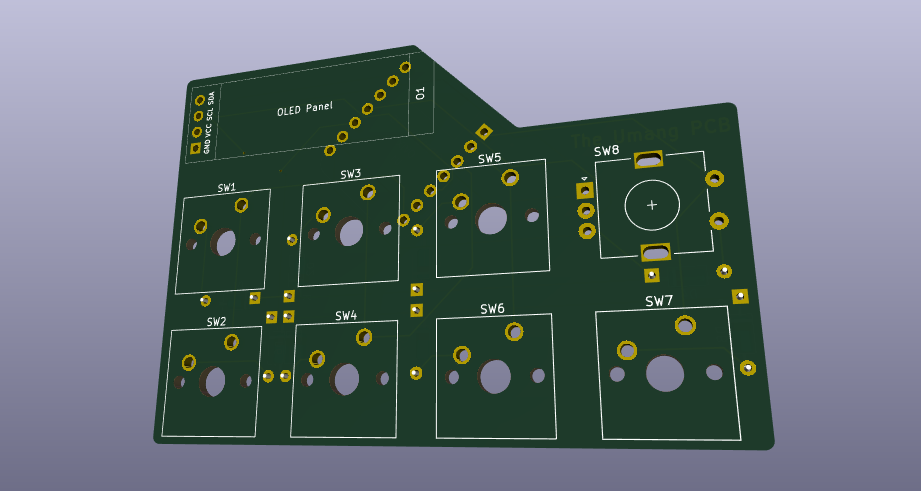
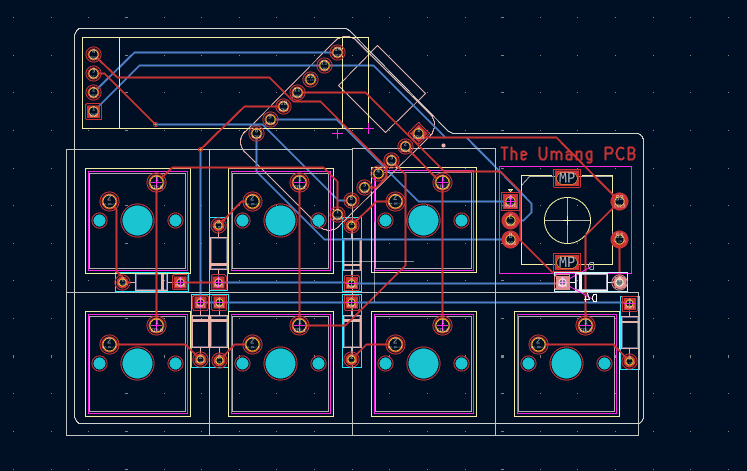
HackPad is an open-source printed circuit board by UKASITECH, from the UKASITECH/HackPad repository on GitHub. It is a 2-layer board of 75.5 × 52.6 mm with 18 parts on 22 nets, routed with 101 tracks and 2 vias.
Its parts include 8 diodes, 8 switches and 1 IC. It belongs with the keyboards and input boards and the SAM D and SAM boards of this library.
built by Umang Kumar Singh for HackClub 2026
Hackpad is my first crack at a hardware project — a simple macropad with seven keys and a rotary encoder. Seven keys for whatever macros you want (calculator hotkey, anyone?), and the encoder handles volume or media scrubbing.
The body is two 3D-printed shells held together with M3 screws and heat-set inserts, with a translucent acrylic plate sandwiched in between. The plate can be swapped out pretty easily if you ever want to change the look.
Under the hood it runs QMK with two layers — a mix of keys I don't have easy access to on my main keyboard, plus a few keycodes I thought were amusing. The 128x32 OLED scrolls through very important and relevant information on loop.
Overall this was a blast. I'd never done PCB design before, and learning KiCad from scratch was surprisingly rewarding. The case was straightforward in CAD, and working around the PCB constraints made for a fun little puzzle. Firmware was the biggest headache, but after digging through QMK and XIAO docs for a while things started clicking. Once the parts arrived, assembly was smooth — I only had to reprint the case once.
9/10. Would build again.
| Qty | Value | Footprint | References |
|---|---|---|---|
| 8 | D | Diode_THT:D_DO-35_SOD27_P7.62mm_Horizontal | D1, D2, D3, D4, D5, D6, D7, D8 |
| 7 | SW_Push_45deg | Button_Switch_Keyboard:SW_Cherry_MX_1.00u_PCB | SW1, SW2, SW3, SW4, SW5, SW6, SW7 |
| 1 | OLEd | Library:SSD1306-0.91-OLED-4pin-128x32 | O1 |
| 1 | RotaryEncoder_Switch | Rotary_Encoder:RotaryEncoder_Alps_EC11E-Switch_Vertical_H20mm | SW8 |
| 1 | Seeed Studio XIAO SAMD21 | Library:XIAO-Generic-Thruhole-14P-2.54-21X17.8MM | U1 |
It measures 75.5 × 52.6 mm and has 2 copper layers, 1.6 mm thick.
18 parts. The full list of its parts is on this page, with links to each part's symbol and footprint where PCBKit's library has them.
From the UKASITECH/HackPad repository on GitHub, at the commit this page was made from: the board is pcb/hackpad.kicad_pcb and its schematic pcb/hackpad.kicad_sch. PCBKit opens the board in the browser, with nothing to install.
Its repository states no licence, so its author keeps all rights: ask UKASITECH before reusing the design.

VoronDesign/Voron-Hardware
Cool Hardware designed by the Voron Design group


hackclub/OnBoard
💡 Join 1,000 teenagers and make your first PCB with a $100 grant!

VoronDesign/Voron-Tap
Tap is a nozzle-based z-probe for the V2 and Trident printer designs. The entire toolhead moves to trigger an optical switch. Tap offers many advantages:

Luos-io/luos_engine
Open-source and real-time orchestrator for cyber-physical-systems, to easily design, test and deploy embedded applications and digital twins.


Twotoz/C5VRX
Ultra-minimal, zero-CPU 5.8 GHz analog FPV video receiver using ESP32-C5 Wi-Fi 6 PHY MODEM_DIAG, BitScrambler WBFM demodulation & resistor DAC CVBS