

Handheld Chess
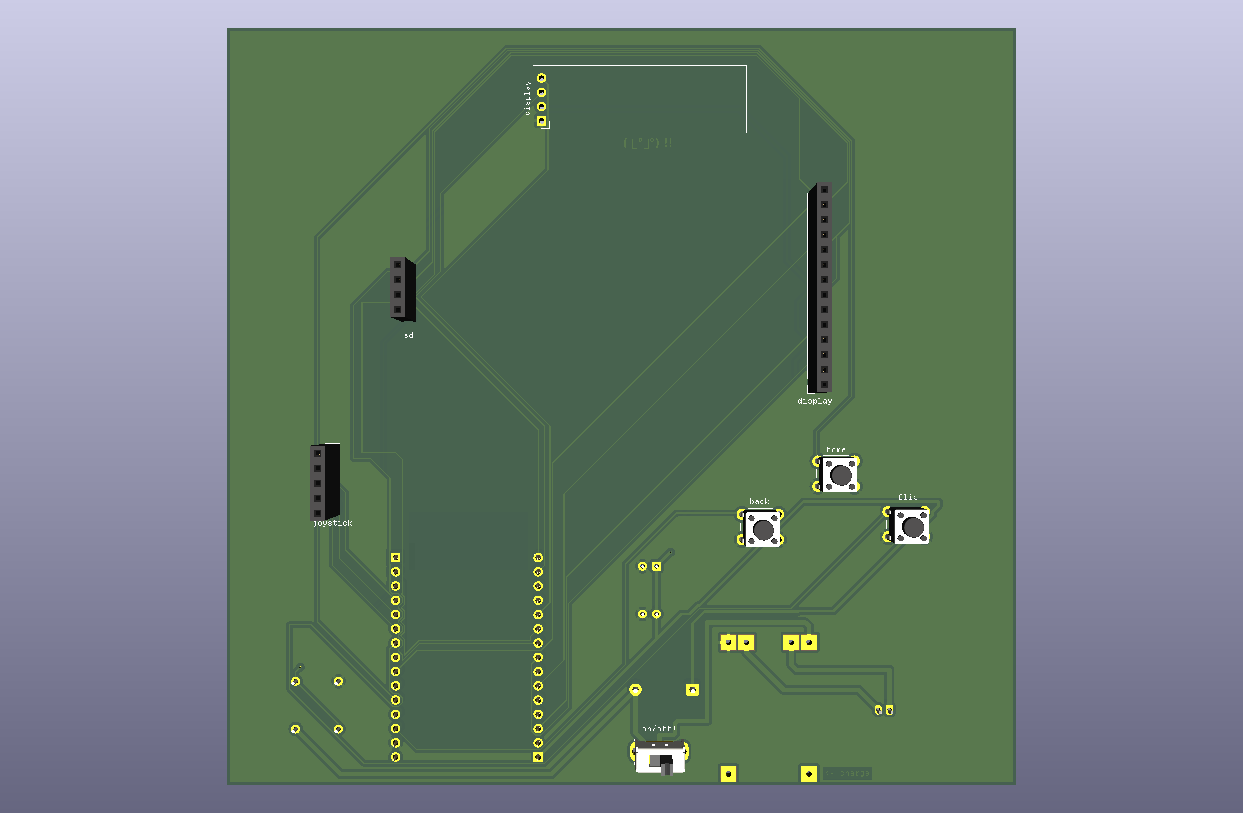
handheld chess console !
- Size
- 140.5 × 134.8 mm
- Copper layers
- 2
- Thickness
- 1.6 mm
- Parts
- 17
- Nets
- 37
- Pads
- 92
- Tracks, vias
- 276, 2
- Pours
- 2
- Routed
- Yes
- KiCad
- KiCad 10.0 (file 20260206)
- Created
- 19 Aug 2026
- Updated
- 22 Sep 2026
Overview
Handheld Chess is an open-source printed circuit board by ufungii, from the ufungii/chesp32s repository on GitHub. It is a 2-layer board of 140.5 × 134.8 mm with 17 parts on 37 nets, routed with 276 tracks and 2 vias.
Its parts include 4 connectors, 2 resistors, 1 capacitor, 1 diode and 1 switch.
README
README.mdthis summer i found myself forced to play chess online with my friends who were interning in different cities
staring at my computer screen got kind of old, so i decided to stare at a 320x240 LCD ILI9341 instead!
chesp32s lets me play with my friends whenever, wherever - close or far :)
(the second i assemble this trust and believe the image will be here)
hardware specs for nerds
- brain: ESP32 Dual-Core (Xtensa LX6) @ 240MHz
- firmware: C++ / PlatformIO
- EDA: KiCad (Schematic + custom footprints + 2-layer PCB)
- fab: JLCPCB (new/)
- board display: 2.8" ILI9341 320x240 Color TFT over dedicated hardware SPI
- HUD display: 0.96" SSD1306 128x64 OLED over I2C
- inputs: 2-axis analog joystick (ADC) + push-to-click, plus tactile action switches (
back,home,flip) - power system: single-cell LiPo (3.7V nominal, 4.2V max) with onboard USB-C charging via TP4056
- telemetry: passive resistor divider to ADC for real-time voltage monitoring & fuel gauging
- protection: reverse-polarity / backfeed isolation diode + decoupling filter capacitor bank
(ノ◕ヮ◕)ノ*:・゚✧
[ LiPo Battery (3.7V) ] ──> [ Voltage Divider ] ──> [ ADC Pin ]
│
▼
[ USB-C ] ──> [ TP4056 / 3.3V LDO ]
│
▼
[ ESP32 Core ]
/ | \
(SPI) (I2C) (Analog/GPIO)
│ │ │
[ ILI9341 ] [ SSD1306 ] [ Joystick & Buttons ]
(Chessboard) (HUD) (Move Navigation)firmwaresque: how do i play?
game modes
- pass n play for when only one person's board is charged: HUD tracks whos turn it is, move history, and board flip can be toggled manually via button
- solo vs. engine (minimax) for when you have no friends: the lightweight, onboard chess engine running directly on the ESP32 uses alpha-beta pruning / minimax evaluation to calculate moves locally without needing an internet connection
- board-to-board (ESP-NOW) for when both boards are charged: direct wireless peer-to-peer between two
chesp32sboards over raw ESP-NOW packets. no Wi-Fi router or pairing menus required. just pinging moves directly over 2.4GHz - lichess online for when you're feeling frisky! : connects over Wi-Fi using the Lichess Board API. game events stream over HTTPS/SSE in the background, and moves are dispatched via REST calls so you can play rated matches against friends or randoms from your pocket console
% ### navigation 101 %
struggles (that i am proud to have overcome)
- bus architecture: driving two separate screens from one ESP32 meant balancing speed and pin budget. squeezing both displays onto one bus was a recipe for sluggish rendering, so the primary ILI9341 runs on dedicated hardware SPI for smooth piece updates, while the secondary status HUD sits on I2C to conserve GPIOs.
- the LDO brownout incident: early prototyping was plagued by random board resets because the devboard's stock onboard linear regulator had an absurdly high dropout voltage. the second the LiPo drifted away from a fresh 4.2V charge, the 3.3V power rail would plummet toward ~2.5V, well below the ESP32's brownout detection threshold. i had to audit the power path, factor in quiescent/dropout specs, and implement proper decoupling passives alongside a protection diode to keep the supply rail clean and prevent USB backfeed.
- battery sensing without frying the ADC: on that note: i needed real-time fuel-gauge tracking for the LiPo. sitting at ~4.2V when charged (well above the ESP32’s 3.3V pin rating), i calculated and routed an analog resistor voltage divider to step the voltage down safely while minimizing parasitic current draw when idle.
- datasheets... : kicad symbols rarely match cheap breakout boards or niche components. as a result, i had to manually measure hardware components, verify mechanical drill tolerances against datasheets, and iteratively debug clearances through JLCDFM rule checks to ensure zero spacing violations before fab.
Parts
17| Qty | Value | Footprint | References |
|---|---|---|---|
| 2 | 100k | Resistor_THT:R_Axial_DIN0207_L6.3mm_D2.5mm_P7.62mm_Horizontal | R1, R2 |
| 2 | Conn_01x15 | Connector_PinSocket_2.54mm:PinSocket_1x15_P2.54mm_Vertical | J5, J6 |
| 1 | 0.1uF | Capacitor_THT:C_Disc_D3.0mm_W2.0mm_P2.50mm | C1 |
| 1 | 100uF | Capacitor_THT:CP_Radial_D5.0mm_P2.50mm | CP1 |
| 1 | 1N4007 | Diode_THT:D_DO-41_SOD81_P10.16mm_Horizontal | D1 |
| 1 | J_BATT | Connector_JST:JST_PH_S2B-PH-K_1x02_P2.00mm_Horizontal | J1 |
| 1 | SW_SPDT | Button_Switch_THT:SW_Slide_SPDT_Straight_CK_OS102011MS2Q | on/off! |
| 1 | TP4056_Module | Handheld_Chess:MODULE_TP4056_MICRO-USB_CHARGER_-_1A | J2 |
| 1 | back | Button_Switch_THT:SW_PUSH_6mm_H5mm | back |
| 1 | display | Display:ER_OLEDM0.91_1x-I2C | display |
| 1 | display | Connector_PinSocket_2.54mm:PinSocket_1x14_P2.54mm_Vertical | display |
| 1 | flip | Button_Switch_THT:SW_PUSH_6mm_H5mm | SW8 |
| 1 | home | Button_Switch_THT:SW_PUSH_6mm_H5mm | home |
| 1 | joystick | Connector_PinSocket_2.54mm:PinSocket_1x05_P2.54mm_Vertical | joystick |
| 1 | sd | Connector_PinSocket_2.54mm:PinSocket_1x04_P2.54mm_Vertical | sd |
Similar boards
- 2 layers50 × 35 mm

- 2 layers139.7 × 62.2 mm

- 2 layers29.2 × 55.9 mm

Deniseadapter
hoglet67/RGBtoHDMI
Bare-metal Raspberry Pi project that provides pixel-perfect sampling of Retro Computer RGB/YUV video and conversion to HDMI
17 parts1kGPL-3.0 - 2 layers24.5 × 36.5 mm

- 2 layers56.3 × 55.7 mm

StarNecklace
hackclub/OnBoard
💡 Join 1,000 teenagers and make your first PCB with a $100 grant!
17 parts915 - 2 layers25 × 25 mm

SmallEncoder
DDeGonge/OS-ARM
This arm is not industrial and it will not be fast, but that is not my goal. But it will hopefully be a very nice looking arm fully capable of 6dof motion, cheap enough to keep it accessable but capable enough to…
17 parts498MIT - 2 layers38.9 × 16.1 mm

- 2 layers36 × 51 mm

Questions
How big is the Handheld Chess PCB?
It measures 140.5 × 134.8 mm and has 2 copper layers, 1.6 mm thick.
What parts does the Handheld Chess use?
17 parts. The full list of its parts is on this page, with links to each part's symbol and footprint where PCBKit's library has them.
Where can I download the Handheld Chess KiCad files?
From the ufungii/chesp32s repository on GitHub, at the commit this page was made from: the board is hardware/Handheld_Chess.kicad_pcb and its schematic hardware/Handheld_Chess.kicad_sch. PCBKit opens the board in the browser, with nothing to install.
Can I use the Handheld Chess design in my own project?
Its repository states no licence, so its author keeps all rights: ask ufungii before reusing the design.