2 layers26.7 × 42.2 mm

 ucdart/UCD-EEC13429
Senior Design Course in High Frequency System Design
Rf gain block is an open-source printed circuit board by ucdart, from the ucdart/UCD-EEC134 repository on GitHub. It is a 2-layer board with 106 parts on 6 nets, routed with 16 tracks and 0 vias.
Its parts include 5 capacitors, 2 connectors, 1 IC and 1 inductor. It belongs with the radio and wireless boards of this library.
The EEC 134 course was created to satisfy the need for a senior project course for students who are interested in high freqeuency electronic systems. The two-quarter long course emphasizes on system level design concepts and strives to provide a hands-on experience. As the course evolves, the projects start to encompass many facets of electrical engineering, including system engineering, antenna design, analog circuit design, embedded systems, and digital signal processing.
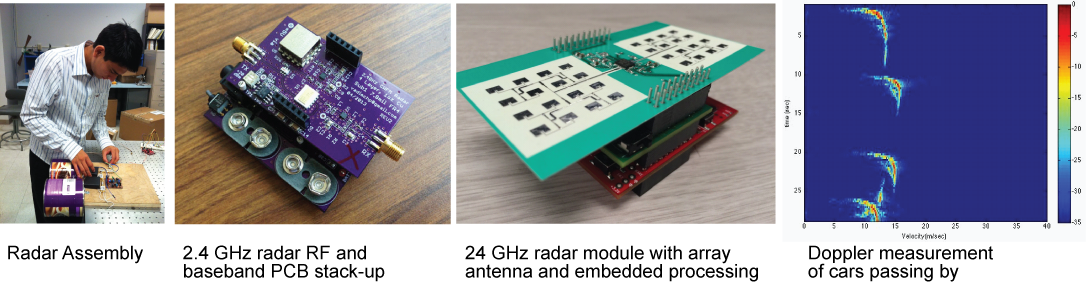
The first project option we have implemented is a frequency modulated continuous wave (FMCW) radar system that can perform range, Doppler, and synthetic aperture radar (SAR) measurements. In the first quarter, the students build an FMCW radar system using breadboard and off-the-shelf connectorized RF components. In the second quarter the students focus on improving the system performance and gauge their success by a performance competition. In the future, other project options, such as software-defined radio (SDR), RFID systems, wireless sensors networks, and RF/microwave biomedical systems, will be explored.
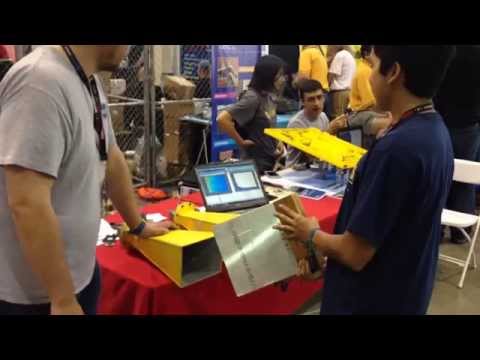
This Github repo is used to distribute the EEC 134 lecture notes, lab manuals, and supplementary materials such as computer codes with registered EEC 134 students as well as anyone who is interested in the course materials. The public nature of this git repo means that that anyone can contribute to the development of the course materials. Simply create a pull request
Roadmap:
| Qty | Value | Footprint | References |
|---|---|---|---|
| 2 | 0.1uF | rf-gain-block-footprints:smd_0603 | C1, C2 |
| 2 | SMA | rf-gain-block-footprints:SMA | P1, P2 |
| 2 | test-point | rf-gain-block-footprints:tp | TP1, TP2 |
| 1 | 1.2nF | rf-gain-block-footprints:smd_0603 | C5 |
| 1 | 1uF | rf-gain-block-footprints:smd_0603 | C6 |
| 1 | 470nH | rf-gain-block-footprints:cc_0603ls | L1 |
| 1 | 68pF | rf-gain-block-footprints:smd_0603 | C4 |
| 1 | ADL5602 | rf-gain-block-footprints:adl5602 | U1 |
The 11 most common of 106 parts.

pcbreflux/espressif
all espressif stuff will committed here

baldengineer/bit-preserve
Project for capturing vintage, classic, aka old computer schematics in KiCad.

ToyotaInfoTech/RAMN
RAMN (Resistant Automotive Miniature Network), a miniature CAN/CAN-FD testbed of 4 Electronic Control Units.

Ardumower/ardumower
Develop an open source robotic lawn mower (HW+SW reference platform)

slu4coder/Minimal-UART-Computer-1-2
Legacy: Version 1 and 2 of my TTL-only CPU featuring UART I/O, an expansion port, 512KB SSD at up to 10MHz clock speed


Spaceboards/SpaceboardsHardware
A collection of open source hardware that has been designed by Spaceboards

LouWii/ErgoMax
Custom ergo split keyboard project, based on ErgoDox, with hot swap sockets
106 parts. The full list of its parts is on this page, with links to each part's symbol and footprint where PCBKit's library has them.
From the ucdart/UCD-EEC134 repository on GitHub, at the commit this page was made from: the board is labs/appendices/kicad/rf-gain-block/rf-gain-block.kicad_pcb. PCBKit opens the board in the browser, with nothing to install.
Its repository states no licence, so its author keeps all rights: ask ucdart before reusing the design.