2 layers138.1 × 114.3 mm
Left
twangodev/dsk
The developer's split keyboard (dsk) is an open-source, ergonomic, and customizable keyboard for developers.
90 partsCERN-OHL-S-2.0

 twangodev/dsk
The developer's split keyboard (dsk) is an open-source, ergonomic, and customizable keyboard for developers.
Encoder daughterboard is an open-source printed circuit board by twangodev, from the twangodev/dsk repository on GitHub, published under the CERN-OHL-S-2.0 licence. It is a 2-layer board of 70 × 21 mm with 9 parts on 14 nets, routed with 63 tracks and 4 vias.
It is built around the EC11E09244BS and AFA07-S12FCA-00. Its parts include 3 diodes, 3 switches and 1 connector. It belongs with the keyboards and input boards of this library.


The developer's split keyboard.
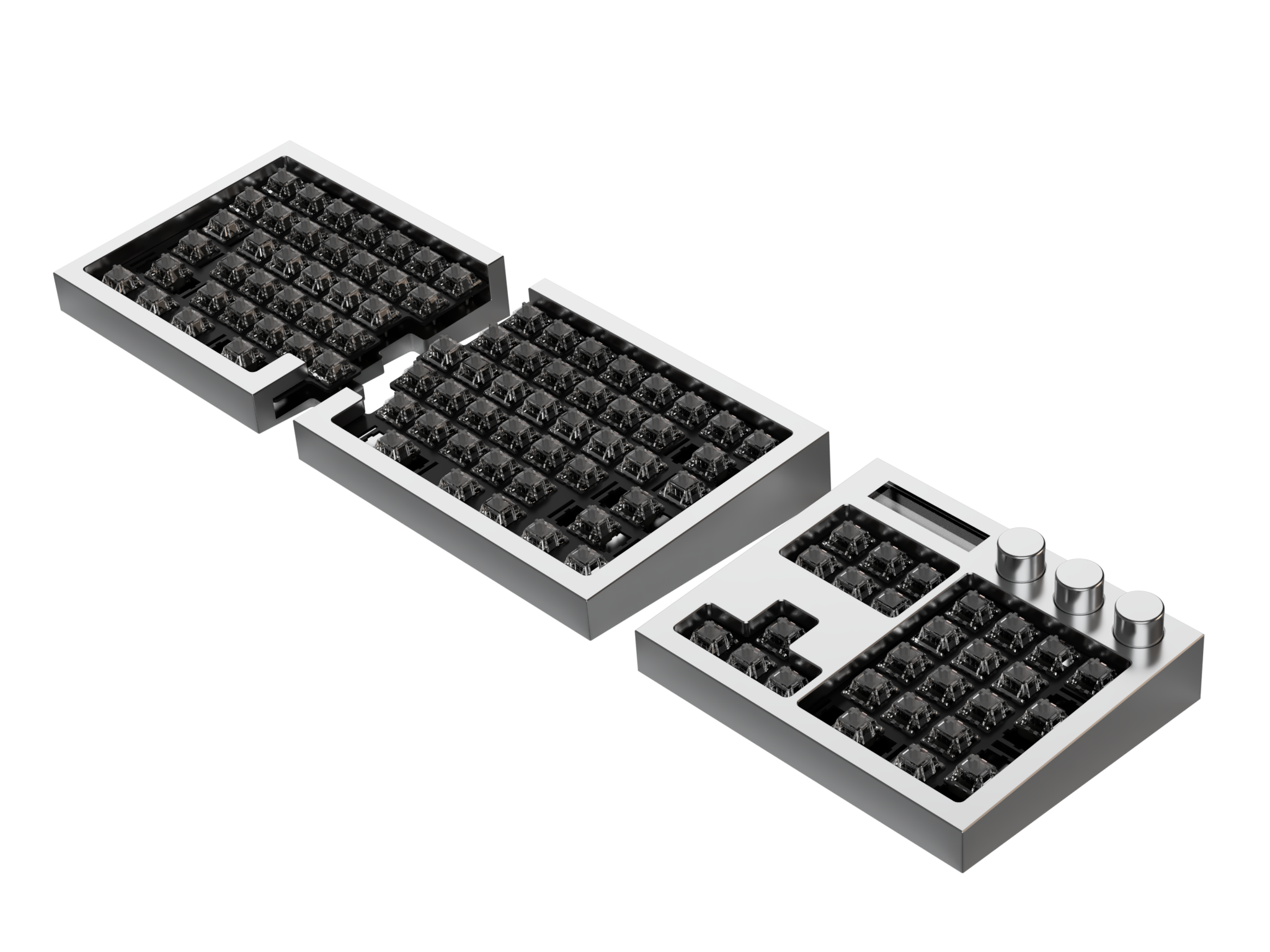


The Developer's Split Keyboard (dsk) is an open-source, ergonomic, and customizable keyboard for developers.
dsk is a modular split keyboard built for developers, offering both ergonomic flexibility and a traditional typing experience. It consists of:
The dsk project is built around the following core principles:
[!NOTE]
This project is still in development and manufacturing details and documentation will be added soon!
dsk can be easily made using additive methods (3D printing, resin, SLS) or CNC milling. Full details at dsk.twango.dev/docs.
[!TIP] Students and educators commonly have access to 3D printers and CNC machines through their institutions! Check with your school or local makerspace for more information.
| Qty | Value | Footprint | References |
|---|---|---|---|
| 3 | Diode | Diode_SMD:D_SOD-123 | D1, D2, D3 |
| 3 | EC11E09244BS | Rotary_Encoder:RotaryEncoder_Alps_EC11E-Switch_Vertical_H20mm | SW1, SW2, SW3 |
| 1 | AFA07-S12FCA-00 | Connector_FFC-FPC:Hirose_FH12-12S-0.5SH_1x12-1MP_P0.50mm_Horizontal | J1 |
| 1 | MountingHole | MountingHole:MountingHole_3.2mm_M3 | H2 |
| 1 | MountingHole_Pad | MountingHole:MountingHole_3.2mm_M3_DIN965_Pad_TopOnly | H1 |
twangodev/dsk
The developer's split keyboard (dsk) is an open-source, ergonomic, and customizable keyboard for developers.

twangodev/dsk
The developer's split keyboard (dsk) is an open-source, ergonomic, and customizable keyboard for developers.

twangodev/dsk
The developer's split keyboard (dsk) is an open-source, ergonomic, and customizable keyboard for developers.

CircuitGuy943/CinderV2-Filament-Dryer
(🚧) A filament dryer to precede my old one made inside a wooden box that never worked properly and didn't heat anything. Features to be estabilished


astinchang/KiCAD-Macropad
Custom RP2040-based controller board designed to interface with:

Merlin2LmmL/Joy-Controller
A custom made Stream deck Like Handheld Controller that can switch modes and supports quick actions and game movement. PCB and 3d Printed Parts custom made.


FrameworkComputer/ExpansionCards
Reference designs and documentation to create Expansion Cards for the Framework Laptop
It measures 70 × 21 mm and has 2 copper layers, 1.6 mm thick.
9 parts, built around the EC11E09244BS and AFA07-S12FCA-00. The full list of its parts is on this page, with links to each part's symbol and footprint where PCBKit's library has them.
From the twangodev/dsk repository on GitHub, at the commit this page was made from: the board is pcb/pad/encoder_daughterboard/encoder_daughterboard.kicad_pcb and its schematic pcb/i2c-trrs/i2c-trrs.kicad_sch. PCBKit opens the board in the browser, with nothing to install.
Its repository publishes it under the CERN-OHL-S-2.0 licence: you may reuse it on that licence's terms (keep the author's notice, and for a copyleft licence share your changes alike).