2 layers93.5 × 54.1 mm
 turtle-bazon/PNCATEHO.old1
РИСАТЕНО (RISATENO) is a 10 key chord keyboard.
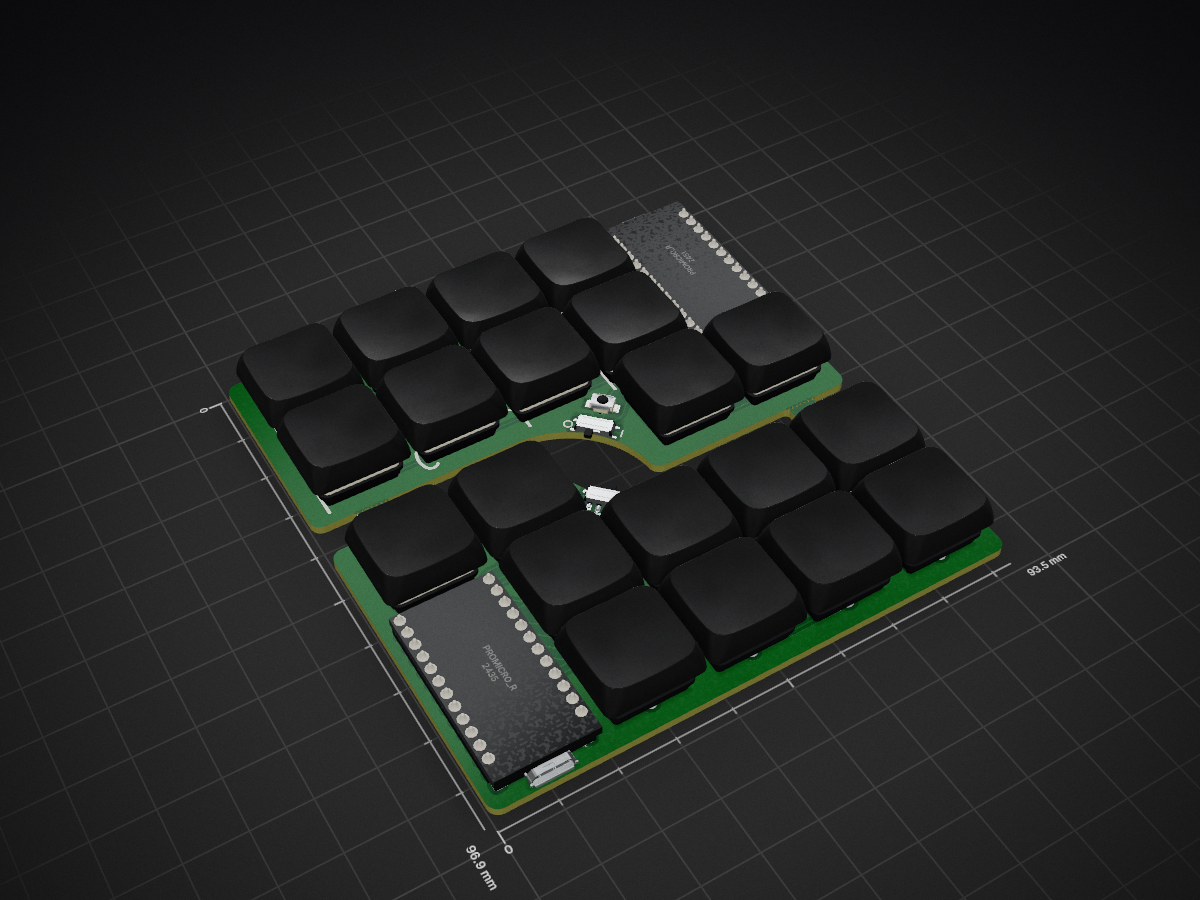
PNCATEHO v3 100x100 is an open-source printed circuit board by turtle-bazon, from the turtle-bazon/PNCATEHO.old repository on GitHub, published under the GPL-3.0 licence. It is a 2-layer board of 93.5 × 96.9 mm with 82 parts on 35 nets, routed with 256 tracks and 2 vias.
Its parts include 20 diodes, 20 switches, 2 ICs and 2 connectors. It belongs with the AVR (ATmega, ATtiny) boards of this library.
РИСАТЕНО (RISATENO) - created as a rethinking of ARTSEY for the Russian language. 10 keys, two for each finger.
The name is made up of letters on the main layer. The letters on the base layer are selected according to the frequency.
Gerber files and stl models can be downloaded in releases.
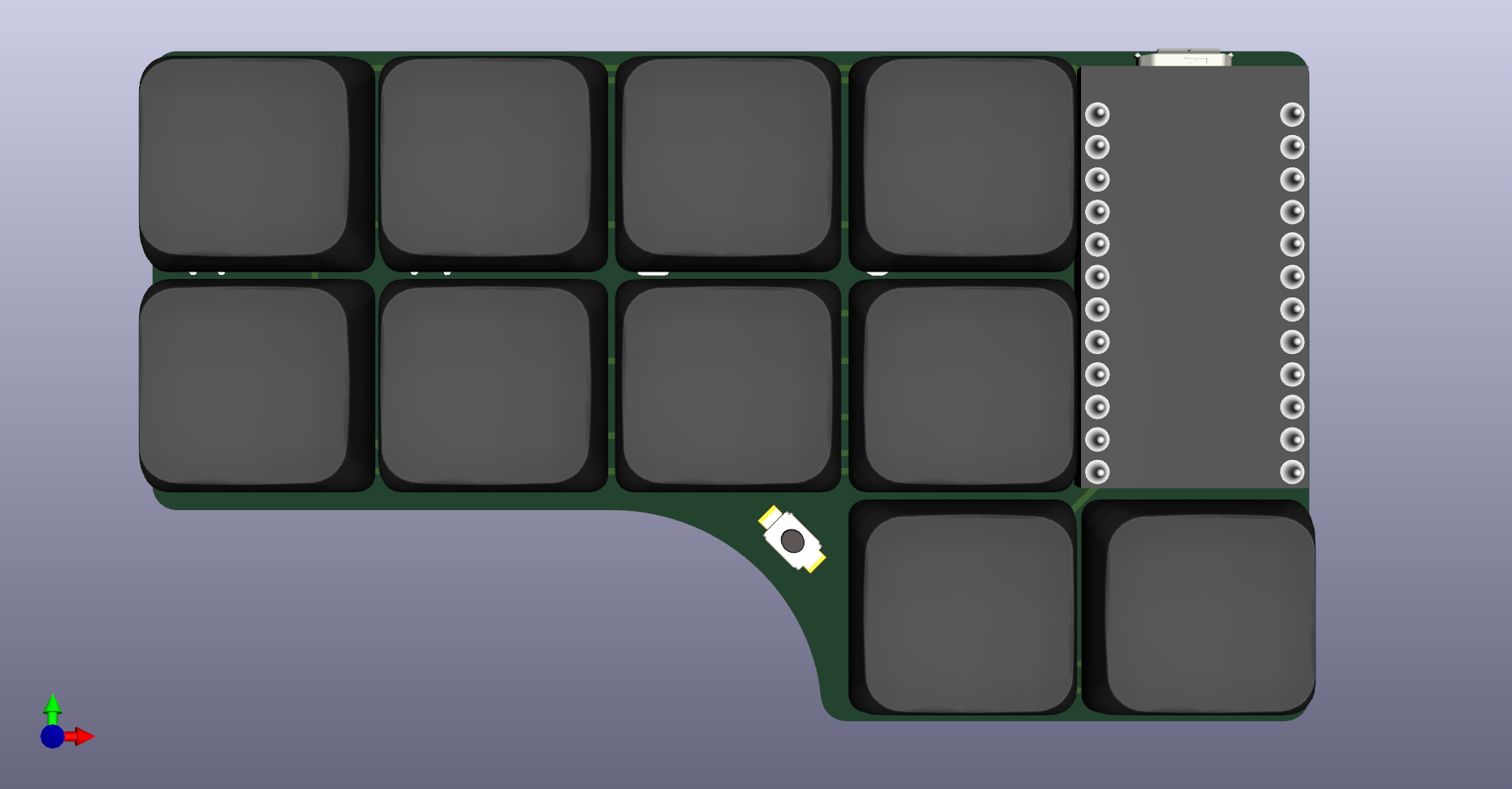
РИСАТЕНО can be used with nRFMicro or nice!nano and 301230 batteries for wireless mode. It can also be used as a split keyboard for two hands with wireless communication of the halves.
From version 0.2+ the PCB are double-sided, one PCB can be used for the right and left variant. On the left version, the controller is soldered components down, on the right, components up.
РИСАТЕНО designed for one-handed chord typing, the layout here.
The original idea was to create a compact keyboard for chord typing, but it can also be used as a macro pad.
When using two halves of РИСАТЕНО connected via Bluetooth, you can use the Kladenets layout.
| Item | Quantity | Remarks |
|---|---|---|
| proMicro | 1 | or any other compatible controller |
| Kailh Choc V1 | 10 | switches |
| Keycaps | 10 | 1U |
| YS-SK6812MINI-E | 10 | RGB leds |
| Magnets | 2-6 | disc 7x2 mm (for case) |
| Bumpers | 7 | 5x2 mm |
| Sockets PH3.5 | 12x2 | for controller |
| SMD button 3x4x2mm | 1 | for reset |
| MSK-12C02 | 1 | Power switch (wireless only) |
| 301230 | 1 | Battery (wireless only) |
| m2 nuts | 3 | for case v3 |
| m2x4 sqrews | 3 | for case v3 |
| Qty | Value | Footprint | References |
|---|---|---|---|
| 20 | SW_PUSH | PNCATEHO:ChocV1_duplex | SW1, SW1, SW2, SW2, SW3, SW3, SW4, SW4, SW5, SW5, SW6, SW6, SW7, SW7, SW10, SW10 +4 |
| 20 | YS-SK6812MINI-E | PNCATEHO:YS-SK6812MINI-E_duplex | LED1, LED1, LED2, LED2, LED3, LED3, LED4, LED4, LED5, LED5, LED6, LED6, LED7, LED7, LED10, LED10 +4 |
| 6 | Hole | enki_lib:HOLE | H1, H1, H2, H2, H3, H3 |
| 2 | ProMicro_r | PNCATEHO:ProMicro_duplex | U1, U1 |
| 2 | SW_PUSH | PNCATEHO:SW_3x4x2_2legs_duplex | RSW1, RSW1 |
| 2 | SW_SPDT | enki_lib:switch_MSK-12C02_smd | PSW1, PSW1 |
| 2 | TestPoint_2Pole | enki_lib:battery_conn | J1, J1 |
The 54 most common of 82 parts.


baldengineer/bit-preserve
Project for capturing vintage, classic, aka old computer schematics in KiCad.


CRImier/MyKiCad
My KiCad boards. Can't be bothered uploading individually anymore, so here you go.

nodestark/mdb-esp32-cashless
ESP32-based MDB cashless device for vending machines, supporting EVA DTS DEX/DDCMP telemetry and payments over the MDB protocol via Bluetooth and MQTT

krikzz/open-ed
Open-ED is a very simple and cheap open source Genesis/Megadrive cartridge. The cartridge does not have its own processor or FPGA, it is built in the old school style using only memory and discrete logic.


It measures 93.5 × 96.9 mm and has 2 copper layers, 1.6 mm thick.
82 parts. The full list of its parts is on this page, with links to each part's symbol and footprint where PCBKit's library has them.
From the turtle-bazon/PNCATEHO.old repository on GitHub, at the commit this page was made from: the board is pcb/PNCATEHO_v3/PNCATEHO_v3_100x100.kicad_pcb and its schematic pcb/PNCATEHO_MK_DOSE/PNCATEHO_MK_DOSE.kicad_sch. PCBKit opens the board in the browser, with nothing to install.
Its repository publishes it under the GPL-3.0 licence: you may reuse it on that licence's terms (keep the author's notice, and for a copyleft licence share your changes alike).