2 layers61.5 × 53 mm
9pin2supergun
turmoni/9pin2supergun
Project to read a CD32, Mega Drive/Genesis, or generic 9-pin gamepad and output each control to a separate pin
12 partsApache-2.0

 turmoni/9pin2supergun
Project to read a CD32, Mega Drive/Genesis, or generic 9-pin gamepad and output each control to a separate pin
9pin2supergun is an open-source printed circuit board by turmoni, from the turmoni/9pin2supergun repository on GitHub, published under the Apache-2.0 licence. It is a 4-layer board of 49.5 × 48.3 mm with 54 parts on 71 nets, routed with 584 tracks and 113 vias.
It is built around the RP2040, W25Q128JVSIQ and SN74LVC2T45DCURE4, with the SN74LVC8T245PW, ABM8-272-T3 and R-667995 among its other parts. Its parts include 18 capacitors, 10 resistors, 6 ICs, 5 connectors and 4 switches. It belongs with the retro computing and games boards and the RP2040 boards of this library.


This is a PCB that contains all the components needed for a fully-functional hardware adapter to work with the 9pin2supergun project in a compact package.
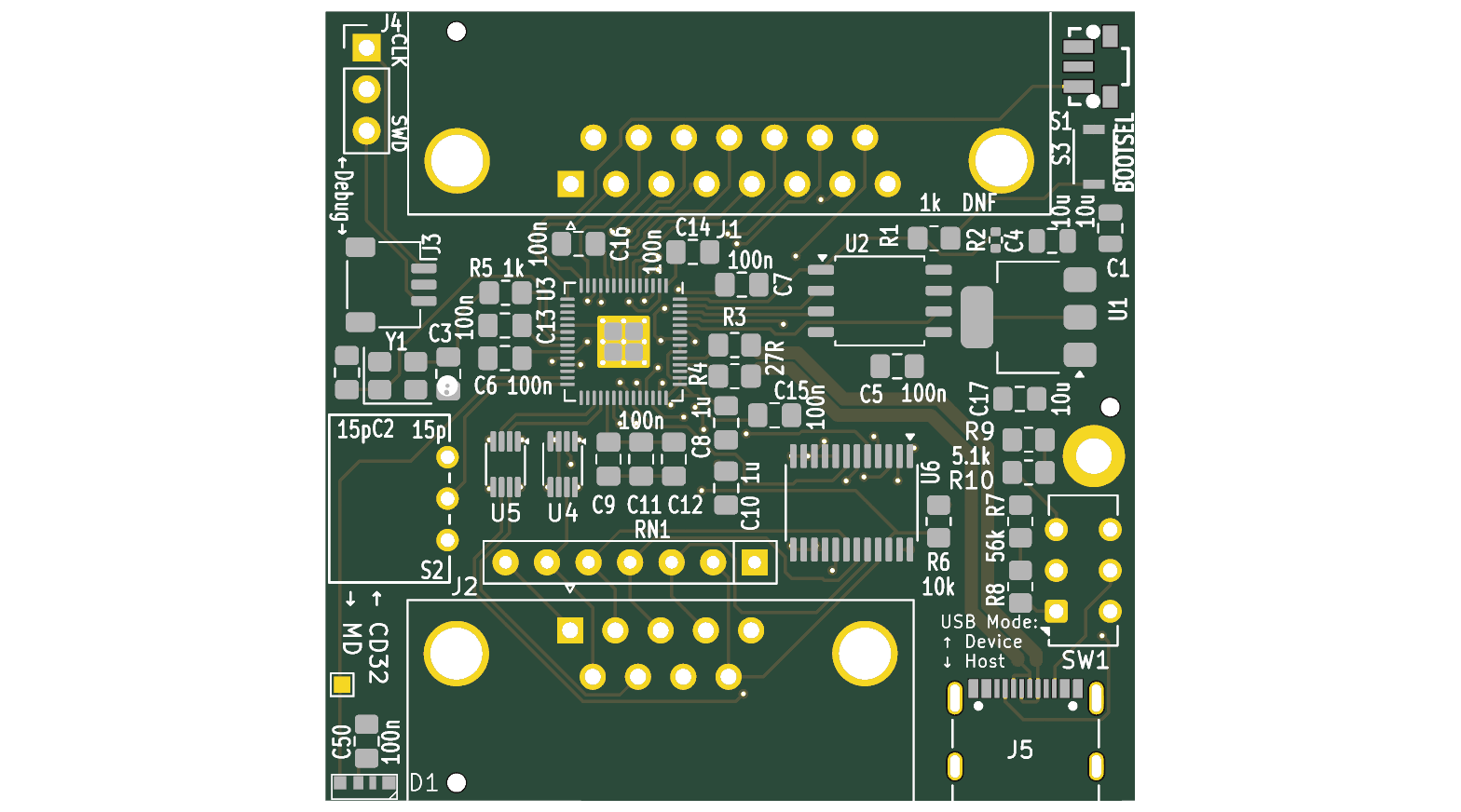
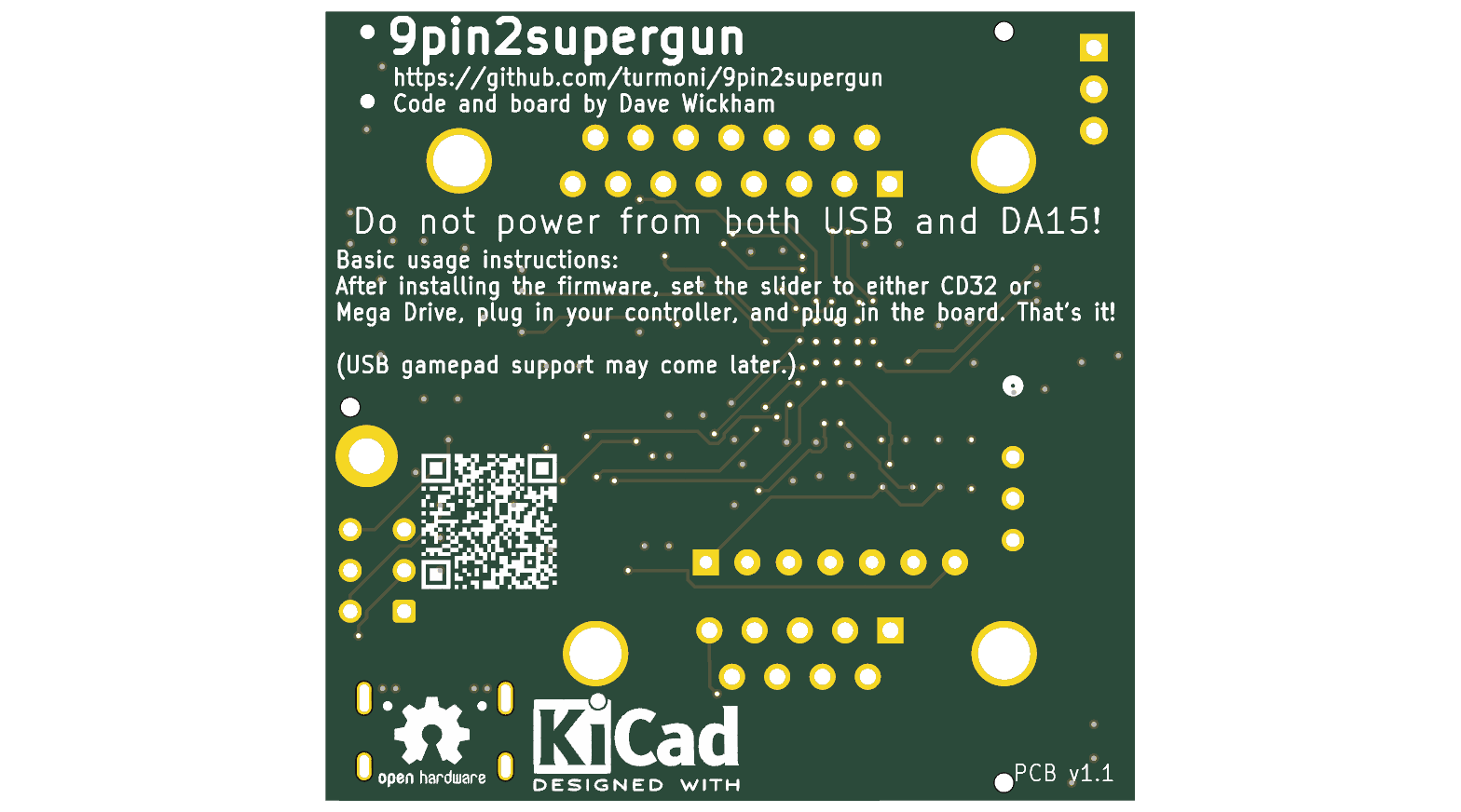
The KiCad project is in this directory, and for convenience each push gets rendered to the rendered directory as a PDF of the schematics, a set of gerber files, and a BOM as a CSV. You should be able to use the gerber archive to order boards directly, but for best results you should generate them yourself following your PCB fabricator's instructions (e.g. for JLCPCB).
Unlike the related Neo Geo Controller Tester, this is a moderately advanced soldering job. Don't be scared away from it if you're experienced with soldering (although you may need to learn some new techniques for fine pitched surface-mount components like the RP2040, and you probably want a hot plate, hot air gun, and solder paste), but if you're a complete beginner, this isn't for you.
The BOM CSV has the list of parts, but I don't know how useful that is for importing elsewhere. I have a DigiKey list that contains all the components that are needed, although at the time of writing, some of them are not available to order.
You may be able to get this fully/partially assembled from your PCB manufacturer - I didn't do this, so I can't comment, but there are only a few unusual components to manually spec and they are at least in LCSC (JLCPCB)'s database. If I end up doing this, I will probably replace U6 with more of the same type of shifter as U4 and U5 for cost reasons (one less reel to load).
When assembling, note that R2 is marked as DNF - if you're using the specified flash module, you shouldn't need to fit a resistor there. See Hardware Design with RP2040 (PDF) for more information on this, since most of the support circuitry is adapted from that reference design.
SW1 switches between presenting itself as a USB device or a USB host, based on the resistors on the CC pins. This doesn't change anything with the software, and any cables other than Type C to Type C will be entirely unimpacted by this. Set it to Device (up) if you want to plug it into your PC, and Host (down) if you want to plug a gamepad into it. Since there's no code at the moment that uses host mode, it's safe to leave or hardcode it as a device for the moment (connect the middle pins of the switch to their respective top pins, and populate R9 and R10).
Do not power the board from more than one place, e.g. don't plug it into a supergun and a USB power source.
| Qty | Value | Footprint | References |
|---|---|---|---|
| 11 | 100n | Capacitor_SMD:C_0805_2012Metric_Pad1.18x1.45mm_HandSolder | C5, C6, C7, C9, C11, C12, C13, C14, C15, C16, C50 |
| 2 | 10u | Capacitor_SMD:C_0805_2012Metric | C1, C4 |
| 2 | 15p | Capacitor_SMD:C_0805_2012Metric_Pad1.18x1.45mm_HandSolder | C2, C3 |
| 2 | 1k | Resistor_SMD:R_0805_2012Metric_Pad1.20x1.40mm_HandSolder | R1, R5 |
| 2 | 1u | Capacitor_SMD:C_0805_2012Metric_Pad1.18x1.45mm_HandSolder | C8, C10 |
| 2 | 27R | Resistor_SMD:R_0805_2012Metric_Pad1.20x1.40mm_HandSolder | R3, R4 |
| 2 | 5.1k | Resistor_SMD:R_0805_2012Metric_Pad1.20x1.40mm_HandSolder | R9, R10 |
| 2 | 56k | Resistor_SMD:R_0805_2012Metric_Pad1.20x1.40mm_HandSolder | R7, R8 |
| 2 | SN74LVC2T45DCUR | Package_SO:VSSOP-8_2.3x2mm_P0.5mm | U4, U5 |
| 1 | 09.10201.02 | footprints:SW3_09.10201.02_EAO | S2 |
| 1 | 10k | Resistor_THT:R_Array_SIP7 | RN1 |
| 1 | 10k | Resistor_SMD:R_0805_2012Metric_Pad1.20x1.40mm_HandSolder | R6 |
| 1 | 10u | Capacitor_SMD:C_0805_2012Metric_Pad1.18x1.45mm_HandSolder | C17 |
| 1 | 436333033816 | 9pin2supergun:436333033816 | S1 |
| 1 | ABM8-272-T3 | Crystal:Crystal_SMD_3225-4Pin_3.2x2.5mm | Y1 |
| 1 | Controller Input | Connector_Dsub:DSUB-9_Pins_Horizontal_P2.77x2.84mm_EdgePinOffset7.70mm_Housed_MountingHolesOffset9.12mm | J2 |
| 1 | Controller Output | Connector_Dsub:DSUB-15_Socket_Horizontal_P2.77x2.84mm_EdgePinOffset7.70mm_Housed_MountingHolesOffset9.12mm | J1 |
| 1 | DNF | Resistor_SMD:R_0402_1005Metric | R2 |
| 1 | Debug (2.54mm holes) | Connector_PinHeader_2.54mm:PinHeader_1x03_P2.54mm_Vertical | J4 |
| 1 | Debug (JST SH) | Connector_JST:JST_SH_SM03B-SRSS-TB_1x03-1MP_P1.00mm_Horizontal | J3 |
| 1 | NCP1117-3.3_SOT223 | Package_TO_SOT_SMD:SOT-223-3_TabPin2 | U1 |
| 1 | QR code | 9pin2supergun:QR code | QR***** |
| 1 | R-667995 | 9pin2supergun:R-667995_MIT | S3 |
| 1 | RP2040 | MCU_RaspberryPi_and_Boards:RP2040-QFN-56 | U3 |
| 1 | SK6812B | 9pin2supergun:SK6812B | D1 |
| 1 | SN74LVC8T245 | Package_SO:TSSOP-24_4.4x7.8mm_P0.65mm | U6 |
| 1 | SW_DPDT_x2 | Button_Switch_THT:SW_CK_JS202011CQN_DPDT_Straight | SW1 |
| 1 | UJ20-C-H-C-4-SMT-TR | 9pin2supergun:CUI_UJ20-C-H-C-4-SMT-TR | J5 |
| 1 | W25Q128JVS | Package_SO:SOIC-8_5.23x5.23mm_P1.27mm | U2 |
The 47 most common of 54 parts.
turmoni/9pin2supergun
Project to read a CD32, Mega Drive/Genesis, or generic 9-pin gamepad and output each control to a separate pin


hpvdt/typhoon_motherboard
Folder for each of the boards designed for a given project, even if there is only one board for a given project.

Tinkerbug-Robotics/TinkerRocket
Model rocket flight computer, ground station, iOS app, and simulation


pustowhite/rp2040-logic-analyzer
An 8-channel RP2040 logic analyzer PCB designed in KiCad, with USB-C and selectable 1.8 V / 3.3 V input logic modes.

deltabeard/DBGC
A Game Boy cartridge using the Raspberry Pi RP2040 with RTC and MBC support.

suddenabnormalsecrets/Serberus
Multi-headed and Multi-Protocol embedded system hacking tool.
It measures 49.5 × 48.3 mm and has 4 copper layers, 1.6 mm thick.
54 parts, built around the RP2040, W25Q128JVSIQ, SN74LVC2T45DCURE4 and SN74LVC8T245PW. The full list of its parts is on this page, with links to each part's symbol and footprint where PCBKit's library has them.
From the turmoni/9pin2supergun repository on GitHub, at the commit this page was made from: the board is pcb/9pin2supergun.kicad_pcb and its schematic pcb/9pin2supergun.kicad_sch. PCBKit opens the board in the browser, with nothing to install.
Its repository publishes it under the Apache-2.0 licence: you may reuse it on that licence's terms (keep the author's notice, and for a copyleft licence share your changes alike).