
2 layers
 tomlonca/SnP-BinaryClock
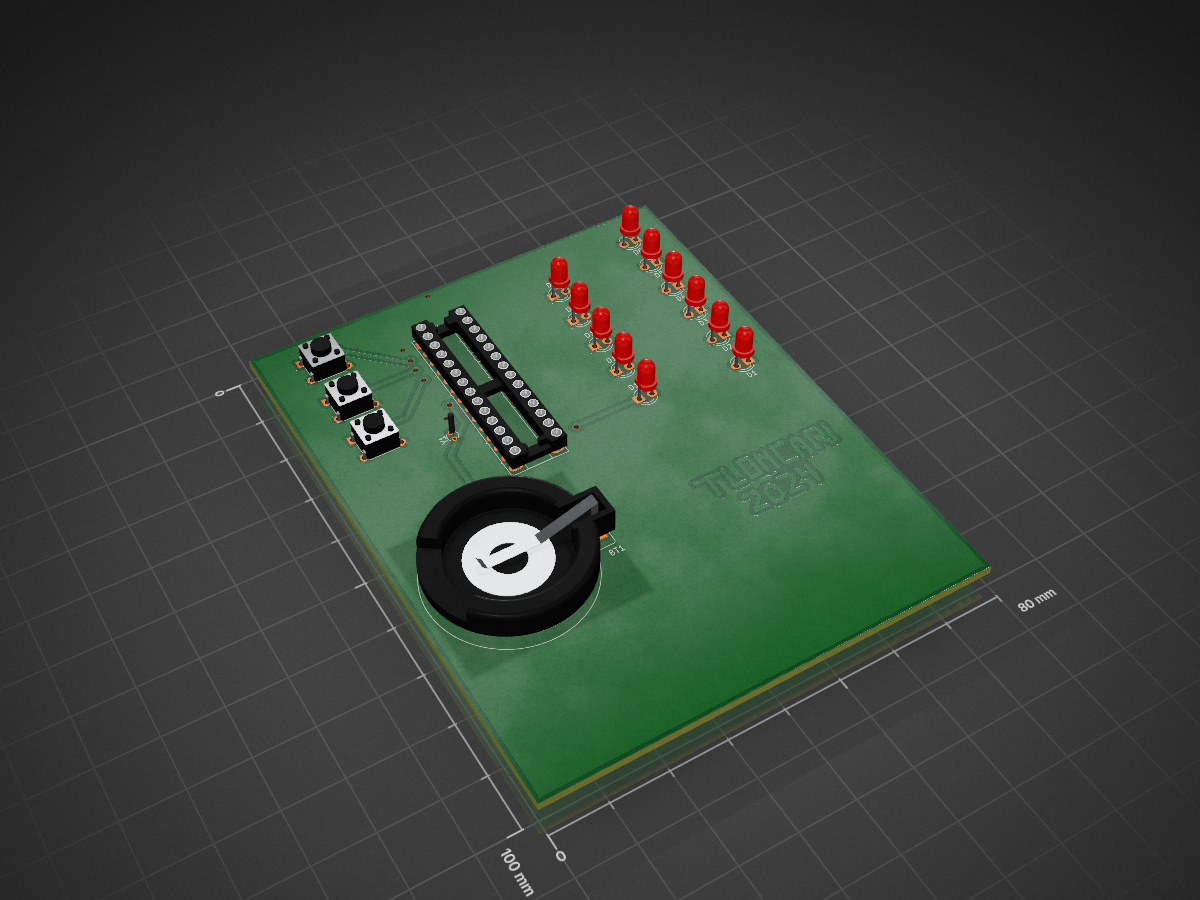
This project is about designing and implementing a binary clock using an AtMega48 microcontroller and a custom PCB.
BinaryClock is an open-source printed circuit board by tomlonca, from the tomlonca/SnP-BinaryClock repository on GitHub. It is a 2-layer board with 17 parts on 27 nets, routed with 190 tracks and 9 vias.
It is built around the ATMEGA48-20PI. Its parts include 11 diodes, 3 switches, 1 IC and 1 crystal. It belongs with the AVR (ATmega, ATtiny) boards of this library.
This project is about designing and implementing a binary clock using an AtMega48 microcontroller and a custom PCB.
The clock supports:
Mode switching is done via three buttons on the top of the board.
BinaryClock_pcb.sch – SchematicBinaryClock_pcb.prl – PCB layoutBinaryClock_pcb.pcb – Compiled firmwareWork in progress.
| Qty | Value | Footprint | References |
|---|---|---|---|
| 11 | LED | LED_THT:LED_D3.0mm | D1, D2, D3, D4, D5, D6, D8, D9, D10, D11, D12 |
| 3 | SW_Push | Button_Switch_THT:SW_TH_Tactile_Omron_B3F-10xx | SW1, SW2, SW3 |
| 1 | ATmega48-20P | Package_DIP:CERDIP-28_W7.62mm_SideBrazed_LongPads_Socket | U1 |
| 1 | Battery_Cell | Battery:BatteryHolder_Keystone_106_1x20mm | BT1 |
| 1 | Crystal | Crystal:Crystal_DS10_D1.0mm_L4.3mm_Vertical | Y1 |
17 parts, built around the ATMEGA48-20PI. The full list of its parts is on this page, with links to each part's symbol and footprint where PCBKit's library has them.
From the tomlonca/SnP-BinaryClock repository on GitHub, at the commit this page was made from: the board is BinaryClock.kicad_pcb and its schematic BinaryClock.kicad_sch. PCBKit opens the board in the browser, with nothing to install.
Its repository states no licence, so its author keeps all rights: ask tomlonca before reusing the design.


michAtEl/Bonsai-Modellcomputer
Es gibt auch eine Simulation des Lerncomputers (https://bonsai.pinyto.de/), die im digitalen Informatik-Schulbuch http://inf-schule.de verwendet wird.


hoglet67/RGBtoHDMI
Bare-metal Raspberry Pi project that provides pixel-perfect sampling of Retro Computer RGB/YUV video and conversion to HDMI
