
4 layers81.2 × 96.6 mm
 tomatencode/PenPlotterPCB
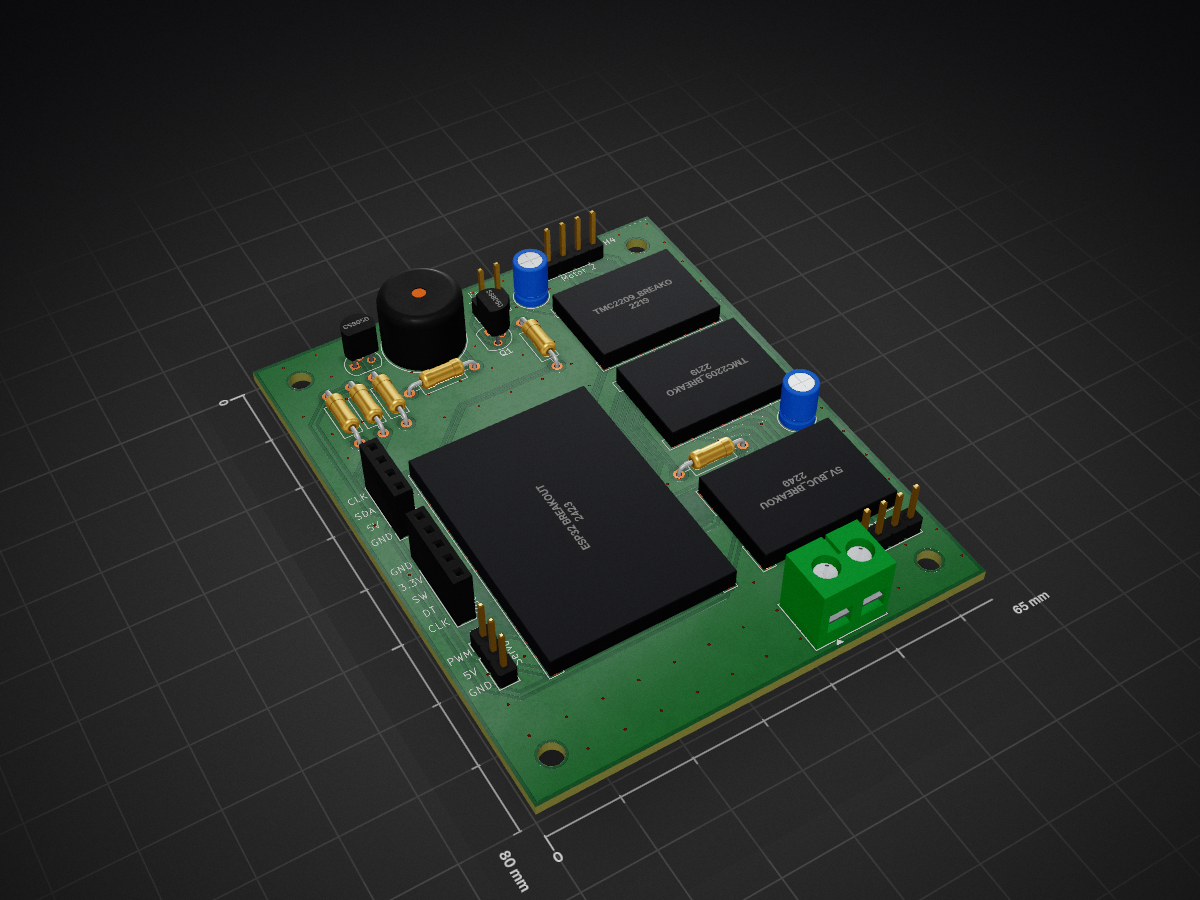
Eine selbst entworfene PCB-Steuerplatine für einen DIY Pen Plotter, entwickelt in KiCad. Die Platine steuert zwei Schrittmotoren für die XY-Bewegung, einen Servo für den Stifthub und übernimmt Benutzerführung sowie…
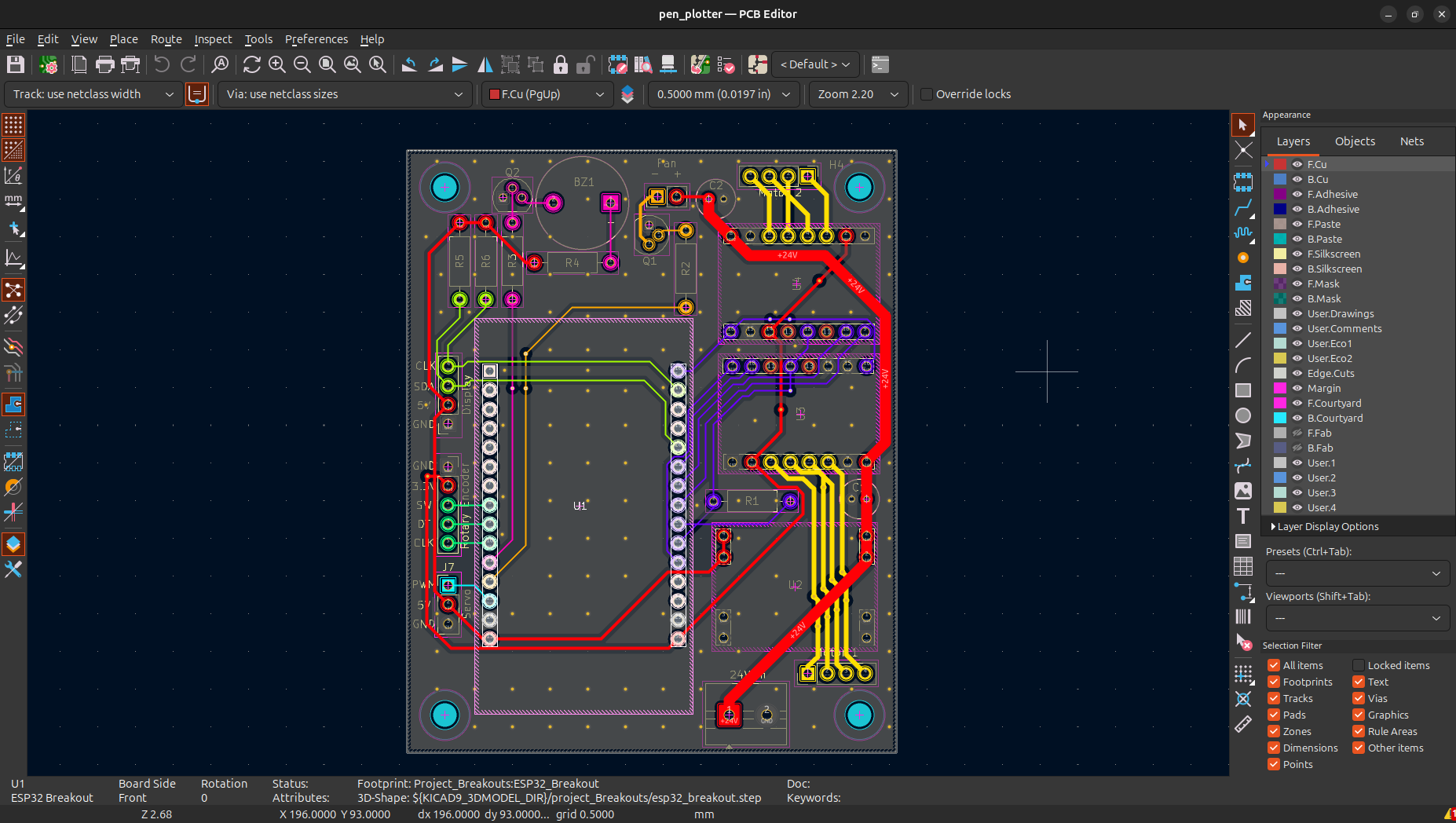
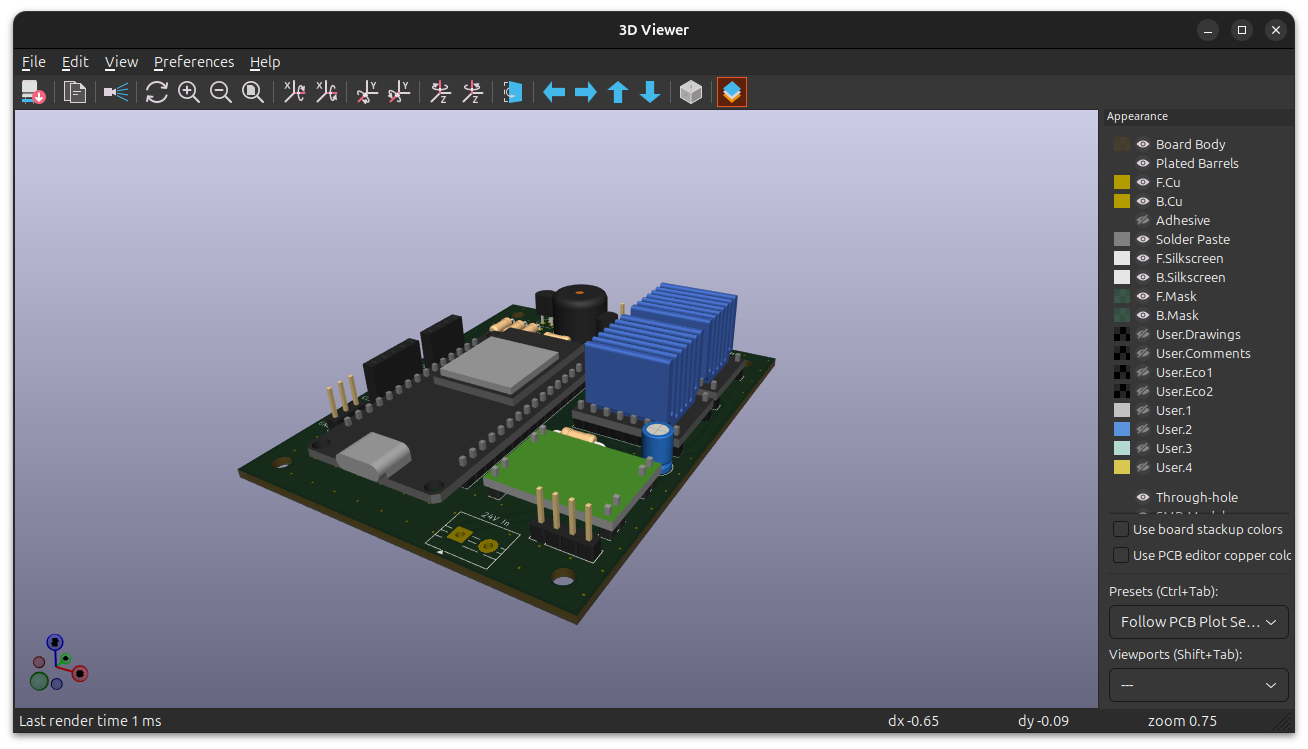
Pen plotter is an open-source printed circuit board by tomatencode, from the tomatencode/PenPlotterPCB repository on GitHub. It is a 2-layer board of 65 × 80 mm with 26 parts on 43 nets, routed with 183 tracks and 151 vias.
It is built around the SS8050. Its parts include 7 connectors, 6 resistors, 4 ICs, 2 capacitors and 2 transistors. It belongs with the ESP32 boards of this library.
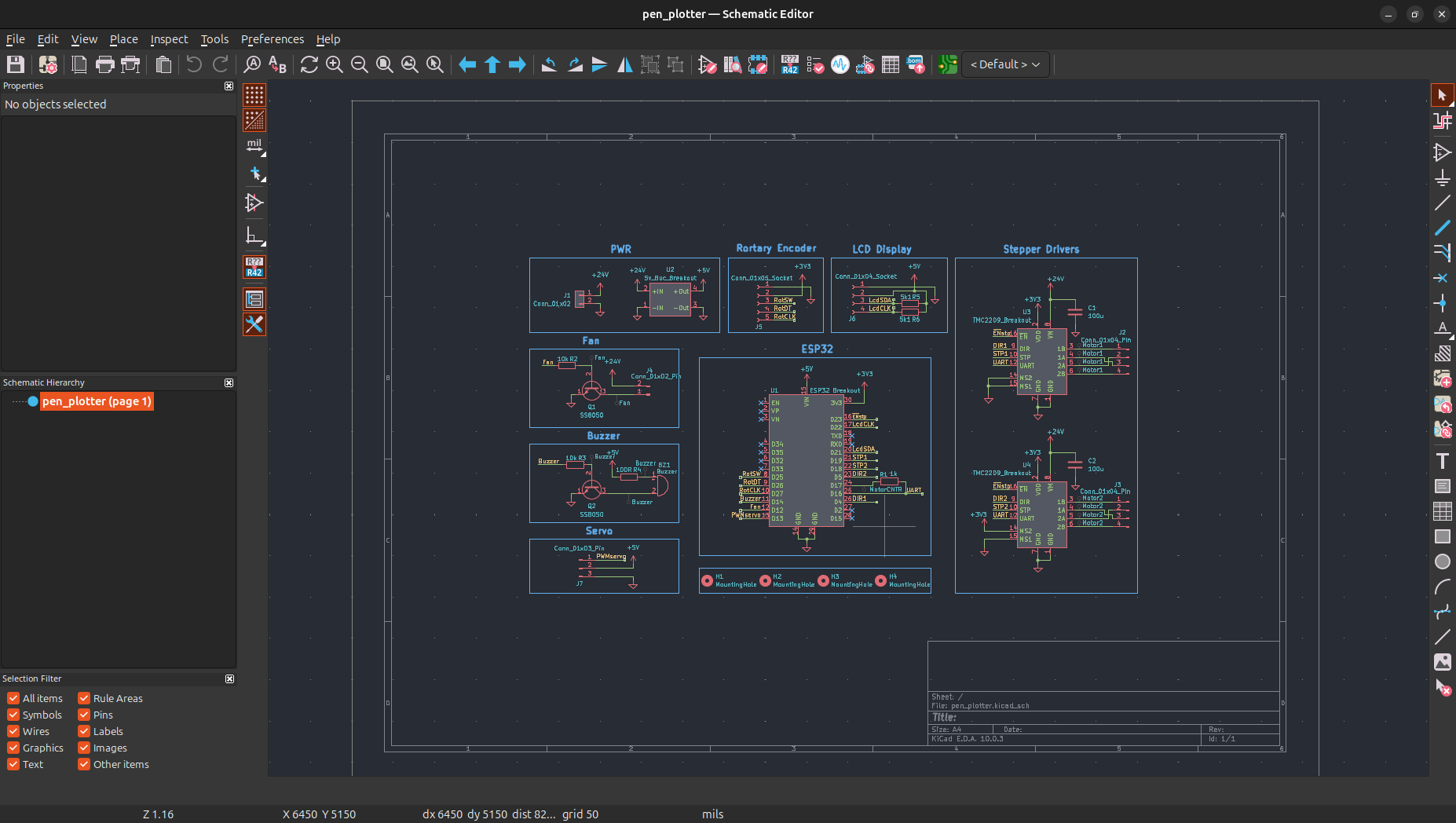
Eine selbst entworfene PCB-Steuerplatine für einen DIY Pen Plotter, entwickelt in KiCad. Die Platine steuert zwei Schrittmotoren für die XY-Bewegung, einen Servo für den Stifthub und übernimmt Benutzerführung sowie Energiemanagement vollständig auf einer einzigen Platine.
| Schiene | Quelle | Verbraucher |
|---|---|---|
| 24 V | Externer Transformator (DC-Buchse) | TMC2209 Motorspannung, Lüfter |
| 5 V | Buck Converter Breakout | ESP32, Servo, Buzzer, LCD |
| 3,3 V | Interner LDO des ESP32 | TMC2209 Logikspannung, Drehgeber |
| Qty | Value | Footprint | References |
|---|---|---|---|
| 4 | MountingHole | MountingHole:MountingHole_3.2mm_M3 | H1, H2, H3, H4 |
| 2 | 100u | Capacitor_THT:C_Radial_D5.0mm_H7.0mm_P2.00mm | C1, C2 |
| 2 | 10k | Resistor_THT:R_Axial_DIN0207_L6.3mm_D2.5mm_P10.16mm_Horizontal | R2, R3 |
| 2 | 5k1 | Resistor_THT:R_Axial_DIN0207_L6.3mm_D2.5mm_P10.16mm_Horizontal | R5, R6 |
| 2 | Conn_01x04_Pin | Connector_PinHeader_2.54mm:PinHeader_1x04_P2.54mm_Vertical | J2, J3 |
| 2 | SS8050 | Package_TO_SOT_THT:TO-92 | Q1, Q2 |
| 2 | TMC2209_Breakout | Project_Breakouts:TMC2209_Breakout | U3, U4 |
| 1 | 100R | Resistor_THT:R_Axial_DIN0207_L6.3mm_D2.5mm_P10.16mm_Horizontal | R4 |
| 1 | 1k | Resistor_THT:R_Axial_DIN0207_L6.3mm_D2.5mm_P10.16mm_Horizontal | R1 |
| 1 | 5v_Buc_Breakout | Project_Breakouts:5V_Buc_Breakout | U2 |
| 1 | Buzzer | Buzzer_Beeper:Buzzer_12x9.5RM7.6 | BZ1 |
| 1 | Conn_01x02 | TerminalBlock:TerminalBlock_MaiXu_MX126-5.0-02P_1x02_P5.00mm | J1 |
| 1 | Conn_01x02_Pin | Connector_PinHeader_2.54mm:PinHeader_1x02_P2.54mm_Vertical | J4 |
| 1 | Conn_01x03_Pin | Connector_PinHeader_2.54mm:PinHeader_1x03_P2.54mm_Vertical | J7 |
| 1 | Conn_01x04_Socket | Connector_PinSocket_2.54mm:PinSocket_1x04_P2.54mm_Vertical | J6 |
| 1 | Conn_01x05_Socket | Connector_PinSocket_2.54mm:PinSocket_1x05_P2.54mm_Vertical | J5 |
| 1 | ESP32 Breakout | Project_Breakouts:ESP32_Breakout | U1 |
It measures 65 × 80 mm and has 2 copper layers, 1.6 mm thick.
26 parts, built around the SS8050. The full list of its parts is on this page, with links to each part's symbol and footprint where PCBKit's library has them.
From the tomatencode/PenPlotterPCB repository on GitHub, at the commit this page was made from: the board is pen_plotter.kicad_pcb and its schematic pen_plotter.kicad_sch. PCBKit opens the board in the browser, with nothing to install.
Its repository states no licence, so its author keeps all rights: ask tomatencode before reusing the design.

bkshepherd/DaisySeedProjects
A collection of hardware and software projects based around the Electro-Smith Daisy Seed


ctag-fh-kiel/ctag-tbd
CTAG TBD >>to be determined<< an extendible open source Eurorack sound module


DerSpatz/PCB-reflow-solder-heat-plate
hardware design for a PCB reflow solder heat plate

GuitarML/GuitarPedalSTM32
Guitar pedal using a stm32h7 microcontroller programmed with CubeIDE (PCB and Firmware)