


2 layers220 × 150 mm
Control
Tom-Michiels/MooMoog
Compact D two-board sloped synthesizer, R0.5 design files (not production-ready)
65 parts

Compact D two-board sloped synthesizer, R0.5 design files (not production-ready)
Core is an open-source printed circuit board by Tom-Michiels, from the Tom-Michiels/MooMoog repository on GitHub. It is a 2-layer board of 210 × 90 mm with 23 parts on 16 nets, routed with 107 tracks and 1 via.
It belongs with the audio and music boards and the ESP32 boards of this library.
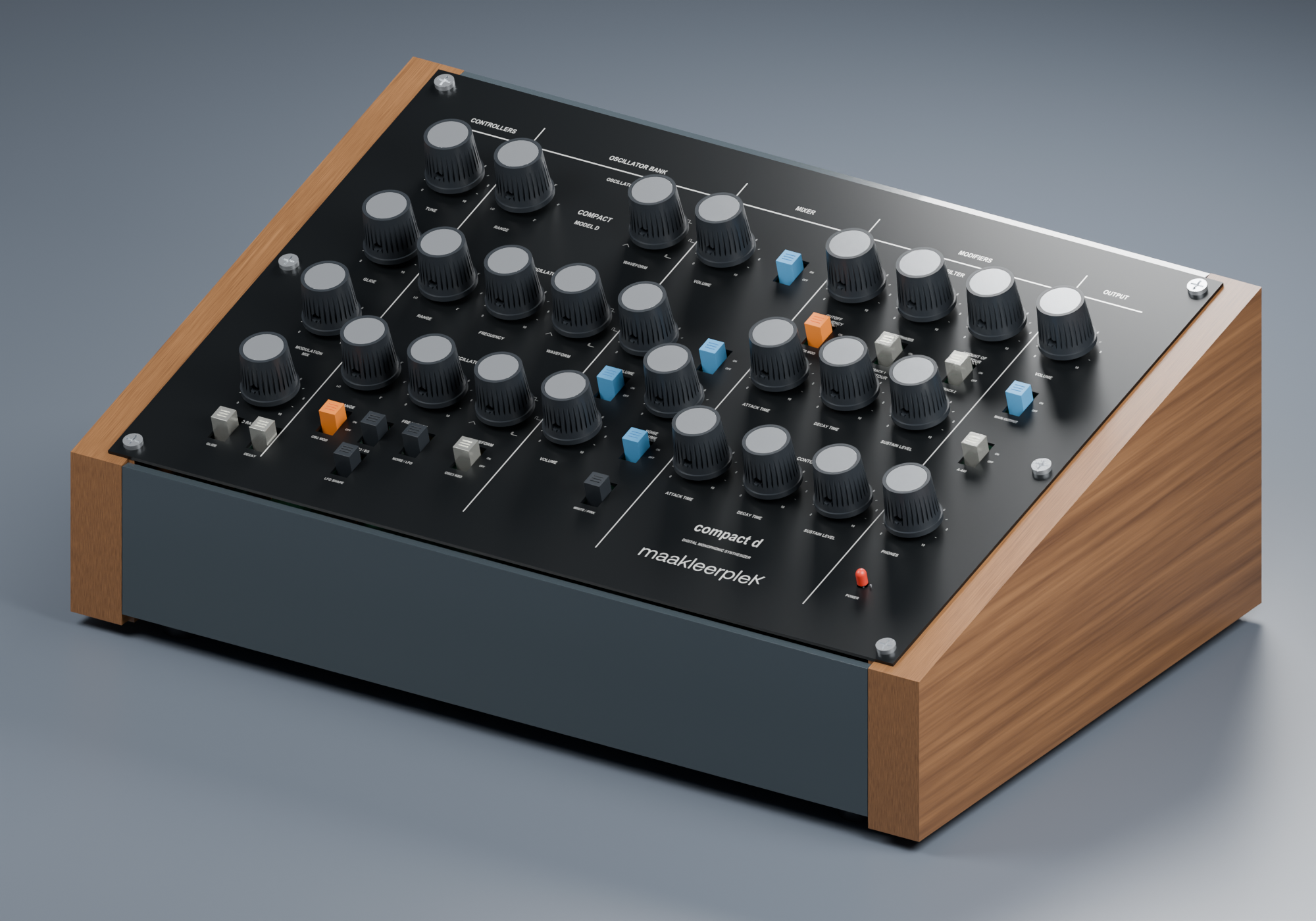
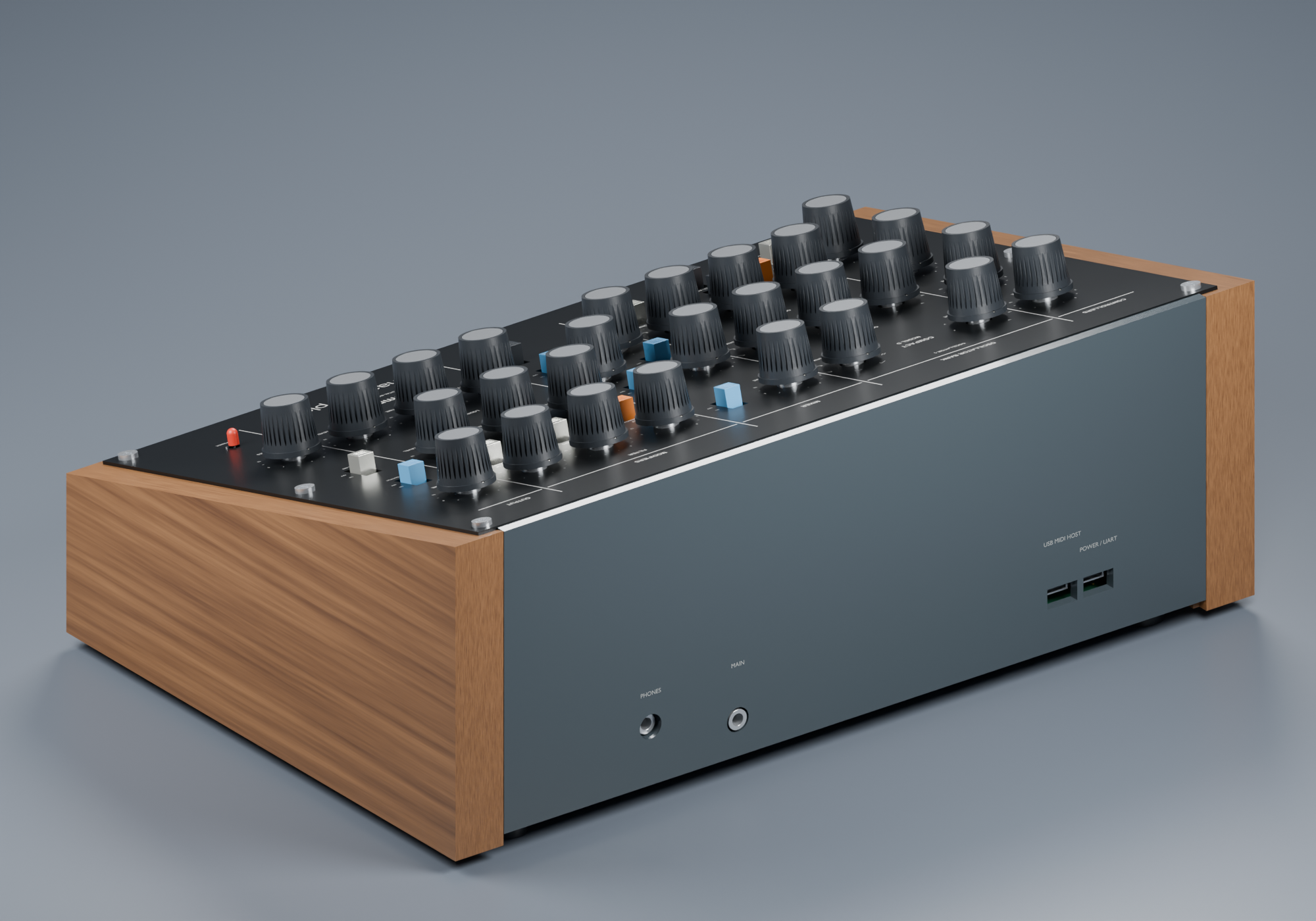 Rear — audio jacks and USB ports | 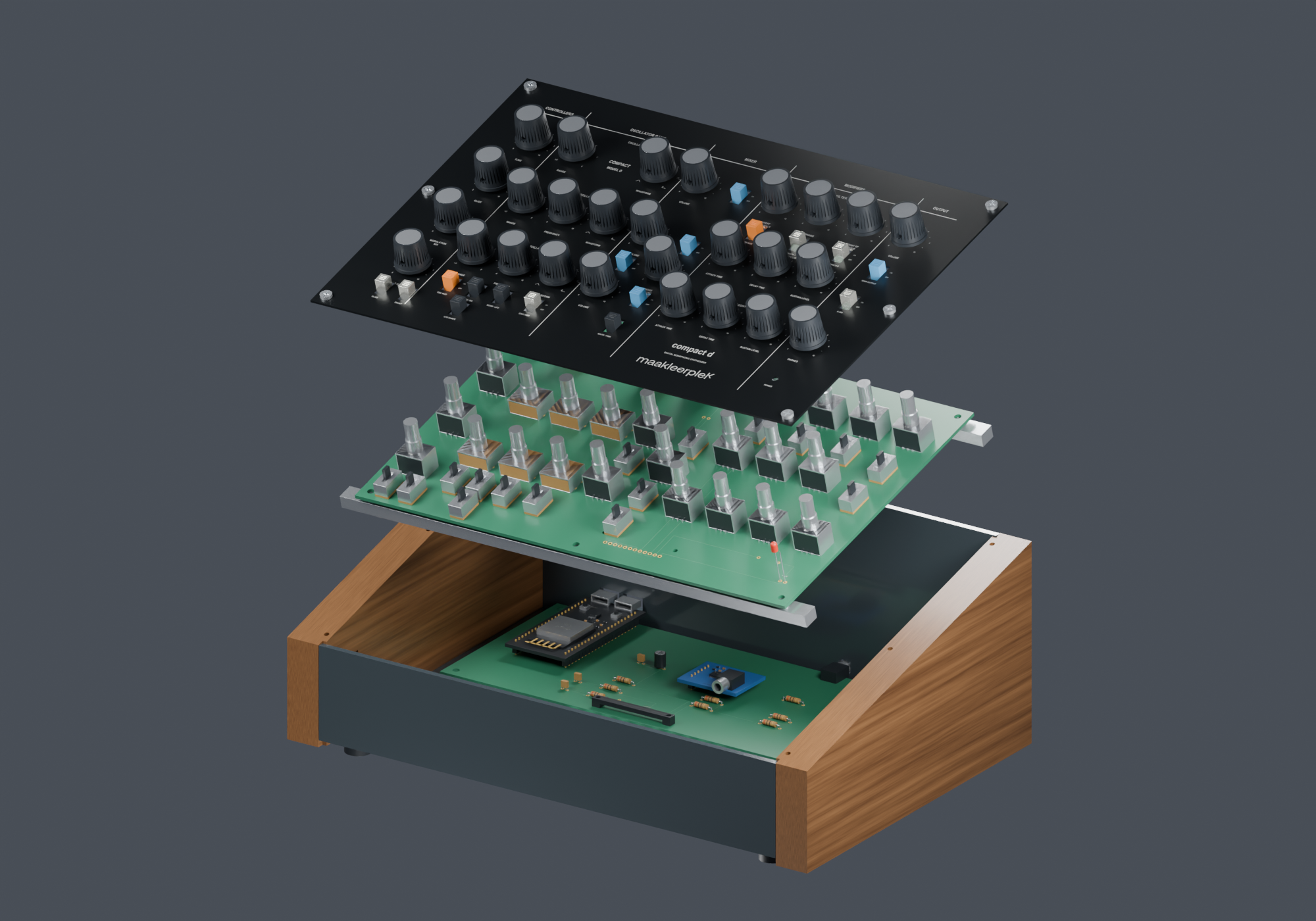 Exploded — panel, control PCB, rails and electronics PCB |
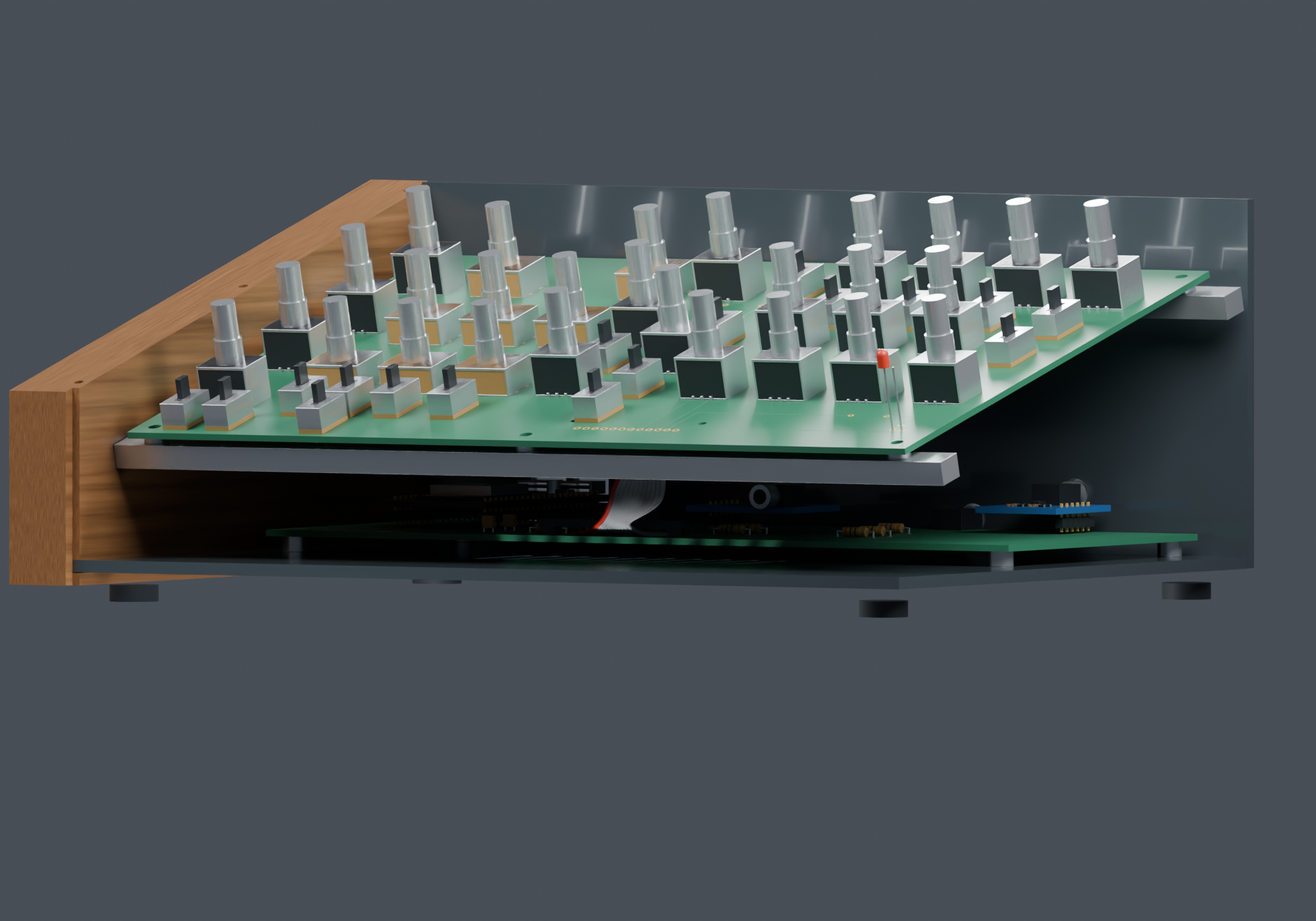 Interior — sloped control board above the flat electronics board | 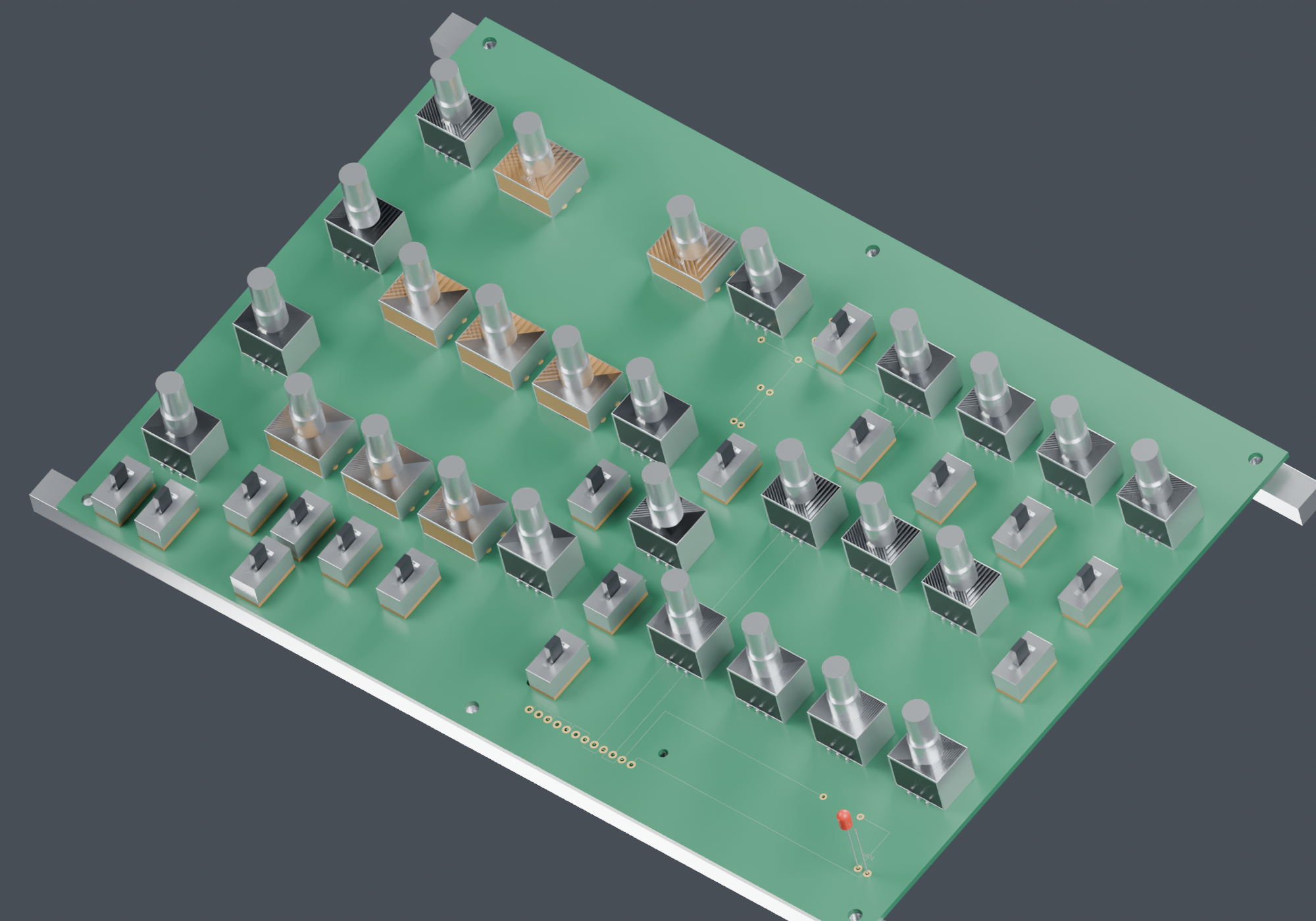 Control PCB — 19 pots, 8 encoders, 17 switches |
Renders use reconstructed component models, not certified vendor CAD.
Active revision: Split R0.5.
A 220 × 150-mm control PCB under a 15° aluminium panel and a separate 210 × 90-mm electronics PCB, joined by a soldered 12-wire ribbon. CNC wooden sides, PMMA front/rear/bottom, classical printed knobs and the official maakleerplek wordmark. Panel screws now have dedicated clear borders.
Audio input removed. MCP internal contact pull-ups used. No added SMD packages on the carrier boards; purchased modules retain their factory SMD electronics. Current counts: 19 pots, 8 encoders, 17 switches and one power LED.
Detailed design, not production-ready. 53 known-pad connection trajectories are routed. Many final physical footprints are still unverified and their missing connections cannot be counted by DRC. Detailed renders use reconstructed component models, not certified vendor CAD. USB keyboard power from the ARCELI board remains unverified. No Gerbers or copper-milling release.
The completion audit compares the functional terminal list against actual KiCad pads: 246 required terminals currently lack matching pads, across 45 padless component instances. These counts include functional module terminals whose physical mapping must still be established. Run scripts/audit_completion_r05.py with KiCad Python; it deliberately returns failure while completion blockers remain. A documented Same Sky SJ1-3523N candidate footprint is now available under core/libraries/Documented.pretty; it is not yet installed on the active board, because its board-edge and panel fit must be redesigned together.
Older revisions remain historical. The original specification is in docs/projectspecification-v1.0.md; decisions and user changes are in docs/decisions.md.
| Qty | Value | Footprint | References |
|---|---|---|---|
| 4 | MountingHole_3.2mm_M3 | MountingHole_3.2mm_M3 | H1, H2, H3, H4 |
| 2 | 100k | R_Axial_DIN0207_L6.3mm_D2.5mm_P10.16mm_Horizontal | RA6, RA7 |
| 2 | 10k | R_Axial_DIN0207_L6.3mm_D2.5mm_P10.16mm_Horizontal | RA4, RP5 |
| 2 | 1k | R_Axial_DIN0207_L6.3mm_D2.5mm_P10.16mm_Horizontal | RA1, RA2 |
| 2 | 1nF | C_Disc_D3.0mm_W1.6mm_P2.50mm | CA1, CA2 |
| 2 | MountingHole_2.2mm_M2 | MountingHole_2.2mm_M2 | HC1, HC2 |
| 1 | 100R | R_Axial_DIN0207_L6.3mm_D2.5mm_P10.16mm_Horizontal | RA3 |
| 1 | 100nF | C_Disc_D3.0mm_W1.6mm_P2.50mm | CC1 |
| 1 | 10uF 10V | CP_Radial_D5.0mm_P2.00mm | CC2 |
| 1 | 12-way soldered ribbon | JCORE | |
| 1 | 3.5mm MAIN output / MPN pending | JMAIN | |
| 1 | 4k7 | R_Axial_DIN0207_L6.3mm_D2.5mm_P10.16mm_Horizontal | RA5 |
| 1 | ARCELI ESP32-S3 N16R8 | MCU1 | |
| 1 | PCM5102 / L main, R phones | DAC1 | |
| 1 | Quystetes TPA6132 module | HP1 |
Tom-Michiels/MooMoog
Compact D two-board sloped synthesizer, R0.5 design files (not production-ready)


google/mozc-devices
Circuit diagrams and firmware source code for Gboard DIY keyboards


Duet3D/Duet-2-Hardware
The KiCAD source for the Duet 3d printer controller see www.duet3d.com
It measures 210 × 90 mm and has 2 copper layers, 1.6 mm thick.
23 parts. The full list of its parts is on this page, with links to each part's symbol and footprint where PCBKit's library has them.
From the Tom-Michiels/MooMoog repository on GitHub, at the commit this page was made from: the board is hardware/split-r0.5/core/core.kicad_pcb and its schematic hardware/split-r0.5/control/control.kicad_sch. PCBKit opens the board in the browser, with nothing to install.
Its repository states no licence, so its author keeps all rights: ask Tom-Michiels before reusing the design.