2 layers52.2 × 52.2 mm
Base promicro
google/mozc-devices
Circuit diagrams and firmware source code for Gboard DIY keyboards
30 parts3kApache-2.0

 timbleman/Window_curtain_alarm1
A standalone alarm system that opens your curtain.
Curtain wiring is an open-source printed circuit board by timbleman, from the timbleman/Window_curtain_alarm repository on GitHub. It is a 2-layer board of 99.1 × 62.2 mm with 30 parts on 113 nets, routed with 89 tracks and 3 vias.
It is built around the TMC22091KHC. Its parts include 10 connectors, 6 resistors, 4 capacitors, 2 ICs and 1 diode. It belongs with the ESP8266 boards of this library.
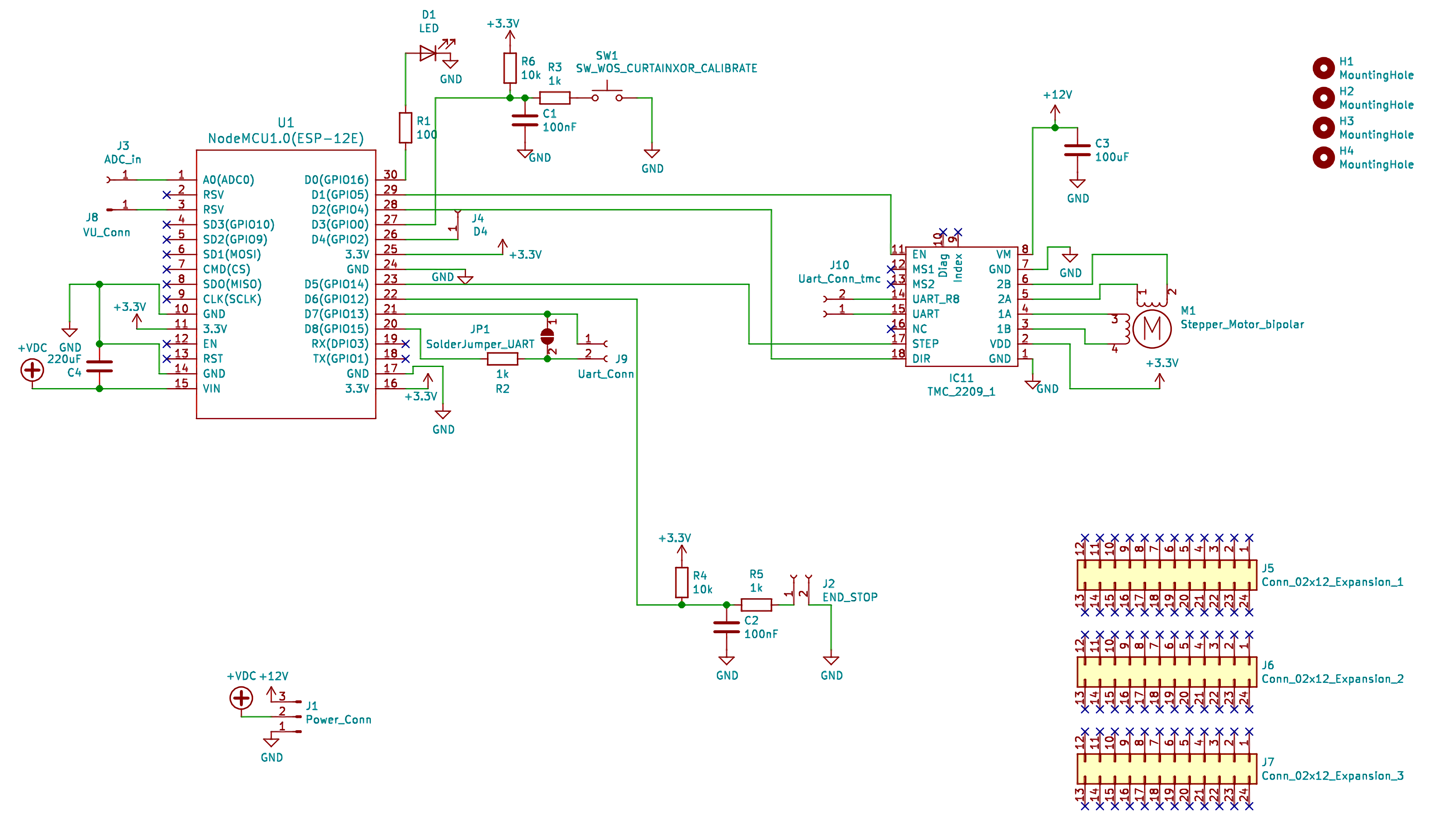
This directory contains a wiring diagram and a PCB design. Created using KiCad.
This wiring diagram is also present as a PDF. Please refer to the document for needed components. Low noise power supplies are expected, if the input voltage is noisy you may need to add some components.
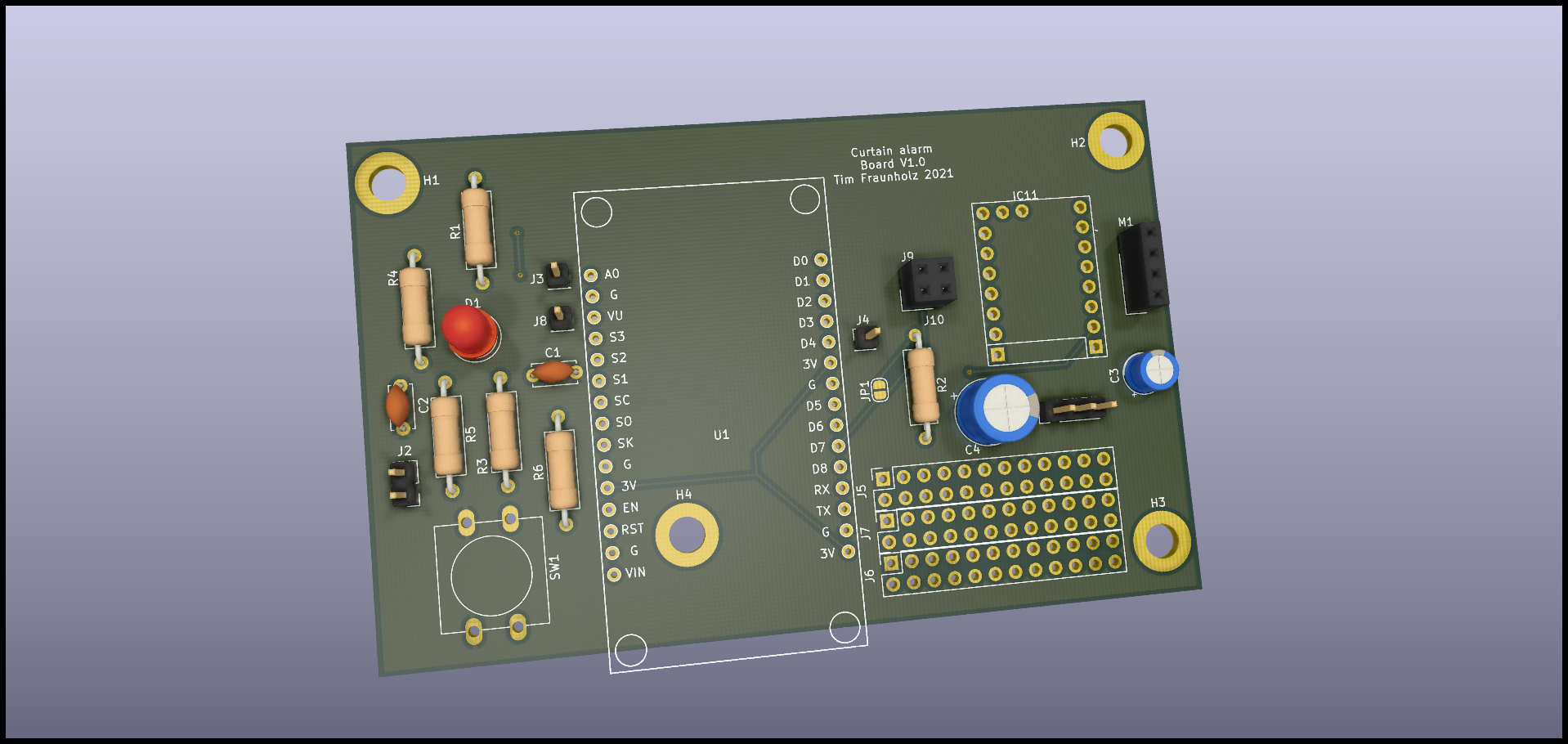
This is the board designed for the curtain alarm.
The board has a status LED and a button for user input.
To fit inside the 3D printed housing, the ESP8266 (NodeMCU 12E) and TMC2209 should be socketed. The LED standoff needs to be installed.
The stepper driver and ESP can use separate power supplies. This is recommended to avoid noise.
Theoretically, you could power both the ESP and motor using the micro USB port and connecting the ESPs VU to the TMCs VM.
If you detect power-related problems (like crashing when the motor starts turning), you could add some additional filtering.
There is some additional space to include some components like a low pass filter.
While the code does not yet utilize the TMCs UART functionality, the board is ready for it. Depending on the desired mode of communication, J9, J10, or JP1 need to be connected.
R2 may need to be added.
| Qty | Value | Footprint | References |
|---|---|---|---|
| 4 | MountingHole | MountingHole:MountingHole_4.3mm_M4_DIN965_Pad_TopBottom | H1, H2, H3, H4 |
| 3 | 1k | Resistor_THT:R_Axial_DIN0309_L9.0mm_D3.2mm_P12.70mm_Horizontal | R2, R3, R5 |
| 2 | 100nF | Capacitor_THT:C_Disc_D5.0mm_W2.5mm_P5.00mm | C1, C2 |
| 2 | 10k | Resistor_THT:R_Axial_DIN0309_L9.0mm_D3.2mm_P12.70mm_Horizontal | R4, R6 |
| 1 | 100 | Resistor_THT:R_Axial_DIN0309_L9.0mm_D3.2mm_P12.70mm_Horizontal | R1 |
| 1 | 100uF | Capacitor_THT:CP_Radial_D5.0mm_P2.50mm | C3 |
| 1 | 220uF | Capacitor_THT:CP_Radial_D8.0mm_P3.50mm | C4 |
| 1 | ADC_in | Connector_PinHeader_2.54mm:PinHeader_1x01_P2.54mm_Vertical | J3 |
| 1 | Conn_02x12_Expansion_1 | Connector_PinSocket_2.54mm:PinSocket_2x12_P2.54mm_Vertical | J5 |
| 1 | Conn_02x12_Expansion_2 | Connector_PinSocket_2.54mm:PinSocket_2x12_P2.54mm_Vertical | J6 |
| 1 | Conn_02x12_Expansion_3 | Connector_PinSocket_2.54mm:PinSocket_2x12_P2.54mm_Vertical | J7 |
| 1 | D4 | Connector_PinHeader_2.54mm:PinHeader_1x01_P2.54mm_Vertical | J4 |
| 1 | END_STOP | Connector_PinHeader_2.54mm:PinHeader_1x02_P2.54mm_Vertical | J2 |
| 1 | LED | LED_THT:LED_D5.0mm | D1 |
| 1 | NodeMCU1.0(ESP-12E) | ESP8266:NodeMCU-LoLinV3 | U1 |
| 1 | Power_Conn | Connector_PinHeader_2.54mm:PinHeader_1x03_P2.54mm_Vertical | J1 |
| 1 | SW_WOS_CURTAINXOR_CALIBRATE | Button_Switch_THT:SW_PUSH-12mm | SW1 |
| 1 | SolderJumper_UART | Jumper:SolderJumper-2_P1.3mm_Open_RoundedPad1.0x1.5mm | JP1 |
| 1 | Stepper_Motor_bipolar | Connector_PinSocket_2.54mm:PinSocket_1x04_P2.54mm_Vertical | M1 |
| 1 | TMC_2209_1 | TMC_test:PinSocket_2x09_P2.54mm_Vertical | IC11 |
| 1 | Uart_Conn | Connector_PinSocket_2.54mm:PinSocket_1x02_P2.54mm_Vertical | J9 |
| 1 | Uart_Conn_tmc | Connector_PinSocket_2.54mm:PinSocket_1x02_P2.54mm_Vertical | J10 |
| 1 | VU_Conn | Connector_PinHeader_2.54mm:PinHeader_1x01_P2.54mm_Vertical | J8 |
google/mozc-devices
Circuit diagrams and firmware source code for Gboard DIY keyboards


VoronDesign/Voron-Hardware
Cool Hardware designed by the Voron Design group

hoglet67/RGBtoHDMI
Bare-metal Raspberry Pi project that provides pixel-perfect sampling of Retro Computer RGB/YUV video and conversion to HDMI

tenderlove/initial-v
It's a BMW shifter converted to a Bluetooth Keyboard that you use with Vim

hackclub/OnBoard
💡 Join 1,000 teenagers and make your first PCB with a $100 grant!


It measures 99.1 × 62.2 mm and has 2 copper layers, 1.6 mm thick.
30 parts, built around the TMC22091KHC. The full list of its parts is on this page, with links to each part's symbol and footprint where PCBKit's library has them.
From the timbleman/Window_curtain_alarm repository on GitHub, at the commit this page was made from: the board is curtain_wiring/curtain_wiring.kicad_pcb. PCBKit opens the board in the browser, with nothing to install.
Its repository states no licence, so its author keeps all rights: ask timbleman before reusing the design.