
2 layers168.9 × 71.1 mm
STPre6080PCB
thorpej/Electronics
thorpej's electronics projects repository. Tube audio, other tube stuff, and stuff with computers in it.
55 parts4MIT
 thorpej/Electronics4
thorpej's electronics projects repository. Tube audio, other tube stuff, and stuff with computers in it.
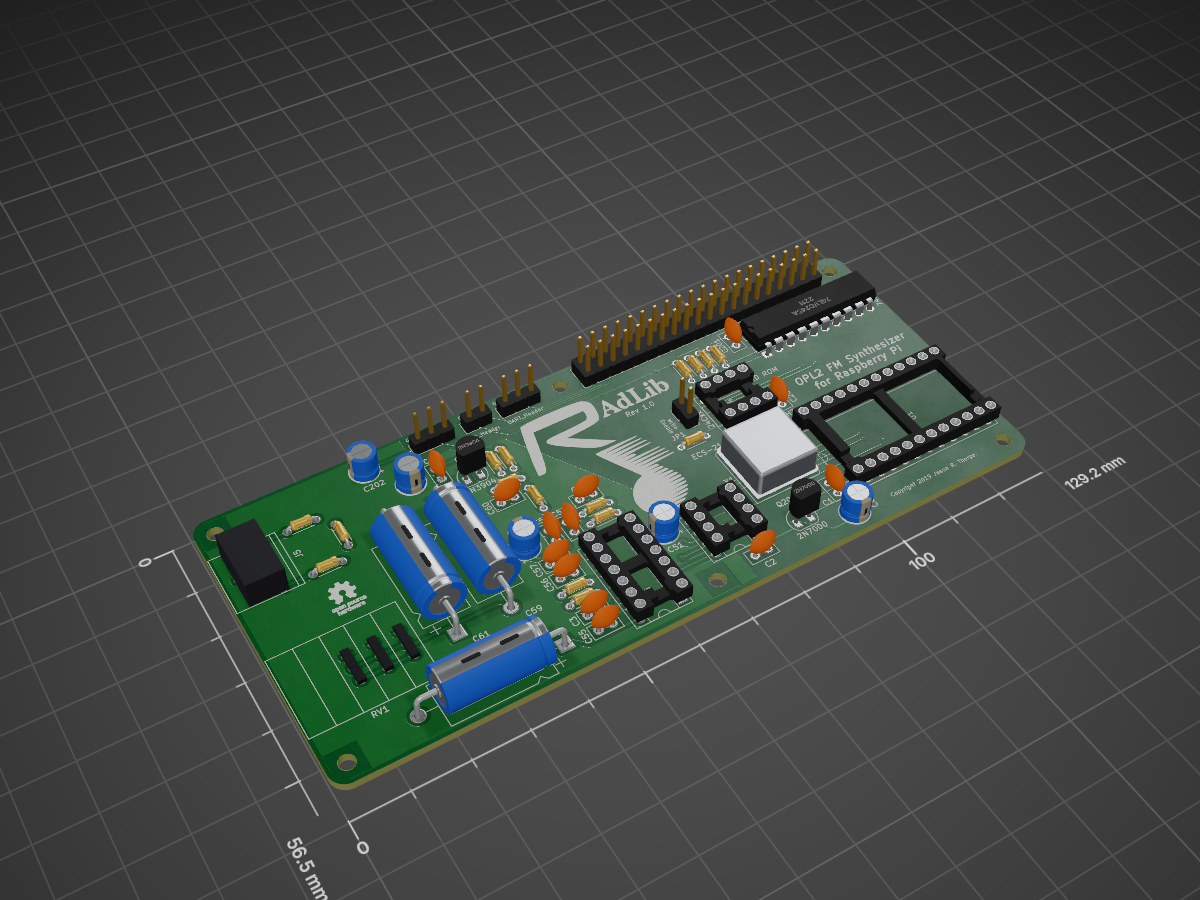
RAdLib is an open-source printed circuit board by thorpej, from the thorpej/Electronics repository on GitHub, published under the MIT licence. It is a 2-layer board of 129.2 × 56.5 mm with 64 parts on 65 nets, routed with 457 tracks and 23 vias.
It is built around the 74LVC245AD. Its parts include 21 capacitors, 16 resistors, 5 ICs, 5 connectors and 2 transistors.
This is just a simple breakout board to make it easier to play around with IN-14 Nixie tubes (or any other Nixie that uses the same basic footprint); I included some old Soviet iconography on the board just for fun.
To use the board, thread the spindly IN-14 lead wires through the holes and solder it into place. The arrow on the footprint indicates the anode lead wire, and corresponds to the arrow on the bottom of the glass. The R1 resistor footprint is for the required current-limiting resistor. If your power supply is already current-limited, yoiu can just place a jumper in this position. Attach some standard 5.04mm pitch screw terminals and some standoffs with #4 machine screws and you're all set.
https://www.instagram.com/p/Bg9sY63FQ7b/
Nixie tubes work like a neon bulb: a threshold voltage is required to light them up (the "striking" voltage), and until that threshold is reached, they behave like an open circuit. However, once the gas ionizes and the glow discharge begins, the resistance drops very quickly to the low-1000s of Ohms. In order to avoid destroying the tube, the current must be limited. For IN-14s, the maximum allowable current is 2.5mA for the digits (and quite a bit less for the decimal points; on the order of 0.5mA).
A fairly safe way to determine the initial value for your current limiting resistor is to use Ohm's Law to calculate the resistor needed to drop the supply voltage at the max current. So, if you have a 180V supply, and wish to limit to 2.5mA, you would need a 72K resistor; 75K is close enough. It's done this way to guarantee that you will not exceed the max current through the tube. The actual current drawn in the next step will be significantly less than 2.5mA because there will be some voltage dropped across the tube.
Now, hook up your Nixie with this resistor in-series with the anode and connect one of the cathodes to ground, let the digit light up, and measure the voltage drop across the resistor. For this example, we'll say that 49V is dropped across the resistor. This means that 0.7mA is flowing through the tube. Now use Ohm's Law again to calculate a new resistor value to give you the desired current at the voltage drop that you just measured. In this case, I want 1mA to flow through my Nixies, which would mean a 49K resistor; 47K is the closest standard value which is what I'll use. 1/2W rating will be sufficient. If you want 2.5mA to flow, a 22K resistor will get you close enough; I chose 1mA because I can't tell any difference in brightness, and 1mA gives me plenty of safety margin and should extend the life of the tube.
| Qty | Value | Footprint | References |
|---|---|---|---|
| 6 | .1uF | Capacitor_THT:C_Disc_D5.0mm_W2.5mm_P2.50mm | C1, C2, C3, C4, C201, C203 |
| 5 | 10K | Resistor_THT:R_Axial_DIN0204_L3.6mm_D1.6mm_P5.08mm_Horizontal | R1, R2, R3, R4, R9 |
| 5 | 10uF | Capacitor_THT:CP_Radial_D5.0mm_P2.50mm | C5, C6, C7, C51, C202 |
| 5 | 3.3K | Resistor_THT:R_Axial_DIN0204_L3.6mm_D1.6mm_P5.08mm_Horizontal | R201, R202, R203, R204, R205 |
| 3 | 10K | jrt-Potentiometers:Potentiometer_Bourns_91A1x_A24 | RV1, RV1, RV1 |
| 3 | 10R | Resistor_THT:R_Axial_DIN0204_L3.6mm_D1.6mm_P5.08mm_Horizontal | R8, R10, R11 |
| 3 | 220uF | Capacitor_THT:CP_Axial_L18.0mm_D8.0mm_P25.00mm_Horizontal | C58, C59, C61 |
| 2 | 1000pF | Capacitor_THT:C_Disc_D5.0mm_W2.5mm_P2.50mm | C53, C56 |
| 2 | 100pF | Capacitor_THT:C_Disc_D5.0mm_W2.5mm_P2.50mm | C54, C57 |
| 2 | 1K | Resistor_THT:R_Axial_DIN0204_L3.6mm_D1.6mm_P5.08mm_Horizontal | R5, R7 |
| 1 | .047uF | Capacitor_THT:C_Disc_D5.0mm_W2.5mm_P2.50mm | C60 |
| 1 | 2.7K | Resistor_THT:R_Axial_DIN0204_L3.6mm_D1.6mm_P5.08mm_Horizontal | R6 |
| 1 | 24Cxx | Package_DIP:DIP-8_W7.62mm_Socket | U204 |
| 1 | 2N3904 | Package_TO_SOT_THT:TO-92_HandSolder | Q1 |
| 1 | 2N7000 | Package_TO_SOT_THT:TO-92_HandSolder | Q201 |
| 1 | 470pF | Capacitor_THT:C_Disc_D5.0mm_W2.5mm_P2.50mm | C55 |
| 1 | 680pF | Capacitor_THT:C_Disc_D5.0mm_W2.5mm_P2.50mm | C52 |
| 1 | 74LVC245A | Package_DIP:DIP-20_W7.62mm | U201 |
| 1 | AudioJack3 | jrt-Connectors:Jack_3.5mm_STX-3120-3B | J5 |
| 1 | ECS-2100AX-3.579545MHZ | Oscillator:Oscillator_DIP-8 | X1 |
| 1 | I2C_Header | Connector_PinHeader_2.54mm:PinHeader_1x02_P2.54mm_Vertical | J4 |
| 1 | Jumper_2_Open | Connector_PinHeader_2.54mm:PinHeader_1x02_P2.54mm_Vertical | JP1 |
| 1 | LOGO | jrt-Graphics:Volvo_R_small | G*** |
| 1 | LOGO | jrt-Graphics:AdLib_Logo_Text | G*** |
| 1 | LOGO | jrt-Graphics:AdLib_Logo | G*** |
| 1 | OP495 | Package_DIP:DIP-14_W7.62mm_Socket | U3 |
| 1 | Power_Output_Header | Connector_PinHeader_2.54mm:PinHeader_1x03_P2.54mm_Vertical | J3 |
| 1 | Raspberry_Pi_2_3 | Connector_PinHeader_2.54mm:PinHeader_2x20_P2.54mm_Vertical | J1 |
| 1 | UART_Header | Connector_PinHeader_2.54mm:PinHeader_1x03_P2.54mm_Vertical | J2 |
| 1 | YM3014B | Package_DIP:DIP-8_W7.62mm_Socket | U2 |
| 1 | YM3812 | Package_DIP:DIP-24_W15.24mm_Socket | U1 |
The 57 most common of 64 parts.
It measures 129.2 × 56.5 mm and has 2 copper layers, 1.6 mm thick.
64 parts, built around the 74LVC245AD. The full list of its parts is on this page, with links to each part's symbol and footprint where PCBKit's library has them.
From the thorpej/Electronics repository on GitHub, at the commit this page was made from: the board is Misc_Audio/RAdLib/RAdLib.kicad_pcb. PCBKit opens the board in the browser, with nothing to install.
Its repository publishes it under the MIT licence: you may reuse it on that licence's terms (keep the author's notice, and for a copyleft licence share your changes alike).
thorpej/Electronics
thorpej's electronics projects repository. Tube audio, other tube stuff, and stuff with computers in it.

thorpej/Electronics
thorpej's electronics projects repository. Tube audio, other tube stuff, and stuff with computers in it.

thorpej/Electronics
thorpej's electronics projects repository. Tube audio, other tube stuff, and stuff with computers in it.

thorpej/Electronics
thorpej's electronics projects repository. Tube audio, other tube stuff, and stuff with computers in it.

thorpej/Electronics
thorpej's electronics projects repository. Tube audio, other tube stuff, and stuff with computers in it.

thorpej/Electronics
thorpej's electronics projects repository. Tube audio, other tube stuff, and stuff with computers in it.

thorpej/Electronics
thorpej's electronics projects repository. Tube audio, other tube stuff, and stuff with computers in it.

thorpej/Electronics
thorpej's electronics projects repository. Tube audio, other tube stuff, and stuff with computers in it.

thorpej/Electronics
thorpej's electronics projects repository. Tube audio, other tube stuff, and stuff with computers in it.

thorpej/Electronics
thorpej's electronics projects repository. Tube audio, other tube stuff, and stuff with computers in it.

thorpej/Electronics
thorpej's electronics projects repository. Tube audio, other tube stuff, and stuff with computers in it.

thorpej/Electronics
thorpej's electronics projects repository. Tube audio, other tube stuff, and stuff with computers in it.


tjboldt/Apple2-IO-RPi
Apple II expansion card using a Raspberry Pi for I/O


rallepalaveev/A2DVI
This is based on Clintech Pico Board (CPB) with 48 GPIOs, most 5V tolerant.

robfinch/Cores
Cores ===== RTF's Cores Use at your own risk. Welcome to my galaxy of cores. Contained in the directories are IP cores, source code for digital circuits.


