2 layers35 × 38.7 mm
Rpi2040-lcd gauge
fharold/rpi2040-lcd-gauge
Basic and versatile gauges based on the WAVESHARE RP2040-LCD-1.28 module. A small HAT enhances it:
52 parts
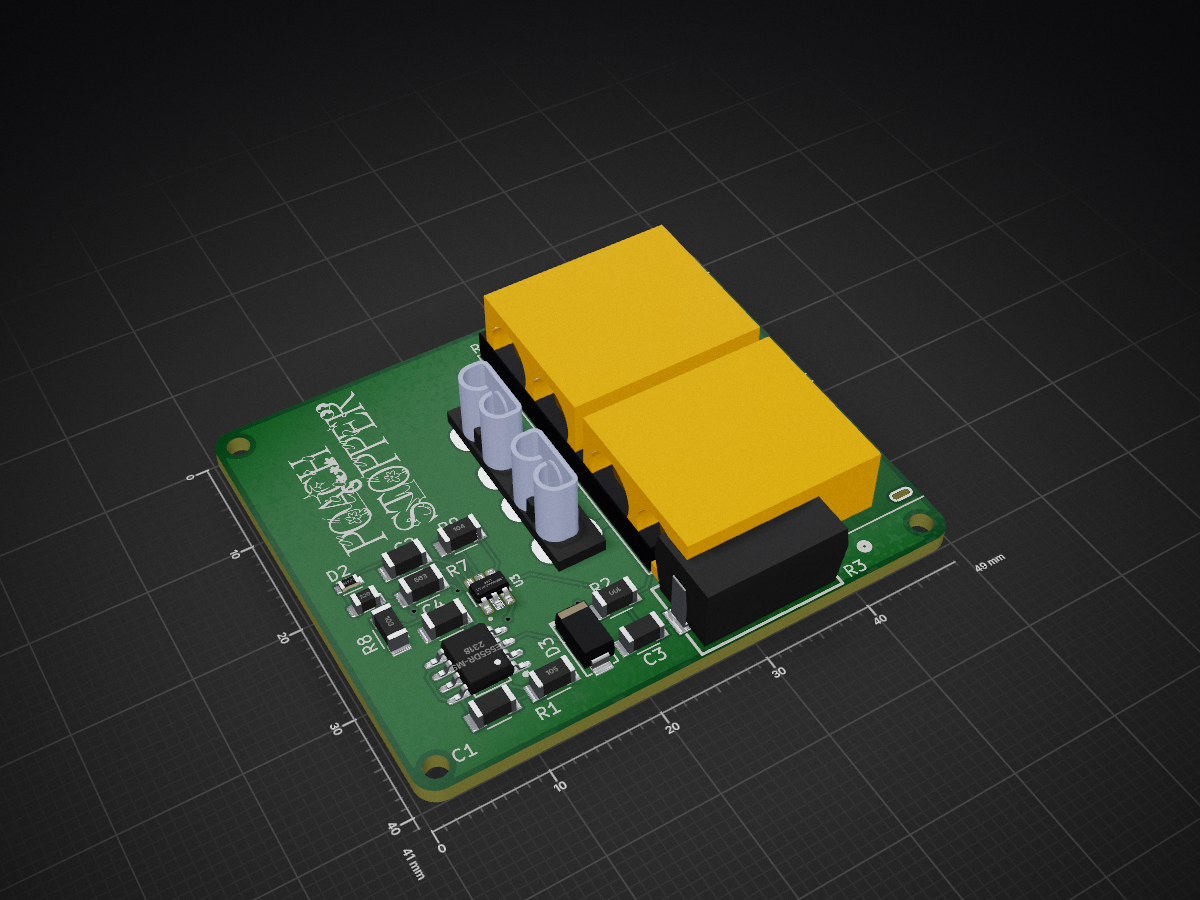
 TheCodedKid/poachstopper
Relay Protection Circuit for MIT Mini Cheetah Motor
Poachstopper is an open-source printed circuit board by TheCodedKid, from the TheCodedKid/poachstopper repository on GitHub, published under the MIT licence. It is a 2-layer board of 49 × 41 mm with 20 parts on 16 nets, routed with 91 tracks and 5 vias.
It is built around the LMR16006XDDCT, NE555DR-MS and XT60PW-M, with the SMW510RJT among its other parts. Its parts include 6 resistors, 4 capacitors, 2 ICs, 2 diodes and 2 connectors.



Inline soft-start for Mini Cheetah motor controllers. Stops the power-on inrush surge that kills the input caps.
Cheap MIT Mini Cheetah clones have undersized input caps and no inrush limiting. Hot-plugging a charged battery, current spike into the FETs, caps die. No good, dead cheetah.
Poach Stopper splices inline on the battery lead, pre-charges through a resistor, then hands over full current. No MCU, no firmware, no buttons.
Delay time is calculated to be about 0.24 seconds, but this is due to nearly zero documentation on the knockoff motor's cap bank size, so this is more of a safety number + I think you can wait a quarter second, but if this is not the case, submit an issue.
| Block | Parts | Job |
|---|---|---|
| Soft-start bypass | G2RL-1A relay + R3 (10 Ω 5 W) | limits inrush; relay shorts it once charged |
| Delay timer | NE555 monostable mode | |
| 5 V rail | LMR16006 buck, 24 V → 5 V | Powers the 555 + relay coil off the pack |
| Protection | Blade fuse F1, 1N4007 flyback D3 | Fault current + coil kickback |
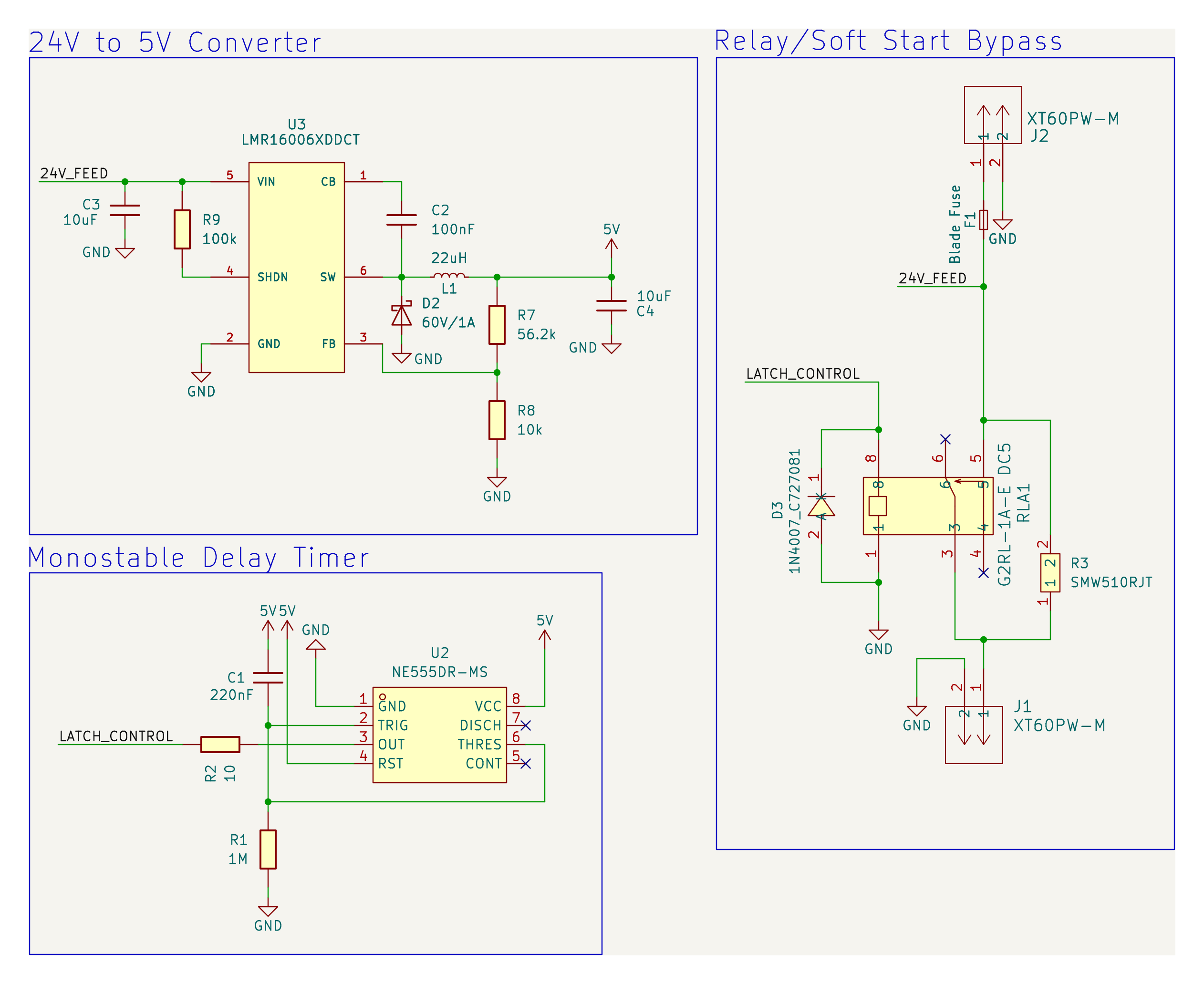
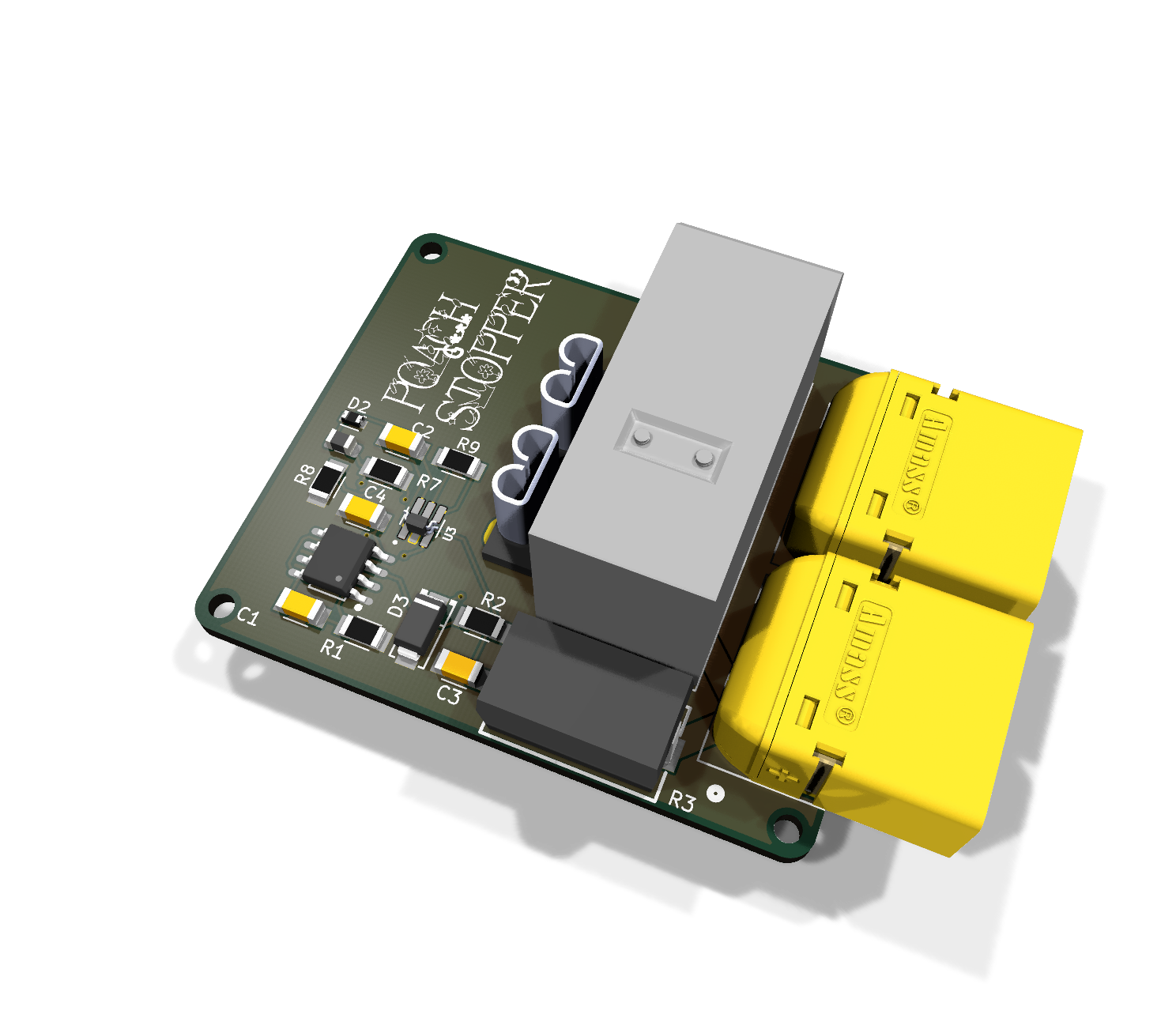
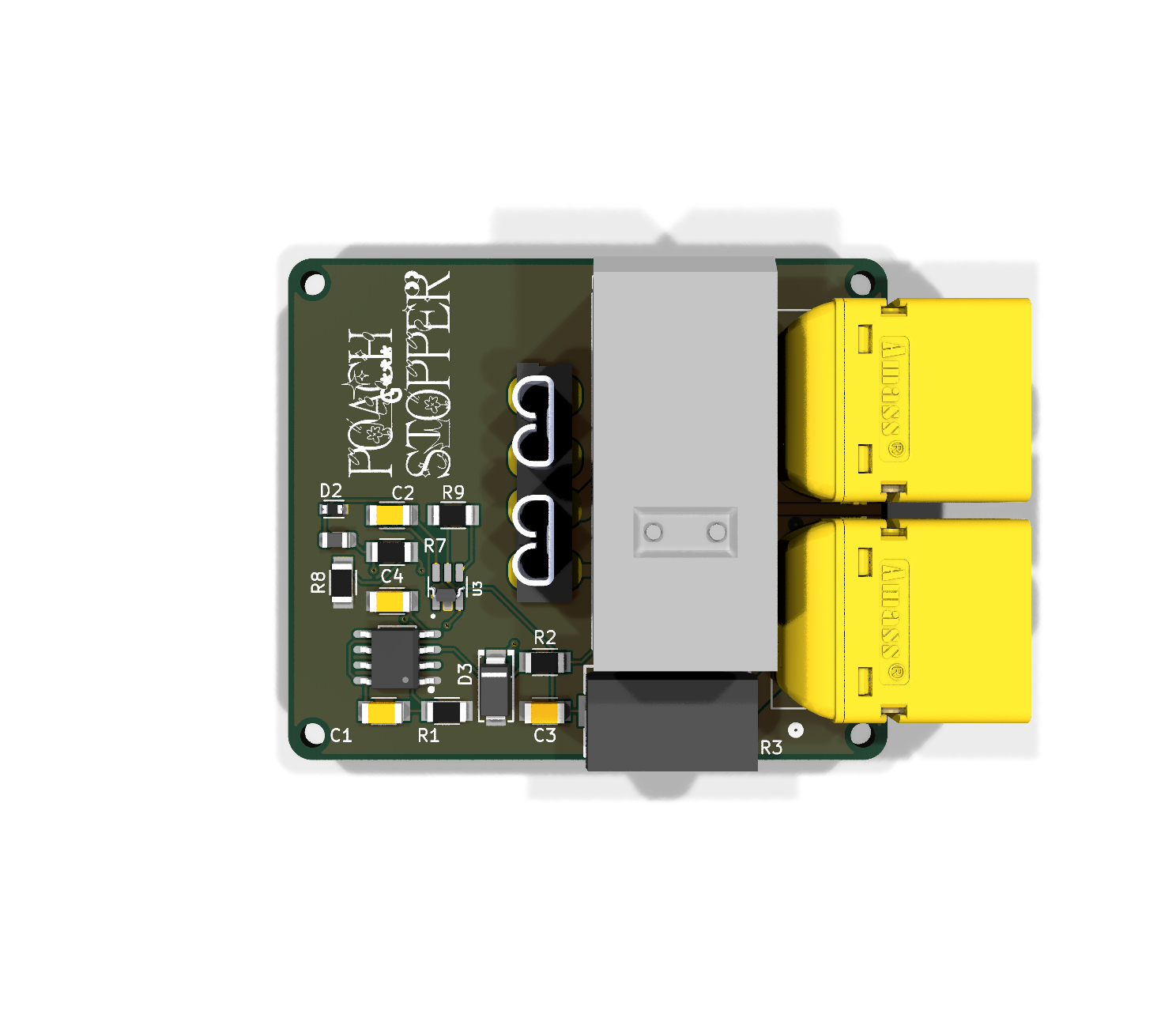
JLCPCB order files are in fab/:
fab/poachstopper-gerbers.zip — gerbersfab/poachstopper-cpl.csv — pick-and-placebom/jlcpcb_bom.csv — assembly BOM (LCSC parts)Hand-solder yourself (not on PnP BOM): R3 (10 Ω 5 W), F1 fuse holder, RLA1 relay, XT60 connectors J1/J2.
Source is KiCad 10 — open poachstopper.kicad_pro.
MIT © 2026 TheCodedKid
| Qty | Value | Footprint | References |
|---|---|---|---|
| 2 | 10uF | PCM_fab:C_1206 | C3, C4 |
| 2 | XT60PW-M | kicad-import:CONN_XT60PW-M_AMA | J1, J2 |
| 1 | 10 | PCM_fab:R_1206 | R2 |
| 1 | 100k | PCM_fab:R_1206 | R9 |
| 1 | 100nF | PCM_fab:C_1206 | C2 |
| 1 | 10k | PCM_fab:R_1206 | R8 |
| 1 | 1M | PCM_fab:R_1206 | R1 |
| 1 | 1N4007_C727081 | kicad-import:SMA_L4.3-W2.5-LS5.0-RD | D3 |
| 1 | 220nF | PCM_fab:C_1206 | C1 |
| 1 | 22uH | PCM_SparkFun-Coil:0805 | L1 |
| 1 | 56.2k | PCM_fab:R_1206 | R7 |
| 1 | 60V/1A | PCM_fab:Diode_Schottky_0603 | D2 |
| 1 | Blade Fuse | PCM_SparkFun-Fuse:Fuseholder_Automotive | F1 |
| 1 | G2RL-1A-E DC5 | kicad-import:RELAY_G2RL-1A-E_DC5_OMR | RLA1 |
| 1 | LMR16006XDDCT | kicad-import:SOT95P280X110-6N | U3 |
| 1 | LOGO | LOGO | G*** |
| 1 | NE555DR-MS | kicad-import:SOIC-8_L4.9-W3.9-P1.27-LS6.0-BL | U2 |
| 1 | SMW510RJT | kicad-import:RES-SMD_L13.5-W7.3 | R3 |
It measures 49 × 41 mm and has 2 copper layers, 1.6 mm thick.
20 parts, built around the LMR16006XDDCT, NE555DR-MS, XT60PW-M and SMW510RJT. The full list of its parts is on this page, with links to each part's symbol and footprint where PCBKit's library has them.
From the TheCodedKid/poachstopper repository on GitHub, at the commit this page was made from: the board is poachstopper.kicad_pcb and its schematic poachstopper.kicad_sch. PCBKit opens the board in the browser, with nothing to install.
Its repository publishes it under the MIT licence: you may reuse it on that licence's terms (keep the author's notice, and for a copyleft licence share your changes alike).
fharold/rpi2040-lcd-gauge
Basic and versatile gauges based on the WAVESHARE RP2040-LCD-1.28 module. A small HAT enhances it:

bejaouihamza/bldc-foc-pcb
This open-source hardware project is a compact, single-board FOC (Field-Oriented Control) motor driver designed for precision robotics, drones, CNC machines, and automation systems.

BenjamimKrug/robo_humanoide
Repositorio para arquivos gerais necessários para o desenvolvimento do Robô humanoide


danielwilczak101/EasyControls
Originally part of the NASA Asteroid flyer program has been repurposed by the EPPL to allow anyone interested in controls to go online and connect with a real working device and test their own control algorithms on a…