4 layers250 × 160.1 mm

 the78mole/4CH-Opto-Iso
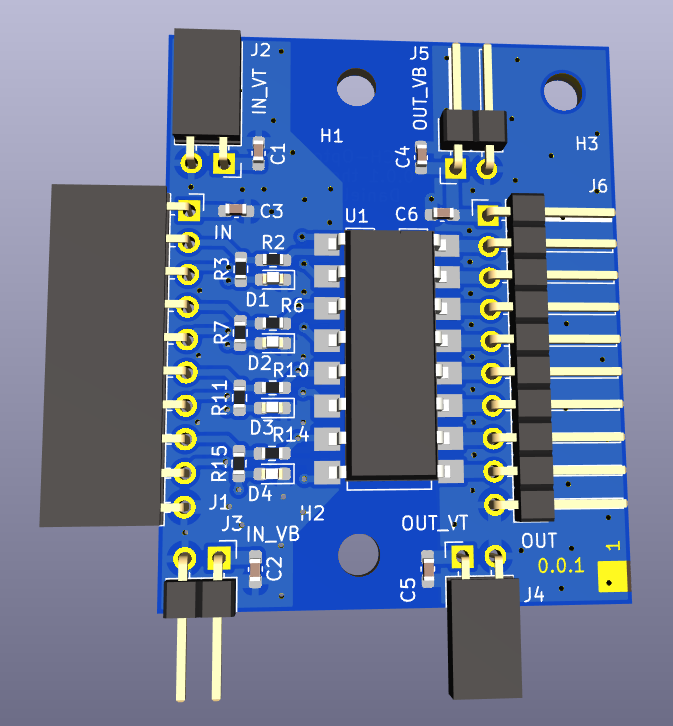
A 4 Channel Opto Isolator
4CH Opto Iso is an open-source printed circuit board by the78mole, from the the78mole/4CH-Opto-Iso repository on GitHub. It is a 2-layer board of 36 × 45 mm with 52 parts on 32 nets, routed with 271 tracks and 87 vias.
It is built around the LTV-847S and BC847. Its parts include 28 resistors, 6 capacitors, 6 connectors, 4 diodes and 4 transistors.


A 4 Channel Opto Isolator
The schematic can be found here.
To access the bom, use this link: https://htmlpreview.github.io/?https://github.com/the78mole/4CH-Opto-Iso/blob/main/bom/ibom.html
| Qty | Value | Footprint | References |
|---|---|---|---|
| 8 | 100 | Resistor_SMD:R_0603_1608Metric_Pad0.98x0.95mm_HandSolder | R1, R4, R5, R8, R9, R12, R13, R16 |
| 8 | 10K | Resistor_SMD:R_0603_1608Metric_Pad0.98x0.95mm_HandSolder | R3, R7, R11, R15, R22, R24, R26, R28 |
| 8 | NP | Resistor_SMD:R_0603_1608Metric_Pad0.98x0.95mm_HandSolder | R2, R6, R10, R14, R17, R18, R19, R20 |
| 6 | 100n | Capacitor_SMD:C_0603_1608Metric_Pad1.08x0.95mm_HandSolder | C1, C2, C3, C4, C5, C6 |
| 4 | 0 | Resistor_SMD:R_0603_1608Metric_Pad0.98x0.95mm_HandSolder | R21, R23, R25, R27 |
| 4 | BC847 | Package_TO_SOT_SMD:SOT-23 | Q1, Q2, Q3, Q4 |
| 4 | RED | LED_SMD:LED_0603_1608Metric_Pad1.05x0.95mm_HandSolder | D1, D2, D3, D4 |
| 3 | MountingHole | MountingHole:MountingHole_3.2mm_M3_DIN965 | H1, H2, H3 |
| 1 | IN | Connector_PinSocket_2.54mm:PinSocket_1x10_P2.54mm_Horizontal | J1 |
| 1 | IN_VB | Connector_PinHeader_2.54mm:PinHeader_1x02_P2.54mm_Horizontal | J3 |
| 1 | IN_VT | Connector_PinSocket_2.54mm:PinSocket_1x02_P2.54mm_Horizontal | J2 |
| 1 | LTV-847S | Package_DIP:SMDIP-16_W9.53mm | U1 |
| 1 | OUT | Connector_PinHeader_2.54mm:PinHeader_1x10_P2.54mm_Horizontal | J6 |
| 1 | OUT_VB | Connector_PinHeader_2.54mm:PinHeader_1x02_P2.54mm_Horizontal | J5 |
| 1 | OUT_VT | Connector_PinSocket_2.54mm:PinSocket_1x02_P2.54mm_Horizontal | J4 |

bryce-builds/PiGarage
Open-source Raspberry Pi power management and audio HAT for automotive head-unit use


Elektropac/MCS_Control
All the firmware for Control module


3DES/WatchdogBoard
watchdog PCB with one watchdog output, up to seven ordinary outputs and four inputs

dvd604/OpenClock
Raspberry Pi Pico / ESPHome based central heating controller
It measures 36 × 45 mm and has 2 copper layers, 1.6 mm thick.
52 parts, built around the LTV-847S and BC847. The full list of its parts is on this page, with links to each part's symbol and footprint where PCBKit's library has them.
From the the78mole/4CH-Opto-Iso repository on GitHub, at the commit this page was made from: the board is 4CH-Opto-ISO.kicad_pcb and its schematic 4CH-Opto-ISO.kicad_sch. PCBKit opens the board in the browser, with nothing to install.
Its repository states no licence, so its author keeps all rights: ask the78mole before reusing the design.