
2 layers96.5 × 96.5 mm

 tgtakaoka/retro-bionic6
Modern platform to run retro CPUs
Bionic mc6801 is an open-source printed circuit board by tgtakaoka, from the tgtakaoka/retro-bionic repository on GitHub. It is a 2-layer board of 25.4 × 68.6 mm with 10 parts on 43 nets, routed with 213 tracks and 21 vias.
It is built around the CSL1901UW1. Its parts include 2 capacitors, 2 ICs, 2 connectors, 1 resistor and 1 diode. It belongs with the retro computing and games boards of this library.



Run real vintage CPUs on a modern Cortex-M7 — with a debugger, assembler and disassembler built in.
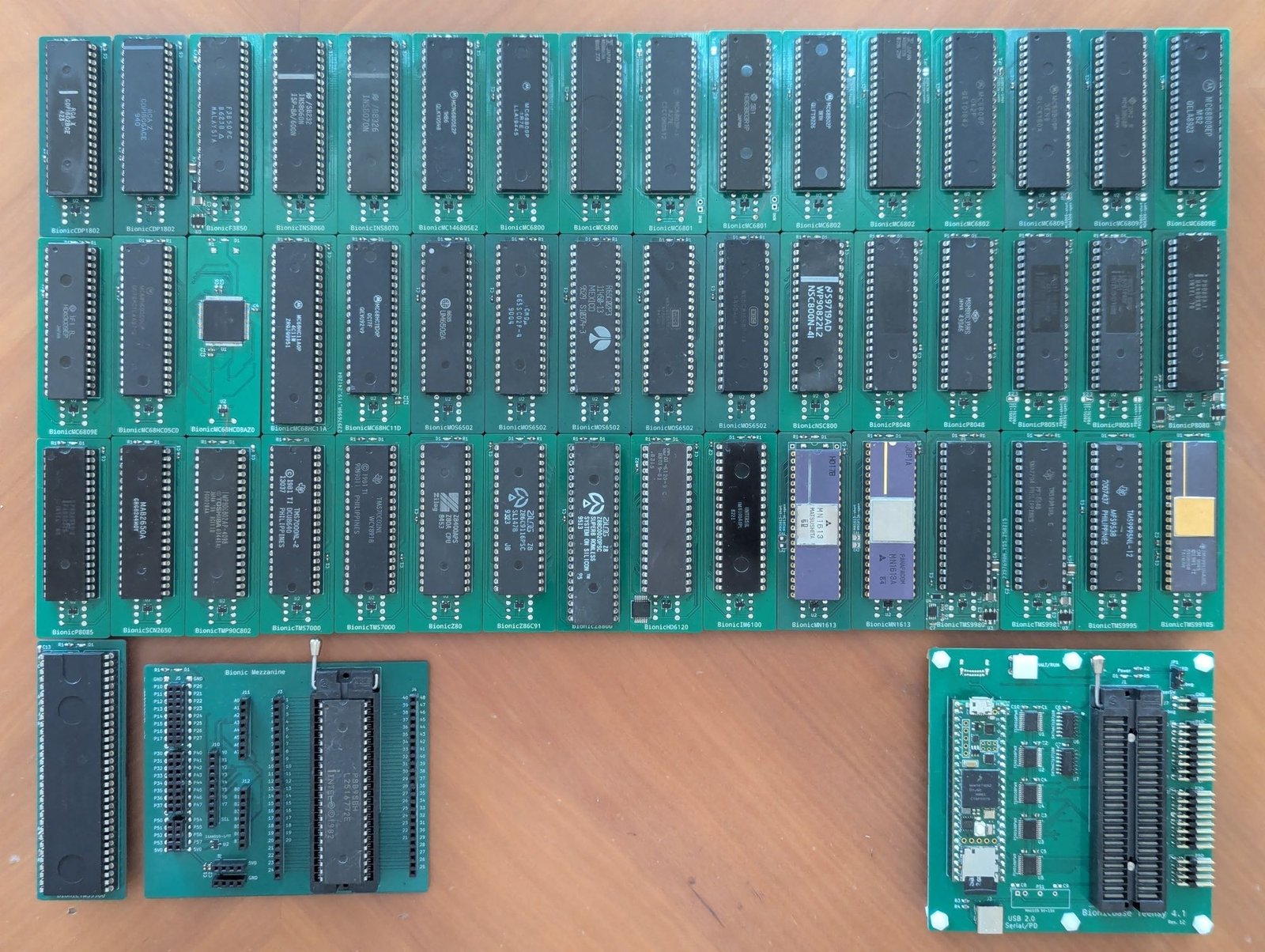
Put a real MC6809, Z80, TMS9900 or CDP1802 into a ZIF socket and single-step it, one bus cycle at a time, from a terminal on your desk.
Bionic runs genuine vintage processors — not emulations of them. A Teensy 4.1 is wired to every pin of the target CPU and drives the whole system around it: the clock, every bus cycle, and the memory and peripherals the chip thinks it is talking to. One firmware image — about 470 kB including every assembler, disassembler and debugger — covers all 50 supported targets, and the board tells the controller which one it is.
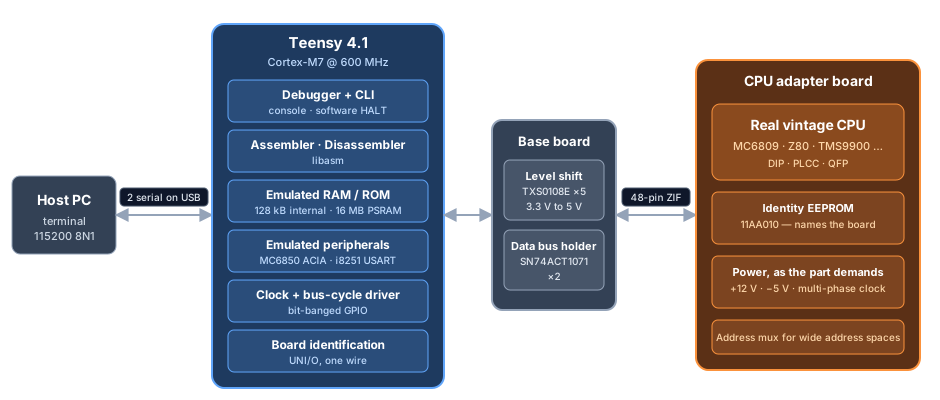
The hardware is two boards:
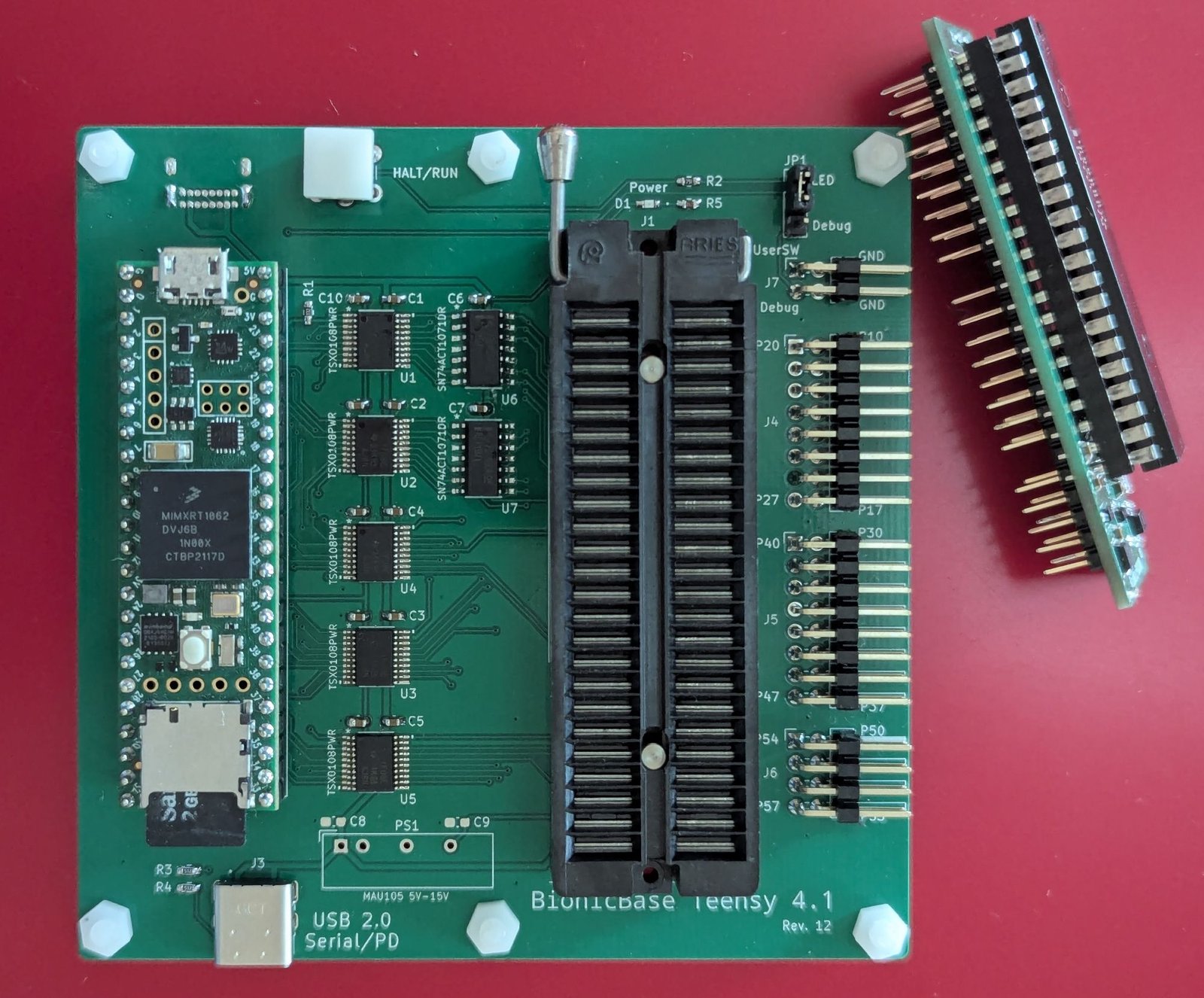
The 48 signals crossing the connector are named P10–P57, and each CPU board maps them to
its own pinout in a small TOML file. See docs/hardware.md.
S).r, =).B, b, g).d, p, m, M), plus a write-protect area on targets that need one (P).U).I).MOS6502, G65SC02, R65C02, W65C02S or
W65C816S depending on which die actually responds.
All 50 targets, grouped by vendor and architecture:
| Vendor | Architecture | Targets |
|---|---|---|
| Motorola | 6800 | MC6800 MB8861, MC6801 HD6301, MC6802 MB8870, MC68HC11A, MC68HC11D |
| 6805 | MC146805E2, MC68HC05C0, MC68HC08AZ0 | |
| 6809 | MC6809 HD6309, MC6809E HD6309E | |
| 68HC12 | MC68HC12B | |
| 68HC16 | MC68HC16Z | |
| MOS Technology | 6502 | MOS6502 G65SC02, R65C02, W65C02S, W65C816S |
| Zilog | Z80 | Z80, Z180, NSC800, KL5C80A12, HD64180S |
| Z280 | Z280 | |
| Z380 | Z380 | |
| Z8000 | Z8001, Z8002 | |
| Z8 | Z86C91, Z88C00 | |
| Intel | MCS-48 | P8048 P8039, MSM80C39 |
| MCS-51 | P8051 | |
| MCS-80/85 | P8080, P8085 | |
| MCS-96 | P8095BH, N8097BH, S80C196K S80C196KB, S80C196KC, S80296SA | |
| Texas Instruments | TMS9900 | TMS9900, TMS9980, TMS9981, TMS9995, TMS99105 TMS99110 |
| TMS7000 | TMS7000 TMS7002 | |
| TMS370 | TMS370Cx5x | |
| TMS320 | TMS320C15 | |
| DEC | PDP-8 | IM6100, HD6120 |
| RCA | COSMAC | CDP1802 CDP1804A |
| Fairchild | F8 | F3850 |
| National | SC/MP II | INS8060 |
| SC/MP III | INS8070 | |
| Signetics | 2650 | SCN2650 |
| Toshiba | TLCS-90 | TMP90C802 |
| Hitachi | H16 | HD641016 |
| Panafacom | MN1610 | MN1613 MN1613A |
Targets in italics are variants the firmware identifies at runtime, by executing instructions that behave differently on each die — not by anything written on the board.
See docs/supported-cpus.md for the full table, including the CPUs still to be supported.
| Path | Contents |
|---|---|
debugger/ | Teensy 4.1 firmware — shared framework plus 25 per-family back ends |
schematics/ | KiCad projects: base, mezzanine, PLCC adapter and 54 CPU adapter boards, with gerbers and PDFs |
pinout/ | Pin-map definitions consumed by dip |
samples/ | Test programs — Mandelbrot, arithmetic suites, serial echo — ported to every CPU |
scripts/ | Bench control, regression, cycle recording and timing scripts, and the PlatformIO compile_commands.json helper |
| Project | Role |
|---|---|
| libasm | The assembler and disassembler engine — 41 architectures, 119 CPU variants, small enough to run on an AVR |
| libcli | The serial command-line front end the debugger is built on |
| dip | Draws the pinout diagrams from the TOML files in pinout/ |
Licensed under the Apache License, Version 2.0.
| Qty | Value | Footprint | References |
|---|---|---|---|
| 1 | 0.1u | Capacitor_SMD:C_0603_1608Metric_Pad1.08x0.95mm_HandSolder | C1 |
| 1 | 1.6k | Resistor_SMD:R_0603_1608Metric_Pad0.98x0.95mm_HandSolder | R1 |
| 1 | 11AA010-I/TT | microchip:SOT-23_MC_MCH-M | U2 |
| 1 | 22u | Capacitor_SMD:C_0603_1608Metric_Pad1.08x0.95mm_HandSolder | C2 |
| 1 | Bionic-P135 | bionic:Bionic-P135_THT | J1 |
| 1 | Bionic-P245 | bionic:Bionic-P245_THT | J2 |
| 1 | CPU | bionic:SolderJumper-2_P1.3mm_Open_RoundedPad1.0x1.5mm | JP1 |
| 1 | CSL1901UW1 | rhom:LED_CSL1901UW1_ROM-M | D1 |
| 1 | LILBUG | Connector_PinHeader_2.54mm:PinHeader_1x02_P2.54mm_Vertical | JP2 |
| 1 | MC6801P | bionic:DIP-40_W15.24mm_Socket | U1 |


gusmanb/logicanalyzer
24 channel, 100Msps logic analyzer hardware and software

byrantech/laptop
anyon_e, a highly integrated, high end, open source laptop. Attempt the impossible.

joeycastillo/Sensor-Watch
A board replacement for the classic Casio F-91W wristwatch


OLIMEX/OLINUXINO
OLINUXINO is Open Source / Open Hardware, low cost from EUR 24 Linux Industrial grade Single Board Computer capable to operate -25+85C

rusefi/rusefi
rusefi - GPL internal combustion engine control unit

VoronDesign/Voron-Hardware
Cool Hardware designed by the Voron Design group
It measures 25.4 × 68.6 mm and has 2 copper layers, 1.6 mm thick.
10 parts, built around the CSL1901UW1. The full list of its parts is on this page, with links to each part's symbol and footprint where PCBKit's library has them.
From the tgtakaoka/retro-bionic repository on GitHub, at the commit this page was made from: the board is schematics/mc6801/bionic-mc6801.kicad_pcb. PCBKit opens the board in the browser, with nothing to install.
Its repository states no licence, so its author keeps all rights: ask tgtakaoka before reusing the design.