2 layers100 × 100 mm
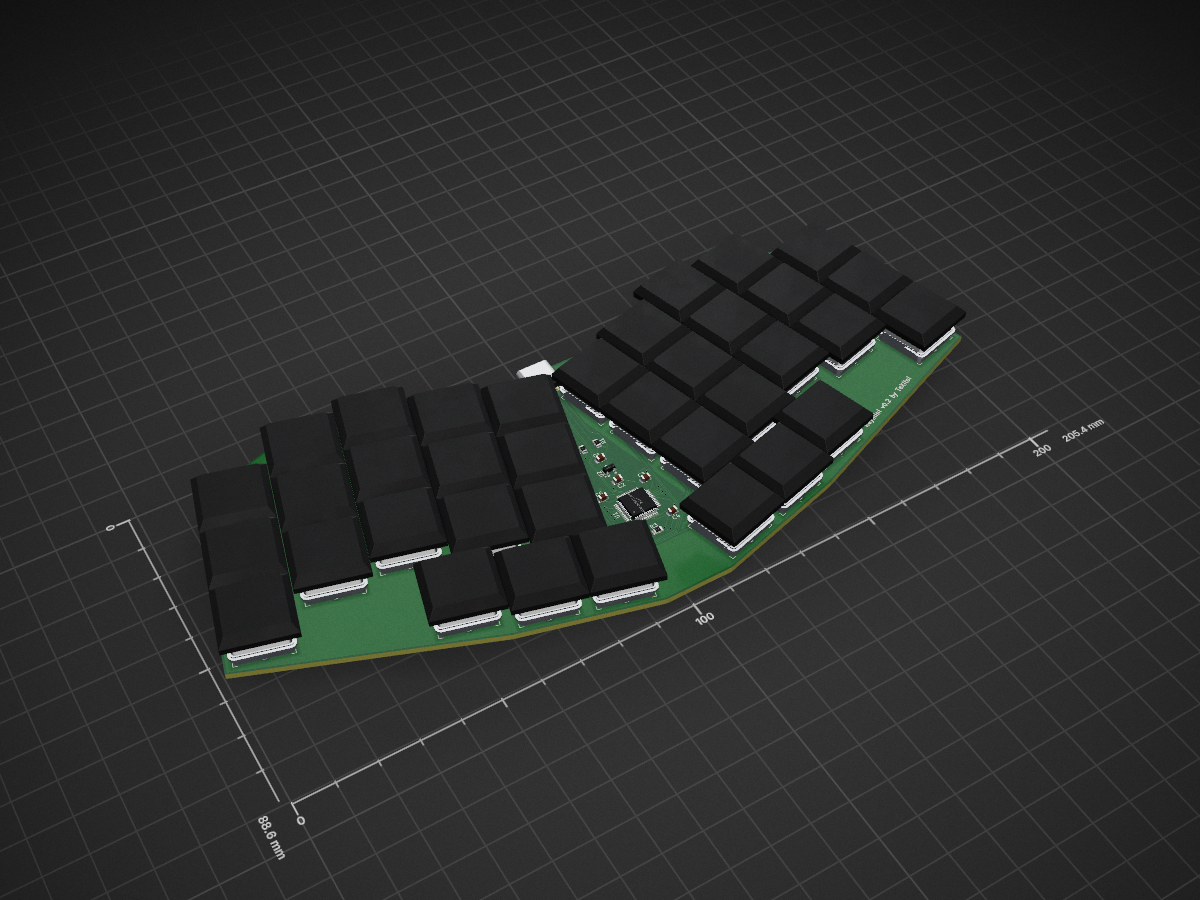
 TeXitoi/keymini25
Keymini, a minimalist ergonomic keyboard.
Keymini is an open-source printed circuit board by TeXitoi, from the TeXitoi/keymini repository on GitHub, published under the MIT licence. It is a 2-layer board of 205.4 × 88.6 mm with 85 parts on 82 nets, routed with 508 tracks and 28 vias.
It is built around the STM32F072CBT6, XC6206P332MR and 1N4148WS. Its parts include 36 diodes, 36 switches, 6 capacitors, 3 resistors and 2 ICs. It belongs with the keyboards and input boards and the STM32 boards of this library.


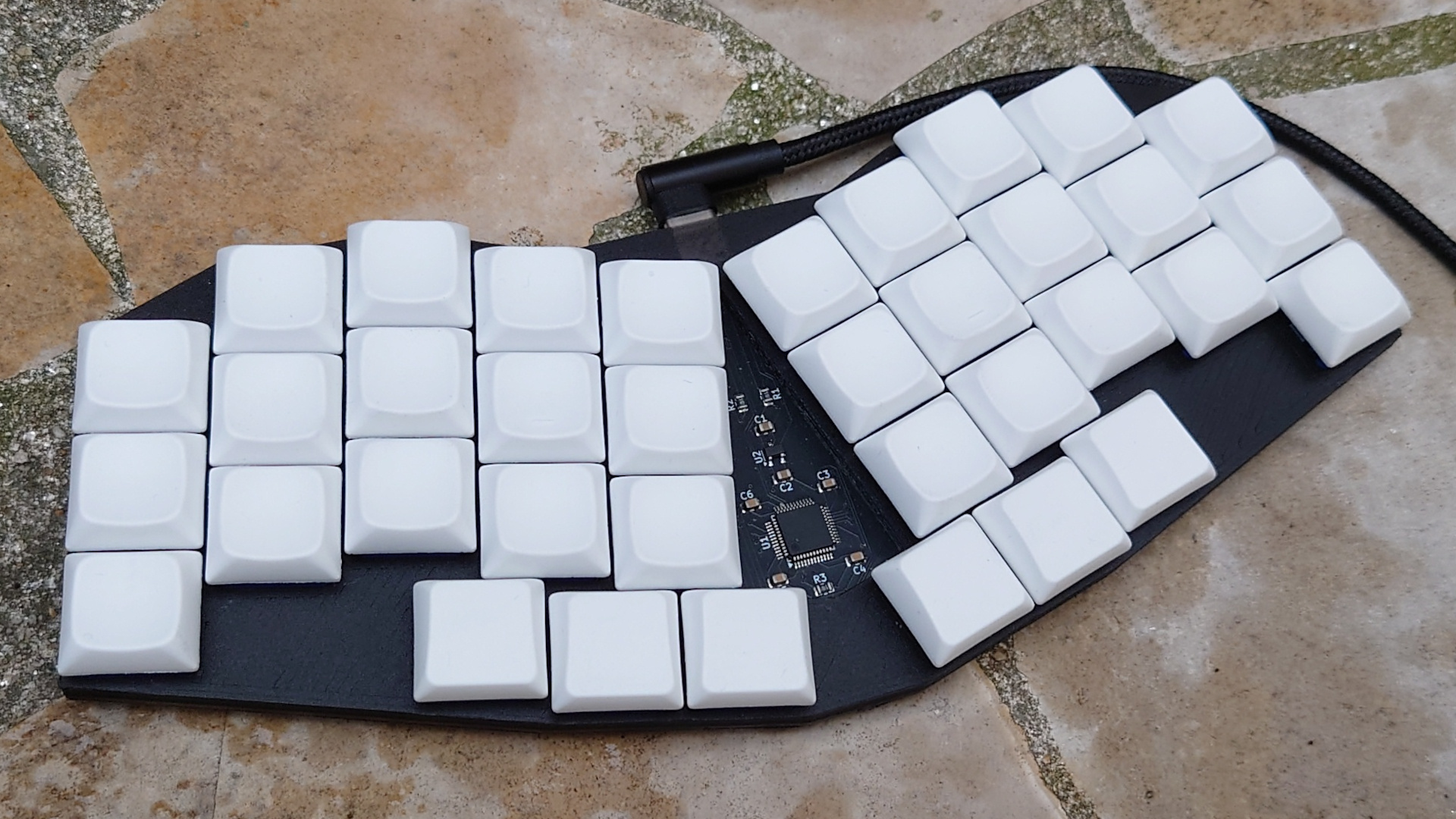
Perfection is achieved, not when there is nothing more to add, but when there is nothing left to take away. ― Antoine de Saint-Exupéry
Keymini is a monoblock ergonomic keyboard with 36 keys. It is as low as possible (with Kailh Choc v1 switches). As it is flat on the underside, it can be used placed on a laptop keyboard, without actuating the laptop keyboard keys.
Keymini is a minimalist keyboard in a lot of way:
Inspirations:
To see more photos, see the gallery.
You can look at the build guide, to see how it is constructed, and to make your own!
For instructions on the PCB manufacturing, see the gerbers directory.
For information on building and flashing the firmware, see the official rust firmware or the unofficial ZMK firmware.
For information on the default layout, see the layout page.
| Qty | Value | Footprint | References |
|---|---|---|---|
| 36 | 1N4148WS | Diode_SMD:D_SOD-323 | D1A1, D1B1, D1C1, D1D1, D1E1, D1F1, D1G1, D1H1, D1I1, D1J1, D2A1, D2B1, D2C1, D2D1, D2E1, D2F1 +20 |
| 36 | SW_Push | switch:SW_PG1350 | SW1A1, SW1B1, SW1C1, SW1D1, SW1E1, SW1F1, SW1G1, SW1H1, SW1I1, SW1J1, SW2A1, SW2B1, SW2C1, SW2D1, SW2E1, SW2F1 +20 |
| 4 | 100nF | Capacitor_SMD:C_0805_2012Metric | C3, C4, C5, C6 |
| 3 | 5.1k | Resistor_SMD:R_0805_2012Metric | R1, R2, R3 |
| 2 | 1µF | Capacitor_SMD:C_0805_2012Metric | C1, C2 |
| 1 | STM32F072CBT6 | Package_QFP:LQFP-48_7x7mm_P0.5mm | U1 |
| 1 | SW_Push | Button_Switch_SMD:SW_SPST_CK_RS282G05A3 | BOOT0 |
| 1 | USB_C_Receptacle_USB2.0_16P | Connector_USB:USB_C_Receptacle_HRO_TYPE-C-31-M-12 | J1 |
| 1 | XC6206P332MR | Package_TO_SOT_SMD:SOT-23-3 | U2 |
It measures 205.4 × 88.6 mm and has 2 copper layers, 1.6 mm thick.
85 parts, built around the STM32F072CBT6, XC6206P332MR and 1N4148WS. The full list of its parts is on this page, with links to each part's symbol and footprint where PCBKit's library has them.
From the TeXitoi/keymini repository on GitHub, at the commit this page was made from: the board is pcb/keymini/keymini.kicad_pcb and its schematic pcb/keymini/keymini.kicad_sch. PCBKit opens the board in the browser, with nothing to install.
Its repository publishes it under the MIT licence: you may reuse it on that licence's terms (keep the author's notice, and for a copyleft licence share your changes alike).

georgsnarbuts/kalkulators
A mechanical-key calculator that also works as a numpad, designed and sold as a kit.

my-fi-25073/MF40
MF40 is my-fi's mini 40% custom keyboard PCB family. The variants share the same general design direction, but differ by horizontal width, column configuration, and bottom-row style.

xiphonics/picoTracker-pcb
Buy the official kit at xiphonics store # Trademark Notice


eurovibes/rack-ser-adapter
rack-ser-adapter is provided under the terms of the CERN-OHL-S license version 2 as provided in the LICENSES/CERN-OHL-S-2.0 file.


Tknika-SCLF/sclf-gripper
Deskargatu eta instalatu Antigravity bere webgune ofizialetik. VSCode/Windsurf-en fork bat da eta modu berean funtzionatzen du.