


4 layers38.4 × 128.5 mm
Plantpal
rajeev2705/PROJECTS
Welcome to my PCB projects repository! This space is dedicated to documenting my journey in designing, creating, and improving printed circuit boards (PCBs).
127 parts

 teapotlaboratories/plantpal98
Your pal in plant care
Plantpal is an open-source printed circuit board by teapotlaboratories, from the teapotlaboratories/plantpal repository on GitHub, published under the MIT licence. It is a 4-layer board of 38.4 × 128.5 mm with 121 parts on 87 nets, routed with 806 tracks and 262 vias.
It is built around the ESP32-C6FH4, BME688 and MCP73831T-2ACI/OT-HXY, with the USBLC6-2P6, XC6220B331MR-G and DMG1012UW-7-VB among its other parts. Its parts include 41 capacitors, 27 resistors, 9 transistors, 6 ICs and 5 diodes. It belongs with the sensors and measurement boards and the ESP32 and RISC-V boards of this library.


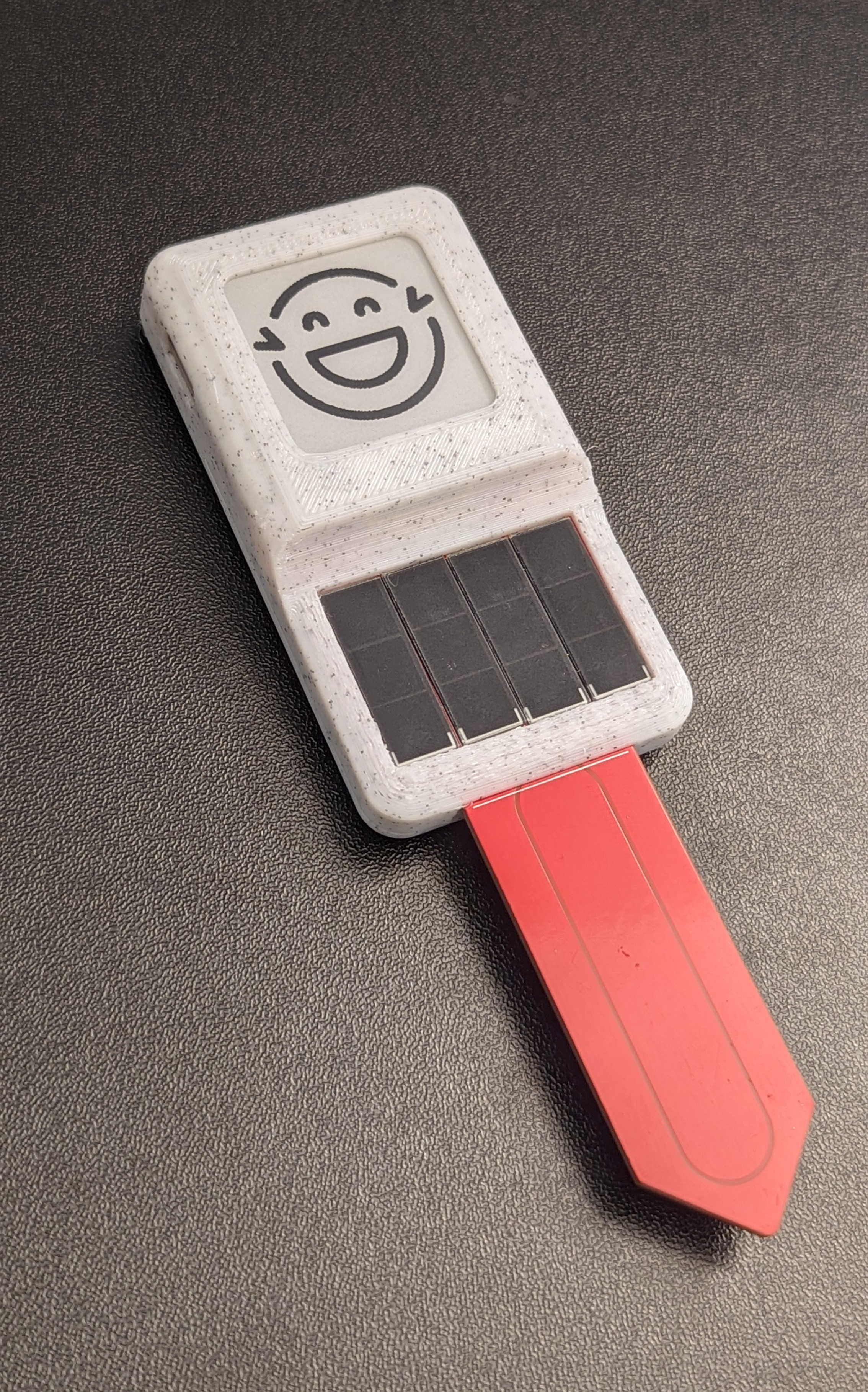
Meet Teapotlabs Plantpal - Your pal in plant care! This adorable device uses capacitive sensing to measure soil moisture. Its low-power e-paper display keeps you updated without draining energy. Plus, with the BME688 sensor, it is able to monitor air quality and CO2 levels, ensuring your plants thrive in optimal conditions.
Teapotlabs Plantpal is part of Teapotlabs open-hardware project.
Huge thanks to PCBWay to sponsored this project! All PCB board and PCB Assembly in this project was using their rapid-prototyping services. The process from ordering to delivery of the device was really smooth and easy. We were really happy with the quality of the assembly and especially the customer support that was really easy to work with, where they help us identify and fix issue such as verifying BOM, checking components for assembly and even replacing damaged parts at no cost.
The project won't be possible without the amazing work from people across the globe. The following are the reference to those awesome projects!
BME688 for Environmental SensingSoil Moisture sensorBattery voltage sensingSENSE_OUT pin 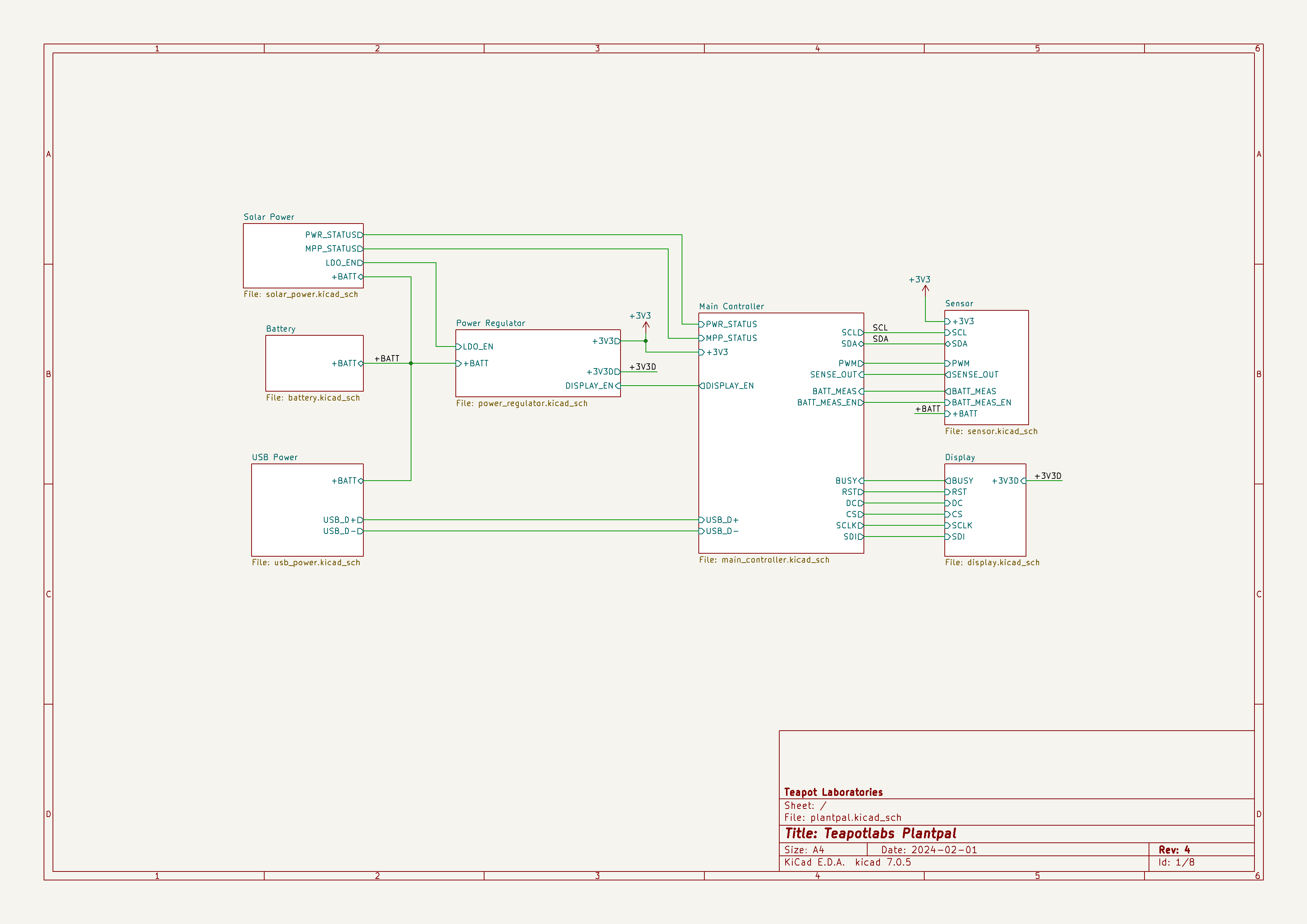
Built using KiCAD 7.0.5 A detailed schematic can be found here

PCB Render
Built using KiCAD, the board is design to be as small as possible with all components placed on the top side of the PCB.
⚠️ The following design are based on revision 3 but is similar to revision 4.
More images can be found here
| Top Board | Bottom Board |
|---|---|
| |
| |

PCB Top and Bottom Layout
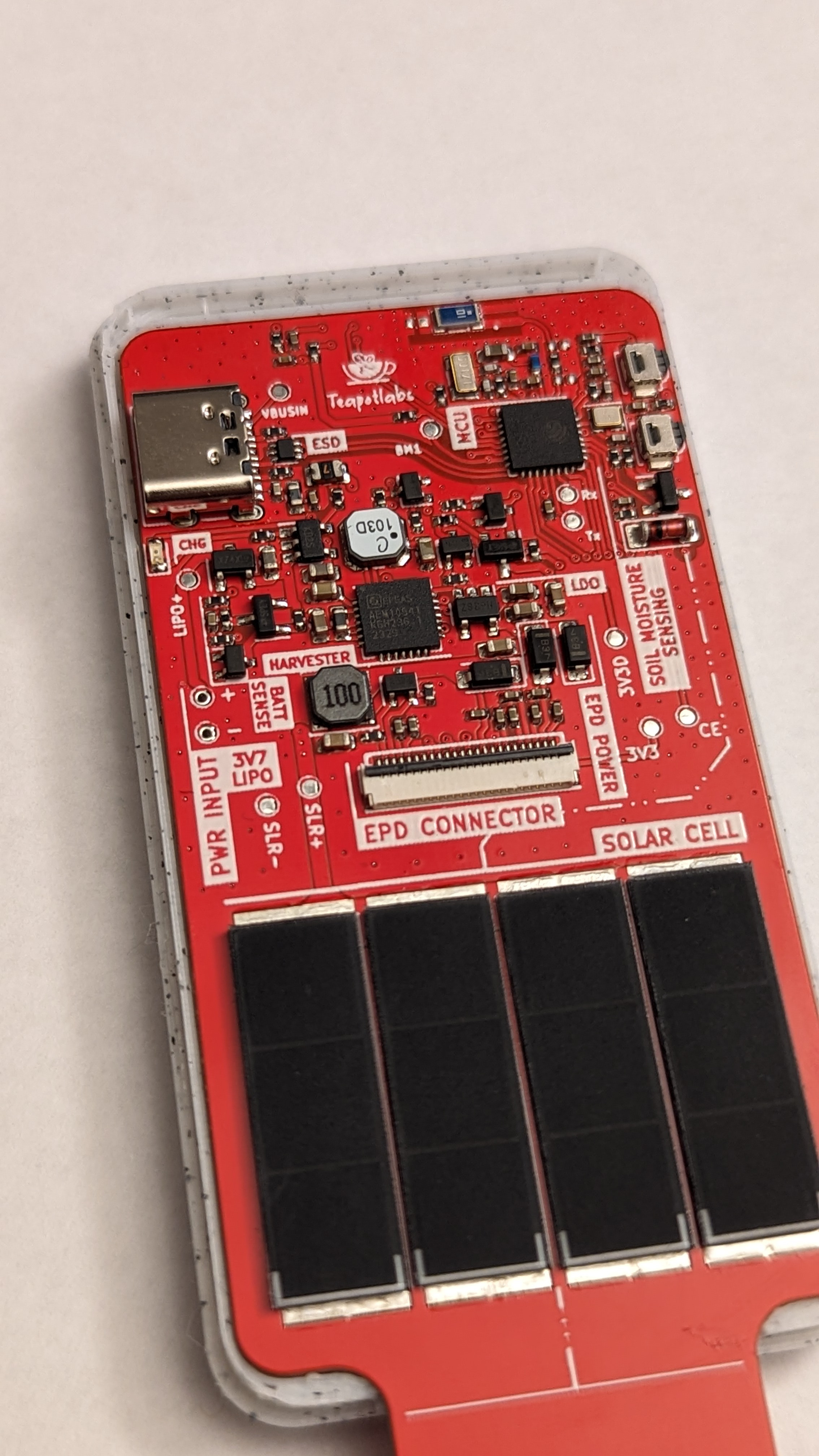
Assembled Front Close-up

Built using TinkerCAD. The case are 3D printable with any generic 3D printer with/without support. The STL files are available here
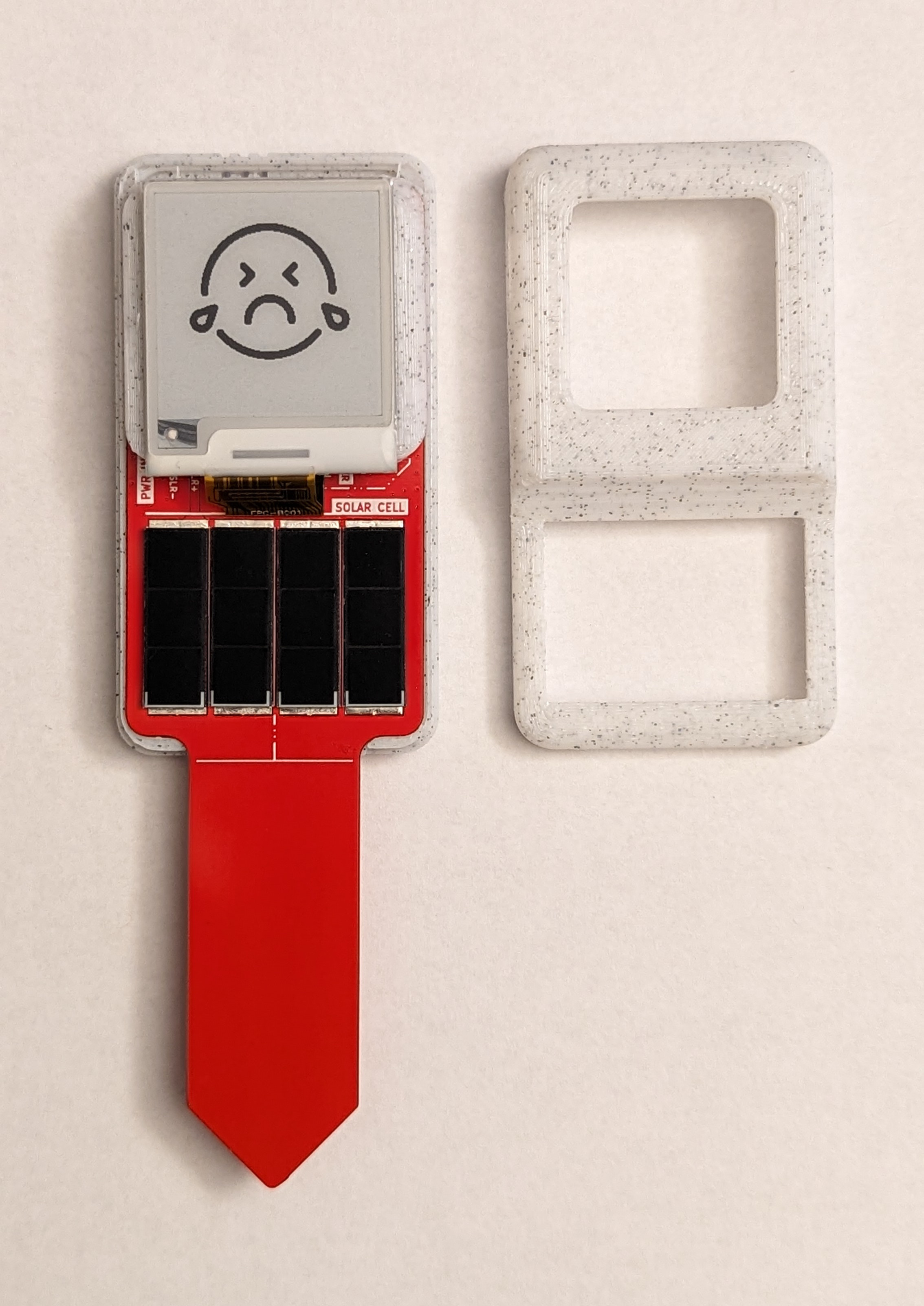
Case Open
BME688 sensor is available in the back, facing 3 small vents in the back of the case
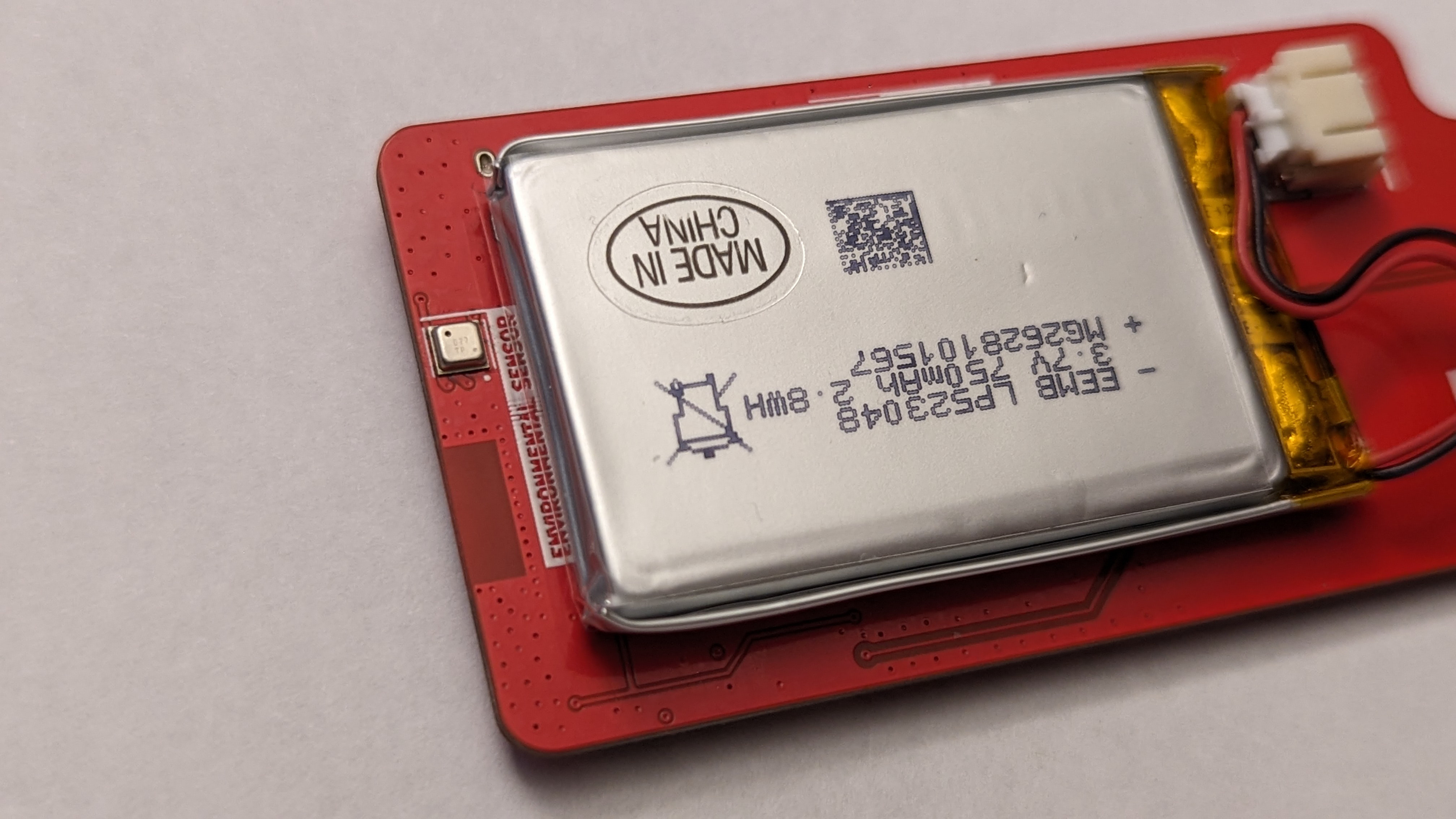
BME688 Position
Based on the amazing project in b-parasite, Plantpal has the built-in soil moisture sensor via capacitive sensing. Using capacitive sensing, enables the device to measure soil moisture without any traces exposed to the environment. See rbaron's b-parasite project for more information on how the sensor works and more additional information to protect the soil moisture sensor!

Soil Moisture Sensing Showcase
Power consumption and solar charging current are measured using Nordic PPK2 and Joulescope. The following are the summary of the measurement:
:warning: Tested on Revision 4-equivalent board, but should be similar to Revision 4

Deep-sleep

Read Sensor, Update Display, and Store Data to Flash

Read Sensor, Update Display, Store Data to Flash, and Publish to MQTT

Solar Charge - Direct Sunlight

Solar Charge - Indirect Sunlight
More measurement can be found here
Most of the components are generic and can be bought from any electornics/semi-conductor distributor. The bill of materials can be downloaded here.
The EPD display used and tested is GDEY0154D67 from GoodDisplay. The following display should be compatible, but the example code would need to be adjusted:
Those displays are available from AliExpress
Programming the device can be done easily over the USB-C.
Out of factory, the ESP32-C6 will be blank and need to be put in bootloader mode. The following is a step-by-step guide to initially program the device
BOOT and RESET buttonRESET buttonBOOT buttonbootloader mode and you can flash it via ESP-IDF or Arduino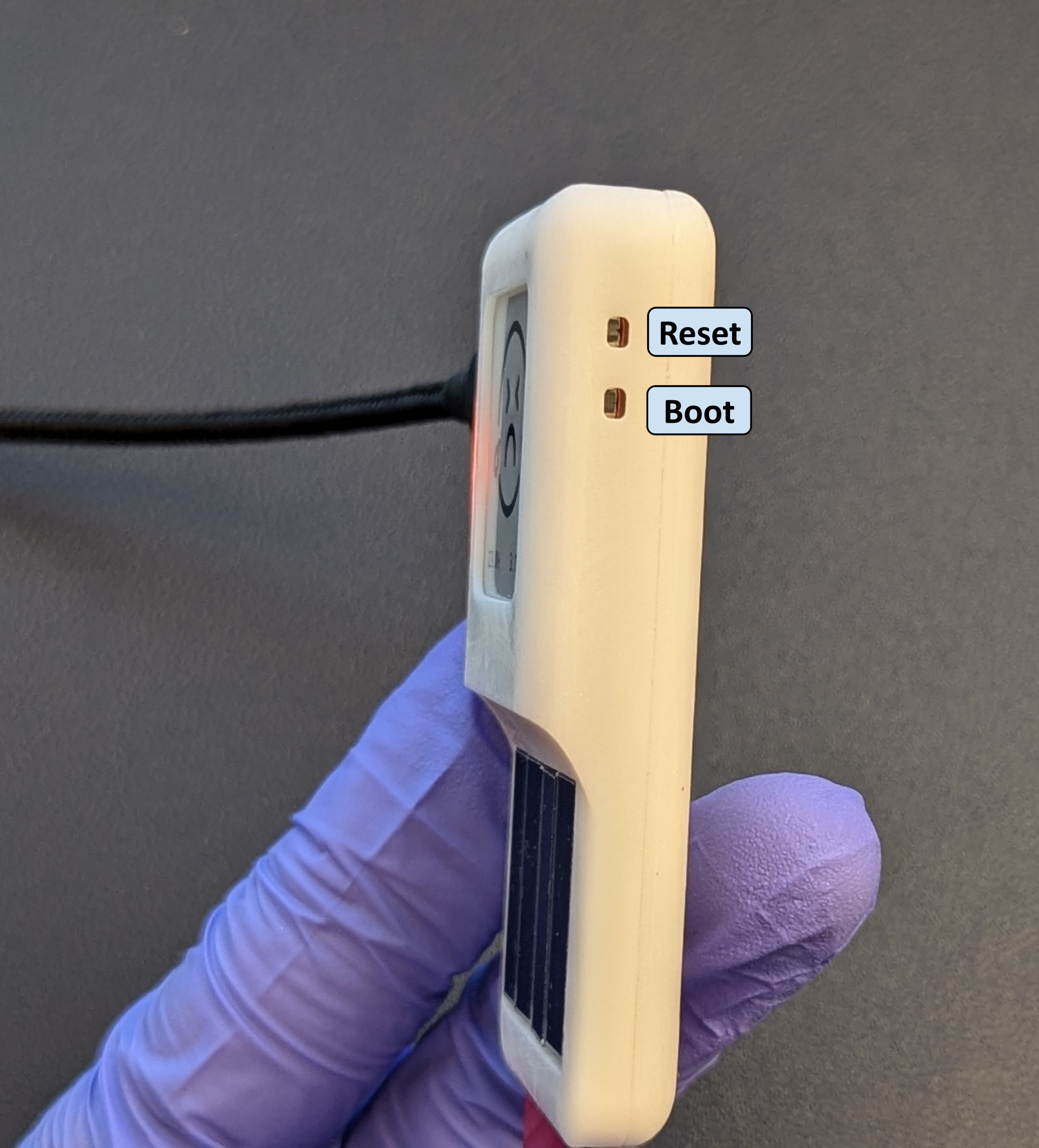
Plantpal buttons
A more detailed information about USB behavior on ESP32-C6 can be here
At the moment, we do not mass produce the device. The fastest way you can get the device is to order it directly from the manufacturer here (does NOT include the display and case). You need to buy the display separately from Aliexpress or other distributor.
If you'd like to buy it from us fully assembled, we might be available and please contact contact@teapotlabs.io
Some disclaimer about Plantpal:
For any questions feel free to create a issue or contact contact@teapotlabs.io
The product is open-source! However, some part of library used under firmware or hardware, might have it's own license. Please reach out or create a ticket if Teapotlabs Plantpal violated any licenses.

| Qty | Value | Footprint | References |
|---|---|---|---|
| 11 | 1u | Capacitor_SMD:C_0402_1005Metric | C9, C14, C31, C32, C33, C34, C35, C36, C37, C38, C39 |
| 10 | 10K | Resistor_SMD:R_0402_1005Metric | R3, R4, R5, R6, R9, R16, R17, R18, R19, R21 |
| 9 | 100n | Capacitor_SMD:C_0402_1005Metric | C6, C7, C10, C11, C13, C18, C27, C28, C29 |
| 8 | 1M | Resistor_SMD:R_0402_1005Metric | R7, R14, R22, R23, R24, R26, R28, R29 |
| 7 | 10u | Capacitor_SMD:C_0603_1608Metric | C5, C19, C20, C23, C24, C25, C26 |
| 4 | DMG1012UW | Package_TO_SOT_SMD:SOT-323_SC-70 | Q1, Q2, Q5, Q9 |
| 4 | KXOB25-05X3TF-TR | plantpal:KXOB25-05X3F | SC1, SC2, SC3, SC4 |
| 3 | 5K1 | Resistor_SMD:R_0402_1005Metric | R8, R10, R11 |
| 3 | DNP | Capacitor_SMD:C_0402_1005Metric | C12, C15, C16 |
| 3 | MBR0530 | Diode_SMD:D_SOD-123 | D4, D5, D6 |
| 2 | 10n | Capacitor_SMD:C_0402_1005Metric | C8, C17 |
| 2 | 10p | Capacitor_SMD:C_0402_1005Metric | C3, C4 |
| 2 | 12p | Capacitor_SMD:C_0402_1005Metric | C1, C2 |
| 2 | 1K | Resistor_SMD:R_0402_1005Metric | R12, R13 |
| 2 | 22 | Resistor_SMD:R_0402_1005Metric | R1, R2 |
| 2 | 22u | Capacitor_SMD:C_0603_1608Metric | C21, C22 |
| 2 | 4u7 | Capacitor_SMD:C_0603_1608Metric | C40, C41 |
| 2 | B3U-3000P | plantpal:SW_SPST_B3U-3000P | SW1, SW2 |
| 2 | PMV32UP | Package_TO_SOT_SMD:SOT-23 | Q4, Q8 |
| 1 | +LIPO | TestPoint:TestPoint_Pad_D1.0mm | TP6 |
| 1 | +LIPO | TestPoint:TestPoint_THTPad_D1.0mm_Drill0.5mm | J2 |
| 1 | -LIPO | TestPoint:TestPoint_THTPad_D1.0mm_Drill0.5mm | J3 |
| 1 | 0 | Inductor_SMD:L_0402_1005Metric | L2 |
| 1 | 0.75A | Fuse:Fuse_0805_2012Metric | F1 |
| 1 | 10u | Inductor_SMD:L_0603_1608Metric | L4 |
| 1 | 10u 0.55A | plantpal:IND_LPS4012-103MRB | L3 |
| 1 | 10u 1A | plantpal:L_Changjiang_FNR4012S | L5 |
| 1 | 1n | Capacitor_SMD:C_0402_1005Metric | C30 |
| 1 | 2n2 | Inductor_SMD:L_0402_1005Metric | L1 |
| 1 | 3V3 | TestPoint:TestPoint_Pad_D1.0mm | TP5 |
| 1 | 3V3D | TestPoint:TestPoint_Pad_D1.0mm | TP10 |
| 1 | 470m | Resistor_SMD:R_0402_1005Metric | R25 |
| 1 | 4K7 | Resistor_SMD:R_0402_1005Metric | R20 |
| 1 | AEM10941 | Package_DFN_QFN:QFN-28-1EP_5x5mm_P0.5mm_EP3.35x3.35mm | U4 |
| 1 | AO3407A | Package_TO_SOT_SMD:SOT-23 | Q6 |
| 1 | BME688 | plantpal:BME680-PSON80P300X300X100-8N | U7 |
| 1 | BOOT_MODE0 | TestPoint:TestPoint_Pad_D1.0mm | TP7 |
| 1 | CHIP_EN | TestPoint:TestPoint_Pad_D1.0mm | TP9 |
| 1 | CM315D32768DZFT | plantpal:Crystal_SMD_3215-2Pin_3.2x1.5mm | Y1 |
| 1 | DL_RXD0 | TestPoint:TestPoint_Pad_D1.0mm | TP2 |
| 1 | DL_TXD0 | TestPoint:TestPoint_Pad_D1.0mm | TP1 |
| 1 | ESP32-C6FH4 | Package_DFN_QFN:QFN-32-1EP_5x5mm_P0.5mm_EP3.6x3.6mm | U1 |
| 1 | HC-FPC-05-09-24RLTAG | plantpal:FPC-SMD_24P-P0.50_HC-FPC-05-09-24RLTAG | J4 |
| 1 | LL4148 | Diode_SMD:D_MiniMELF | D3 |
| 1 | LOGO | plantpal:TeapotLogo4mm | G*** |
| 1 | LOGO | plantpal:TeapotLogo | G*** |
| 1 | MCP73831T-2ACI/OT | Package_TO_SOT_SMD:SOT-23-5 | U3 |
| 1 | MMBT3906 | Package_TO_SOT_SMD:SOT-23 | Q3 |
| 1 | MMZ1608B601CTAH0 | Inductor_SMD:L_0603_1608Metric | FB1 |
| 1 | R940000171 | plantpal:Crystal_SMD_2016-4Pin_2.0x1.6mm | Y2 |
| 1 | RFECA3216060A1T | plantpal:RFECA3216060A1T | AE1 |
| 1 | S2B-PH-SM4-TB(LF)(SN) | plantpal:JST_PH_S2B-PH-SM4-TB_1x02-1MP_P2.00mm_Horizontal | BT1 |
| 1 | SI1308EDL | Package_TO_SOT_SMD:SOT-323_SC-70 | Q7 |
| 1 | SOLAR+ | TestPoint:TestPoint_Pad_D1.0mm | TP3 |
| 1 | SOLAR- | TestPoint:TestPoint_Pad_D1.0mm | TP4 |
| 1 | U262-161N-4BVC11 | plantpal:USB_C_Receptacle_XKB_U262-16XN-4BVC11 | J1 |
| 1 | USBLC6-2P6 | Package_TO_SOT_SMD:SOT-666 | U2 |
| 1 | VBUS_IN | TestPoint:TestPoint_Pad_D1.0mm | TP8 |
| 1 | VLMO1300-GS08 | LED_SMD:LED_0603_1608Metric | D1 |
| 1 | XC6220 | Package_TO_SOT_SMD:SOT-23-5 | U6 |
rajeev2705/PROJECTS
Welcome to my PCB projects repository! This space is dedicated to documenting my journey in designing, creating, and improving printed circuit boards (PCBs).

Kmshanley/PicoSat-Initiative
The pocket cube standard requires satellites to be 5x5x5cm and under 250 grams. Upon completion of this Wentworth PicoSat it will become one of the smallest satellites capable of high resolution imagery from LEO.

teapotlaboratories/bwlr3d
Teapot BWLR3D: Asset Tracker and Environmental Sensor with Solar Energy Harvesting


Thaddeus-Maximus/dotclock
An ESP32-based alarm clock with a dot matrix LED display, rotary encoder interface, MP3 audio playback, and a web configuration UI.


It measures 38.4 × 128.5 mm and has 4 copper layers, 1.58 mm thick.
121 parts, built around the ESP32-C6FH4, BME688, MCP73831T-2ACI/OT-HXY and USBLC6-2P6. The full list of its parts is on this page, with links to each part's symbol and footprint where PCBKit's library has them.
From the teapotlaboratories/plantpal repository on GitHub, at the commit this page was made from: the board is hardware/kicad/plantpal.kicad_pcb and its schematic hardware/kicad/battery.kicad_sch. PCBKit opens the board in the browser, with nothing to install.
Its repository publishes it under the MIT licence: you may reuse it on that licence's terms (keep the author's notice, and for a copyleft licence share your changes alike).