2 layers49.5 × 30 mm
Business card round
t-mullin/Business_Card
Repo for the Stepped tone generator business card.
11 parts1

 t-mullin/Business_Card1
Repo for the Stepped tone generator business card.
Business card is an open-source printed circuit board by t-mullin, from the t-mullin/Business_Card repository on GitHub. It is a 2-layer board of 58.4 × 31.8 mm with 12 parts on 11 nets, routed with 62 tracks and 0 vias.
Its parts include 2 capacitors, 1 resistor, 1 IC and 1 switch. It belongs with the retro computing and games boards of this library.
I am working on some updates to the STG Business Card project.
The motive behind this project is to provide to prospective employers an example of my pcb work in a form factor that is easy for them to carry around. I came up with the idea of putting a simple Stepped Tone Generator onto a PCB the size of a business card after watching a video from Look Mum No Computer, where he builds an Atari Punk Console (Stepped Tone Generator).
Using the same instructables guide from BrownDogGadgets, I used KiCad to draw up the schematic and designed a PCB to go with it. The PCB is a 2-layer design with through-hole components. Below are pictures of the 3D model and the PCB layout in KiCad.
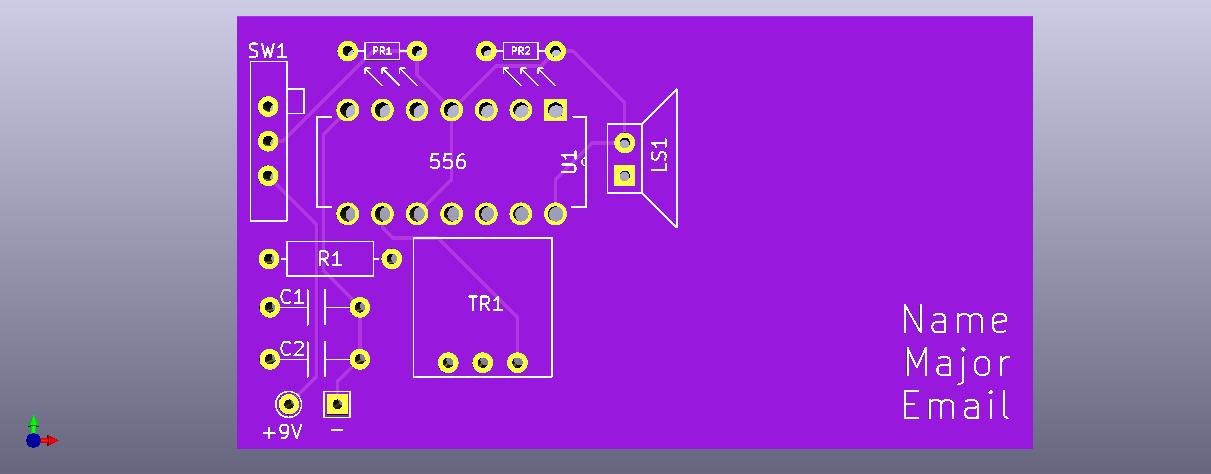
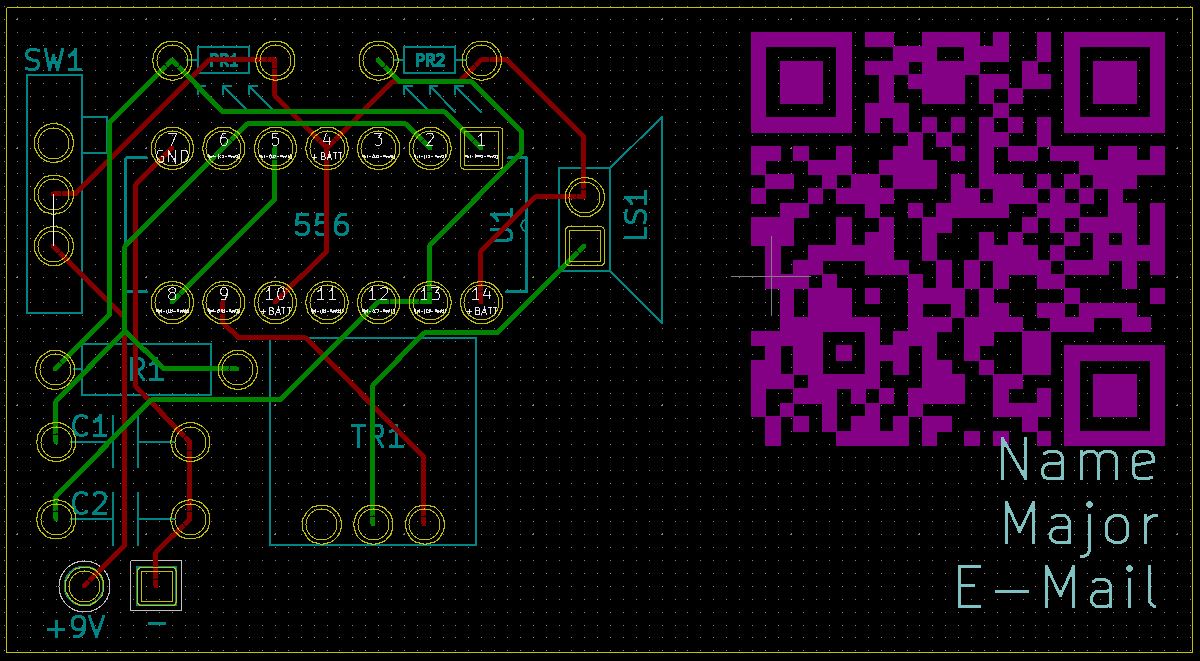
| Description | Ref | Component Value | Part # | Link |
|---|---|---|---|---|
| Resistor | R1 | 1K | CFR-25JB-52-1K | Digi-key |
| Capacitor | C1, C2 | 0.22u | K224M20X7RF53H5 | Mouser |
| 556 Timer | U1 | 556 | NE556N | Mouser |
| IC Socket | U1 | 14 Pin DIP | ICS-314-T | Digi-Key |
| Photoresistor | PR1, PR2 | 1k - 10k | 161 | Adafruit |
| Trimmer Resistor | TR1 | 5k | 3386T | Mouser |
| Speaker | LS1 | 8 ohm | 1890 | Adafruit |
| Switch | SW1 | SPDT | 805 | Adafruit |
| 9V Battery Clip | Batt/9V | 9V | 235 | Mouser |
For ease of assembly, start with the lower profile components and work up to the higher profile components.
I assembled the circuit in this order:
Below is an assembled STG circuit. A demo of the circuit can be found here: STG Demo
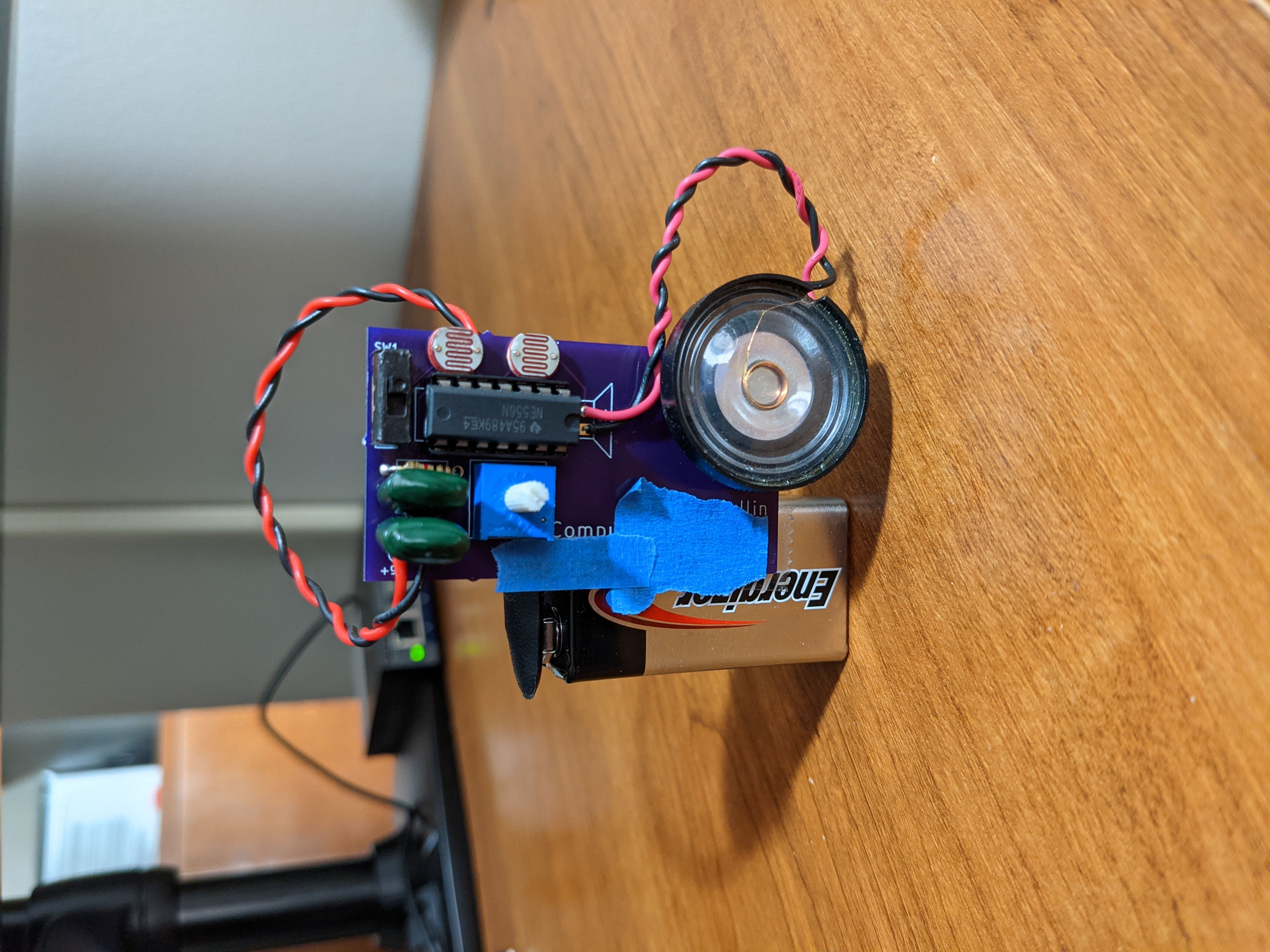
Overall, I happy with the final product. However, I may add an additional PCB, to this project, that swaps out the photoresistors for potentiometers. Alternate version has been added. However, it is untested.
For the alternate design, below are the parts that have changed.
| Qty | Value | Footprint | References |
|---|---|---|---|
| 2 | c_gen | capacitor_general:c_gen | C1, C2 |
| 2 | photores_gen | resistor_general:photores_gen | PR1, PR2 |
| 1 | LOGO | QR_CODE:qrcode_github | G*** |
| 1 | NE556N_gen | NE556N:DIP254P762X508-14 | U1 |
| 1 | Speaker | speaker_general:speaker_gen | LS1 |
| 1 | TestPoint_THTPad_1.5x1.5mm_Drill0.7mm | TestPoint:TestPoint_THTPad_1.5x1.5mm_Drill0.7mm | - |
| 1 | TestPoint_THTPad_D1.5mm_Drill0.7mm | TestPoint:TestPoint_THTPad_D1.5mm_Drill0.7mm | +9V |
| 1 | r_gen | resistor_general:r_gen | R1 |
| 1 | slide_switch_general | slide_switch_general:slide_switch_general | SW1 |
| 1 | trimpot_gen | resistor_general:trimpot_gen | TR1 |
t-mullin/Business_Card
Repo for the Stepped tone generator business card.


github-linguist/linguist
Language Savant. If your repository's language is being reported incorrectly, send us a pull request!


google/mozc-devices
Circuit diagrams and firmware source code for Gboard DIY keyboards


hackclub/OnBoard
💡 Join 1,000 teenagers and make your first PCB with a $100 grant!

VoronDesign/Voron-Tap
Tap is a nozzle-based z-probe for the V2 and Trident printer designs. The entire toolhead moves to trigger an optical switch. Tap offers many advantages:

stacksmashing/pico-tpmsniffer
A simple, very experimental TPM sniffer for LPC bus
It measures 58.4 × 31.8 mm and has 2 copper layers, 1.6 mm thick.
12 parts. The full list of its parts is on this page, with links to each part's symbol and footprint where PCBKit's library has them.
From the t-mullin/Business_Card repository on GitHub, at the commit this page was made from: the board is archive/business_card.kicad_pcb and its schematic Rounded/THT/business_card.kicad_sch. PCBKit opens the board in the browser, with nothing to install.
Its repository states no licence, so its author keeps all rights: ask t-mullin before reusing the design.