2 layers36.8 × 34.7 mm
Tinylab proto1
espotek-org/Labrador
EspoTek Labrador is a USB device that transforms your PC or smartphone into a fully-featured electronics lab. This repo holds all of the source code!
79 parts1.2k

 strayer/taira-keyboard164
A wireless low-profile split mechanical keyboard with 66 keys inspired by the ErgoDash and Corne Chocolate
Tairakb is an open-source printed circuit board by strayer, from the strayer/taira-keyboard repository on GitHub, published under the MIT licence. It is a 2-layer board of 151.3 × 120.8 mm with 79 parts on 56 nets, routed with 995 tracks and 158 vias.
Its parts include 34 switches, 33 diodes and 1 IC. It belongs with the keyboards and input boards and the nRF52 and nRF5x boards of this library.
A wireless low-profile split mechanical keyboard with 66 keys inspired by the ErgoDash and Corne Chocolate. It runs ZMK on two nice!nanos, is fully wireless via Bluetooth and uses Kailh Choc V1 switches in a 18x19mm grid layout.
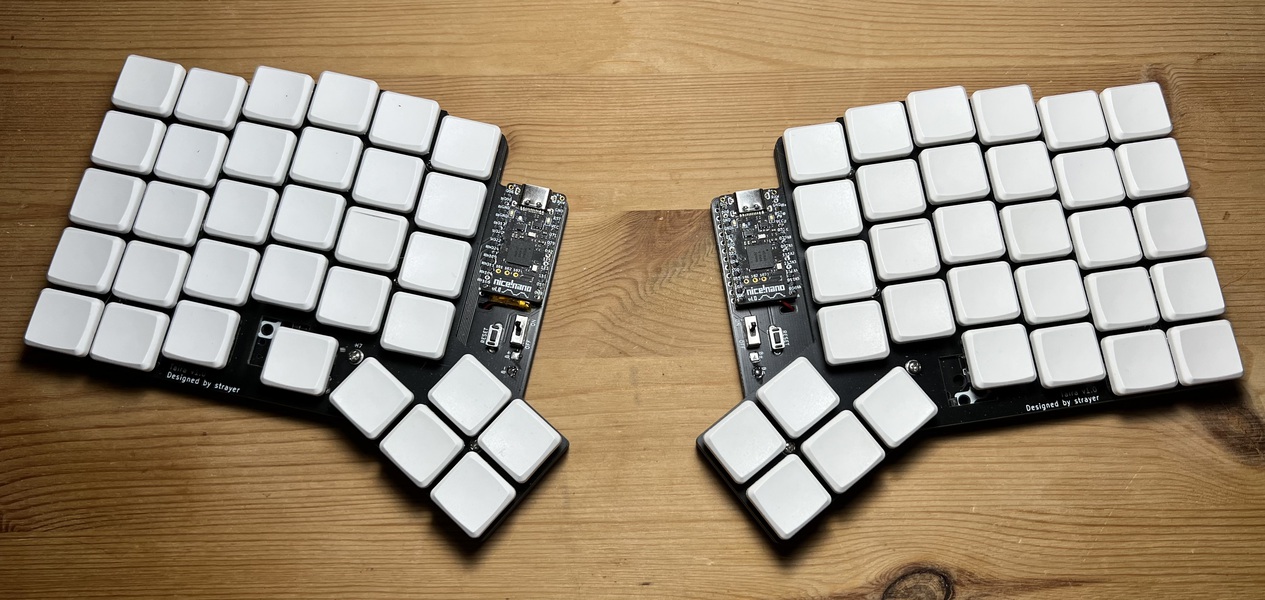
I used an ErgoDash with MX switches for over a year multiple hours each day. Even though I love typing on it, it always felt too bulky and the wires really started to annoy me - especially when moving between workplaces. At some point I discovered ZMK and started plans on building a keyboard based on the ErgoDash, but as low-profile as I could manage.
After investigating which other low-profile keyboards exist in the community, I quickly realized that the most sophisticated offer seems to be the Corne Chocolate. This keyboard is heavily based upon the footprints of the Corne Chocolate, but layed out in a layout very similar to the original ErgoDash.
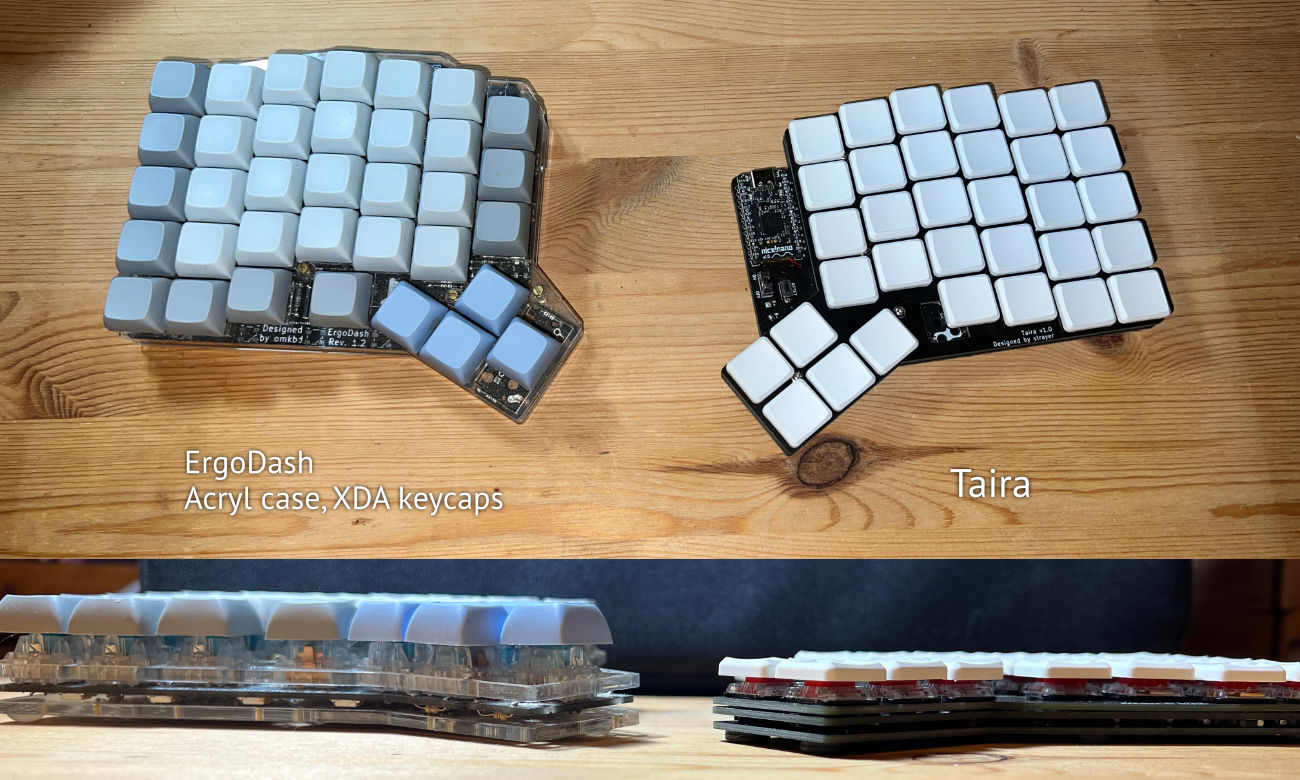
Follow the build guide if you are interested in building your own Taira.
The ZMK firmware is managed in a separate repository: strayer/taira-keyboard-zmk-config
Thanks to @omkbd and @foostan for releasing both the ErgoDash and the Corne Chocolate under the MIT license. Without their work, this keyboard would not exist.
Copyright 2022 Sven Grunewaldt
License: MIT
| Qty | Value | Footprint | References |
|---|---|---|---|
| 34 | SW_Push | tairakb:Choc_Hotswap | SW1, SW2, SW10, SW11, SW12, SW13, SW14, SW15, SW16, SW17, SW18, SW19, SW20, SW20-1, SW21, SW22 +18 |
| 33 | D | tairakb:D3_SMD | D1, D2, D10, D11, D12, D13, D14, D15, D16, D17, D18, D19, D20, D21, D22, D23 +17 |
| 8 | MountingHole | tairakb:LEGO_HOLE | H1, H2, H3, H4, H5, H6, H7, H8 |
| 1 | Battery | tairakb:Battery_Wire_Connector | BT1 |
| 1 | SW_DPDT_x2 | tairakb:SS-12D00 | BSW1 |
| 1 | SW_Push | tairakb:ResetSW | RSW1 |
| 1 | nice!nano | tairakb:nicenano | U3 |
espotek-org/Labrador
EspoTek Labrador is a USB device that transforms your PC or smartphone into a fully-featured electronics lab. This repo holds all of the source code!

hackclub/OnBoard
💡 Join 1,000 teenagers and make your first PCB with a $100 grant!

ElectronicCats/Minino
Minino is an original multiprotocol and multiband board made for sniffing, communicating, and attacking IoT devices. It was designed as a mini Cat that integrates the powerful ESP32C6, GPS, microSD and OLED.


cnlohr/cnhardware
My dumping grounds for all my kicad projects and random hardware bringup.


It measures 151.3 × 120.8 mm and has 2 copper layers, 1.6 mm thick.
79 parts. The full list of its parts is on this page, with links to each part's symbol and footprint where PCBKit's library has them.
From the strayer/taira-keyboard repository on GitHub, at the commit this page was made from: the board is pcb/tairakb.kicad_pcb. PCBKit opens the board in the browser, with nothing to install.
Its repository publishes it under the MIT licence: you may reuse it on that licence's terms (keep the author's notice, and for a copyleft licence share your changes alike).