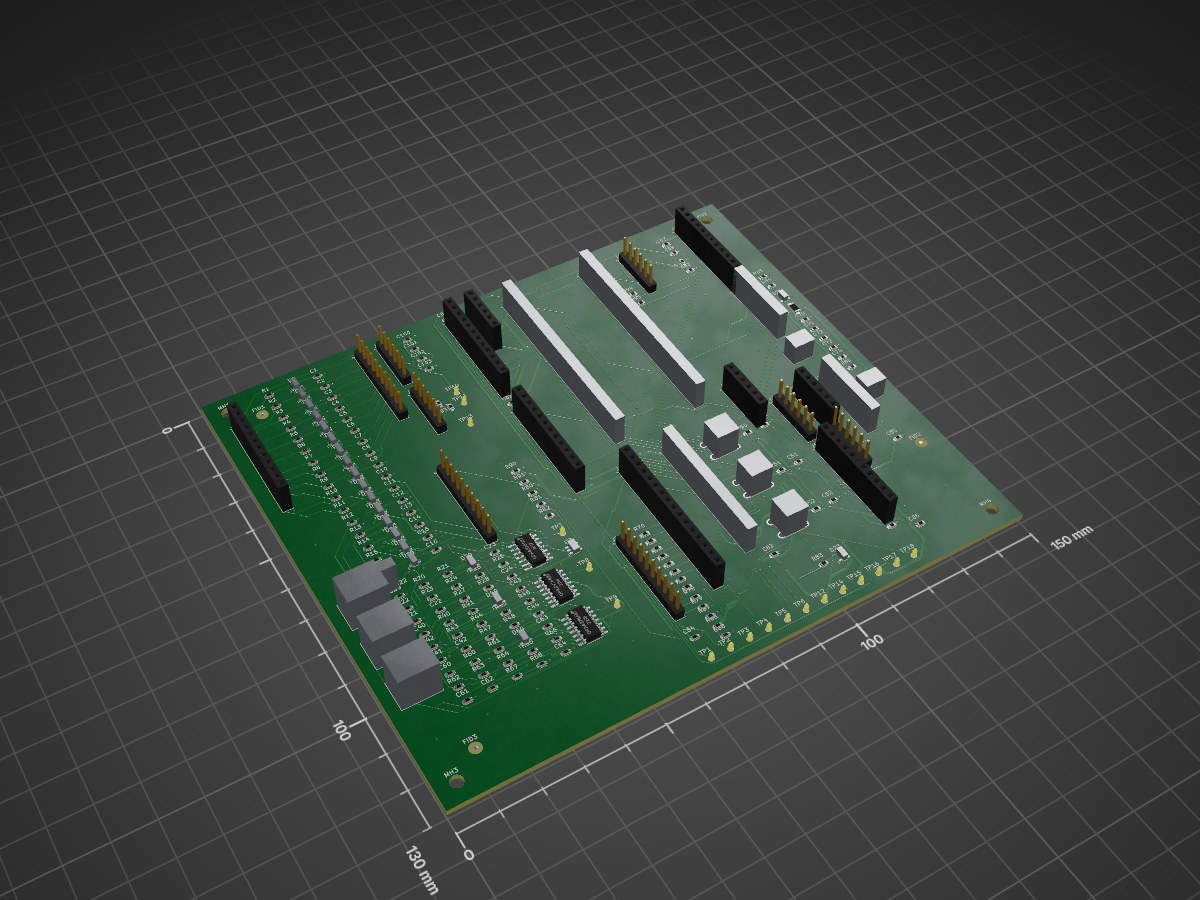
The complete manufacturing package for EEG-CAR-01 Rev B: a battery-powered, 16-channel EEG headset built around an ESP32-S3 carrier board, together with the helmet and enclosure, the electrode harness, the firmware, the…
EEG CAR-01 RevB routed is an open-source printed circuit board by stepvda, from the stepvda/EEG-kit repository on GitHub. It is a 4-layer board of 150 × 130 mm with 211 parts on 156 nets, routed with 3,745 tracks and 552 vias.
It is built around the TLV3201AIDBV, BAV99 and BAT54S, with the PESD5V0S2BT among its other parts. Its parts include 72 resistors, 54 capacitors, 30 connectors, 21 diodes and 4 ICs. It belongs with the ESP32 boards of this library.
TI One Voice research programme — one.witysk.org, Brussels, Belgium
Board revision B · 2 September 2026
The complete manufacturing package for EEG-CAR-01 Rev B: a battery-powered, 16-channel EEG headset
built around an ESP32-S3 carrier board, together with the helmet and enclosure, the electrode harness,
the firmware, the production test programme and fixtures, and all the packing, quality and regulatory
documentation needed to produce the finished kit — flight case included.
The package is designed so that a manufacturer can quote, review and build from it directly: the
Gerbers, drill files, netlist, BOM and CPL files are included, along with every printed part, the
assembly work instructions and an end-to-end test programme that runs from Chrome over USB. For the
study itself — participants, collaborators, grant bodies and funders — see
one.witysk.org/studies.
Status at a glance
Nothing in this package has been manufactured or measured. No board has been fabricated, no part
has been printed, no firmware has been flashed to silicon, and no electrode has touched a person.
Every performance figure is calculated, and each is labelled as calculated where it appears.
Area
State
Carrier board routing
Complete. 145 of 145 nets connected, 0 DRC violations. Released for review under RFQ-EEG-002A — not yet released for fabrication: no human layout engineer has reviewed it, and 169 connections close at relaxed width or gap.
Firmware
Built and boots under QEMU (ESP-IDF v5.2.5, esp32s3). Never run on real hardware — no hardware exists.
Mechanical parts
29 STL + 28 STEP released. Nothing has been printed. Foam case insert not released for cutting until the helmet shell is measured.
Test programme
Written and self-tested (57/57 interop checks). Never run against a physical unit.
Production simulation
193 checks passed, 0 failed, 6 open items.
Safety
Not done. The safety review gates Phase 2; nothing goes on a head before it.
Read KNOWN_ISSUES.txt before quoting or building anything. It is the short
list, in one place, of what is wrong with the data as shipped — 6 open items and 22 unapproved
assumptions in 15 sections. Everything in it is also in the controlled documents; the file exists so
that problems are found here rather than at CAM time.
Orientation — read in this order
README_package_index.txt + KNOWN_ISSUES.txt — the orientation pair. The index says what
every folder is for and gives the rebuild commands (its header is stale at v2.2; this package
is v2.4).
docs/RFQ-EEG-001 Rev E — the actual request: numbered requirements (E-, S-, F-, T-), the
pricing template, and §9.4's correction-iteration terms for prototypes that arrive not working.
docs/DSN-EEG-003 Rev D — the governing document. Architecture, the carrier board, and the
precedence rules that decide which document wins when two disagree.
Precedence: DSN-EEG-003 Rev D > RFQ-EEG-001 Rev E > ICD-EEG-006 > SCH-EEG-005 > DSN-EEG-002 >
PARTS-EEG-019 > RUL-EEG-021 > the bidder BOM. Where a number appears in a document and in
tools/design.py, design.py governs — tools/emit_all.py regenerates every fabrication file
from it in one pass, so the package cannot drift.
Repository layout
Path
Contents
docs/
21 controlled documents (Rev-controlled, in .md, .docx and .pdf): the RFQ, the manufacturing design package, interface control, schematic set, assembly work instructions, harness wire list, test specification, fixture design, quality plan, risk & safety pack, regulatory file (incl. lithium shipping UN3481/PI967), service & refurbishment, participant card, packing & labelling, change control, approved vendor list, production simulation, part register, firmware build & provisioning, rulings register — plus the three workbooks: bidder BOM, internal costed BOM, manufacturer contacts.
kicad/
EEG-CAR-01 Rev B fabrication pack: routed .kicad_pcb, DRC report, BOM, two CPL files, fabrication/assembly/copper drawings, PCB spec sheet, machine-readable net report — and gerber/: 11 Gerber X2 layers, two Excellon drills, IPC-D-356A netlist, zipped, with a SHA-256 for every file.
kicad/wh-bus-01/
The second, tiny PCB: 14 × 10 × 0.8 mm bus board that splits the harness LED_V into eight contact-light tails. The helmet doesn't work without it.
schematic/
SCH-EEG-005 Rev B, an 8-sheet A3 schematic set (PDF + PNGs), generated from tools/design.py. Drawings only — there is no editable .kicad_sch.
mech/
Every printed and cut part: stl/ (29 printable meshes), step/ (28 parametric solids for dimensioning and inspection), drawings/ (25 dimensioned sheets), renders/ (25 shaded views), 7 foam-layer DXFs for the flight case, the hardware schedule and the mechanical release status.
firmware/
The ESP-IDF project (main.c, drivers, provisioning opcodes) and release/: four flashable ESP32-S3 images (bootloader, partition table, OTA data, app) with a SHA-256 manifest and the exact esptool command — no toolchain needed to program a board. firmware/tools/ is the end-of-line provisioning station: ATECC608B keying, serial & calibration writes, signed-stream verification.
webtest/
TOOL-EEG-022, the connectivity test: one self-contained 52 kB HTML file an assembler double-clicks in Chrome to prove browser–computer–USB–device connectivity (no measurement, no server, nothing to install). The interop harness compiles the real main.c against ESP-IDF stubs and drives it with the real host protocol module — 57/57 checks green.
fixtures/
The four production test fixtures of JIG-EEG-009 as buildable data: PCB outlines and netlists (deliberately no copper), printed-part geometry, and RP2040 controller firmware speaking the FIXPROTO v1 line protocol. Nothing here has been built.
records/
The machine-readable per-unit test record of TST-EEG-004 §12: a JSON Schema, a stdlib-only validator, and a worked example (all-DEFERRED). No unit has been built, so the schema has never met real output.
graphics/
Board plots (four copper layers, fabrication drawing, drill map, assembly views, 3D renders) and labels/: the packing and marking artwork of PKG-EEG-015 — unit label, kit ID plate, 9 foam bay tags, carton set, lithium mark, tamper seal, disinfection card (22 SVG + 11 PDF).
tools/
The generator: 42 Python modules, 19,072 lines, 27 entry points. design.py is the single source of truth for the board; mech_gen.py for the printed parts. Five re-runnable verification gates check connectivity, DRC, placement, cross-document consistency and the 15-station production dry run. Every figure in this package can be regenerated from source.
project/
Why the kit exists: the 3-page partner proposal, the 161-page experiment design v4.2, and the 11-page project plan with its schedule and workstreams (supplier costs are placeholders).
reports/
Working DRC reports, metrics and the placement checklist from the routing campaign.
constraints/
Net rules used by the router.
The board
EEG-CAR-01 Rev B — 150.0 × 130.0 mm, four layers (L1 signal, L2/L3 reference planes split
AGND_REF/DGND, L4 signal), 30 connectors, 211 reference designators, 156 nets.
3,745 track segments, 552 through vias, 0 duplicates
145 of 145 nets one connected copper island; 0 DRC violations
Smallest clearance 0.260 mm, narrowest conductor 0.200 mm, smallest plated hole 0.300 mm
No digital net in the analogue zone; exactly one AGND_REF-to-DGND bridge and one
HARN_SHIELD-to-DGND bridge
The layout was produced by the programme's own constraint-aware autorouter and verified by
measurement on the finished polygons — but it has not been reviewed by a human layout
engineer. The DRC report lists every one of the 169 relaxed connections so a reviewer can go
straight to the places that need attention.
Firmware
ESP-IDF v5.2.5, target esp32s3, Phase 1 configuration (secure boot off). Four release images with
SHA-256 checksums, a 920-line main.c with 16 host commands and 13 provisioning opcodes, drivers
for the ES8388 codec, SDMMC, ATECC608B, MAX17048 gauge and the envelope onset detector.
What has happened
What it proves
What it does not
It builds, clean at -Wall -Werror=all
The image links and fits
That any of it is right
It boots under QEMU (esp32s3)
Bootloader, partition table and app_main() behave as written
Any peripheral — QEMU has no PSRAM, SD, ES8388 or ADS1299
It agrees with the browser tool (57/57)
Framing, CRC, opcodes, the S-01 interlock
Anything about ESP-IDF or hardware
It has never run on silicon, and no hardware exists. The SPI timing, every ADS1299 register
value, USB enumeration and the whole analogue front end are assumptions no silicon has answered.
F-08 (block signing) is unimplemented; the ATECC608B config template is only 4 of 128 bytes
reviewed — that write is irreversible, so it gates on a real part.
Testing & quality
TST-EEG-004 Rev C — the per-unit test: 32 steps T00–T30, with a 5,033-line JSON Schema and a
stdlib-only validator so any two vendors emit the same record file.
JIG-EEG-009 Rev C + fixtures/ — four test fixtures as buildable data, with RP2040
controller firmware passing 154 host checks.
TOOL-EEG-022 — the browser connectivity test (webtest/EEG-Connectivity-Test.html) and the
interop harness that keeps firmware and protocol from drifting apart.
SIM-EEG-018 — a production simulation that walks one unit through all fifteen stations,
purchase order to refurbishment: 193 passed, 0 failed, 6 open.
ECO-EEG-016 — the change register that owns the document namespace and explains why
everything is the way it is.
Rebuilding the package from source
sh
python3 tools/run_build.py          # route, pour, check            (~20 min)
python3 tools/emit_all.py --cached  # Gerbers, drawings, schematic
python3 tools/emit_extras.py        # spec sheet, netreport, STEP, manifest
python3 tools/mech_gen.py           # STL and STEP for every printed part
python3 tools/mech_drawings.py      # dimensioned drawings and renders
python3 tools/emit_workbooks.py     # the three spreadsheets
python3 tools/simulate_production.py --report docs/SIM-EEG-018_....md
python3 tools/make_docs.py          # A4 .docx and .pdf of every document

python3 tools/check_consistency.py  # cross-document consistency gate
python3 webtest/build.py            # rebuild the single-file connectivity tester
node webtest/tests/*.mjs            # protocol tests
sh webtest/tests/interop/run.sh     # firmware-vs-protocol interop (57 checks)
Production phases
Phase 1 — 2 prototypes
Phase 2 — 10 kits
Phase 3 — 10 to 40 further kits (25 to 50 total)
Sponsorship
This study is run by a non-profit and funded by donations and grants that have not yet all been
secured. Any part of the work treated as sponsorship — a discounted prototype build, parts at
cost, donated units — is welcome, in return for named credit in the published open-hardware design
files, acknowledgement in the resulting papers and on the platform, and the case study of an
instrument you built being used in a pre-registered study.
Licence & contact
Hardware and documents: CC BY-SA 4.0 · Firmware: MIT
Third-party datasheets are excluded from both grants. Manufacturer datasheets and other
third-party documents referenced by this package remain the property of their respective
manufacturers, are referenced or redistributed for reference only, and are not covered by
the CC BY-SA 4.0 licence above. See docs/datasheets/README_datasheets.md
for the index and docs/datasheets/third_party/LICENCE_NOTE.md
for the terms.
The complete manufacturing package for EEG-CAR-01 Rev B: a battery-powered, 16-channel EEG headset built around an ESP32-S3 carrier board, together with the helmet and enclosure, the electrode harness, the firmware, the…
A 1-Channel 20MHz 100MS/s Mixed-Signal Digital Storage Oscilloscope on a custom 4-layer PCB. Powered by STM32H7, Lattice iCE40 FPGA, and USB-C
120 parts1
Questions
How big is the EEG CAR-01 RevB routed PCB?
It measures 150 × 130 mm and has 4 copper layers, 1.6 mm thick.
What parts does the EEG CAR-01 RevB routed use?
211 parts, built around the TLV3201AIDBV, BAV99, BAT54S and PESD5V0S2BT. The full list of its parts is on this page, with links to each part's symbol and footprint where PCBKit's library has them.
Where can I download the EEG CAR-01 RevB routed KiCad files?
From the stepvda/EEG-kit repository on GitHub, at the commit this page was made from: the board is kicad/EEG-CAR-01_RevB_routed.kicad_pcb and its schematic kicad/EEG-CAR-01_RevC.kicad_sch. PCBKit opens the board in the browser, with nothing to install.
Can I use the EEG CAR-01 RevB routed design in my own project?
Its repository states no licence, so its author keeps all rights: ask stepvda before reusing the design.