
6 layers160 × 120 mm
Pic32main
JuanPoueriet/automatic-spork
Máquina de ruleta física de casino. 6 PCBs: pic32main (cerebro), wheel (rueda de LEDs), displaysa/b/c (paneles de 7 segmentos en cascada) y buttons (botonera).
256 parts

CHORD ZERO Stenographic Keyboard
Zero is an open-source printed circuit board by stenobase, from the stenobase/chord-zero repository on GitHub. It is a 2-layer board of 266 × 76 mm with 75 parts on 68 nets, routed with 241 tracks and 19 vias.
It is built around the 1N4148W, SK6812MINI-E and P6SMB6.8A. Its parts include 33 diodes, 30 switches and 1 IC. It belongs with the keyboards and input boards and the RP2040 boards of this library.


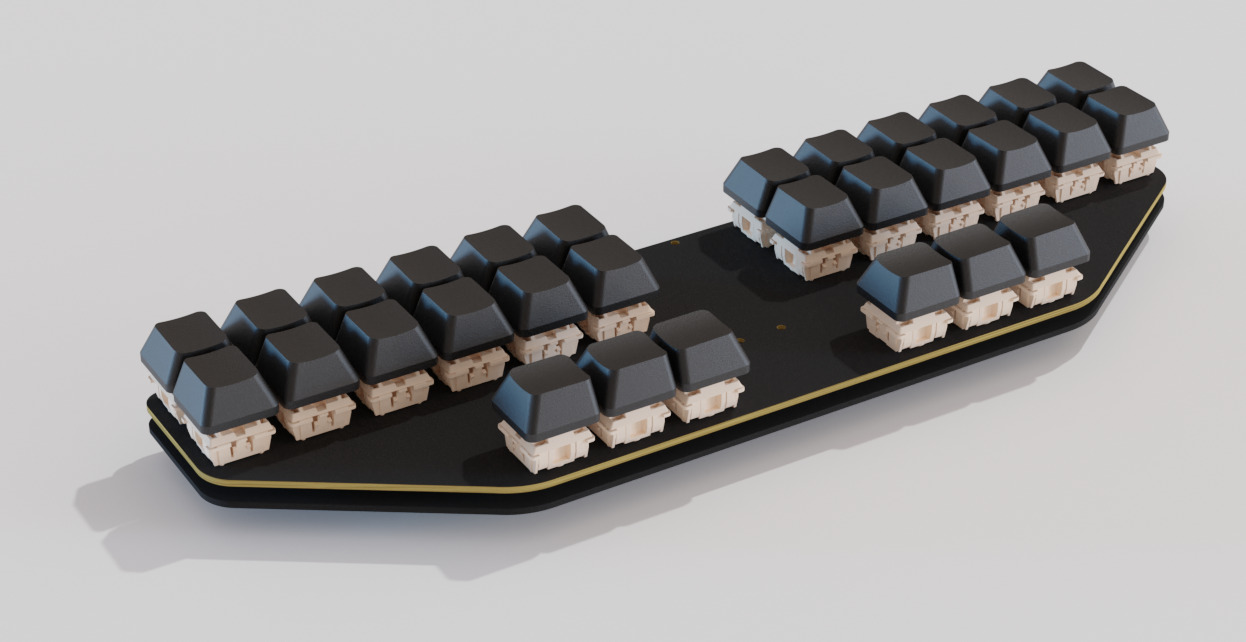
CHORD ZERO is a stenographic keyboard that can be used with Plover or any other application that supports the TX Bolt or GeminiPR protocol.
The easiest way to create gerber files is with
KiKit; and the easiest way to install
KiKit is with pipx:
$ pipx install kikit --system-site-packages
$ kikit fab <your_fab_of_choice> zero.kicad_pcb gerbers
This creates gerbers/gerbers.zip. Use this file to order PCBs the same way
as you would usually do.
You will need the following parts:
1N4148W (or similar)SMBJ5.0A (or similar)SK6812MINI (optional)You want linear switches with low actuation force. Gateron clears are a good option.
You want key caps that minimize the gap between top and bottom row. Cherry R2/R3 or OEM R3 are good options.
Firmware and instructions are available here.
The CHORD ZERO Stenographic Keyboard is open source hardware. You are encouraged to produce your own keyboard based on the documentation and design files of this project. You are also encouraged to study and modify the design and create derivatives.
| Qty | Value | Footprint | References |
|---|---|---|---|
| 30 | 1N4148W | footprints:D_SOD-123 | D101, D102, D103, D104, D105, D106, D107, D108, D109, D110, D111, D112, D201, D202, D203, D204 +14 |
| 30 | SW_Push | footprints:CherryMX_1u_snug_fit | SW101, SW102, SW103, SW104, SW105, SW106, SW107, SW108, SW109, SW110, SW111, SW112, SW201, SW202, SW203, SW204 +14 |
| 6 | MountingHole | footprints:M2 Hole | H1, H2, H3, H4, H5, H6 |
| 4 | MountingHole Pico | footprints:M2 Hole Pico | H7, H8, H9, H10 |
| 2 | SK6812MINI | LED_SMD:LED_SK6812MINI_PLCC4_3.5x3.5mm_P1.75mm | D1, D2 |
| 1 | CHORD LOGO | footprints:chord_logo_3d | LOGO_1 |
| 1 | P6SMB6.8A | Diode_SMD:D_SMB_Handsoldering | D4 |
| 1 | Pico | footprints:RPi_Pico_SMD | U1 |
It measures 266 × 76 mm and has 2 copper layers, 1.6 mm thick.
75 parts, built around the 1N4148W, SK6812MINI-E and P6SMB6.8A. The full list of its parts is on this page, with links to each part's symbol and footprint where PCBKit's library has them.
From the stenobase/chord-zero repository on GitHub, at the commit this page was made from: the board is zero.kicad_pcb and its schematic switch.kicad_sch. PCBKit opens the board in the browser, with nothing to install.
Its repository states no licence, so its author keeps all rights: ask stenobase before reusing the design.
JuanPoueriet/automatic-spork
Máquina de ruleta física de casino. 6 PCBs: pic32main (cerebro), wheel (rueda de LEDs), displaysa/b/c (paneles de 7 segmentos en cascada) y buttons (botonera).


sillevl/spha-btni-hardware
SPHA 16-channel input module with microcontroller, input/output circuitry, and CAN connectivity.


sadekbaroudi/bgkeeb
This is a reversible 100mm x 100mm pcb with support for mx or choc switches (no hotswap), per key led, rotary encoders, and exposes the SDA/SCL/GND/VCC lines in the form of the pimoroni trackball pins (meaning you can…


sadekbaroudi/barobord
I have spent a lot of time and money designing prototypes, testing, developing, etc. Any contributions would be greatly appreciated!

sporkus/le_chiffre_keyboard_stm32
Le Chiffre keyboard pcb with stm32F072