
2 layers94 × 85 mm

 stem-piano/sensor-systems1
Hybrid MIDI digital pianos sensors
2040-centered-4x QRE1113GR is an open-source printed circuit board by stem-piano, from the stem-piano/sensor-systems repository on GitHub, published under the GPL-3.0 licence. It is a 2-layer board of 49 × 52 mm with 14 parts on 13 nets, routed with 57 tracks and 0 vias.
It is built around the QRE1113GR. Its parts include 4 ICs and 1 connector.
These are the KiCad files for a sensorboard containing 4 QRE1113GR (surface mount) as in the raytracing below.
The files are named 2040-centered-4x-QRE1113GR because:
The QRE1113-protector.stl is the 3D-print model for the sensor protector.
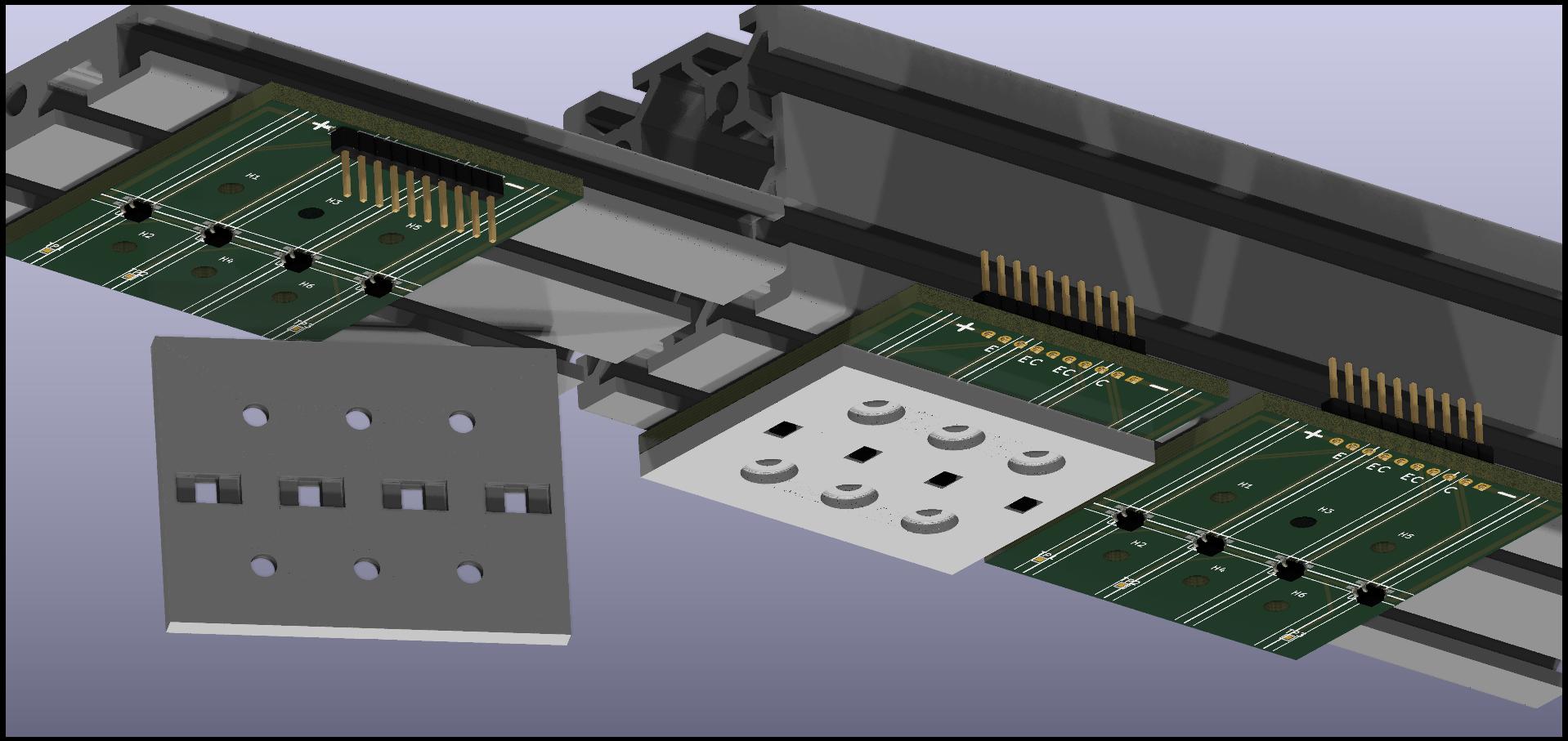
The image depicts an assembly of sensorboards on thick and thin rails (in dark gray, on the top). The thick rails will be used for hammer sensors. The hammers will come from down in this picture and the keys are "inside the screen" toward the left.
The lighter grey "sensor protector" will absorb at least part of the hammer impacts. All the hammer boards will have those installed, but it is not shown on the board to the right to show better the board itself. There is a levitating "sensor protector" on the left, showing the other side with the clearance for the pins.
The board on the left, on the thinner extrusion is identical to the others. The assembly is slightly different in that the jumper connector will be mounted on the other side of the board (or it can be installed 90-degrees, see pictures in the assembly instructions linked below). That, and the thinner extrusion make it a "key sensor" board. It will need to be flipped upside down for the purpose, and lowered under the keys which are not shown in this image. All keys will have them (also the keys not damped on a piano: note off is still needed for MIDI even if it might be ignored by the virtual instrument for the highest notes of the piano).
More detailed assembly instructions (with pictures) can be found here
These can be purchased here
Instead of using regular aluminum extrusions, these sensorboards fit perfectly with the specialty ones linked below.
Advantages of specialty extrusions:
The extrusions I used are for the hammer sensors are https://us.misumi-ec.com/vona2/detail/110302684530/ and for the key (dampers) sensors are https://us.misumi-ec.com/vona2/detail/110302261730/ but of course many alternatives exist. I prefer MISUMI as the market leader in the field having a top-notch product, rather than saving a few dollars and encountering flex problems, or difficulty matching the nuts.
| Qty | Value | Footprint | References |
|---|---|---|---|
| 6 | MountingHole | Mounting_Holes:MountingHole_3.2mm_M3 | H1, H2, H3, H4, H5, H6 |
| 4 | QRE1113GR | OptoDevice:QRE1113GR | U1, U2, U3, U4 |
| 3 | TestPoint | TestPoint:TestPoint_Pad_1.0x1.0mm | TP1, TP2, TP3 |
| 1 | Conn_01x10_Male | Connector_PinHeader_2.54mm:PinHeader_1x10_P2.54mm_Vertical | J1 |
It measures 49 × 52 mm and has 2 copper layers, 1.6 mm thick.
14 parts, built around the QRE1113GR. The full list of its parts is on this page, with links to each part's symbol and footprint where PCBKit's library has them.
From the stem-piano/sensor-systems repository on GitHub, at the commit this page was made from: the board is qps/4x-QRE1113GR/2040-centered-4x-QRE1113GR.kicad_pcb and its schematic qps/4x-QRE1113GR/2040-centered-4x-QRE1113GR.kicad_sch. PCBKit opens the board in the browser, with nothing to install.
Its repository publishes it under the GPL-3.0 licence: you may reuse it on that licence's terms (keep the author's notice, and for a copyleft licence share your changes alike).

fwachsmuth/Synkino
Allows sound playback synchronised to a running,jittery Super 8 projector

opulo-inc/lumenpnp-archive
This repository is a public archive of the LumenPnP Pick and Place (formerly Index) source material from the beginning in mid-2020 until May 2022. The current source can be found at https://github.com/opulo-inc/lumenpnp


alientanya/line-follower-PCB
A modular PCB platform for Fast Line Follower (FLF) robots, designed to prioritize sensor experimentation and component flexibility.

class-ab/open-soccer
Mindstormers' open soccer repo. contains code, pcbs, elec, diagrams, etc...

falconecorp/BOBBY
Robot triatlón : seguidor de linea , quita obstáculos, sumo. Este proyecto esta construido por el técnico físico Lautaro Lammers, el doctor en sistemas Lucas Chavez, el Ingeniero en informatico Dante Canale, El…

AlisonTristao/mouse_robot
Robo para experimentação de rede neural baseada no comportamento de roedores