
2 layers96.6 × 82.8 mm

 star-waroobah/Starbie
My starbie PCB for half life.
STARBIE W is an open-source printed circuit board by star-waroobah, from the star-waroobah/Starbie repository on GitHub, published under the MIT licence. It is a 2-layer board of 106 × 96.3 mm with 7 parts on 27 nets, routed with 82 tracks and 4 vias.
It is built around the DHT11. Its parts include 2 ICs, 2 connectors, 2 switches and 1 resistor. It belongs with the ESP32 and RISC-V boards of this library.
A small star-shaped PCB desk pet built around a XIAO ESP32-C3, with an OLED screen, a motion sensor and a temperature sensor.
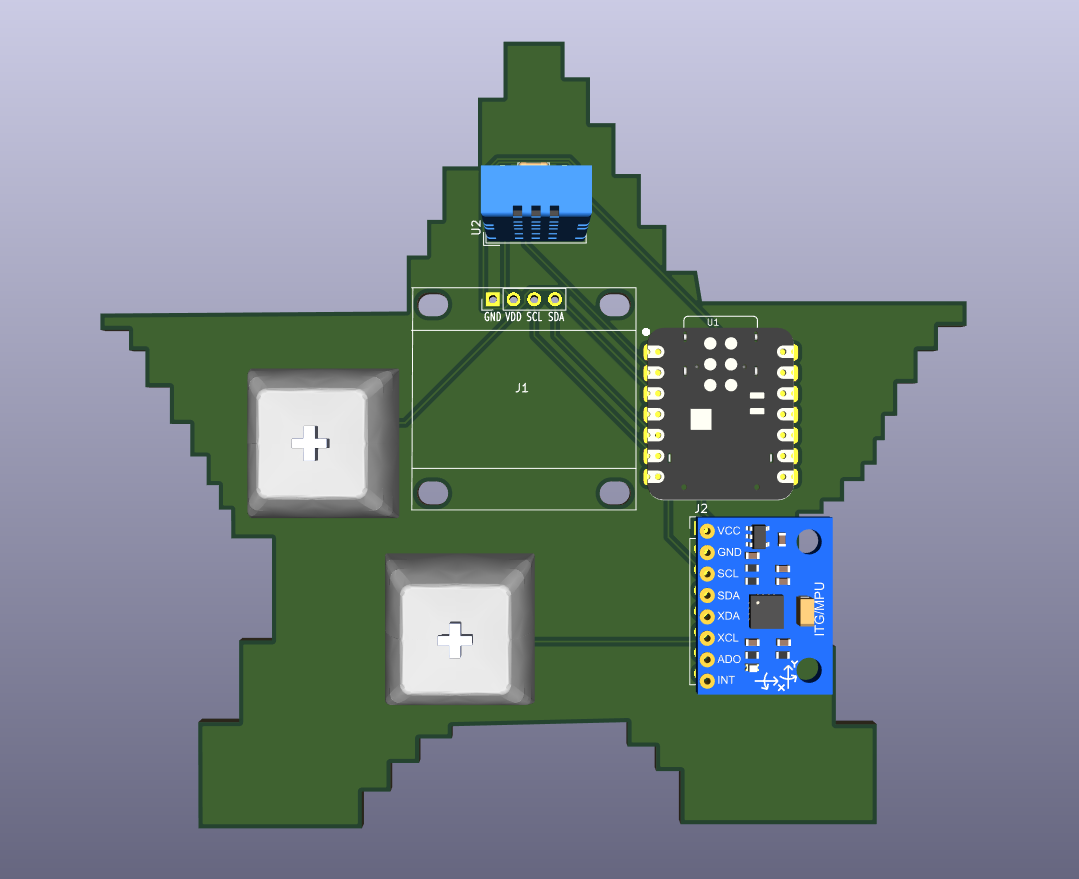
I made it as the week 1 project of half life hack club and I picked Starbie because it’s a small, fun project that combines a screen, sensors and buttons on one board. It was a great way to learn KiCad as a beginner using the guide :)
The XIAO ESP32-C3 is the brain. It draws the pet on the OLED screen, reads the MPU6050 so the pet reacts when the board is tilted or shaken, reads the DHT11 for temperature and humidity, and reads two buttons for input.
The firmware used in this project is based on the original Starbie firmware provided by SharKingStudios in the Hack Club Half-Life guide. Original firmware: https://github.com/SharKingStudios/Starbie/tree/main/Firmware The original firmware is licensed under the MIT License, Copyright (c) 2026 Logan Peterson. The license text is included in this repository. I followed the official guide for the firmware rather than generating it with AI.
| Part | What it does | Qty | Unit price | Total | Vendor | Link |
|---|---|---|---|---|---|---|
| XIAO ESP32-C3 | The main chip | 1 | $4.90 | $4.90 | Seeed Studio | Buy |
| 0.96 inch OLED display (I2C) | Screen that shows the pet | 1 | $3.76 | $3.76 | Daraz | Buy |
| DHT11 | Temperature and humidity sensor | 1 | $2.90 | $2.90 | Daraz | Buy |
| 10k resistor (pack of 10) | Pull-up resistor on the DHT11 data line | 1 | $0.42 | $0.42 | Daraz | Buy |
| Custom PCB (Starbie) | The circuit board, made from my Gerber files | 1 | $6.44 | $6.44 | PCBX | Buy |
| MPU6050 module | Motion sensor that detects tilting and shaking | 1 | $1.81 | $1.81 | Daraz | Buy |
| Tactile push buttons 6x6x5mm | The 2 buttons on the board | 1 | $1.08 | $1.08 | Daraz | Buy |
| Tax & shipping | For the whole order | - | - | $7.40 | - | - |
| Total | $28.71 |
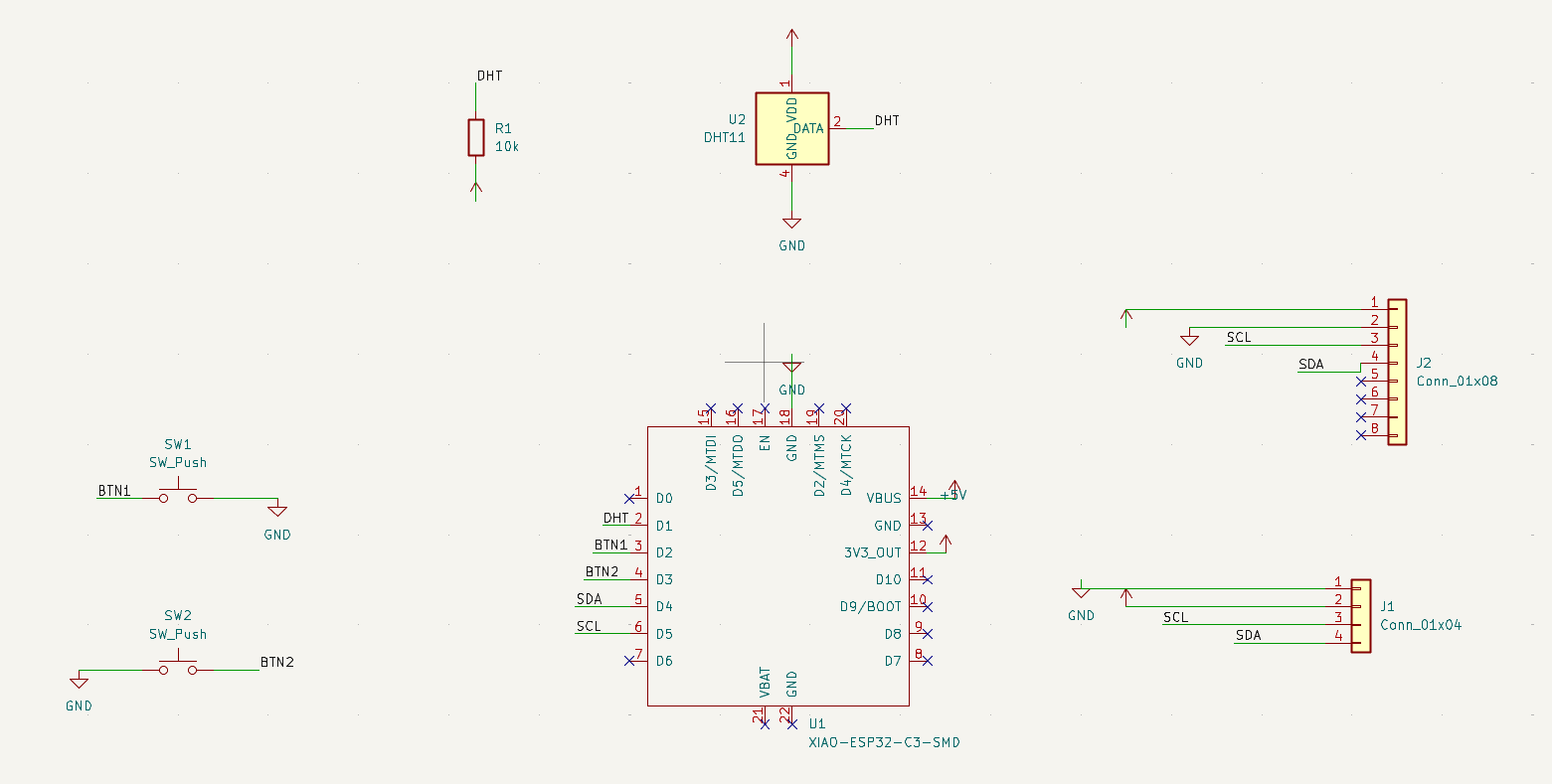
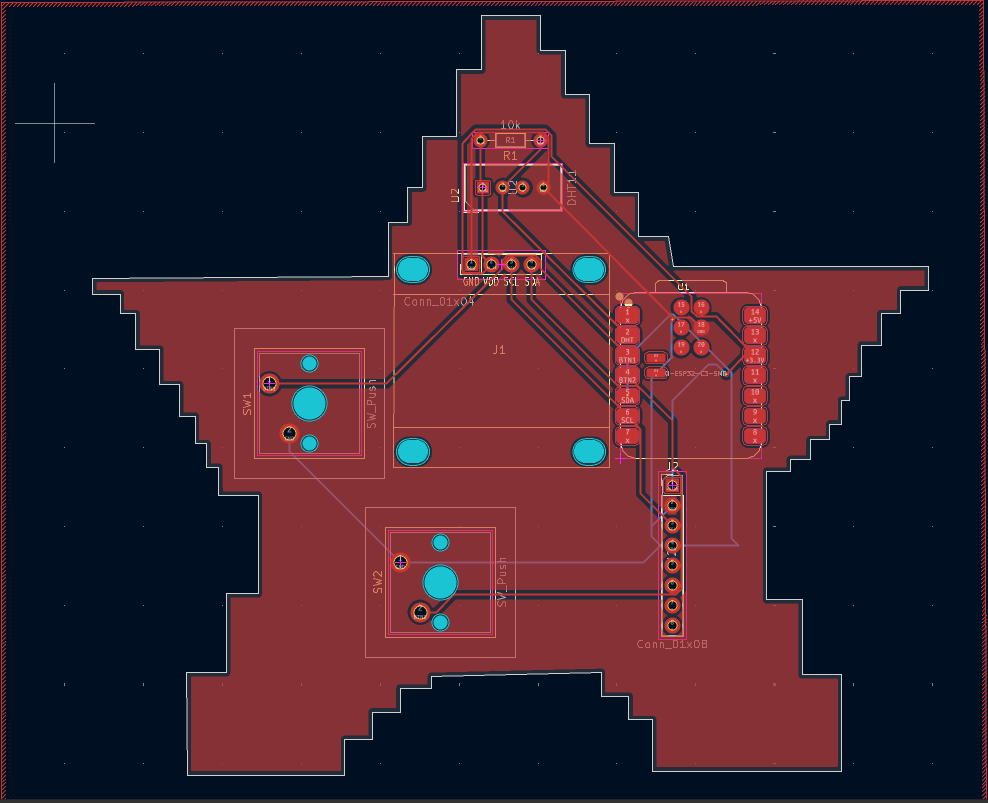
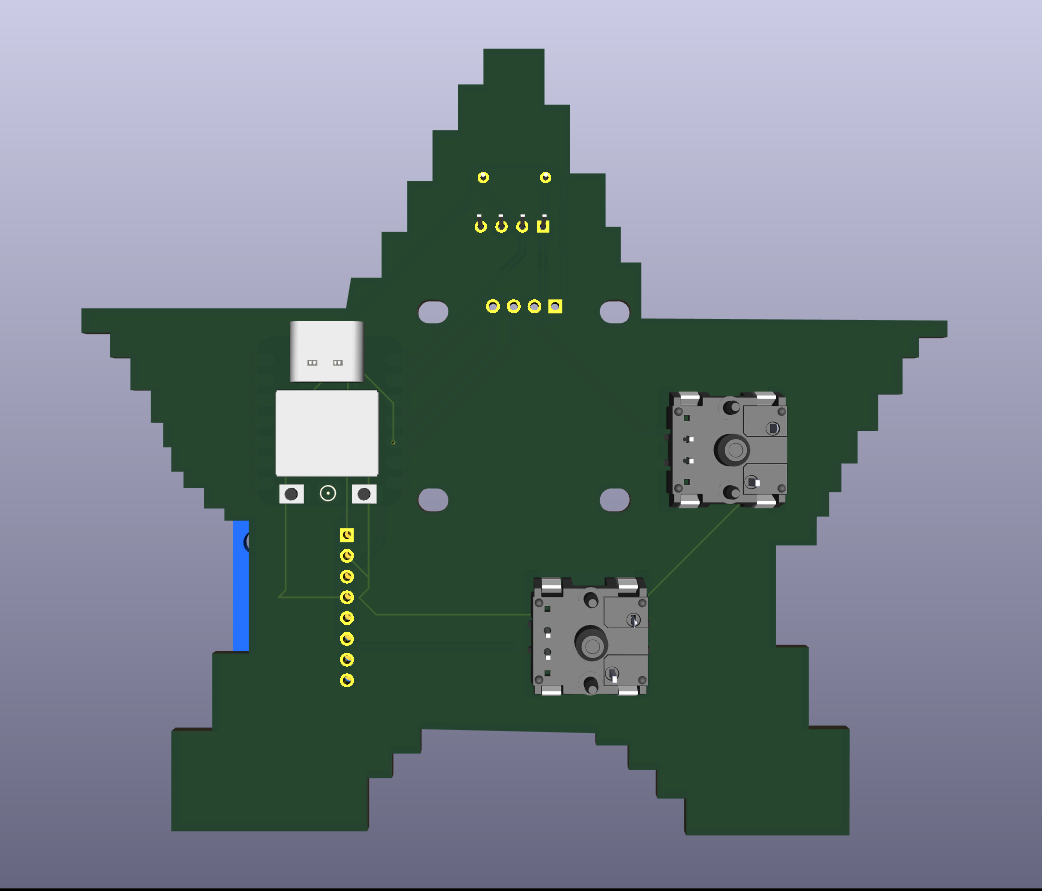
PCB/ KiCad project filesproduction/ Gerber and drill filesFirmware/ Arduino codeAssets/ imagesBOM.csv parts list| Qty | Value | Footprint | References |
|---|---|---|---|
| 2 | SW_Push | Button_Switch_Keyboard:SW_Cherry_MX_1.00u_PCB | SW1, SW2 |
| 1 | 10k | Resistor_THT:R_Axial_DIN0204_L3.6mm_D1.6mm_P7.62mm_Horizontal | R1 |
| 1 | Conn_01x04 | Imported Parts:Display_128x64_096_I2C | J1 |
| 1 | Conn_01x08 | Connector_PinHeader_2.54mm:PinHeader_1x08_P2.54mm_Vertical | J2 |
| 1 | DHT11 | Sensor:Aosong_DHT11_5.5x12.0_P2.54mm | U2 |
| 1 | XIAO-ESP32-C3-SMD | Imported Parts:XIAO-ESP32-C3-SMD | U1 |

lansidev/conveyor-belt
Miniature 3D printed conveyor belt for simulation and fun working with sensors, all controllable with Raspberry Pi


ebrithiljonas/OMG_PCB
All in One PCB for the OpenMQTTGateway Project

GeorgK/SniffingTrinket
A room climate monitor using the Adafruit Trinket Pro

bhaskar9980/Guardian
Guardian is an advanced, fully automated hydroponics system designed to optimize plant growth and maximize yield.

Twistx77/Firefly
Open WIFI-enabled RGB lamp with temperature, humidity, suspended air particles and eCO2 sensors.

unla-investigacion-desarrollo/ecosistema-iot
Antes de desarrollar el sistema final, realizamos una etapa de exploración donde investigamos y experimentamos con las siguientes tecnologías:
It measures 106 × 96.3 mm and has 2 copper layers, 1.6 mm thick.
7 parts, built around the DHT11. The full list of its parts is on this page, with links to each part's symbol and footprint where PCBKit's library has them.
From the star-waroobah/Starbie repository on GitHub, at the commit this page was made from: the board is PCB/STARBIE W.kicad_pcb and its schematic PCB/STARBIE W.kicad_sch. PCBKit opens the board in the browser, with nothing to install.
Its repository publishes it under the MIT licence: you may reuse it on that licence's terms (keep the author's notice, and for a copyleft licence share your changes alike).