
4 layers16.9 × 119.4 mm

 ssnivy/TheWearableBearable2
Sponsored by InterPLAY Orchestra. Credits: Akash Saran, Katherine Xu, Anna Zhou
WearableBearable is an open-source printed circuit board by ssnivy, from the ssnivy/TheWearableBearable repository on GitHub. It is a 4-layer board of 29 × 42.5 mm with 13 parts on 28 nets, routed with 52 tracks and 0 vias.
It is built around the WS2812B-2020. Its parts include 3 resistors, 2 capacitors, 2 diodes, 1 IC and 1 transistor. It belongs with the ESP32 and RISC-V boards of this library.
The Wearable Bearable is a prototype wearable haptic timing system that helps groups stay synchronized through shared vibration cues. It was originally developed for the Interplay Orchestra, a nonprofit ensemble for adults with disabilities, where some musicians may benefit from an additional tactile signal to reinforce the conductor’s tempo.
The system consists of one master device and one or more slave devices. A phone or other Bluetooth Low Energy (BLE) controller sends a selected tempo in beats per minute (BPM) to the master. The master converts that tempo into timed vibration pulses, activates its own motor, and broadcasts synchronization commands to nearby slaves using ESP-NOW. Each slave reproduces the same short vibration pulses, allowing all connected wearers to receive a coordinated tactile beat without physical connections between devices.
The project explores low-cost wearable haptic feedback as an accessibility tool for shared timing and coordination. The Wearable Bearable is a prototype and is not a medical device; it does not measure heart rate or diagnose, monitor, or treat any medical condition.
The custom KiCad PCB is built around the Seeed Studio XIAO ESP32-C6 and includes:
The vibration motor is controlled through the MOSFET rather than directly from a GPIO pin, while the flyback diode protects the circuit from voltage spikes produced by the motor.
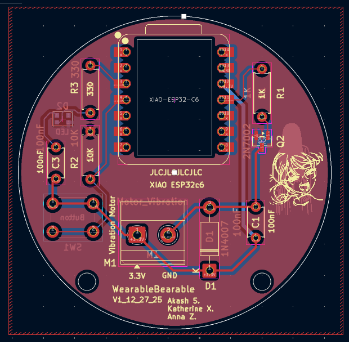
The PCB schematic, layout, component footprints, 3D models, and design backups are located in KiCAD PCB/.
The electronics are housed inside a custom 3D-printed bear-shaped enclosure mounted to an adjustable wristband. The enclosure is designed to securely hold the PCB while allowing the vibration to be felt through the wrist or forearm.
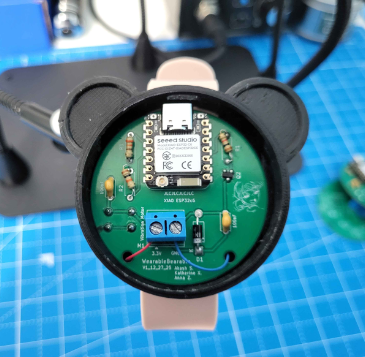
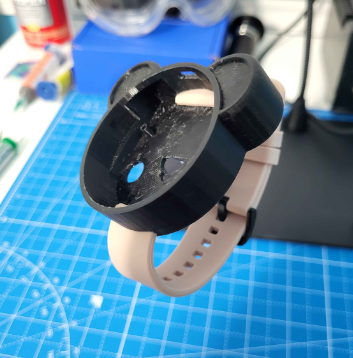
The enclosure was designed in Onshape.
Onshape Model: View CAD Design
The Arduino sketches are located in ESP32c6 Code/:
MasterCode.ino receives a BPM value over BLE, controls the local vibration motor, and broadcasts the BPM using ESP-NOW.SlaveCode.ino receives the ESP-NOW command and reproduces the vibration rhythm.A BPM value of 0 stops the rhythm. Values above 200 BPM are limited to 200.
The planned communication system also includes support for device/group IDs, relay networking, and synchronization compensation so larger groups can remain coordinated even when some devices are outside the master’s direct range.
Special thanks to Katherine Xu for designing the app.
The Bearable ao is the control application for the Wearable Bearable system. It allows the conductor to connect to the master device over BLE, set the desired tempo, and start or stop the synchronized haptic rhythm.
The application is currently built for Android and works alongside the ESP32-C6 firmware in this repository. Future software development may include group management, saved songs/tempos, improved pairing, and additional calibration controls.
Bearable App Repository: View Repository
Download the APK here and install like a normal app.
Wearable Bearable is currently an engineering prototype. The repository contains the PCB design, proof-of-concept firmware, Android control application, and 3D-printed wearable enclosure.
Planned features include expanded group management, relay networking, synchronization calibration, LED status indicators, and a more finalized communication protocol.
Wearable Bearable was created by Akash Saran, Katherine Xu, and Anna Zhou.
Credit to my best friend Katherine Xu for designing the Bearable React app (currently on Android) that controls the device and Anna Zhou for maintaining all communication efforts with Wearable's sponsors.
Special thanks to the Interplay Orchestra and Technical Director Shri Khalpada for supporting the project and providing feedback throughout development.
The repository includes component symbols, footprints, reference designs, and supporting assets from the Seeed Studio Open Parts Library and Seeed Studio XIAO ecosystem. Those third-party materials remain subject to their respective licenses and attribution requirements.
Project Originally Started: 10/17/2025
Github Saved: 8/18/2026
| Qty | Value | Footprint | References |
|---|---|---|---|
| 2 | 100nF | Capacitor_THT:C_Disc_D4.7mm_W2.5mm_P5.00mm | C1, C3 |
| 2 | LOGO | LOGO | G***, G*** |
| 1 | 10K | Resistor_THT:R_Axial_DIN0207_L6.3mm_D2.5mm_P7.62mm_Horizontal | R2 |
| 1 | 1K | Resistor_THT:R_Axial_DIN0207_L6.3mm_D2.5mm_P7.62mm_Horizontal | R1 |
| 1 | 1N4007 | Diode_THT:D_DO-41_SOD81_P10.16mm_Horizontal | D1 |
| 1 | 2N7002 | Package_TO_SOT_SMD:SOT-23 | Q2 |
| 1 | 330 | Resistor_THT:R_Axial_DIN0207_L6.3mm_D2.5mm_P7.62mm_Horizontal | R3 |
| 1 | Motor_Vibration | TerminalBlock_Phoenix:TerminalBlock_Phoenix_MKDS-1,5-2_1x02_P5.00mm_Horizontal | M1 |
| 1 | SW_Push | Button_Switch_THT:SW_PUSH_6mm | SW1 |
| 1 | WS2812B-2020 | LED_SMD:LED_WS2812B-2020_PLCC4_2.0x2.0mm | D2 |
| 1 | XIAO-ESP32-C6 | Seeed Studio XIAO Series Library:XIAO-ESP32C6-DIP | U2 |


VimDrones/AM32_esc_development_board
Open Source AM32 ESC development board

rianadon/Cosmos-Keyboard-PCBs
Open-Source keyboard PCB designs for the Cosmos Keyboard Generator

phil31/NerdEKO-Gamma
fork of the NerdOCTAXE-Gamma design (https://github.com/Patsch91/NerdOCTAXE-Gamma), with 12 x BM1370 (14TH/s SHA256)
It measures 29 × 42.5 mm and has 4 copper layers, 1.6 mm thick.
13 parts, built around the WS2812B-2020. The full list of its parts is on this page, with links to each part's symbol and footprint where PCBKit's library has them.
From the ssnivy/TheWearableBearable repository on GitHub, at the commit this page was made from: the board is KiCAD PCB/WearableBearable/WearableBearable.kicad_pcb and its schematic KiCAD PCB/Footprints/OPL_Kicad_Library-master/Grove Vision AI V2 Library/Grove - Vision AI Module V2.kicad_sch. PCBKit opens the board in the browser, with nothing to install.
Its repository states no licence, so its author keeps all rights: ask ssnivy before reusing the design.