Skip to the content
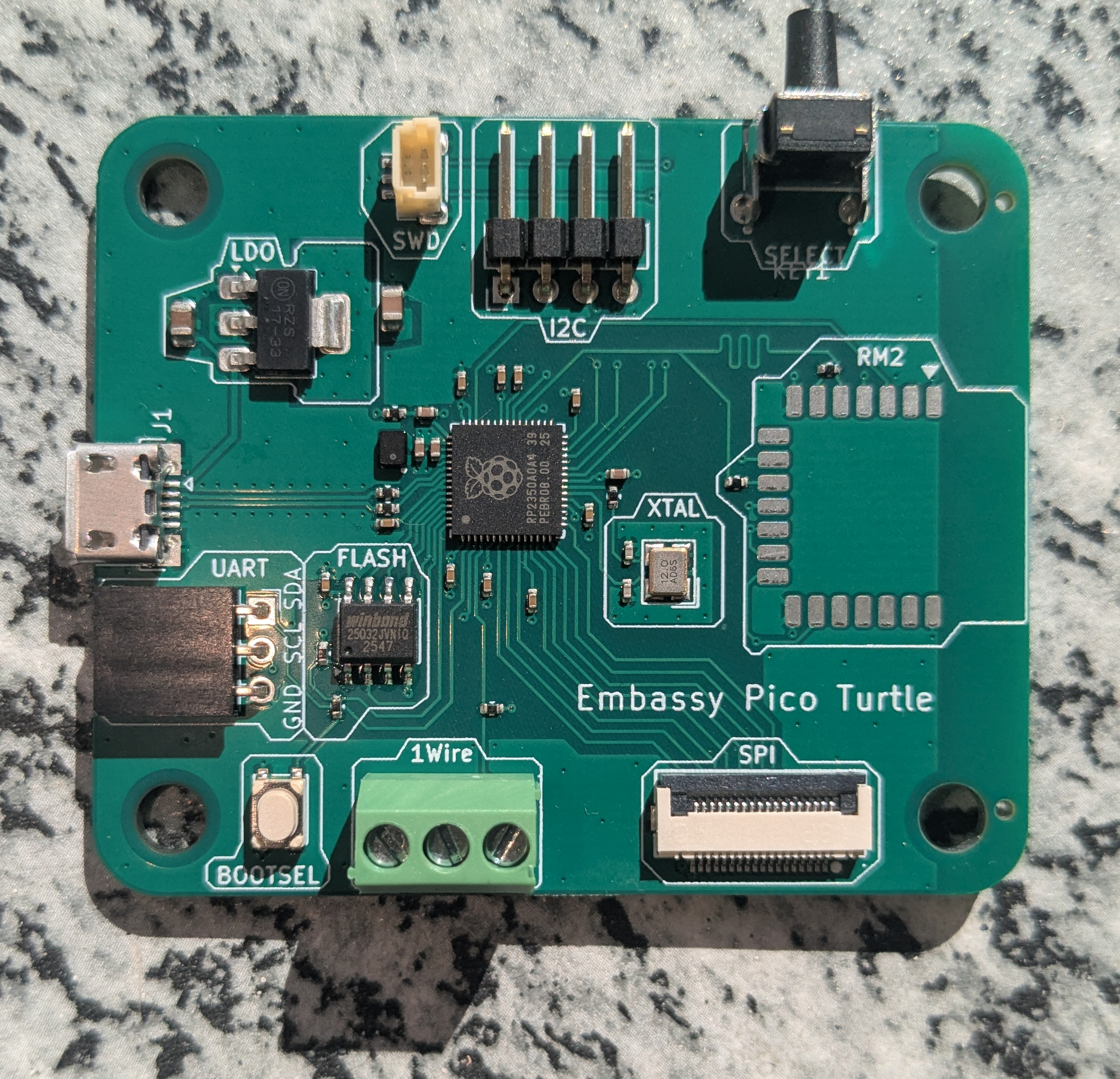
4 layers60 × 50 mmEmbassy turtle, the printed circuit board in 3D

Embedded IoT Turtle Tank controller based on the rp2350 microcontroller

Size
60 × 50 mm
Copper layers
4
Thickness
1.61 mm
Parts
45
Nets
69
Pads
231
Tracks, vias
478, 151
Pours
13
Routed
Yes
KiCad
KiCad 10.0 (file 20260206)
Created
14 Apr 2026
Updated
3 Nov 2026

Overview

Embassy turtle is an open-source printed circuit board by so-groenen, from the so-groenen/embassy_pico_turtle repository on GitHub, published under the GPL-3.0 licence. It is a 4-layer board of 60 × 50 mm with 45 parts on 69 nets, routed with 478 tracks and 151 vias.

It is built around the W25Q32JVSSIQ, A2541WR-4P and ABM8-272-T3, with the FPC-05F-18PH20, BM03B-SRSS-TB(LF)(SN) and DB301V-3.5-3P-GN-S among its other parts. Its parts include 18 capacitors, 9 resistors, 5 connectors, 4 ICs and 1 switch. It belongs with the home automation and IoT boards and the RP2350 boards of this library.

Main components

8

README

README.md

Embedded IoT Turtle Tank Controller using Rust-Embassy & RP2350

WORK IN PROGRESS

PCB

Overview

This turtle tank controller:

  • measures water temperature using water proof DS18B20 OneWire probe
  • measures above turtle platform air temperature and humidity using HTU21d I2C probe
  • displays data on ST7789 TFT-LCD screen via SPI on demand
  • automatically switches off display after 10secs of no use
  • uses push button to wake-up display
  • optionally dispatches data via WiFi using MQTT protocol
  • Automatically reconnects to WiFi and MQTT broker on connection loss
It also features a modular PCB designed with KiCAD:
  • All sensors can be easily replaced
  • WiFi optional by adding the Raspberry Pi Radio Module 2
A very basic dashboard with FastAPI server can be used to view MQTT data in real time.

3D printed enclosure design with FreeCAD:

  • TO BE FINISHED

Hardware

  • RP2350 Microcontroller
  • Push button
  • DS18B20 OneWire Probe
  • ST7789 LCD-TFT with 18 pin 0.5mm pitch FPC connector (ex. Adafruit EYESPI)
  • HTU21d Temperature & Humidity I²C sensor which include pull-up resistors
  • OPTIONAL: Raspberry Pi RM2 WiFi Module

Firmware

Firmware build using Embassy-Rust for efficient co-operative multitasking, thread-safety, and easier project architecture!
Everything is no_std and hence only static allocation is used. Under the hood, Embassy extensively uses DMA, interrupts and state machines to allow multiple tasks to be run concurrently. This avoids the overhead of CPU context switching as in a traditional RTOS.
The firmware also makes use of the rp2350 dual-core:

With WiFi:
  • core0:
    • WiFi & MQTT tasks
  • Core1:
    • Sensor tasks
    • TFT-LCD tasks
    • Button task
Without WiFi:
  • core0:
    • TFT-LCD tasks
  • Core1:
    • Sensor tasks
    • Button task

State synchronization and inter task communication is mostly done using Embassy's synchronization primitives like signals and Publish-Subscribe channels.

Firmware Architecture

The firmware makes extensive use of Rust's async-await syntax:

text
                         ┌─────────────────────┐
                         │    Embassy Executor │
                         └──────────┬──────────┘
                                    │
              ┌─────────────────────┼─────────────────────┐
              │                     │                     │
              ▼                     ▼                     ▼
      ┌──────────────┐      ┌──────────────┐      ┌──────────────┐
      │ Sensor Task  │      │  Wi-Fi Task  │      │  MQTT Task   │
      │              │      │   cyw43      │      │              │
      │ I2C / OneWire│      │ TCP/IP       │      │  Publish /   │
      │ measurements │      │ networking   │      │  Subscribe   │
      └──────┬───────┘      └──────┬───────┘      └──────┬───────┘
             │                     │                     │
             └─────────────┬───────┴─────────────────────┘
                           │
                           ▼
                    ┌──────────────┐
                    │ Shared State │
                    │ / Channels   │
                    └──────────────┘

Parts

45
QtyValueFootprintReferences
10100nPCM_JLCPCB:C_0402C2, C8, C11, C12, C13, C14, C15, C16, C17, C18
4MountingHoleMountingHole:MountingHole_4.3mm_M4H3, H4, H5, H6
34.7uRP2350_60QFN_minimal:C_0402_1005Metric_small_padsC6, C7, C9
210uPCM_JLCPCB:C_0805C1, C5
215pPCM_JLCPCB:C_0402C3, C4
21kResistor_SMD:R_0402_1005MetricR4, R6
227Resistor_SMD:R_0402_1005MetricR7, R8
11-1825027-1easyeda2kicad:KEY-TH_1-1825027-1KEY1
110kResistor_SMD:R_0402_1005MetricR3
110kSparkFun-Resistor:R_0402_1005MetricR1
12.2kResistor_SMD:R_0402_1005MetricR12
13.3umyLib:0806_PolarizedL1
133Resistor_SMD:R_0402_1005MetricR5
14.7uPCM_JLCPCB:C_0402C10
1470SparkFun-Resistor:R_0402_1005MetricR2
1A2541WR-4PConnector_PinHeader_2.54mm:PinHeader_1x04_P2.54mm_HorizontalJ3
1ABM8-272-T3easyeda2kicad:CRYSTAL-SMD_4P-L3.2-W2.5-BLY1
1AFC01-S18FCA-00easyeda2kicad:FPC-SMD_18P-P0.50_JS_AFC01-S18FCA-00FPC1
1BM03B-SRSS-TB(LF)(SN)Connector_JST:JST_SH_BM03B-SRSS-TB_1x03-1MP_P1.00mm_VerticalJ4
1DB301V-3.5-3P-GNeasyeda2kicad:CONN-TH_DB301V-3.5-3P-GNJ2
1HC-PM254-8.5H-1x3PW-02AConnector_PinSocket_2.54mm:PinSocket_1x03_P2.54mm_HorizontalJ6
1NCP1117-3.3_SOT223Package_TO_SOT_SMD:SOT-223-3_TabPin2U4
1PTS815SJM250SMTRLFSButton_Switch_SMD:SW_SPST_PTS810SW1
1RM2RF_Module:RMC20452TU2
1RP2350_60QFNRP2350_60QFN_minimal:RP2350-QFN-60-1EP_7x7_P0.4mm_EP3.4x3.4mm_ThermalViasU1
1USB_B_MicroRP2350_60QFN_minimal:USB_Micro-B_Amphenol_10103594-0001LF_Horizontal_modifiedJ1
1W25Q32JVSSPackage_SO:SOIC-8_3.9x4.9mm_P1.27mmU3

Similar boards

  • 4 layers56.3 × 39.7 mmFOC DualDRV8323, the printed circuit board in 3D

    FOC DualDRV8323

    totaldesaster/SimpleFOC-Serial-Driver

    Advanced dual BLDC driver based on the RP2350 and DRV8323S ICs, designed to be controlled from a trajectory controller over RS-485, RS-422 or TTL UART. Features a compact high power design with two stacked PCBs.

    66 parts1GPL-3.0
  • 2 layers39.5 × 38 mmPokerPlaque, the printed circuit board in 3D

    PokerPlaque

    Poker-NG/Plaque

    15 partsMIT
  • 4 layers49.1 × 54.3 mmRp2350-hdmi hexpansion, the printed circuit board in 3D

    Rp2350-hdmi hexpansion

    Corteil/rp2350-hdmi-hexpansion

    RP2350 HDMI hexpansion for the EMF Tildagon badge -- mirrors the badge's display to a monitor over HSTX/DVI

    57 parts2
  • 4 layersCABadge V2 1, the printed circuit board in 3D

    CABadge V2 1

    nbtca/CABadge

    CABadge 计协电子吧唧:基于 ESP32-S3 的开源圆屏互动徽章,支持动态壁纸、触摸交互、Wi-Fi/BLE 和趣味小应用,提供 PCB、3D 打印外壳、固件及配套工具。

    110 parts15MIT
  • 4 layers99.8 × 73.8 mmHfsdr, the printed circuit board in 3D

    Hfsdr

    rhgndf/hfsdr

    SDR Badge, supports 0-300MHz 192kHz I/Q output to USB

    146 parts4
  • 4 layers152.4 × 63.5 mmKrecek, the printed circuit board in 3D

    Krecek

    mordae/krecek

    bash # Prepare build for Krecek cmake -B build src -G Ninja

    166 parts2Unlicense

Questions

How big is the Embassy turtle PCB?

It measures 60 × 50 mm and has 4 copper layers, 1.61 mm thick.

What parts does the Embassy turtle use?

45 parts, built around the W25Q32JVSSIQ, A2541WR-4P, ABM8-272-T3 and FPC-05F-18PH20. The full list of its parts is on this page, with links to each part's symbol and footprint where PCBKit's library has them.

Where can I download the Embassy turtle KiCad files?

From the so-groenen/embassy_pico_turtle repository on GitHub, at the commit this page was made from: the board is hardware/embassy_turtle/embassy_turtle.kicad_pcb and its schematic hardware/embassy_turtle/embassy_turtle.kicad_sch. PCBKit opens the board in the browser, with nothing to install.

Can I use the Embassy turtle design in my own project?

Its repository publishes it under the GPL-3.0 licence: you may reuse it on that licence's terms (keep the author's notice, and for a copyleft licence share your changes alike).