
2 layers247.7 × 97.7 mm
Woagboard
hackclub/OnBoard
💡 Join 1,000 teenagers and make your first PCB with a $100 grant!
104 parts915

Ergonomic monoblock keyboard
Chrumm is an open-source printed circuit board by sevmeyer, from the sevmeyer/chrumm-keyboard repository on GitHub. It is a 2-layer board of 147 × 116 mm with 104 parts on 57 nets, routed with 351 tracks and 7 vias.
Its parts include 35 diodes, 35 switches, 4 connectors and 1 IC. It belongs with the keyboards and input boards and the RP2040 boards of this library.
Chrumm is an open-hardware ergonomic keyboard, made of a 3D-printable body, a bendable PCB, and custom firmware for the Raspberry Pi Pico.
This repository contains all relevant source files. I share these files in the hope that they are useful, or at least interesting to others. Keep in mind that this is a free, do-it-yourself project. What you see is what you get. Make sure to check the license.
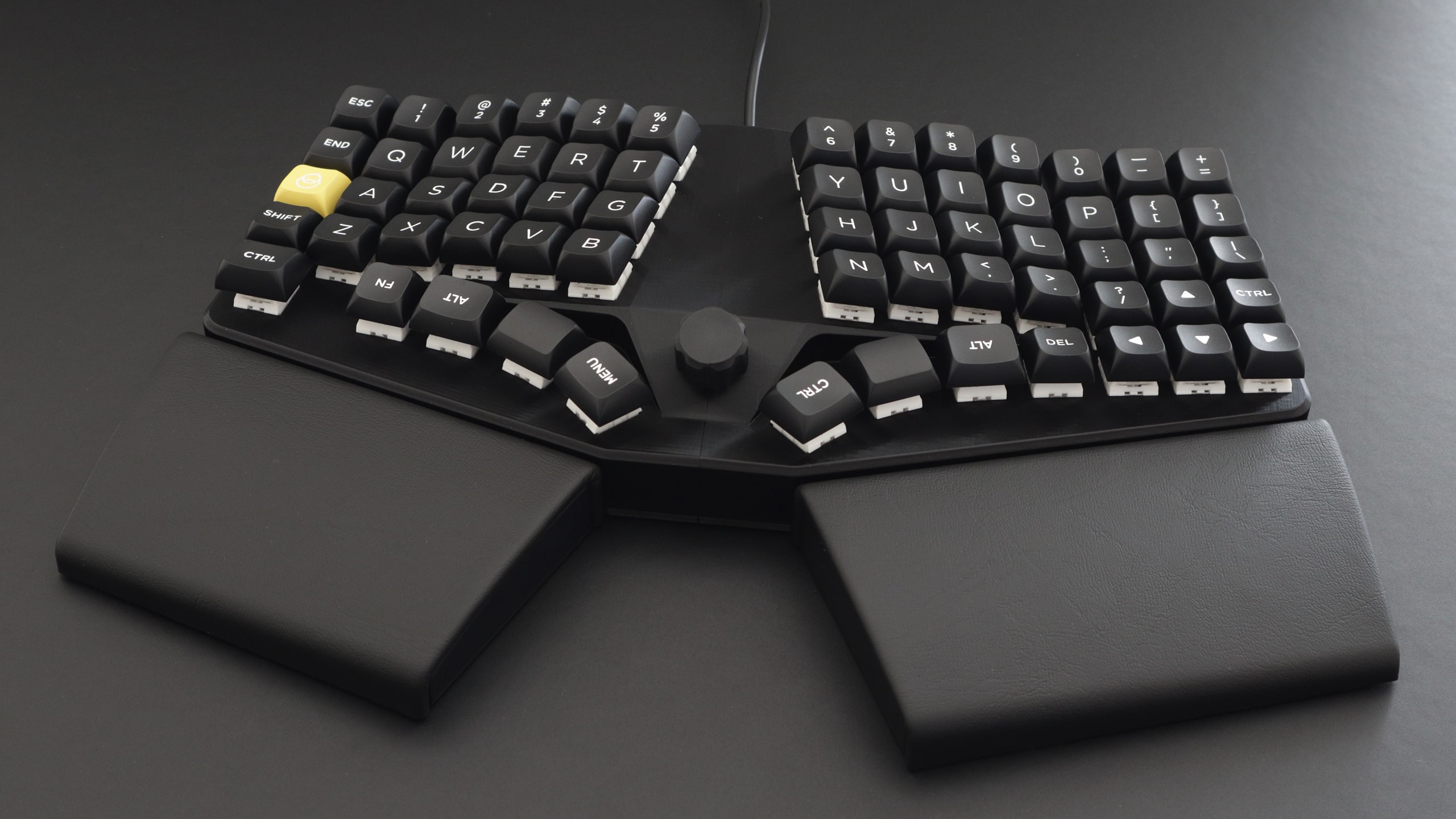
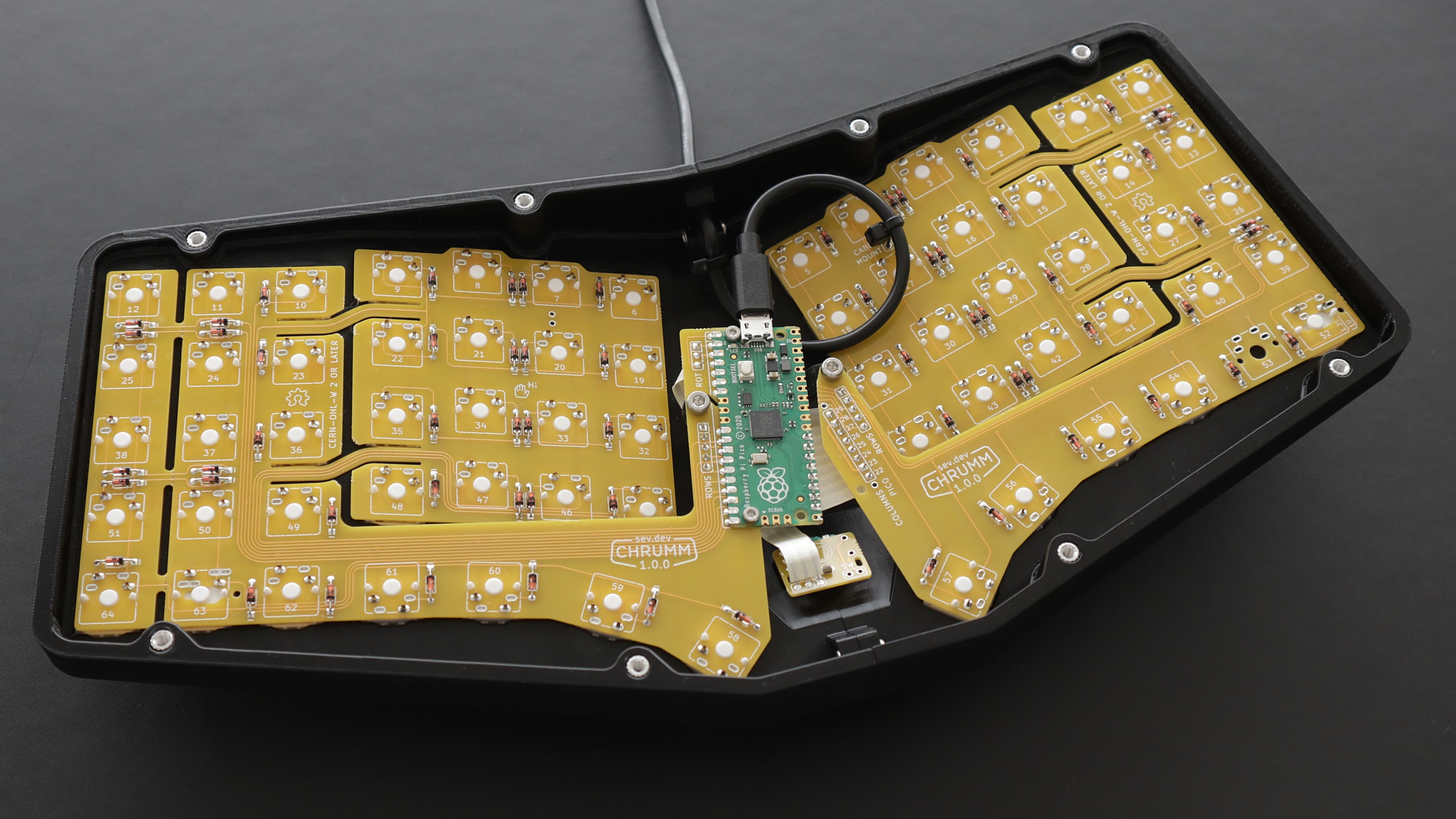
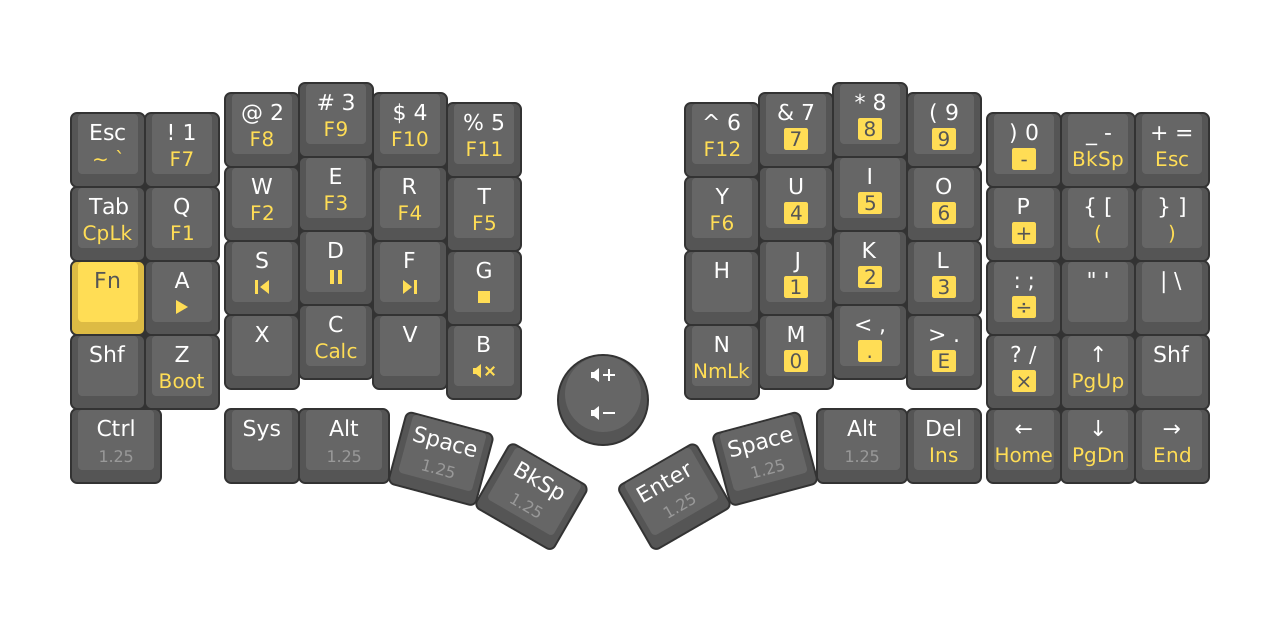
Chrumm features a column staggered layout with simple thumb clusters. The right side has an additional column, to better approximate the standard ANSI layout, and to provide dedicated arrow keys. A central encoder allows for rotational input.
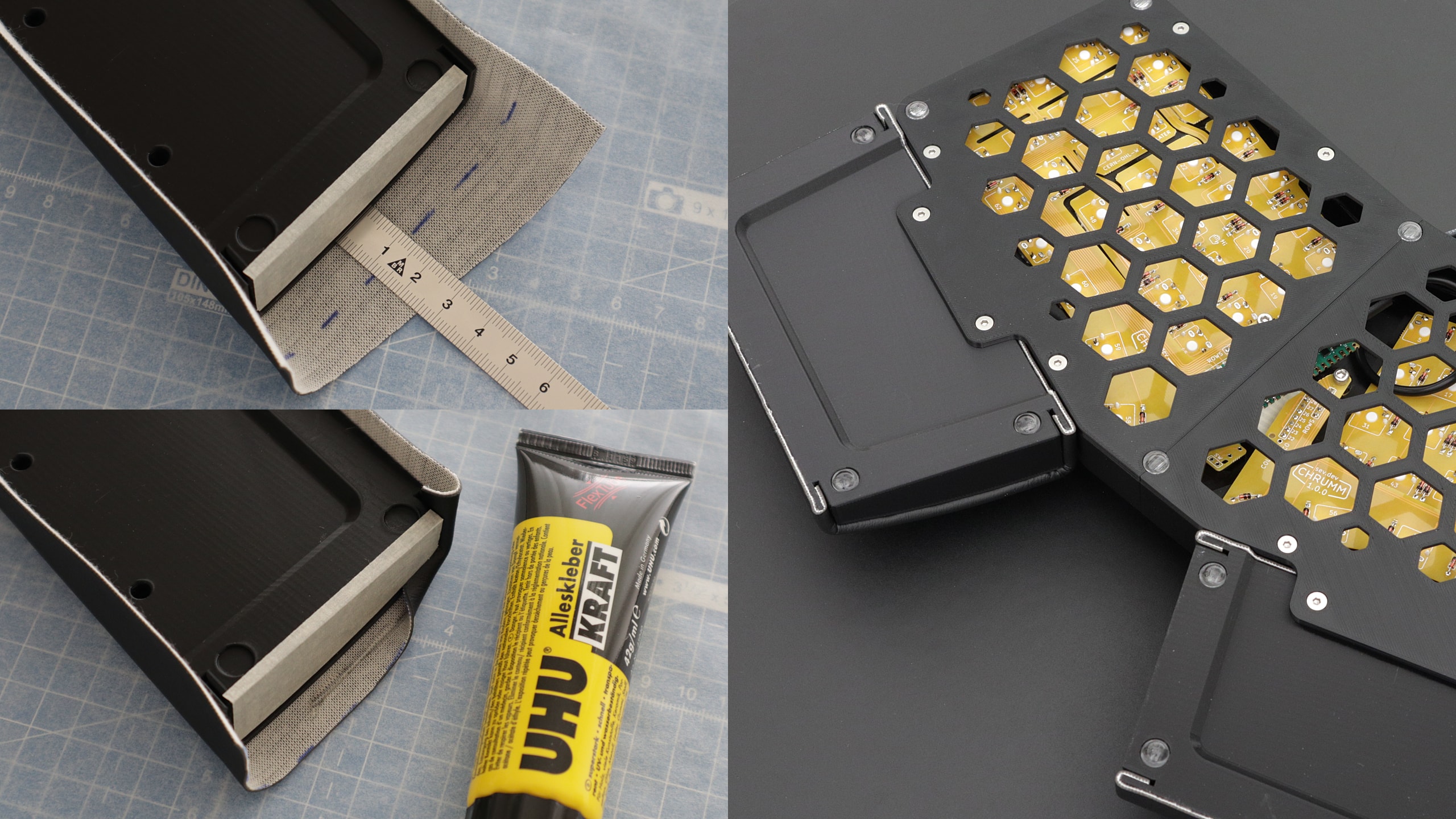
The body is a robust monoblock without visible screws. It has integrated split, tent, and tilt angles, similar to commercial ergonomic boards. The palm rests and the USB cable are firmly attached, so that everything can be moved around without hassle.
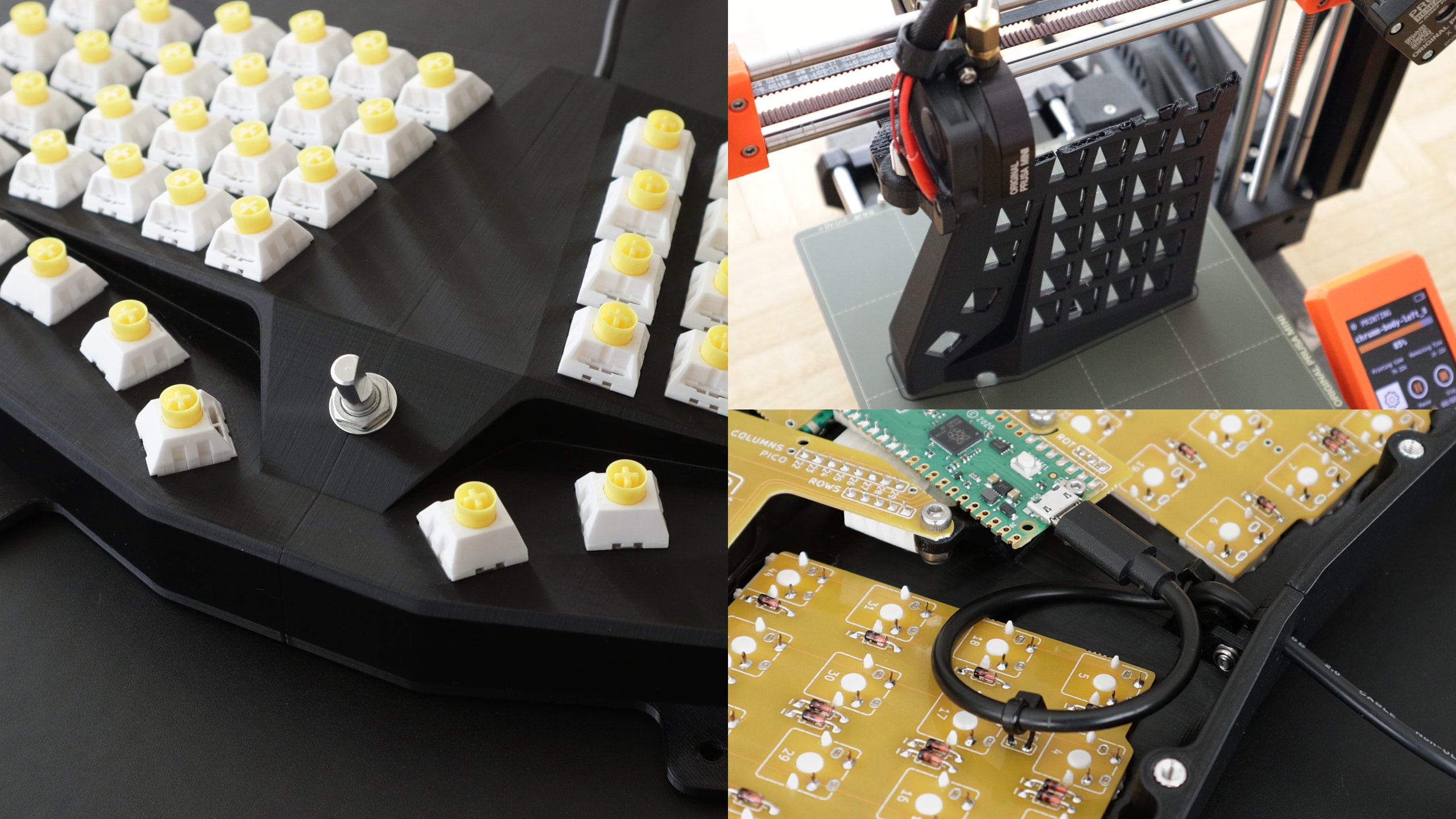
The STL files are generated programmatically, with a pure Python package that has no dependencies. They are optimized for FFF 3D printing. Most parts are printed sideways, to produce a smooth surface without the need of post-processing. Custom supports minimize the print time and filament cost.
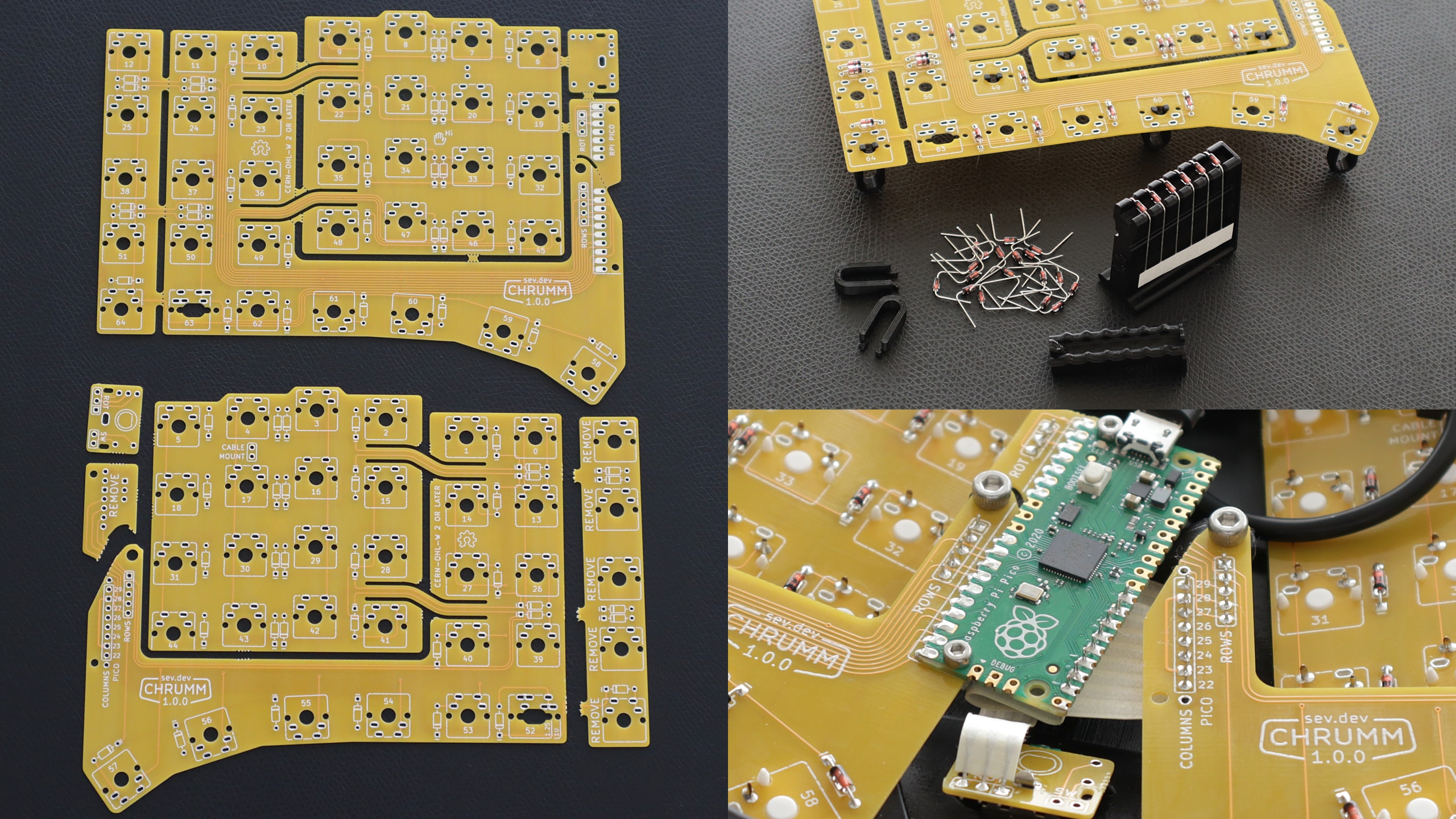
The body houses two reversible, bendable, interconnected PCBs. They are powered by a Raspberry Pi Pico.
Chrumm would not exist without the shared knowledge of the mechanical keyboard community.
I found inspiration on Reddit, KBD.news, geekhack, and learned a lot from the PCB guides by ai03 and Ruiqi Mao, the Keyboard posts by Masterzen, and the Matrix Help by Dave Dribin.
The layout and body is influenced by projects like the Ergodox, Dactyl, Sofle, Pteron, and everything from Bastardkb. I also used established open hardware repositories for reference, including the UHK60, Skeletyl, Sofle, Corne, and Torn.
| Qty | Value | Footprint | References |
|---|---|---|---|
| 35 | Diode | footprints:Diode_1N4148_P7.6mm | D0, D1, D2, D3, D12, D13, D14, D15, D16, D17, D18, D25, D26, D27, D28, D29 +19 |
| 34 | Switch | footprints:Switch_MX | S0, S1, S2, S3, S12, S13, S14, S15, S16, S17, S18, S25, S26, S27, S28, S29 +18 |
| 2 | PinHeader_1x3 | footprints:PinHeader_1x3_P2.54mm | J2, J3 |
| 1 | PinHeader_1x2 | footprints:PinHeader_1x2_P2.54mm_Custom | J4 |
| 1 | PinHeader_1x5 | footprints:PinHeader_1x5_P2.54mm | J1 |
| 1 | RPi_Pico_Custom | footprints:RPi_Pico_Custom | U1 |
| 1 | RotaryEncoder_Switch | footprints:RotaryEncoder_PEC11R_Custom | E1 |
| 1 | Switch | footprints:Switch_MX_CTRL | S52 |
The 76 most common of 104 parts.
It measures 147 × 116 mm and has 2 copper layers, 0.8 mm thick.
104 parts. The full list of its parts is on this page, with links to each part's symbol and footprint where PCBKit's library has them.
From the sevmeyer/chrumm-keyboard repository on GitHub, at the commit this page was made from: the board is pcb/chrumm/chrumm.kicad_pcb and its schematic pcb/chrumm/chrumm.kicad_sch. PCBKit opens the board in the browser, with nothing to install.
Its repository states no licence, so its author keeps all rights: ask sevmeyer before reusing the design.
hackclub/OnBoard
💡 Join 1,000 teenagers and make your first PCB with a $100 grant!

Miceuz/PlantWateringAlarm
A soil humidity level sensor based on ATTINY44. Uses capacitive sensing.


cnlohr/cnhardware
My dumping grounds for all my kicad projects and random hardware bringup.

apuder/TRS-IO
TRS-IO gives a TRS-80 Model 1/III online capabilities and provides access to a variety of services. TRS-IO currently features the following capabilities: