4 layers65.8 × 56.1 mm
MosaicG5 RPi HAT
septentrio-gnss/mosaicG5-HAT
MosaicG5-HAT: an open source Raspberry Pi HAT based on Septentrio's mosaic-G5
55 parts2

 septentrio-gnss/TeenG51
TeenG5: Is an open source HW for mosaic G5 GNSS modules of Septentrio. It is a carrier board for Teensy computers.
G5 Teensy is an open-source printed circuit board by septentrio-gnss, from the septentrio-gnss/TeenG5 repository on GitHub. It is a 4-layer board of 62.8 × 27 mm with 44 parts on 97 nets, routed with 535 tracks and 202 vias.
It is built around the XC8111AA01MR-G, ECMF02-2AMX6 and TPS7A9401DSCR, with the MOSAIC-G5 and ESDA7P120-1U1M(ES) among its other parts. Its parts include 12 capacitors, 12 resistors, 7 ICs, 6 connectors and 2 diodes.



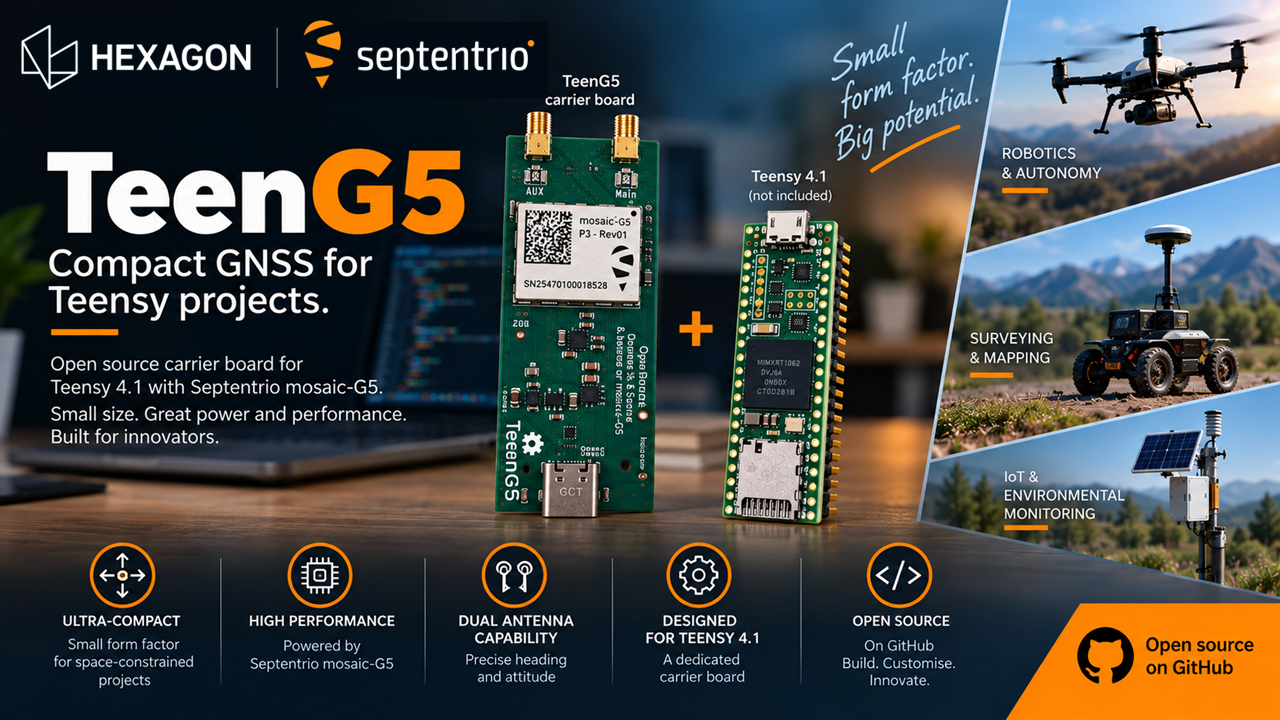
| TeenG5 | Carrier board for Teensy 4.1 |
|---|---|
| Author | laekaz |
| Maintainer | Septentrio gnss github user |
| external website | https://github.com/septentrio-gnss/TeenG5 |
| License | CC BY-SA 4.0 and open source |
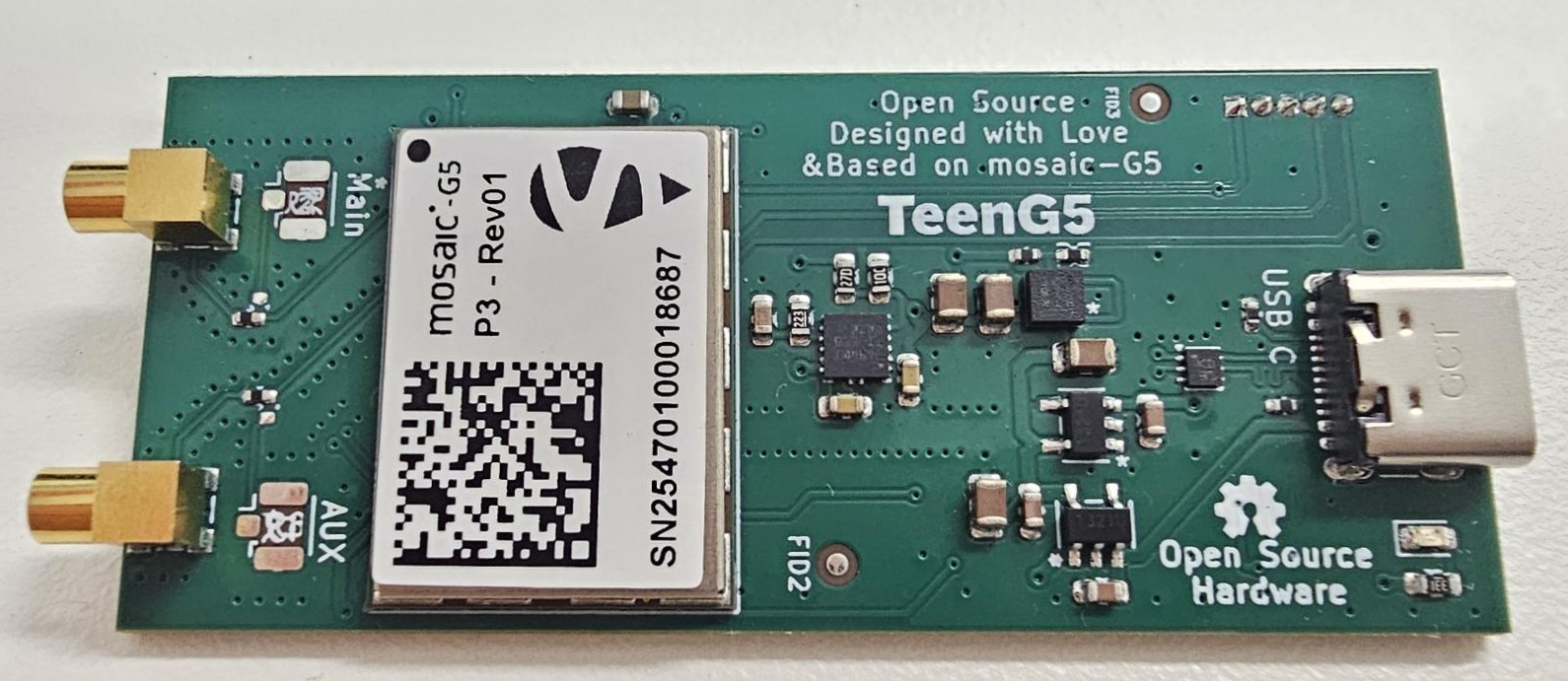
This is a compact carrier board that brings high precision GNSS (GPS) which integrates mosaic-G5 Septentrio's GNSS module with basic communications, allowing the system to receive signals from multiple GNSS constellations, such as GPS, Galileo, GLONASS, and BeiDo. The goal of the design is to simplify hardware prototyping and integration of the mosaic-G5 by taking advantage of the Teensy 4.1's high-performance microcontroller, extensive peripheral interfaces, and Arduino-compatible development ecosystem. This makes TeenG5 well suited for embedded applications such as robotics, autonomous vehicles, UAVs, precision agriculture, surveying, timing, and other systems that require low-latency GNSS processing without relying on an external computer.
The board can also operate as a standalone device when powered through its USB connector.
The Teensy 4.1 is a compact, high-performance microcontroller development board based on the NXP i.MX RT1062 ARM Cortex-M7 processor running at 600 MHz. It offers 1 MB of RAM, 8 MB of onboard flash memory, a microSD card slot, USB host and device capabilities, Ethernet, and a wide range of digital, analog, and communication interfaces (UART, SPI, I²C, and CAN). Compatible with the Arduino IDE through Teensyduino software, it is well suited for robotics, real-time control,embedded systems, audio processing, data acquisition, and other performance-critical applications.
A carrier board is a board that hosts a removable Teensy 4.1. The Teensy plugs into the board through two 24-pin headers and can be removed or replaced, while the carrier board integrates the Septentrio mosaic-G5 GNSS receiver, power management, and communication interfaces into a single embedded platform.
You can use the design files, Bill of Materials from this project and contact your manufacturing company for production. In this project we used JLCPCB for producing the PCB and assembling it. We used JLCPCB because of its competitive pricing and component availability.
Yes, Some components are not available through JLCPCB's standard parts library and must be supplied separately. however, if you are assembling the PCB by yourself, all components are available on DigiKey and clearly listed in the project's Bill of Materials. The mosaic GNSS module can be obtained from Digikey or directly from Septentrio. For larger production volumes, we recommend contacting the Septentrio sales team directly at Septentrio Contact Page
The mosaic-G5 is a compact GNSS receiver from Septentrio, engineered for high reliability and precise positioning. It integrates the latest multi-band, multi-constellation GNSS technology, providing accurate positions while minimizing power consumption. The receiver can access signals from all major GNSS constellations, including GPS, Galileo, GLONASS, and BeiDou.
Different versions of the mosaic-G5 are available to suit various applications, as summarized below:
| Features | mosaic-G5 P1 | mosaic-G5 P3 | mosaic-G5 P3H | mosaic-G5 P6 | mosaic-G5 P8 |
|---|---|---|---|---|---|
| Functionality | High-precision positioning | High-precision positioning | Positioning + Heading | Positioning + Heading | Positioning + Heading |
| Use case | Robotics (e.g robotic mowers), GIS devices | UAV, Commercial mowers, Industrial Robotics, Survey, Marine navigation | Marine navigation, Machine control, Autonomous vehicles, Survey | Autonomous vehicles, Marine navigation, Machine control, Survey | High-end autonomous systems, Robotics, Marine navigation, Survey, Machine control |
| GNSS bands | Triple-band | Quad-band | Quad-band | Quad-band | Quad-band |
| RTK support | Yes | Yes | Yes | Yes | Yes |
| Dual antenna | No | No | Yes | Yes | Yes |
| Heading | NO | No | Yes | Yes | Yes |

Septentrio is a leading company that designs, manufactures and sells high precision and multi-frequency GPS/GNSS receivers for demanding applications. Septentrio products are used in different industries including automotive, marine, construction, rail, machine control, logistics, precision agriculture, geographic information systems (GIS), Unmanned aerial vehicles (UAVs), surveying, mapping and scientific development. Septentrio’s receivers constantly deliver accurate and precise GNSS positioning scalable to centimetre-level and designed to perform perfectly in challenging environments.
Septentrio's technology offers high accuracy and reliability thanks to advanced GNSS signal-processing algorithms as well as Advanced interference Monitoring and Mitigation (AIM+) This protects your application against jamming (RF interference) and spoofing (malicious attacks).
For more information about Septentrio products go to https://www.septentrio.com/.
This project provides the following deliverables for system integrators and hardware designers developing solutions based on Septentrio's mosaic-G5 modules.
| Files | Description |
|---|---|
| G5_Teensy.kicad_pro | KiCad project |
| G5_Teensy.kicad_pcb | KiCad layout |
| G5_Teensy.kicad_sch | KiCad schematic |
| TeenG5 3D.step | TeenG5 3D |
| mosaic-G5.STEP | mosaic-G5 3D |
| LGA54_MOSAIC-MINI_SEP.kicad_mod | mosaic-G5 footprint |
| BOM | TeenG5 Bill of Materials |
Yes, We made this open source so you can tinker, adapt, and create. If you are building your own robotics project, a spin-off device, or integrating GNSS into a larger system, this is a great starting point.
Open source here means:
More info about licensing can be found here: CC BY-SA 4.0 and open source
This project is offered as-is. The main interfaces have been tested, but the design has not been fully checked or approved by the author or Septentrio. You are responsible for how you use it in your own projects. For guidance on working with Septentrio’s GNSS mosaic-G5 modules, we suggest reaching out to Septentrio directly.
Support website: https://www.septentrio.com/en/support
This project provides two main documentation sections:
TeenG5 User Documentation
Contains information for users on how to install, configure, and use the TeenG5.
TeenG5 Design Documentation
Intended for hardware designers who want to understand, customize, or modify the reference design of the TeenG5.
| Qty | Value | Footprint | References |
|---|---|---|---|
| 4 | 0 | Resistor_SMD:R_0402_1005Metric | R6, R7, R8, R9 |
| 4 | 22uF | Capacitor_SMD:C_0805_2012Metric | C11, C13, C14, C15 |
| 3 | 1uF | Capacitor_SMD:C_0603_1608Metric | C8, C9, C10 |
| 3 | Fiducial | Fiducial:Fiducial_1mm_Mask2mm | FID1, FID2, FID3 |
| 2 | 10uF | Capacitor_SMD:C_0603_1608Metric | C1, C2 |
| 2 | MMCX | Tee_CONMMCX002_SMD:CONMMCX002-SMD | J6, J7 |
| 2 | XC8111AA01MR-G | RPi_dealdiode_XC8111AA01MR_G:SOT-25_TOR | U3, U7 |
| 2 | u.FL | Connector_Coaxial:U.FL_Hirose_U.FL-R-SMT-1_Vertical | J2, J3 |
| 1 | 100nF | Capacitor_SMD:C_0603_1608Metric | C5 |
| 1 | 12.4k | Resistor_SMD:R_0603_1608Metric | R12 |
| 1 | 187k | Resistor_SMD:R_0603_1608Metric | R11 |
| 1 | 200k | Capacitor_SMD:C_0402_1005Metric | R4 |
| 1 | 22k | Resistor_SMD:R_0603_1608Metric | R10 |
| 1 | 22uF | Capacitor_SMD:C_0603_1608Metric | C4 |
| 1 | 330 | Resistor_SMD:R_0603_1608Metric | R3 |
| 1 | 4.7uF | Capacitor_SMD:C_0603_1608Metric | C3 |
| 1 | 40.2K | Resistor_SMD:R_0402_1005Metric | R5 |
| 1 | 5.1k | Resistor_SMD:R_0402_1005Metric | R2 |
| 1 | 5.1k | Capacitor_SMD:C_0402_1005Metric | R1 |
| 1 | Conn_01x05_Pin | Connector_PinHeader_1.27mm:PinHeader_1x05_P1.27mm_Vertical | J4 |
| 1 | ECMF02-2AMX6 | Package_DFN_QFN:ST_UQFN-6L_1.5x1.7mm_P0.5mm | U2 |
| 1 | ESDA7P120_1U1M | Tee_ESDA7P120_1U1M:DIODE_ESDA7P120-1U1M_STM | D2 |
| 1 | LED | LED_SMD:LED_0603_1608Metric | D1 |
| 1 | LOGO | open source logo:LOGO | G*** |
| 1 | TPS7A9401DSCR | RPi_LDO_DSC0010J-MFG:DSC0010J-MFG | U5 |
| 1 | mosaic-G5 | footprints:LGA54_MOSAIC-MINI_SEP | U1 |
| 1 | ~ | Teensy:Untitled_1 | U4 |
| 1 | ~ | RPi_MPM3814C:ECLGA-14_MPM3814C_MNP | U8 |
| 1 | ~ | Connector_USB:USB_C_Receptacle_GCT_USB4105-xx-A_16P_TopMnt_Horizontal | J5 |
The 43 most common of 44 parts.
septentrio-gnss/mosaicG5-HAT
MosaicG5-HAT: an open source Raspberry Pi HAT based on Septentrio's mosaic-G5

tmcit-ararobo-2026a/jetson-interface-board
Jetsonのヘッダーに取り付けてCANトランシーバーやデバッグ用USBポートを搭載する基板

esl-epfl/X-MODs
Modular hardware platform based on the RISC-V X-HEEP family architecture developed at ESL, targeting ultra-low-power consumption and miniaturization, facilitating the creation of wearable devices for clinical trials

esl-epfl/CHEEP-boards
This chewing gum board is designed to be an extended-range voltage supply + current measurement circuit, intended for connection to the main board through the male pin headers to both sides.

CausticLime1/Debugging-Board
The purpose of this project is to develop a budget-friendly electronics debugging station that includes various PCBs (Printed Circuit Boards) that incorporate different functionalities.

HarrySkySon/BitForge-SDR
Open-Source 16-bit Direct-Sampling HF SDR Transceiver | 9 kHz - 72 MHz | >100 dB Dynamic Range


KOEGlike/meko
A linux music player with ddr3, a 70hz e-paper display and a haptic touchpad
It measures 62.8 × 27 mm and has 4 copper layers, 1.6 mm thick.
44 parts, built around the XC8111AA01MR-G, ECMF02-2AMX6, TPS7A9401DSCR and MOSAIC-G5. The full list of its parts is on this page, with links to each part's symbol and footprint where PCBKit's library has them.
From the septentrio-gnss/TeenG5 repository on GitHub, at the commit this page was made from: the board is Kicad/TeenG5/G5_Teensy.kicad_pcb and its schematic Kicad/TeenG5/G5_Teensy.kicad_sch. PCBKit opens the board in the browser, with nothing to install.
Its repository states no licence, so its author keeps all rights: ask septentrio-gnss before reusing the design.