
4 layers68.6 × 53.3 mm
Icezum
FPGAwars/icezum
:star2: IceZUM Alhambra: an Arduino-like Open FPGA electronic board
218 parts357GPL-3.0
 scrapcomputing/ISABlaster53
A software-defined ISA card powered by a Raspberry Pi Pico
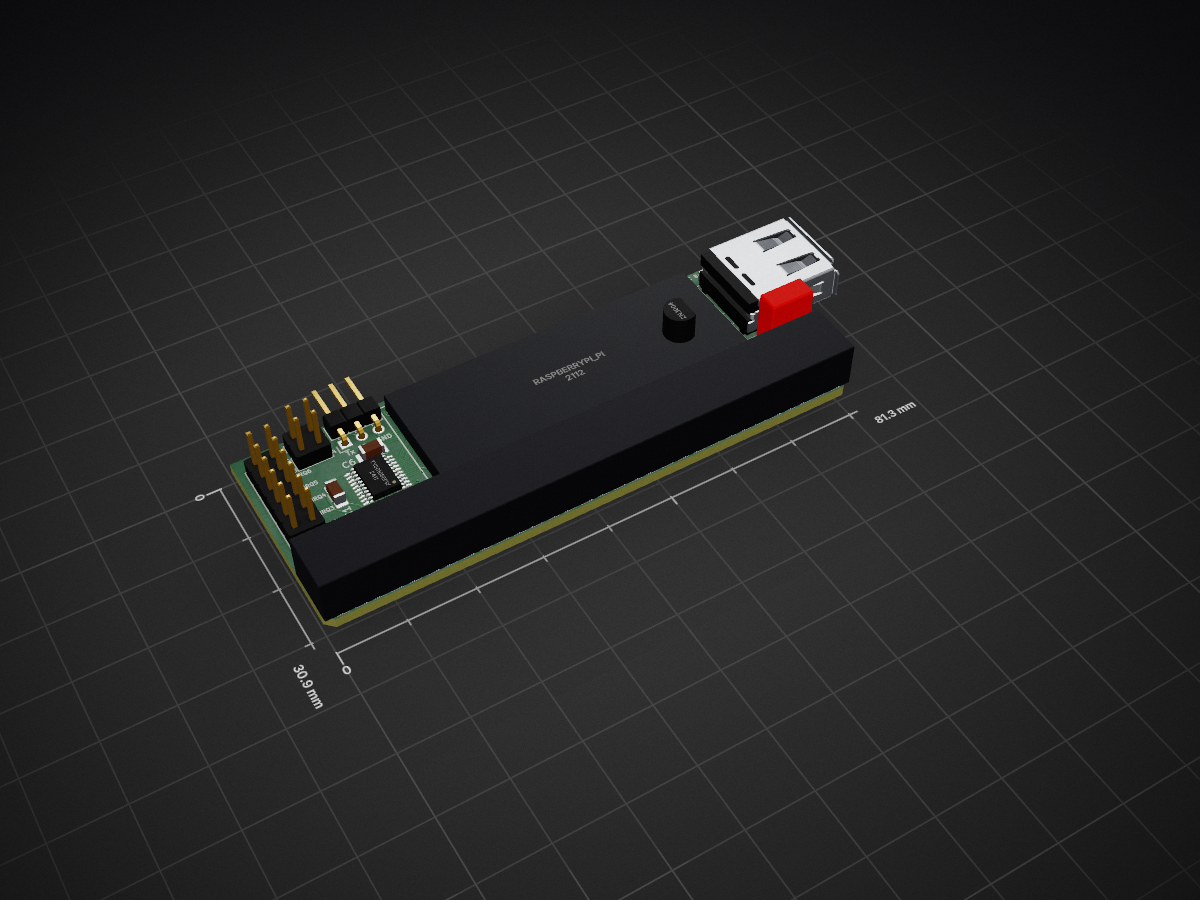
ISABlaster is an open-source printed circuit board by scrapcomputing, from the scrapcomputing/ISABlaster repository on GitHub, published under the GPL-2.0 licence. It is a 2-layer board of 81.3 × 30.9 mm with 24 parts on 68 nets, routed with 1,047 tracks and 52 vias.
It is built around the TXS0108EPW. Its parts include 7 capacitors, 6 resistors, 5 connectors, 4 ICs and 1 transistor. It belongs with the RP2040 boards of this library.
A PCB for a software-defined ISA card powered by a Raspberry Pi Pico micro-controller. All the logic for interfacing to the ISA bus is done in software.
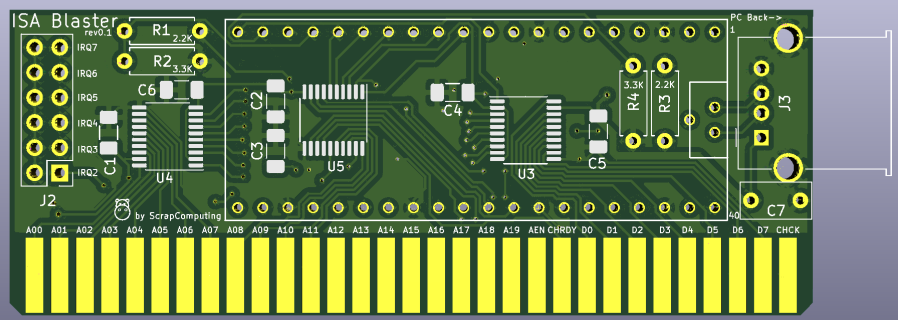
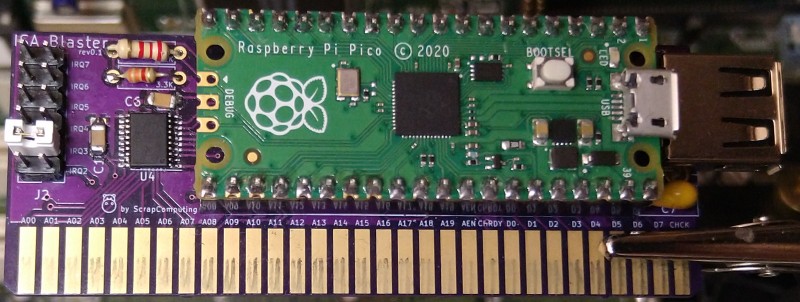
We can use the ISA Blaster as a USB mouse adapter card. This allows you to use a USB mouse on your vintage DOS PC without the need for an external adapter. This requires the use of:
Gerber files are published in the releases: https://github.com/scrapcomputing/ISABlaster/releases
| Item | # | Description |
|---|---|---|
| Raspberry Pi Pico | 1 | |
| 1x20-pin 2.54mm Female Headers | 2 | For plugging in the Pico |
| 1x20-pin 2.54mm Male Headers | 2 | For the Pico |
| TXS0108EPW 20TSSOP | 3 | Bidirectional level-shifters 3.3V/5V |
| 2x6 2.54mm Male Pin Headers | 1 | For the IRQ selection |
| 2.54mm Jumper | 1 | For the IRQ selection |
| 0.1uF 1206 SMD capacitors | 6 | Decoupling capacitors for the ICs C1-6 |
| 2.2K through-hole resistor 1/8W | 2 | * Better to leave them unpopulated: See "Known Issues" below |
| 3.3K through-hole resistor 1/8W | 2 | * Better to leave them unpopulated: See "Known Issues" below |
| 1uF through-hole ceramic capacitor | 1 | Smoothing capacitor for the board. |
| Horizontal Female USB connector | 1 | For plugging in a USB device. |
| 3-4cm short jumper wires | 2 | For connecting Pico's TP2,TP3 pads to the PCB's pads for the on-bard USB connector |
| Qty | Value | Footprint | References |
|---|---|---|---|
| 6 | 0.1u | Capacitor_SMD:C_1206_3216Metric_Pad1.33x1.80mm_HandSolder | C1, C2, C3, C4, C5, C6 |
| 3 | 2.2K | Resistor_SMD:R_1206_3216Metric_Pad1.30x1.75mm_HandSolder | R1, R3, R5 |
| 3 | 3.3K | Resistor_SMD:R_1206_3216Metric_Pad1.30x1.75mm_HandSolder | R2, R4, R6 |
| 3 | TXS0108EPW | Package_SO:TSSOP-20_4.4x6.5mm_P0.65mm | U3, U4, U5 |
| 1 | |||
| 1 | 10uF | Capacitor_THT:C_Rect_L7.0mm_W3.5mm_P5.00mm | C7 |
| 1 | 2N3904 | Package_TO_SOT_THT:TO-92_Inline | Q1 |
| 1 | Bus_ISA_8bit | isa_blaster:8bit_BUS_AT | J1 |
| 1 | Conn_01x03 | Connector_PinHeader_2.54mm:PinHeader_1x03_P2.54mm_Horizontal | J5 |
| 1 | Conn_02x02_Odd_Even | Connector_PinHeader_2.54mm:PinHeader_2x02_P2.54mm_Vertical | J4 |
| 1 | Conn_02x06_Odd_Even | Connector_PinHeader_2.54mm:PinHeader_2x06_P2.54mm_Vertical | J2 |
| 1 | RaspberryPi_Pico | isa_blaster:raspberry_pi_pico | U6 |
| 1 | USB_A | Connector_USB:USB_A_Molex_67643_Horizontal | J3 |
It measures 81.3 × 30.9 mm and has 2 copper layers, 1.6 mm thick.
24 parts, built around the TXS0108EPW. The full list of its parts is on this page, with links to each part's symbol and footprint where PCBKit's library has them.
From the scrapcomputing/ISABlaster repository on GitHub, at the commit this page was made from: the board is kicad/isa_blaster.kicad_pcb. PCBKit opens the board in the browser, with nothing to install.
Its repository publishes it under the GPL-2.0 licence: you may reuse it on that licence's terms (keep the author's notice, and for a copyleft licence share your changes alike).
FPGAwars/icezum
:star2: IceZUM Alhambra: an Arduino-like Open FPGA electronic board

MetalMusings/MyOwnEtherCATDevice
Documentation accompanying the "Make My Own EtherCAT device" video serie on Youtube.

NVIDIA-AI-IOT/my-jetson-nano-baseboard
An open source Jetson Nano baseboard and tools to design your own.

AndreiVladescu/ESP32-Bit-Pirate-Hardware
Carrier breaker-board for the ESP32-S3 Devkit. Works great with the ESP32-Bit-Pirate firmware.


florianbrede-ayet/esphome-toshiba-hvac-controller
ESPhome component & hardware to control Toshiba & Carrier HVAC units with WIFI interface


ffxx68/Sharp_ce140f_emul
At the time (I'm talking about mid '80s early '90s), what I thought my Sharp-PC was missing the most was a convenient way to store and load programs.