2 layers
Nrf bga
github-linguist/linguist
Language Savant. If your repository's language is being reported incorrectly, send us a pull request!
12 parts14kMIT
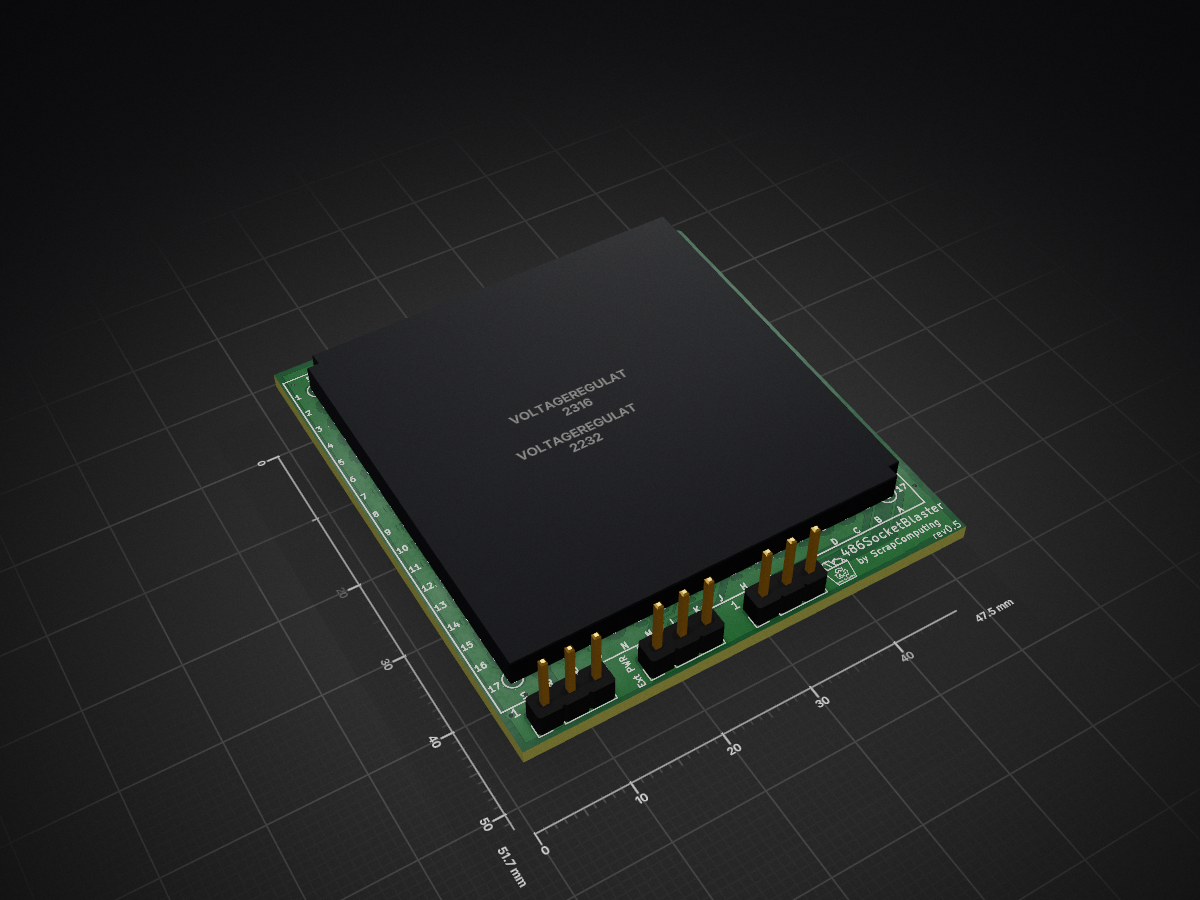
 scrapcomputing/486SocketBlaster51
A voltage adapter PCB for 486 CPUs
486SocketBlaster is an open-source printed circuit board by scrapcomputing, from the scrapcomputing/486SocketBlaster repository on GitHub, published under the GPL-2.0 licence. It is a 2-layer board of 47.5 × 51.7 mm with 12 parts on 122 nets, routed with 1,116 tracks and 45 vias.
Its parts include 5 capacitors and 2 ICs. It belongs with the interfaces and adapters boards of this library.
486SocketBlaster is a simple voltage adapter for 486 processors. It allows you to use a 3-volt 486 CPU on an older 5-volt-only motherboard. For example you can use a DX4 or an Am5x86 on an old 486 motherboard that would normally only work with 5-volt CPUs. This basically converts any 3-volt CPU to an "Overdrive".
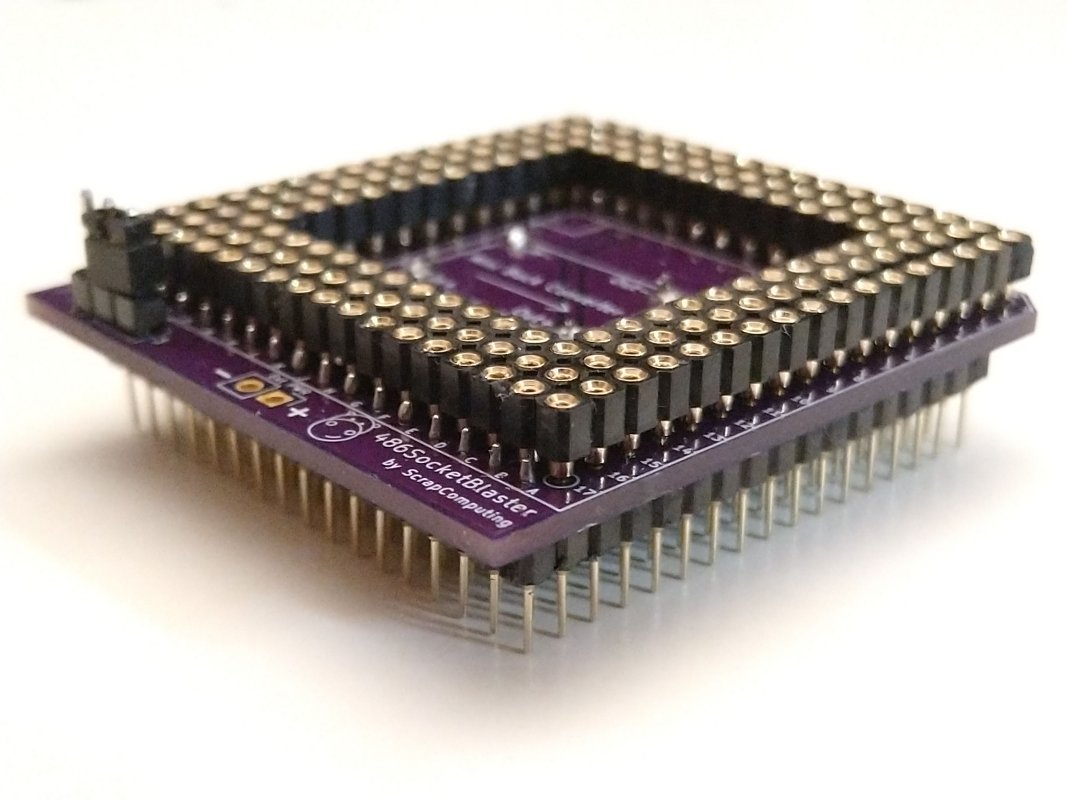
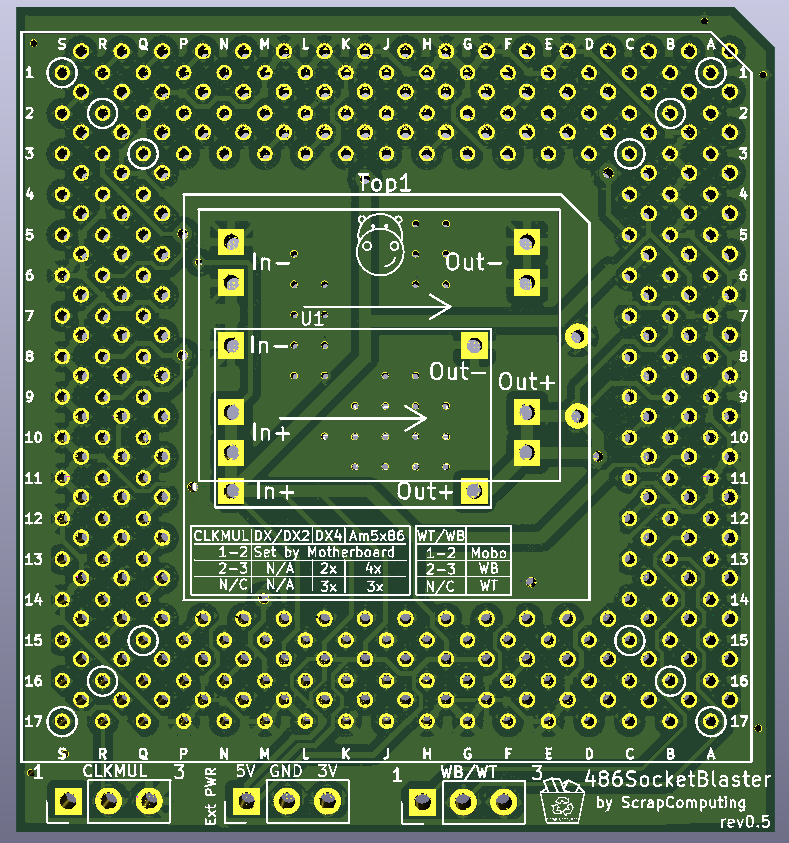
It is really simple: All CPU pins are passed through to the motherboard socket, except for the Vcc. Those are connected to the output of a mini buck converter that can be soldered to the 486SocketBlaster board.
This board is not the easiest thing to solder, but can be done with a standard soldering iron and some patience. The best way to solder the headers is to start with the innermost one and work outwards in a spiral manner alternating between the top and bottom side as needed (see image below). This way you only work on the outside and can easily reach all the pins.
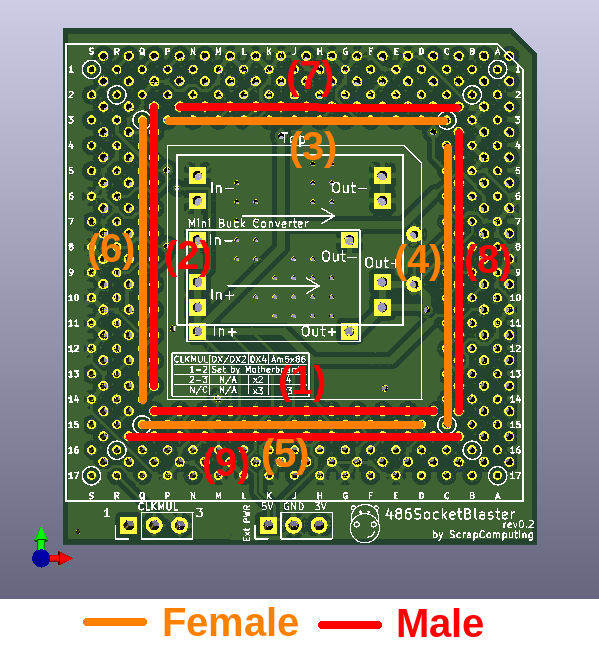
A desoldering gun may be useful when you accidentally clog up other holes. But it is probably best to be very careful and avoid clogging them in the first place. Also using flux makes it easier.
Please make sure you check the solder joints (also check for continuity) before you add another row of headers on the same side, because the new row will permanently block your access to the solder joints! Desoldering a header is almost impossible even with a desoldering gun due to the very tight hole tolerances. So it has to be soldered correctly from the first try.
The 486SocketBlaster can be powered by a cheap of-the-shelf buck converter, or by an external one. The circuit board accepts two common types of small voltage buck converters, usually found using keywords like "mini buck converter". These are commonly rated at up to 3A of current. Given that 3-volt 486 CPUs are usually very efficient (the DX4-100 is rated at max 3.55/5.22W typical/max) such a regulator should be adequate in most cases. For best stability try to source a good quality part.
If you are planning to overclock or to use a more power hungry CPU, please use an external regulation circuit plugged in to the ExtPwr header, or use a very good quality mini buck converter.
Please make sure you know what you are doing! Improper assembly/settings/use can damage both your precious motherboard and your precious CPU!
R17. 1-2 connects it to the motherboard socket pin and 2-3 connects it to ground. This reduces the multiplier of a DX4 to 2x (66MHz) and sets the multiplier of an Am5x86 to 4x (133MHz).B13 (which is the CLKMUL pin in earlier 486 CPUs). 1-2 connects it to the motherboard socket pin, and 2-3 connects it to Vcc, which enables Write-Back.| Item | ## | Description |
|---|---|---|
| mini buck converter | 1 | We support two common sizes: 22x17mm and 18x12mm. These usually have chips like MP1584, MP2307 and others |
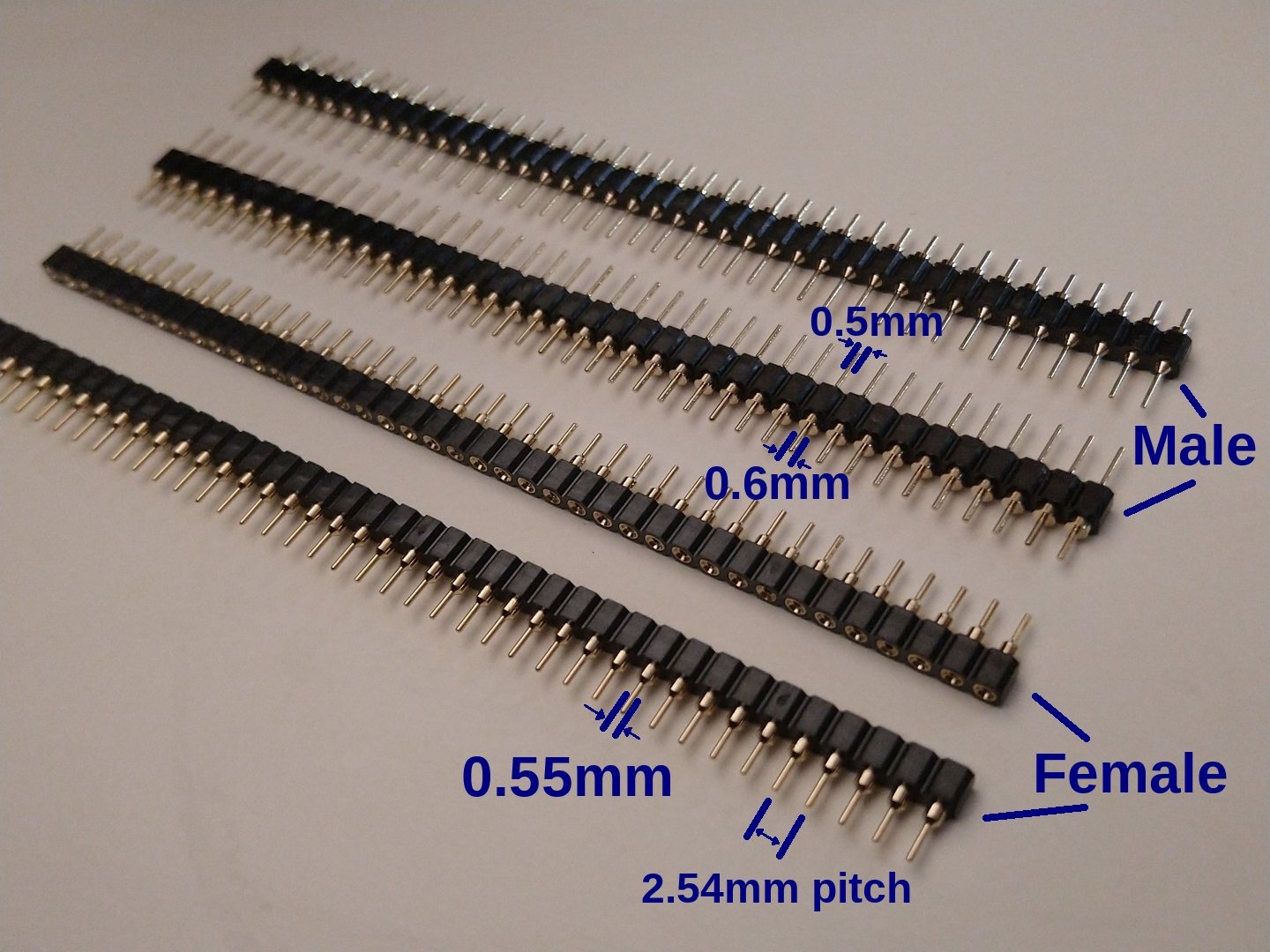
| 40pin SIP pin header (male) | 5 | Single-row round pin 2.54mm pitch (male). Socket pin diameter: 0.50mm, PCB pin diameter: 0.60mm. (see photo below) |
| 40pin SIP socket header (female) | 5 | Single-row round pin sockets, 2.54mm pitch. PCB pin diameter: 0.55mm. (see photo below) |
| SMD Ceramic Capacitors | 4 | 10uF SMD 1206, 6.3V or higher |
| Through-hole Capacitor | 1 | 10uF ceramic through-hole capacitor, 6.3V or higher |
| 3-pin header 2.54mm pitch | 2 | (optional) Headers used for selecting the CPU Multiplier (CLKMUL) and Write-Back/Write-Through cache (WB/WT) |
| Jumper 2.54mm pitch | 2 | (optional) Jumpers for the CLKMUL and WB/WT headers |
Gerber files can be found in the releases: https://github.com/scrapcomputing/486SocketBlaster/releases
Please note that the headers are a very tight fit. So please make sure that you get headers of the correct pin diameter.
With the limited testing I have done so far, it seems that you need at least one 10uF through-hole ceramic capacitor, otherwise the voltage ripple is too high and the system can become unstable with a DX4 @ 100MHz, using a cheap MP1584-based buck converter.
| Qty | Value | Footprint | References |
|---|---|---|---|
| 4 | 10uF | Capacitor_SMD:C_1206_3216Metric_Pad1.33x1.80mm_HandSolder | C1, C2, C3, C4 |
| 2 | Conn_01x03 | Connector_PinHeader_2.54mm:PinHeader_1x03_P2.54mm_Vertical | ExtPwr1, J1 |
| 1 | 10uF | Capacitor_THT:C_Rect_L7.0mm_W3.5mm_P5.00mm | C5 |
| 1 | 486 | 486pga:486_168pga | Bot1 |
| 1 | 486 | 486pga:486_168pga_socket | Top1 |
| 1 | CLKMUL | Connector_PinHeader_2.54mm:PinHeader_1x03_P2.54mm_Vertical | CLKMUL |
| 1 | VoltageRegulator | 486pga:VoltageRegulator2 | U1 |
| 1 | VoltageRegulator | 486pga:VoltageRegulator | U3 |
It measures 47.5 × 51.7 mm and has 2 copper layers, 1.6 mm thick.
12 parts. The full list of its parts is on this page, with links to each part's symbol and footprint where PCBKit's library has them.
From the scrapcomputing/486SocketBlaster repository on GitHub, at the commit this page was made from: the board is kicad/486SocketBlaster.kicad_pcb. PCBKit opens the board in the browser, with nothing to install.
Its repository publishes it under the GPL-2.0 licence: you may reuse it on that licence's terms (keep the author's notice, and for a copyleft licence share your changes alike).
github-linguist/linguist
Language Savant. If your repository's language is being reported incorrectly, send us a pull request!


google/mozc-devices
Circuit diagrams and firmware source code for Gboard DIY keyboards


hackclub/OnBoard
💡 Join 1,000 teenagers and make your first PCB with a $100 grant!

VoronDesign/Voron-Tap
Tap is a nozzle-based z-probe for the V2 and Trident printer designs. The entire toolhead moves to trigger an optical switch. Tap offers many advantages:

stacksmashing/pico-tpmsniffer
A simple, very experimental TPM sniffer for LPC bus