4 layers97.8 × 22.2 mm

 schlae/gvpsimm31
GVP-Compatible 64-pin 4MB SIMM
Gvpsimm16 is an open-source printed circuit board by schlae, from the schlae/gvpsimm repository on GitHub, published under the CERN-OHL-P-2.0 licence. It is a 4-layer board of 97.8 × 23.5 mm with 19 parts on 58 nets, routed with 961 tracks and 114 vias.
Its parts include 8 capacitors, 8 ICs and 1 connector.
GVP (Great Valley Products) made a number of Amiga accelerator cards back in the 80s and 90s. Many of the accelerator cards accept 64-pin memory modules; however they do not follow a standard pinout.
These GVP proprietary SIMMS are somewhat hard to find and expensive when they do turn up. Others have reverse engineered the design, but these clones use CAD tools that are not open source.
This design is based on a 4MB SIMM that came from my own GVP 68030 accelerator card. You can see my epic build thread on Twitter.
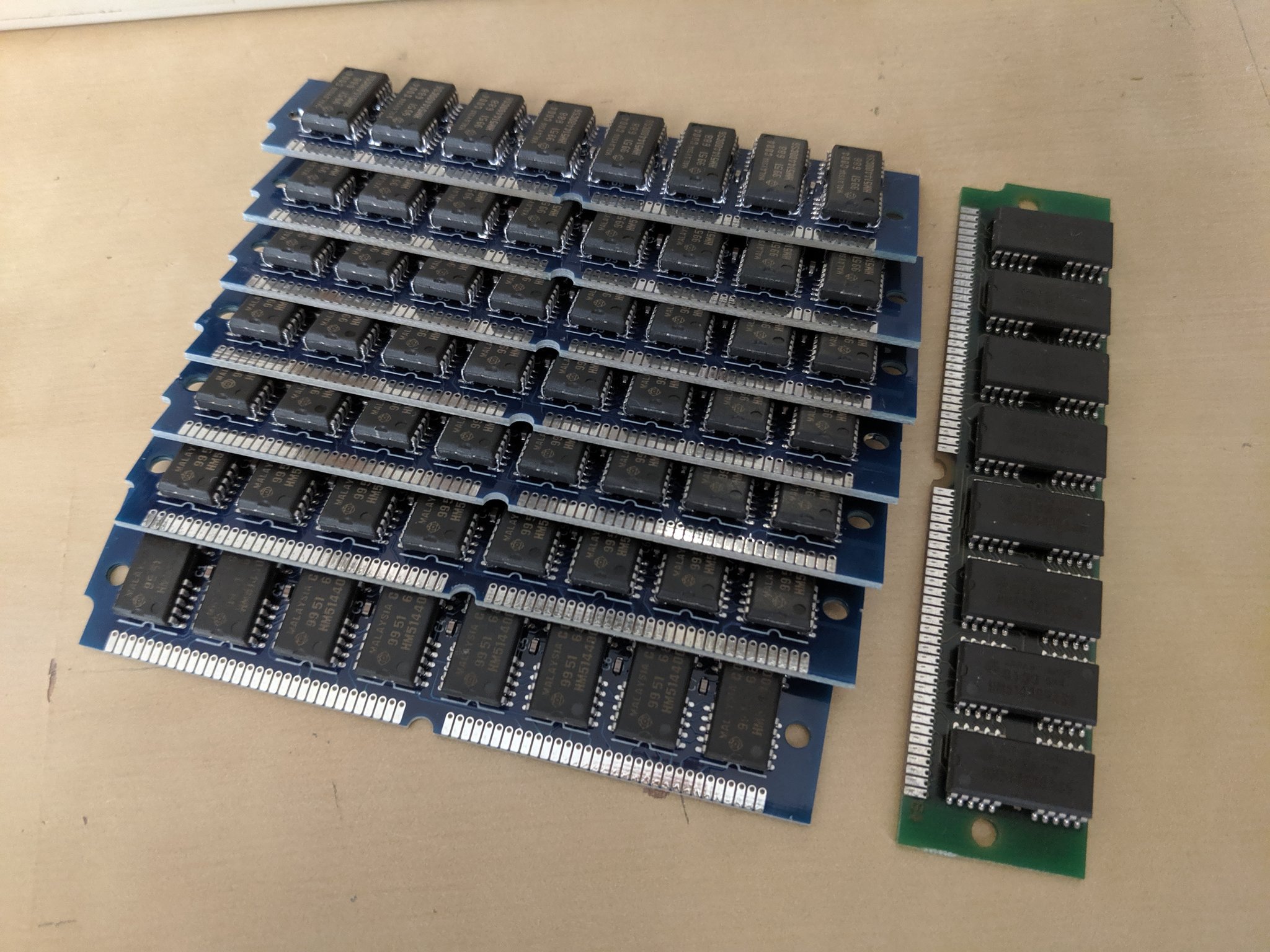
(The original SIMM is on the right, and on the left are my clones.)
Design files are here:
Board dimensions are 3.85 x 0.875 inches, and it is a 4 layer board. When ordering the board, remember to specify a board thickness of 1.2mm. This ensures it will fit in the SIMM slot.
My original SIMM module uses the Hitachi HM514400CS-6 memory chips, which are 1 Meg x 4 bit 60ns devices. Since there are eight memory chips, this results in a memory array of 1 Meg x 32 bit, or 4 megabytes. I have built and tested a large number of SIMMs with these chips and they all work fine.
There exist a number of memory chips which I have not tested (beware!) but are likely compatible:
The list is from this thread at Abime.
There exist 256K x 4 bit memories in the same package that are pin compatible with the larger chip, and it can be installed instead, yielding a 1MB SIMM. The difference is that pin 5 (A9 address line) is a no-connect. I have not tested this configuration, but if you want to try it, I found a couple of memory chips that might work.
Others have mistakenly assumed that the original GVP SIMM has no bypass capacitors. This is not true--on detailed inspection I observed eight ultra-low profile ceramic capacitors soldered directly underneath the memory chips.
Ultra-low profile ceramic capacitors are hard to find now, and would make assembly somewhat difficult. Instead of this I opted to use seven standard 0603 ceramic capacitors placed in between the memory chips. For best results, use 0.22uF or larger. Ensure the voltage rating is 10V or higher, as 6.3V ceramics do not have sufficient derating for use at 5V. Consider also that the capacitance of many ceramic capacitors decreases significantly as the operating voltage nears the rated voltage, as much as 40%!
When you send the board out for fabrication, please specify a board thickness of 1.2mm instead of the more common 1.6mm thickness. This will ensure that the SIMM will fit correctly in the sockets.
Since the components are packed relatively close together, they can be difficult to solder by hand. I recommend using a solder stencil and a reflow process.
This project is licensed under the CERN Open Hardware License Version 2 - Permissive.
| Qty | Value | Footprint | References |
|---|---|---|---|
| 8 | 0.22 | Passive:CAPC1608X100 | C1, C2, C3, C4, C5, C6, C7, C8 |
| 8 | 41C4400x | Active:SOJ127P851X356-24 | U1, U2, U3, U4, U5, U6, U7, U8 |
| 2 | MountingHole | Conn:MH_125 | H1, H2 |
| 1 | SIMM64_EDGE | Conn:EDGE_SIMM_64_127 | J1 |


agranlund/raven
Homemade MC68060 + DSP56303 Atari-compatible computer. Hardware, firmware, and software stack


TeaRex-coder/hardwareddc
a custom PCB that makes adjusting monitor settings easy and convenient

BenjaminSoelberg/elektronika-1
A replacement module for the USSR vintage LED watch Elektronika-1 anno 1978
It measures 97.8 × 23.5 mm and has 4 copper layers, 1.2 mm thick.
19 parts. The full list of its parts is on this page, with links to each part's symbol and footprint where PCBKit's library has them.
From the schlae/gvpsimm repository on GitHub, at the commit this page was made from: the board is 16MB/gvpsimm16.kicad_pcb and its schematic 16MB/gvpsimm16.kicad_sch. PCBKit opens the board in the browser, with nothing to install.
Its repository publishes it under the CERN-OHL-P-2.0 licence: you may reuse it on that licence's terms (keep the author's notice, and for a copyleft licence share your changes alike).