2 layers
Nrf bga
github-linguist/linguist
Language Savant. If your repository's language is being reported incorrectly, send us a pull request!
12 parts14kMIT

 SaifYasir/PicoWOL1
Rasberry Pi Pico to send WOL packets
PicoWOL is an open-source printed circuit board by SaifYasir, from the SaifYasir/PicoWOL repository on GitHub, published under the MIT licence. It is a 2-layer board of 61 × 76 mm with 12 parts on 47 nets, routed with 83 tracks and 0 vias.
Its parts include 4 ICs, 4 switches, 3 connectors and 1 capacitor. It belongs with the RP2040 boards of this library.
Rasberry Pi Pico to send WOL packets
This project provides both physical and remote means to wake up machines configured with wake-on-lan.
To generate documentation Doxygen must be installed, simply call doxygen in the root folder of this project and doxygen documentation will be generated.
This project relies on carlk3's great work in creating an sd card library for the Rasberry Pi Pico.
To see how to aquire required hardware see readme.
This program allows the picowol to turn machines on through Wake-on-lan. Pico_WOL can either turn machines by using physical buttons on the device or sending a UDP packet (see ...) to the microcontroller's ip to turn the requested device on. The precompiled uf2 file sets External components to certain GPIO pins on the pico, these will be listed in case you wish not to buy a pcb.
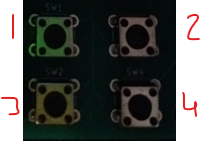
The list below provides detail of what each button does and the mappings via GPIO to the Rasberry Pi Pico.
This reader is responsible in loading profiles and getting neccessary details to connect to the network.
This program expects the file 'wifi_credentials.txt' to be at the base of the SD card in which will store the required credentials. The credentials are seperated via semi colons and in the structure: SSID;SSID_PASSWORD i.e. VM112121;password123
This program currently expects all profiles to be loaded in a singular file called 'wol_profiles.txt' which stores the name of the profile and its respective IP Address. The structure of storing profiles is as so: PROFILE_NAME;MACADDRESS ie gaming_pc;60ABDBA2A2A8.
Such that the file looks like this:
This display enables the user to view the currently selected profile.
The GPIO Mappings are as so:
This project was mainly a way for myself to learn more about microcontrollers and become more familiar with technologies like CMake and Doxygen. However this program could do with a few improvements, mainly:
| Qty | Value | Footprint | References |
|---|---|---|---|
| 4 | SW_Push | Button_Switch_THT:SW_PUSH_6mm | SW1, SW2, SW3, SW4 |
| 2 | Conn_01x01_Pin | Connector_Wire:SolderWire-1.5sqmm_1x01_D1.7mm_OD3.9mm | J1, J2 |
| 1 | C_Polarized | Capacitor_THT:CP_Radial_D5.0mm_P2.50mm | C1 |
| 1 | Conn_01x04_Pin | Connector_Wire:SolderWire-1.5sqmm_1x04_P7.8mm_D1.7mm_OD3.9mm | J3 |
| 1 | Pico | MCU_RaspberryPi_and_Boards:RPi_Pico_SMD_TH | U1 |
| 1 | ~ | custom_compontents:USB_A_BATTERY_CHARGER | U4 |
| 1 | ~ | custom_compontents:boost_converter | U5 |
| 1 | ~ | custom_compontents:Dokai_SD_READER | U2 |
It measures 61 × 76 mm and has 2 copper layers, 1.6 mm thick.
12 parts. The full list of its parts is on this page, with links to each part's symbol and footprint where PCBKit's library has them.
From the SaifYasir/PicoWOL repository on GitHub, at the commit this page was made from: the board is pcb_board/kikad_project/Pico_WOL.kicad_pcb and its schematic pcb_board/kikad_project/Pico_WOL.kicad_sch. PCBKit opens the board in the browser, with nothing to install.
Its repository publishes it under the MIT licence: you may reuse it on that licence's terms (keep the author's notice, and for a copyleft licence share your changes alike).
github-linguist/linguist
Language Savant. If your repository's language is being reported incorrectly, send us a pull request!


google/mozc-devices
Circuit diagrams and firmware source code for Gboard DIY keyboards


hackclub/OnBoard
💡 Join 1,000 teenagers and make your first PCB with a $100 grant!

VoronDesign/Voron-Tap
Tap is a nozzle-based z-probe for the V2 and Trident printer designs. The entire toolhead moves to trigger an optical switch. Tap offers many advantages:

stacksmashing/pico-tpmsniffer
A simple, very experimental TPM sniffer for LPC bus