
2 layers44.5 × 72.7 mm
OSO SWAT C1-jig
joeycastillo/Sensor-Watch
A board replacement for the classic Casio F-91W wristwatch
28 parts2.1k

An open-source, modular Indoor Environmental Quality (IEQ) monitoring system featuring a gamified Graphical User Interface (GUI)
RWTH is an open-source printed circuit board by RWTH-E3D, from the RWTH-E3D/ressourcenwaechter repository on GitHub, published under the GPL-3.0 licence. It is a 2-layer board of 120 × 70 mm with 28 parts on 48 nets, routed with 391 tracks and 66 vias.
Its parts include 16 connectors, 6 resistors, 2 ICs, 2 switches and 1 capacitor. It belongs with the sensors and measurement and lEDs and displays boards and the ESP32 boards of this library.
Resource Guardian - An open-source, modular Indoor Environmental Quality (IEQ) monitoring system featuring a gamified Graphical User Interface (GUI)

Resource Guardian's Wiki: Link
Modular IEQ monitoring system
Open-source system for monitoring key IEQ parameters, designed for real-world field studies and long-term deployment.
Multi-sensor data acquisition
Support for air temperature, humidity, illuminance, sound level, CO2 concentration, VOC, wind speed, window status, electric power, and other IEQ sensors, with synchronized data collection and time-stamping.
Autonomous system
On-device GUI providing real-time visualization, intuitive interaction, and immediate feedback without requiring an external computer or internet connection. All data are stored locally on a microSD card.
Behavior-oriented feedback system
Context-aware feedback and recommendations aiming to support more resource-/energy-efficient and healthy user behavior, based on measured IEQ conditions.
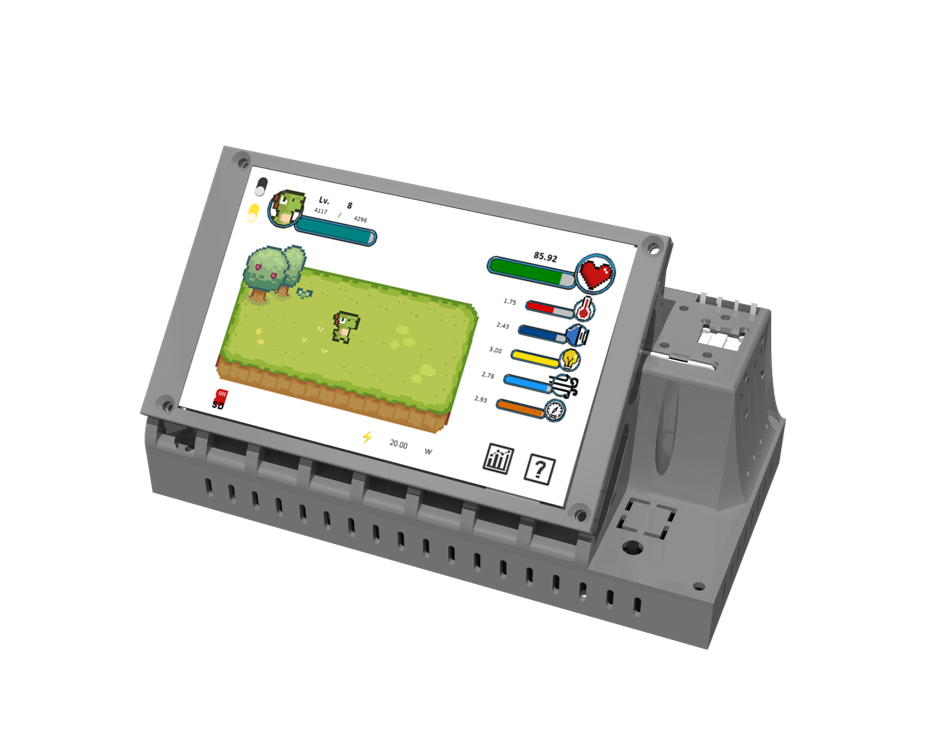
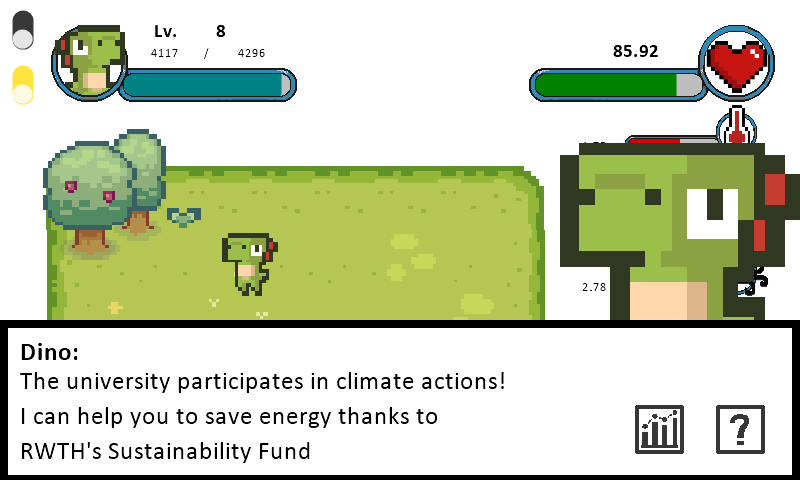
Feedback System Resource Guardian can provide recommendations and energy-saving tips based on your current IEQ environment |
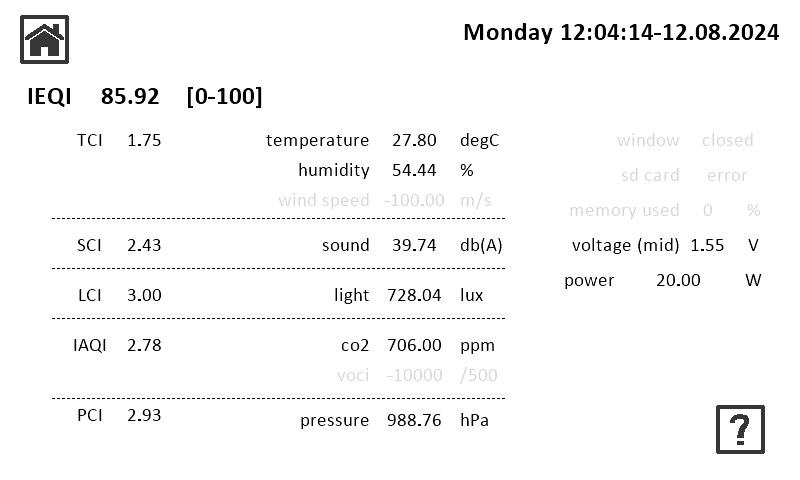
Sensor Data Resource Guardian's modular design allows real-time IEQ data to be displayed based on your sensor configuration. |
The Ressourcenwächter (Resource Guardian) project is a mixed open-source project consisting of software, firmware, hardware designs, documentation, feedback content, and third-party artwork. Different components of the project are released under different licenses, as outlined below.
In general, this project may be used, modified, and redistributed, provided that appropriate attribution is given and the respective license terms of each component are respected. Non-commercial use is permitted for all components, while commercial use is restricted for parts of the project licensed under non-commercial Creative Commons licenses. Third-party assets remain subject to their original licenses.
Please read this section carefully before reusing or redistributing any part of the project.
The codebase is structured into following main components:
Firmware: Code running on embedded microcontrollers.
Software for touch display GUI: Graphical user interface running directly on the monitoring device.
Author: Qirui Huang
License: GNU General Public License v3.0 (GPL-3.0)
Unless stated otherwise, all software and firmware developed within this project are licensed under GPL-3.0. Any derivative work must be distributed under the same license.
Author: Qirui Huang
License: Creative Commons Attribution-NonCommercial-ShareAlike 4.0 International (CC BY-NC-SA 4.0)
This license applies to all hardware-related materials, including but not limited to schematics, PCB layouts, enclosure designs, and mechanical drawings.
Commercial use is not permitted. Adaptations must be shared under the same license.
Authors: Qirui Huang, Marc Syndicus, Anna Langenbeck, Anna Deriks, Sonja Herzogenrath
License: CC BY-NC-SA 4.0
This license applies to feedback texts, categorization schemes, behavioral recommendation concepts, and related content, except for quotations and otherwise indicated parts.
Authors: Qirui Huang, Marc Syndicus
License: CC BY-NC-SA 4.0
This includes assembly guides, methodological documentation, and other written materials, except for quotations and otherwise indicated parts.
This project incorporates third-party assets. These assets are not covered by the software license and remain subject to their respective licenses:
All artworks not listed above are created by Qirui Huang and licensed under CC BY-NC-SA 4.0.
The project Ressourcenwächter was funded by RWTH Aachen University's Sustainability Fund (Ref. 02-2023-004). We are grateful for the support.

If you use Resource Guardian in your academic work, please cite our journal paper: https://doi.org/10.1016/j.buildenv.2026.114657
Examples:
BibTeX:
@article{Huang_2026_Potential_Gamification_BAE,
  title = {The potential of gamification in IEQ monitoring: Open-source hardware development and field studies},
  journal = {Building and Environment},
  volume = {298},
  pages = {114657},
  year = {2026},
  issn = {0360-1323},
  doi = {https://doi.org/10.1016/j.buildenv.2026.114657},
  url = {https://www.sciencedirect.com/science/article/pii/S0360132326004622},
  author = {Qirui Huang and Marc Syndicus and Dono Jamoliddinova and Jérôme Frisch and Christoph {van Treeck}},
  keywords = {Indoor environmental quality, Gamification, Monitoring, User behavior, Hardware},
}
APA style:
Huang, Q., Syndicus, M., Jamoliddinova, D., Frisch, J., & van Treeck, C. (2026). The potential of gamification in IEQ monitoring: Open-source hardware development and field studies. Building and Environment, 298, 114657. https://doi.org/10.1016/j.buildenv.2026.114657| Qty | Value | Footprint | References |
|---|---|---|---|
| 8 | Conn_01x05 | Connector_PinSocket_2.54mm:PinSocket_1x05_P2.54mm_Vertical | J1, J2, J6, J7, J8, J10, J11, J12 |
| 3 | 10k | Resistor_THT:R_Axial_DIN0207_L6.3mm_D2.5mm_P10.16mm_Horizontal | R2, R4, R6 |
| 3 | Conn_01x04 | Connector_PinSocket_2.54mm:PinSocket_1x04_P2.54mm_Vertical | J5, J13, J16 |
| 2 | Conn_01x02 | Connector_PinSocket_2.54mm:PinSocket_1x02_P2.54mm_Vertical | J3, J15 |
| 1 | 10 µF | Capacitor_THT:CP_Radial_D5.0mm_P2.50mm | C1 |
| 1 | 10K | Resistor_THT:R_Axial_DIN0207_L6.3mm_D2.5mm_P10.16mm_Horizontal | R3 |
| 1 | 22 | Resistor_THT:R_Axial_DIN0207_L6.3mm_D2.5mm_P10.16mm_Horizontal | R5 |
| 1 | 220 | Resistor_THT:R_Axial_DIN0207_L6.3mm_D2.5mm_P10.16mm_Horizontal | R1 |
| 1 | CEG006900 | RFID-RC522:MODULE_CEG006900 | U2 |
| 1 | Conn_01x03 | Connector_PinSocket_2.54mm:PinSocket_1x03_P2.54mm_Vertical | J14 |
| 1 | Conn_01x07 | Connector_PinSocket_2.54mm:PinSocket_1x07_P2.54mm_Vertical | J9 |
| 1 | Conn_01x17 | Connector_PinSocket_2.54mm:PinSocket_1x17_P2.54mm_Vertical | J4 |
| 1 | ESP32-DEVKITC-32D | ESP32-DEVKITC-32D:MODULE_ESP32-DEVKITC-32D | U1 |
| 1 | LED | LED_THT:LED_D3.0mm | D1 |
| 1 | SW_Push | Button_Switch_Keyboard:SW_Cherry_MX_1.00u_PCB | SW1 |
| 1 | SW_Push | Button_Switch_THT:SW_PUSH_6mm_H9.5mm | SW2 |
joeycastillo/Sensor-Watch
A board replacement for the classic Casio F-91W wristwatch

TalismanDesign/PocketMage_PDA
An E-Ink PDA device using the ESP32 S3.

rusefi/rusefi
rusefi - GPL internal combustion engine control unit

hackclub/OnBoard
💡 Join 1,000 teenagers and make your first PCB with a $100 grant!

asterics/esp32_mouse_keyboard
ESP32 implementation for HID over GATT Keyboard and Mouse (Bluetooth Low Energy). Including serial API for external modules (similar to Adafruit EZKey HID)


Luos-io/luos_engine
Open-source and real-time orchestrator for cyber-physical-systems, to easily design, test and deploy embedded applications and digital twins.

Chrismettal/EleLab_v2
Cheap DIY lab system for hobbyists and the tinkering folk
It measures 120 × 70 mm and has 2 copper layers, 1.6 mm thick.
28 parts. The full list of its parts is on this page, with links to each part's symbol and footprint where PCBKit's library has them.
From the RWTH-E3D/ressourcenwaechter repository on GitHub, at the commit this page was made from: the board is hardware/pcb/KiCAD/RWTH/RWTH.kicad_pcb and its schematic hardware/pcb/KiCAD/RWTH/RWTH.kicad_sch. PCBKit opens the board in the browser, with nothing to install.
Its repository publishes it under the GPL-3.0 licence: you may reuse it on that licence's terms (keep the author's notice, and for a copyleft licence share your changes alike).