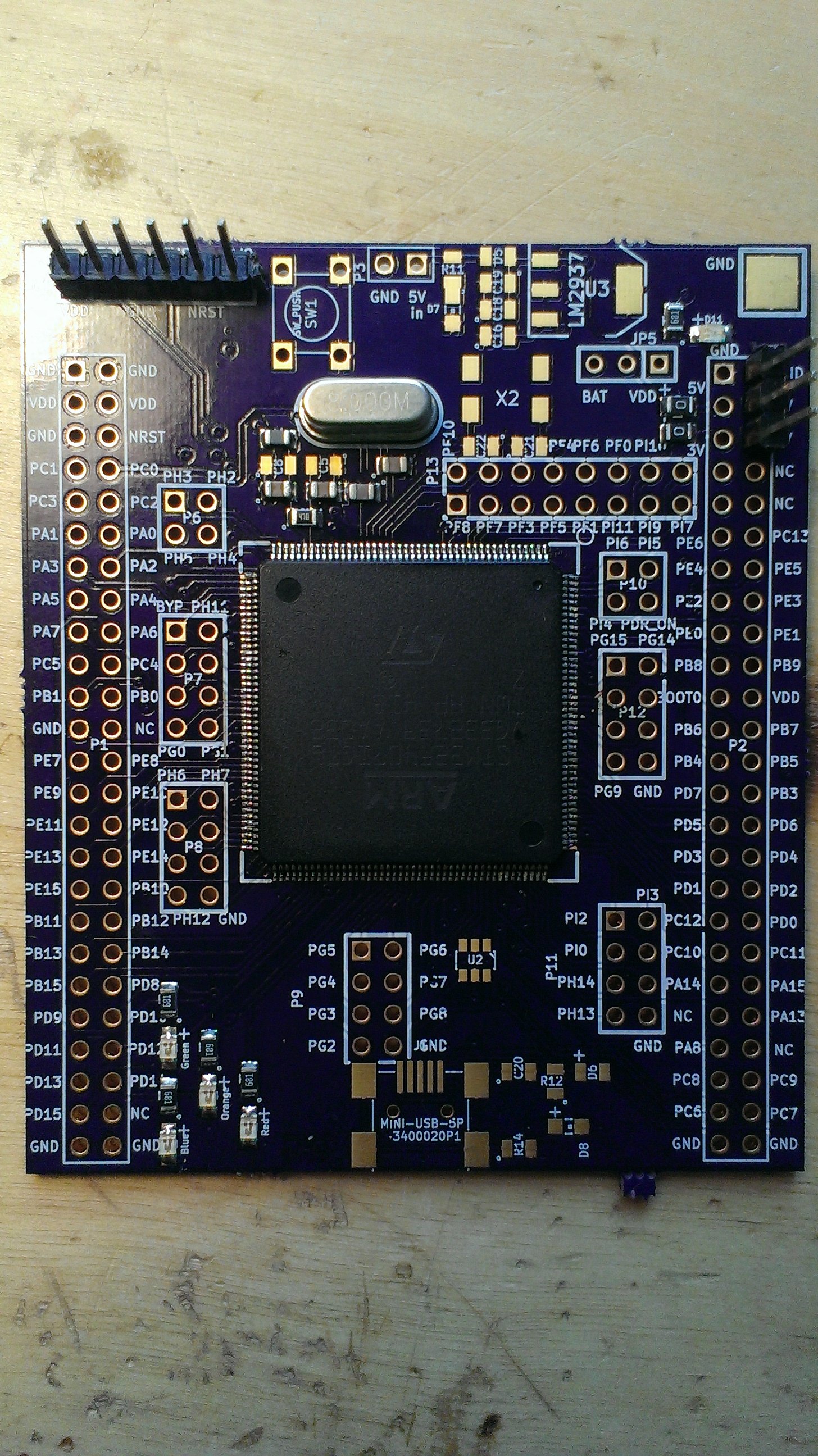
4 layers101.6 × 119.6 mm

 rusefi/rusefi1.2k
rusefi - GPL internal combustion engine control unit
Stimulator is an open-source printed circuit board by rusefi, from the rusefi/rusefi repository on GitHub. It is a 2-layer board of 101.6 × 32.4 mm with 152 parts on 122 nets, routed with 768 tracks and 31 vias.
It is built around the MAX232N and MCP42010-I/P. Its parts include 82 connectors, 34 resistors, 22 capacitors, 6 ICs and 4 transistors. It belongs with the STM32 boards of this library.


| Qty | Value | Footprint | References |
|---|---|---|---|
| 67 | CONN_1 | PIN_ARRAY_1 | P1, P2, P10, P11, P12, P13, P14, P16, P17, P18, P20, P21, P22, P26, P27, P28 +51 |
| 16 | 0 | SM0805 | R8, R9, R10, R11, R12, R13, R14, R15, R18, R19, R20, R21, R22, R23, R24, R25 |
| 16 | 10k | SM0805 | R1, R2, R4, R5, R6, R7, R16, R17, R26, R27, R28, R29, R30, R31, R33, R34 |
| 14 | 1uF | SM0805 | C1, C2, C3, C4, C5, C6, C7, C16, C17, C18, C19, C20, C21, C22 |
| 7 | TEST | SIL-2 | P7, P8, P23, P25, P40, P78, P79 |
| 4 | 0.1uF | SM0805 | C10, C11, C12, C13 |
| 4 | 100 pF | SM0805 | C8, C9, C14, C15 |
| 4 | 2N7002 | sot23 | Q1, Q2, Q3, Q4 |
| 4 | CONN_10 | SIL-10 | P15, P24, P64, P75 |
| 4 | MCP42010 | SO14N | U2, U3, U4, U5 |
| 2 | 700R | SM0805 | R3, R32 |
| 2 | CONN_10X2 | Pin_Headers:Pin_Header_Straight_2x10 | P19, P70 |
| 2 | DIL16 | SO16N | P80, P81 |
| 2 | MAX232 | DIP-16__300_ELL | U1, U6 |
| 1 | ECU PWR | LED-0805 | D1 |
| 1 | LOGO | LOGO | G*** |
| 1 | LOGO_F | LOGO_F | G*** |
| 1 | STIM PWR | LED-0805 | D2 |


rusefi/rusefi
rusefi - GPL internal combustion engine control unit

rusefi/rusefi
rusefi - GPL internal combustion engine control unit


Vishalbabu-09/Auralab_Workstation
Advanced 4-layer PCB design featuring split-plane noise isolation (AGND/DGND) and asynchronous dual-core processing. Implements a handheld multi-tool oscilloscope, current tracker, and symmetrical DC power supply.


mikechristle/StereoTheremin
I'm sure you are familiar with the Theremin. It is a musical instrument that uses hand movements to control pitch and volume. With my version each hand controls both pitch and volume.


stevieb9/rpi-wiringpi
Perl interface to Raspberry Pi's board, GPIO and various sensors and ICs

klaus-liebler/sensact
Es gibt vier Namespaces für Nachrichten "REQUEST" und "RESPONSE", "EVENT" und "ACKNOWLEDGE". Dies wird mit den beiden LSB des Versions-Namespace-Bytes erklärt (Somit bleiben 64 Versionierungsmöglichkeiten) Alle vier…

It measures 101.6 × 32.4 mm and has 2 copper layers, 1.6 mm thick.
152 parts, built around the MAX232N and MCP42010-I/P. The full list of its parts is on this page, with links to each part's symbol and footprint where PCBKit's library has them.
From the rusefi/rusefi repository on GitHub, at the commit this page was made from: the board is hardware/Stimulator/Stimulator.kicad_pcb. PCBKit opens the board in the browser, with nothing to install.
Its repository states no licence, so its author keeps all rights: ask rusefi before reusing the design.