6 layers90 × 90 mm
SolarDataLogger
brokebit/SolarDataLogger
Firmware for custom data logger for Victron MPPT charge controllers via the Ve.Direct port/protocol.
70 partsCC0-1.0

 Rufilla/ESP32_HAT1
A Raspberry Pi HAT for the ESP32 C6
ESP32 HAT is an open-source printed circuit board by Rufilla, from the Rufilla/ESP32_HAT repository on GitHub, published under the Apache-2.0 licence. It is a 4-layer board of 30 × 65 mm with 69 parts on 121 nets, routed with 587 tracks and 53 vias.
It is built around the ESP32-C6-MINI-1-H8, CP2102N-A02-GQFN28 and LBC847BDW1T1G, with the NCP1117LPST33T3G-MS, LESD5D5.0CT1G and 1N4148W among its other parts. Its parts include 27 resistors, 15 capacitors, 9 diodes, 4 ICs and 3 connectors. It belongs with the radio and wireless boards and the ESP32, RISC-V, FPGA and CPLD and Raspberry Pi (Linux) boards of this library.


KiCad design files for a Raspberry Pi Zero form-factor HAT carrying an Espressif ESP32-C6-MINI-1 module. The board gives a Raspberry Pi (or any 40-pin host) 2.4 GHz Wi-Fi 6, Bluetooth 5 LE, Zigbee and Thread connectivity, and can also be used stand-alone over its USB-C port. This repository contains the hardware design only — schematic, PCB and design rules; no firmware.
| Client | Internal |
| Status | Version 1.0 - Checked |
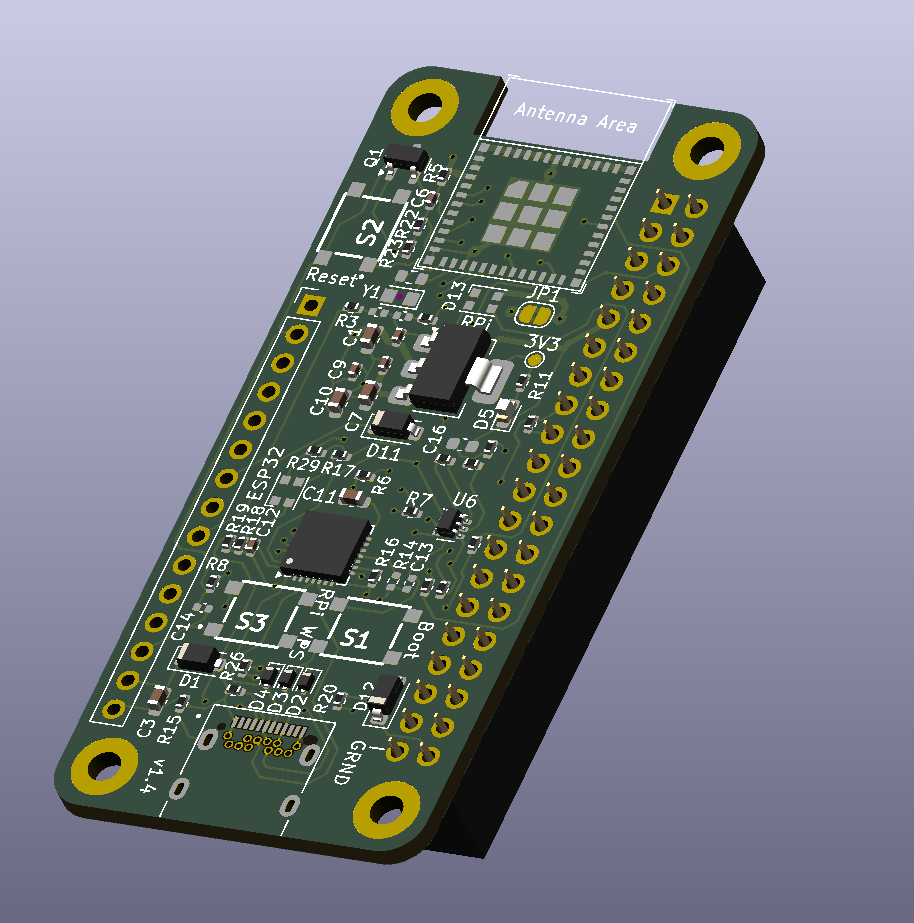
The board is a four-layer, 1.6 mm PCB measuring 30 x 65 mm, with two internal power planes.
Hardware
Software
kicad-cli (shipped with KiCad) for headless export and rule checks.git clone git@github.com:Rufilla/ESP32_HAT.git
cd ESP32_HATOpen esp32_HAT.kicad_pro in KiCad. Footprint libraries are resolved through the local
fp-lib-table.
Generating the manufacturing outputs headlessly:
kicad-cli sch export pdf  esp32_HAT.kicad_sch -o production/esp32_HAT-schematic.pdf
kicad-cli sch export bom  esp32_HAT.kicad_sch -o production/esp32_HAT-bom.csv
kicad-cli pcb export gerbers esp32_HAT.kicad_pcb -o production/
kicad-cli pcb export drill esp32_HAT.kicad_pcb -o production/production/, output/ and exported BOM/netlist files are git-ignored, so fabrication outputs are
regenerated rather than committed.
Run the electrical and design rule checks before releasing a revision. Custom design rules live in
esp32_HAT.kicad_dru.
kicad-cli sch erc esp32_HAT.kicad_sch
kicad-cli pcb drc esp32_HAT.kicad_pcb --severity-erroresp32_HAT.kicad_pro KiCad project: DRC severities, net classes, board stack-up
esp32_HAT.kicad_sch Schematic
esp32_HAT.kicad_pcb PCB layout (4 layers, 1.6 mm, 30 x 65 mm)
esp32_HAT.kicad_dru Custom design rules for the fabricator
system_block.kicad_sch System block diagram
fp-lib-table Project footprint library table
esp32_HAT.png Board render used in this README
docs/images/ Images referenced by documentationTo report a security concern in this design, email hello@rufilla.com rather than opening a public issue.
Apache License, Version 2.0 — see LICENSE.
Third-party components keep their own licences. KiCad symbols and footprints taken from the standard KiCad libraries remain under the KiCad Library Licence; the ESP32-C6-MINI-1/U module and other parts are covered by their manufacturers' terms.
Rufilla Ltd · Building D5, Culham Campus, Abingdon, Oxfordshire, UK, OX14 3DB hello@rufilla.com · +44 (0)1865 601201 · www.rufilla.com
© 2026 Rufilla Ltd
| Qty | Value | Footprint | References |
|---|---|---|---|
| 11 | 0(1%) | Resistor_SMD:R_0402_1005Metric | R2, R3, R7, R8, R9, R13, R15, R17, R21, R23, R30 |
| 7 | 10K(1%) | Resistor_SMD:R_0402_1005Metric | R4, R5, R10, R12, R20, R22, R29 |
| 5 | 0.1uF/50V(10%) | Capacitor_SMD:C_0402_1005Metric | C2, C8, C9, C13, C14 |
| 5 | 10uF/25V(20%) | Capacitor_SMD:C_0603_1608Metric | C1, C3, C7, C10, C11 |
| 4 | MountingHole | MountingHole:MountingHole_2.5mm_Pad | H1, H2, H3, H4 |
| 3 | 431181015816 | 431181015816:431181015816 | S1, S2, S3 |
| 3 | 5.1K(1%) | Resistor_SMD:R_0402_1005Metric | R11, R25, R26 |
| 3 | LESD5D5.0CT1G | Library:D_SOD-523-Mod | D2, D3, D4 |
| 2 | 12pF/50V(5%)(NC) | Capacitor_SMD:C_0402_1005Metric | C4, C5 |
| 2 | 1N4148W | Diode_SMD:D_SOD-123 | D11, D12 |
| 2 | 1uF/16V(10%) | Capacitor_SMD:C_0402_1005Metric | C6, C12 |
| 1 | 10K(1%)(NC) | Resistor_SMD:R_0402_1005Metric | R14 |
| 1 | 10M/0402(NC) | Resistor_SMD:R_0603_1608Metric | R1 |
| 1 | 1K(1%) | Resistor_SMD:R_0402_1005Metric | R16 |
| 1 | 1N5819HW-7-F | Diode_SMD:D_SOD-123F | D1 |
| 1 | 22.1K(1%) | Resistor_SMD:R_0402_1005Metric | R19 |
| 1 | 3.3K(1%) | Resistor_SMD:R_0402_1005Metric | R6 |
| 1 | 32.768KHz(NC) | Crystal:Crystal_SMD_2012-2Pin_2.0x1.2mm_HandSoldering | Y1 |
| 1 | 47.5K(1%) | Resistor_SMD:R_0402_1005Metric | R18 |
| 1 | BC817 | Package_TO_SOT_SMD:SOT-23 | Q1 |
| 1 | CON15X1_2P54 | Connector_PinHeader_2.54mm:PinHeader_1x15_P2.54mm_Vertical | J1 |
| 1 | CP2102N-A02-GQFN28 | Package_DFN_QFN:QFN-28-1EP_5x5mm_P0.5mm_EP3.35x3.35mm | U3 |
| 1 | ESP32-C6-MINI-1-H8 | PCM_Espressif:ESP32-C6-MINI-1 | U1 |
| 1 | LBC847BDW1T1G | Package_TO_SOT_SMD:SOT-363_SC-70-6 | U6 |
| 1 | NC | Capacitor_SMD:C_0603_1608Metric | C16 |
| 1 | NCP1117LPST33T3G | Package_TO_SOT_SMD:SOT-223 | IC1 |
| 1 | Raspberry_Pi_2_3 | Connector_PinSocket_2.54mm:PinSocket_2x20_P2.54mm_Vertical | J5 |
| 1 | SolderJumper_2_Bridged | Jumper:SolderJumper-2_P1.3mm_Bridged2Bar_RoundedPad1.0x1.5mm | JP1 |
| 1 | TLMS1000-GS15 | LED_SMD:LED_0603_1608Metric | D5 |
| 1 | TestPoint | TestPoint:TestPoint_Pad_D1.0mm | 3V3 |
| 1 | UJ32-C-H-G-SMT-7-P24-TR | UJ32-C-H-G-SMT-7-P24-TR:SAMESKY_UJ32-C-H-G-SMT-7-P24-TR | J3 |
| 1 | WS2812B-2020/ WiFi | LED_SMD:LED_WS2812B-2020_PLCC4_2.0x2.0mm | D13 |
| 1 | WS2812B-2020/ Zigbee | LED_SMD:LED_WS2812B-2020_PLCC4_2.0x2.0mm | D6 |
It measures 30 × 65 mm and has 4 copper layers, 1.6 mm thick.
69 parts, built around the ESP32-C6-MINI-1-H8, CP2102N-A02-GQFN28, LBC847BDW1T1G and NCP1117LPST33T3G-MS. The full list of its parts is on this page, with links to each part's symbol and footprint where PCBKit's library has them.
From the Rufilla/ESP32_HAT repository on GitHub, at the commit this page was made from: the board is esp32_HAT.kicad_pcb and its schematic esp32_HAT.kicad_sch. PCBKit opens the board in the browser, with nothing to install.
Its repository publishes it under the Apache-2.0 licence: you may reuse it on that licence's terms (keep the author's notice, and for a copyleft licence share your changes alike).
brokebit/SolarDataLogger
Firmware for custom data logger for Victron MPPT charge controllers via the Ve.Direct port/protocol.

AronTech1/Galatea-75-wireless-mechanical-keyboard
Galatea: 75% wireless mechanical keyboard with a 5" IPS display, per-key LEDs, rotary encoder, voice button and I²S microphone.

uw-roamr/roamr
turn your phone into a robot running SLAM with two motors, two control boards, and a bluetooth chip


DEDALUS-5x/axes-controller-board
Motherboard schematic design dedicated to motors control


AshiqAshref/Garage-Door-Opener
Universal Garage Door using BLE (Bluetooth Low Power) running on ESP32 with highest security possible.

ardiloot/dif-pressure-meter
ESP32 based differential pressure (and air flow) meter. Handheld, battery powered DIY device for measuring small pressure differences (Sensirion SDP810-500Pa).